Assalamualaikum wa rahmatullahi wa barakatuhu….
Nahmaduhuwanusallai ala rasulihil kareem…amma baad….
Imam Muhammad ibn Sareeh rahimahullah “this knowledge is a matter of deen, so be careful who you take your deen from.”
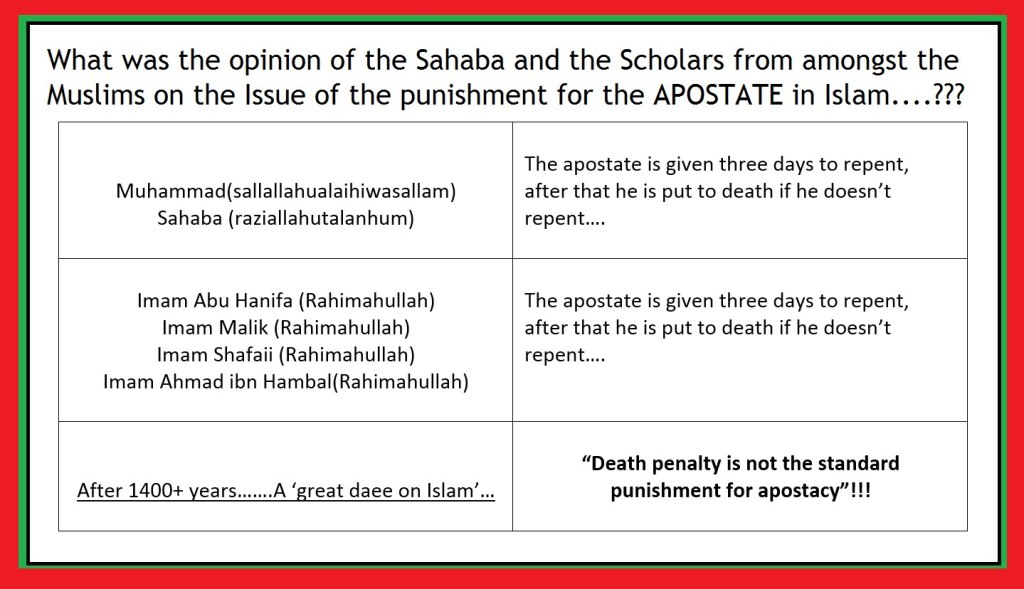
These days we the students of knowledge have turned on to speakers for our ilm-e-deen rather than the scholars….and as such we’ve seen many of these illustrious celebrated speakers coming up with new rulings on islam ,which are actually contrary to the undertanding of the sahaba….In sha allah if you read this note,with an open and unbiased heart,you’ll see the errors in this particular issue of “Punishment for the apostate in islam” committed by one such ‘caller to islam’……
A famous daee answered at the Oxford Union Debate on the issue of “Punishment of Riddah (apostasy) in Islam”
In reply to a question, Dr.Daee said,
“…death penalty is not the standard punishment for any Muslim who leaves his faith and professes any other religion…” and he substantiated it by stating that Muslim who converted to another faith, was pardoned by Allah’s Messenger (sallallahu alaihe wasallam) according to hadeeth no. 4345 from Sunan Abu Dawood.
Let’s understand the issue as per the understanding of the Sahaba and the scholars of the past,in Sha Allah…
Al-Bukhaari (6922) narrated that Ibn ‘Abbaas said: The Messenger of Allaah (peace and blessings of Allaah be upon him) said: “Whoever changes his religion, put him to death.”
Al-Bukhaari (6484) and Muslim (1676) narrated that ‘Abd-Allaah ibn Mas’ood said: The Messenger of Allaah (peace and blessings of Allaah be upon him) said: “It is not permissible to shed the blood of a Muslim who bears witness that there is no god except Allaah and that I am the Messenger of Allaah, except in one of three cases: a soul for a soul (i.e., in the case of murder); a previously-married person who commits zina; and one who leaves his religion and separates from the main body of the Muslims.”
In the hadith that the daee quoted we see a person abu sarh(raziallahuanhu),who the daee said became a jew and asked forgiveness and allah’s messenger pardned him!!!
now I must tell you that abu sarh had actually accepted islam and that’s the reason muhammad sallallahualihiwasallam forgave him….
The summary of the incident in the narration is that Abdullah ibn abu Sarh accepted Islam and was one of the scribes of the Qur’aan. He then became an apostate and returned to Meccah. After the conquest of Meccah, the Prophet (salallahu alaihe wasallam) ordered the killing of Abdullah ibn abu Sarh and some others, even if they were found clinging to the curtains of the Kaaba.
Abu Sarh hid in the house of Uthmaan ibn Affan (radhiallahu anhu), and came along with him to Allah’s Messenger salallahu alaihe wasallam to enter Islam again, but the Prophet refused three times. He sallallahu alaihe wasallam finally accepted Abu Sarh’s return to Islam because of hayaa for Uthmaan (radhiallahu anhu). The Prophet salallahu alaihe wasallam hoped that while he refused to accept Abu Sarh’s return to Islam three times, one of his companions would kill him.
Therefore, this incident is not about pardoning the murtad (apostate) who insists upon his apostasy (which is the situation Dr.Daee was asked about). Rather the incident is about the Prophet’s refusal to accept Abu Sarh’s “return to Islam” three times because of the severity of his crime, while hoping that one of his sahabah would come forward and kill him.
The narration which Dr.Daee gave the reference to is as follows:
Narrated Abdullah ibn Abbas: Abdullah ibn Abu Sarh used to write (the revelation) for the Apostle of Allah (salallahu alaihe wasallam). Satan made him slip, and he joined the infidels. The Apostle of Allah (salallahu alaihe wasallam) commanded to kill him on the day of Conquest (of Mecca).
Uthman ibn Affan sought protection for him. The Apostle of Allah (salallahu alaihe wasallam) gave him protection.” (Abu Dawood, Book #38, Hadith #4345)
as for this hadeeth lets see what the hadees before and after this hadees say:_
Book 33, Number 4341:
Narrated Mu’adh ibn Jabal:
AbuMusa said: Mu’adh came to me when I was in the Yemen. A man who was Jew embraced Islam and then retreated from Islam. When Mu’adh came, he said: I will not come down from my mount until he is killed. He was then killed. One of them said: He was asked to repent before that.
*this s a hadith from abu daud which clealy shows the manhaj of sahaba in dealing with an apostate…
(the other hadith in secession are similar)
Book 33, Number 4345:
Narrated Abdullah ibn Abbas:
Abdullah ibn AbuSarh used to write (the revelation) for the Apostle of Allah (peace_be_upon_him). Satan made him slip, and he joined the infidels. The Apostle of Allah (peace_be_upon_him) commanded to kill him on the day of Conquest (of Mecca). Uthman ibn Affan sought protection for him. The Apostle of Allah (peace_be_upon_him) gave him protection.
*this is the hadith misquoted by Dr.Daee!
Book 38, Number 4346:
Narrated Sa’d ibn AbuWaqqas:
On the day of the conquest of Mecca, Abdullah ibn Sa’d ibn AbuSarh hid himself with Uthman ibn Affan.
He brought him and made him stand before the Prophet (peace_be_upon_him), and said: Accept the allegiance of Abdullah, Apostle of Allah! He raised his head and looked at him three times, refusing him each time, but accepted his allegiance after the third time.
Then turning to his companions, he said: Was not there a wise man among you who would stand up to him when he saw that I had withheld my hand from accepting his allegiance, and kill him?
They said: We did not know what you had in your heart, Apostle of Allah! Why did you not give us a signal with your eye?
He said: It is not advisable for a Prophet to play deceptive tricks with the eyes.
The Manner of Repentance(of the apostate) from the book-The Penalties for Apostasy in Islam-by ‘Abdurrahmani’l-Djaziri
from all the four schools of thought-
(in the introductin to his book he writes)
All four imams (the founders of the four schools of Islamic law) — may Allah have mercy upon them — agree that the apostate whose fall from Islam is beyond doubt — may Allah forbid it — must be killed, and his blood must be spilled without reservation. The hypocrite and heretic (zindiq) who poses as a Muslim but has secretly remained an unbeliever must also be killed.
time of three days-
The Hanafi jurists-
If he needs time to reconsider, it is desirable that the judge allow him a three-day extension, during which he is to remain in custody. If he accepts Islam thereafter, it is good; if not, he is to be killed….
The Maliki jurists-
…If he repents after three days, he is to be released; but if he does not, he is to be killed on the third day, at sunset. His corpse is to be neither washed nor embalmed. He is to be buried neither in the cemeteries of the Muslims nor of the unbelievers (kuffar), for he is not one of them, having once been a Muslim. In fact, his body is to be thrown upon the ground as a public example……
The Shafii Jurists-
If the apostate repents, or utters the two main articles of faith (al-shahadatain), or confesses faith in the oneness of Allah (monotheism), he will be released. But if he does not repent, he is to be killed by the sword immediately. ..
The Hambali jurists-
The Hanbalites: There are two opinions on this issue. Some believe that the apostate should be given a period for repentance consisting of three days, while others are of the opinion that he is to be granted no time for reconsideration but should only be offered Islam. If he accepts the offer, he is to be set free; if not, he is to be put to death immediately.
A detailed narration on the hadith Abu Dawuud 4345…
A Detailed narration from Abu Dawood concerning the incident,
Sunan Abu Dawood contains a much more detailed account of the incident that clarifies the reality of the matter, yet Dr. Daee chose to give the reference of a very brief narration, that fits his distorted view. The detailed narration is as follows …
“Narrated Sa’d, “On the day when Mecca was conquered, the Prophet of Allah (sallallahu alaihe wasallam) gave protection to the people except four men and two women and he named them. Ibn Abu Sarh was one of them… Ibn Abu Sarh hid himself with Uthman ibn Affan.
When the Prophet of Allah (sallallahu alaihe wasallam) called the people to take the oath of allegiance, he (Uthmaan) brought him and made him stand before the Prophet of Allah. He (Uthmaan) said, “O Prophet of Allah, receive the oath of allegiance from him.”
The Prophet (sallallahu alaihe wasallam) raised his head and looked at him thrice, denying him every time. After the third time, the Prophet received his oath.
The Prophet then turned to his companions and said, “Is not there any intelligent man among you who would stand to this (man) when he saw me desisting from receiving the oath of allegiance, and kill him?”
They replied, “We do not know, O Prophet of Allah, what lies in your heart? Had you given us an hint with your eye?”
The Prophet said, “It is not proper for a Prophet to have a treacherous eye.” [Abu Dawood (book no. 14, no.2677)]
From the Tafseer of Imam Qurtubi
To know more about Abu Sarh, we quote below the words of Imam Qurtubi from his Tafseer, “al-Jame li-Ahkaam al-Qur’aan” explaining the verse, “Who can be more unjust than he who invents a lie against Allah, or says… “I will reveal the like of what Allah has revealed.” [Soorah al-An’aam: 93]
Imam Qurtubi writes, “The person meant in the Saying of Allah, ” who says, ‘I will reveal the like of what Allah has revealed.” – is Abdullah ibn Abi Sarh, who used to write the revelation for the Prophet of Allah, then he apostatized and joined the mushrikeen.
The reason behind that is – as the interpreters have mentioned – when the verse (12) of Soorah al-Mu’minoon was revealed, “Indeed, We created man (Adam) out of an extract of clay (water and earth).”
The Prophet called Abu Sarh and dictated it to him and when he reached to the verse, ‘and then We brought it forth as another creation.’ [Soorah al-Mu’minoon (23): 14] Abdullah ibn Sarh was amazed by the details of the creation of man and said, “So blessed be Allah, the Best of creators.”
The Prophet (sallallahu alaihe wasallam) said, ‘this is how it was revealed to me.’ (but) Abdullah doubted it and said, ‘If Muhammad is truthful, then it is revealed to me the like of what is revealed to him, and if he is a liar then I have said what he has said.’
So, he committed Riddah and joined the mushrikeen – that is the saying of Allah, ”and who says, “I will reveal the like of what Allâh has revealed.” – reported by al-Kalbi from Ibn Abbas (rahiallahu anhuma).
It is mentioned by Muhammad ibn Ishaq, Sharhabil said to me, “The verse, ‘and who says, I will reveal the like of what Allah has revealed’, was revealed concerning Abdullah ibn Sa’ad ibn Abi Sarh.
He had apostatized from Islam. So, when Allah’s Messenger (sallallahu alaihe wasallam) entered Makkah, he ordered his killing, and the killing of Abdulllah ibn Khatal and Muqees ibn Sababa – even if they were found under the curtains of Ka’ba.
So, Abdullah ibn Abi Sarh fled to Uthmaan (radiallahu anhu), who was his foster brother – his mother had suckled Uthmaan.
Uthmaan (radiallahu anhu) hid him until he brought Abdullah ibn Abi Sarh to the Prophet after the people of Makkah had settled and he sought security for Abdullah but the Prophet kept silent for a long time and then said, ‘Yes.’
When Uthmaan left, Allah’s Messenger said, ‘I kept quiet so that some of you would kill him.’
A man from the Ansaar said, ‘If only you had hinted me, O Messenger of Allah.’
Allah’s Messenger said, ‘Treachery of the eye does not befit the Prophet.’
Abu Umar said, ‘Abdullah ibn Sa’ad ibn Abi Sarh accepted Islam during the days of the conquest of Makkah, and his Islam was excellent and nothing which could be reproached appeared from him and he was one of the wise and noble from the Quraysh… Then in the year, 25H Uthman (radiallahu anhu) appointed him the governor of Egypt. And Africa was conquered at his hand in the year 27H … (and his other achievements)” [end quote of Imam Qurtubi]
The meaning of ‘protection’ in the narration of Abu Dawood is …
In the narration (no. 4345) that Dr.Daee mentioned, “…Uthman ibn Affan sought protection for him. The Messenger of Allah (salallahu alaihe wasallam) gave him protection.”
- Protection (or pardon) here is not about waiving the punishment of killing the murtad (apostate); but the protection means accepting the murtad’s repentance and accepting him back to Islam.
The incident shows the gravity of the situation in that the Prophet refused to accept Abu Sarh’s repentance. The Prophet’s attitude reflects the gravity of the crime, while Dr.Daee lightens the issue for all those who watch him when said, “… but later on when Hazrat Uthman approached the Prophet and he said that the man should be forgiven, the Prophet pardoned him”
Furthermore, by drawing the conclusion that, “In this hadeeth, the Prophet pardoned the person who was a Muslim and changed to another faith”, Dr.Daee has understood the matter, completely opposite to that of the scholars – who mention this incident as a proof for killing the apostate, as in the next quote by Imam Ibn al-Qayyim.
Imam Ibn al-Qayyim writes about the incident,
“In it (i.e. the incident) is the understanding of the permissibility of killing the murtad whose riddah has become intense and he does not repent from it… (Imam Ibn al-Qayyim then mentioned the long narration of Abu Dawood, we quoted earlier)… …
… This was the one whose disbelief had become intense with his Riddah (apostasy) after Eeman, and the Prophet (sallallahu alaihe wasallam) wanted to kill him, but when Uthmaan ibn Affan came with him (i.e. Abdullah ibn Abi Sarh), who was his foster brother, the Prophet did not order to kill him due to Haya (discretion, prudence, honor) for Uthman. And the Prophet did not accept his (Abdullah ibn Sarh’s) Bay’ah (oath of allegiance as a Muslim) so that some of his Sahabah would come forward and kill him, but due to respect for the Prophet, the Sahabah did not come forward to kill him without his permission and the Prophet felt haya for Uthman (radiallahu anhu) and thus, accepted his Bay’ah.”
[end quote of Ibnil-Qayyim. Quoted from Majallah al-Buhooth al-Islami, issue. No. 77 1426-1427: Protecting the Muslim society from intellectual heresy, part 2, section.1]
Thus we understand from the whole incident,
The Prophet did not pardon the man for his changing his faith – rather Abdullah ibn Abu Sarh was not killed because he returned back to Islam.
If it were not for Prophet’s Haya for Uthmaan (radiallahu’anhu), the man would have been killed because the Prophet (sallallahu alaihe wasallam) had already ordered the killing of the man due to apostasy, and he refused to accept his coming back to Islam initially.
Thus we understand from the whole incident,
The Prophet did not pardon the man for his changing his faith – rather Abdullah ibn Abu Sarh was not killed because he returned back to Islam.
If it were not for Prophet’s Haya for Uthmaan (radiallahu’anhu), the man would have been killed because the Prophet (sallallahu alaihe wasallam) had already ordered the killing of the man due to apostasy, and he refused to accept his coming back to Islam initially.
Is giving reference enough?
Dr.Daee boasts in his answer
“Now when I give reference… anyone can go and check up. In this hadeeth, the Prophet pardoned the person who was a Muslim and changed to another faith.
Now the difference between my answer and the other answers are that the other people just say without giving reference.
Now when I give a reference, … … this gives more authenticity and I am sure now, there are millions of Muslims who will agree that death penalty is not the standard rule for any Muslim who changes his faith to any other religion…”
What distinguishes those upon the way of the SALAF, from those who are not upon it – is the understanding not the reference. Even the most devious and misguided of groups, whether they are the Qadianis, or the Ismailis or the Raafidah, they all give references from the Qur’aan and Sunnah to argue their ideas; but the question is – Do they understand those references from the Qur’aan and the Sunnah, the way they are supposed to be understood?
As for us, the Salafis or the ahlul-Hadeeth – the question we ask to the one who presents a matter of Deen to us, is ….
Who is your Salaf in this understanding? i.e. Who preceded you in this statement or understanding of yours?
If the answer is the sahabah or the Imams of Ahlus-Sunnah, then we know this to be a matter that is given consideration. If the answer is, this is speculation by a contemporary academic on an issue explained and agreed upon a 1000 plus years back, these views are not even given consideration – and the one who publicizes these issues amongst the people is considered a fitnah and a spreader of innovation.
Bukhari, volume 9, #57
Narrated Ikrima, “Some atheists were brought to Ali and he burnt them. The news of this event, reached Ibn Abbas who said, “If I had been in his place, I would not have burnt them, as Allah’s messenger forbade it, saying, “Do not punish anybody with Allah’s punishment (fire).” I would have killed them according to the statement of Allah’s Messenger, “Whoever changed his Islamic religion, then kill him.”
Bukhari, volume 9, #58
Narrated Abu Burda, “Abu Musa said…..Behold there was a fettered man beside Abu Musa. Muadh asked, “Who is this (man)?” Abu Musa said, “He was a Jew and became a Muslim and then reverted back to Judaism.” Then Abu Musa requested Muadh to sit down but Muadh said, “I will not sit down till he has been killed. This is the judgment of Allah and his messenger,” and repeated it thrice. Then Abu Musa ordered that the man be killed, and he was killed. Abu Musa added, “Then we discussed the night prayers …..
(Unedited)
Originally written on- 1st March 2013
 Saheehus-Seerah