السلام عليكم ورحمة الله وبركاته. الحمد لله و الصلاة والسلام على نبينا محمد وعلى آله و اصحابه اجمعين.
I received this image on WhatsApp by a concerned brother, which asserted a few things about women in the era of the Prophet ﷺ and the Sahabah (companions (رضي الله عنهم)).
The image:
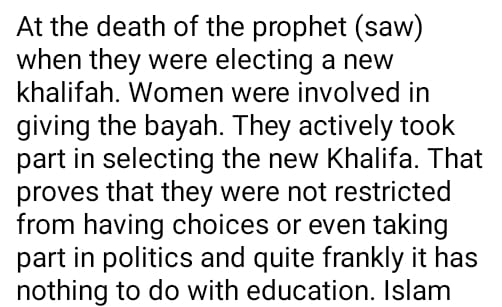
1. The first sentence, ‘At the death of The Prophet ﷺ they were electing a new Khalifah’…
Correction: They were *not* ‘electing’ a new Khalifah similar to how modern day democracies elect their leaders where every person has the right to vote.
Rather some of the leaders from amongst the Ansaar (Companions of Madinah) wanted to chose a leader from amongst themselves and a leader from amongst the Muhajiroon (Companions who migrated from outside into Madinah). It was at this point that Abu Bakr As-Siddeeq (رضي الله عنه) told them that the Ameer (leader) will only be from the tribe of the Quraysh, and he asked them to chose from Umar or Abu Ubaidah (رضي الله عنهما). At this point Umar (رضي الله عنه) gave his hand (pledge of allegiance) to Abu Bakr, and then everyone followed. (See Sahih Al-Bukhari 3667,3668, 3669, 3670, for the detailed narrations.)
So here, in these narrations, you will not see Abu Bakr As-Siddeeq (رضي الله عنه) standing for an election, and woman being asked to vote. As a matter of fact, not even the majority of the companions were consulted in this matter. Only some of the senior most were consulted and the decision was taken. After that everyone pledged allegiance to the new Khalifah (Caliph).
A similar thing occured when Umar ibn Al-Khattab (رضي الله عنه) was nominated for the post of the Khalifah by Abu Bakr. Abu Bakr As-Siddeeq just sought counsel from some of the the senior most companions and placed Umar as his successor.
Umar ibn Al-Khattab, made a panel of 6+1 (seven) companions to chose the next Khalifah from amongst the six, and the panel chose Uthman bin Affan (رضي الله عنه).
So there’s no democratic election going on where everyone had the right to vote.
2. The second sentence, ‘Women were taking part in the Bayah. They actively took part in selecting the Khalifah.’…
Women were taking part in the Bayah (pledge of allegiance), just like the other male companions, who were non-panelists in the consultation committee, were taking part in the Bayah. Regardless of they attending the Bayah session or not, didn’t affect the selection of the Khalifah at all.
3. The paragraph says, ‘That proves that they were not restricted from having choices or even taking part in politics and quite frankly it has nothing to do with education.’
The women had no choices in selecting or electing the Khalifah. Islamically speaking, not every Muslim (male or female) has the right to select or elect the Khalifah, Ameer or King (as in a monarchy). The rulers are selected by a limited elite panel of scholars, commanders and other important stakeholders of the nation, as it happened in the era of The First Four Khalifas, and after them when monarchies (Kingship) began.
Common Muslims (men and women) may give necessary suggestions to their rulers, as was done during the era of The Prophet Muhammad ﷺ and his Companions, and there are various examples of this.
May Allah guide us all to the truth and grant us the proper understanding of The Religion. Aameen.
-Mohammed Manna.
 Saheehus-Seerah