The questioner: “Your Eminence, there is a Hadith in which the Prophet ﷺ mentioned that seventy thousand people from the Ummah of Muhammad ﷺ will enter paradise without being taken into account or subjected to punishment. When the companions (May Allah be pleased with them all) discussed among themselves who these people were and what their qualities were, the Prophet ﷺ came out to inform them about their discussion. He ﷺ said that they are the ones who do not practice ‘Ruqyah’, do not believe in omens, and do not cauterize.” The questioner requests: “We hope, your eminence, that you explain these qualities to us so that we can adhere to them.”
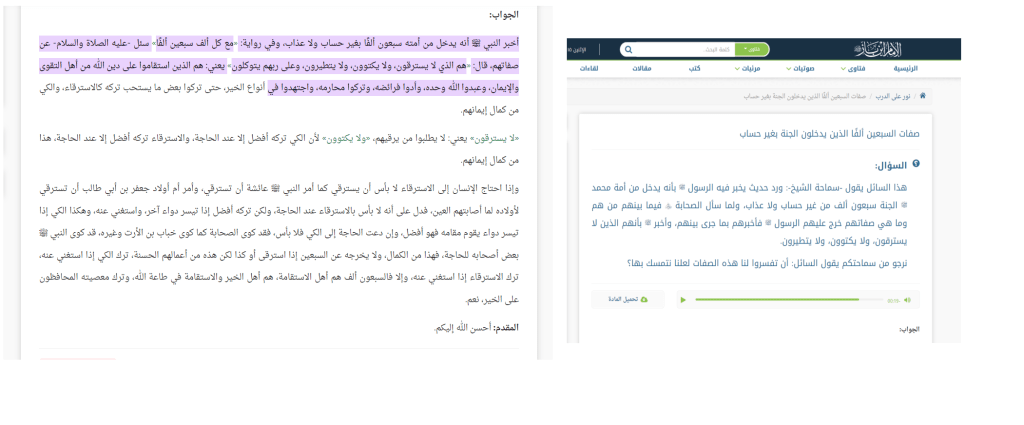
The answer (by Shaikh Abdul Azeez bin Abdullah bin Baaz): The Prophet ﷺ informed that from his Ummah, there will be seventy thousand people who will enter paradise without being held accountable or punished [1]. In another narration he ﷺ said, for every thousand (who will enter Paradise directly), there will be another seventy thousand (who will also enter Paradise directly without being taken into account) [2]. When he ﷺ was asked about their qualities, he said: “They are the ones who do not practice ‘Ruqyah’, do not believe in omens, do not cauterize, and solely rely (have Tawakkul) on their Lord.”
This means they (the seventy thousand and those who will enter Paradise directly) are the ones who uphold the religion of Allah, have piety and faith, worship Allah alone, fulfil their religious obligations, avoid forbidden acts, and strive in various forms of goodness. They even refrain from some recommended acts like ‘Ruqyah’ and cauterization, as their faith is complete and perfect.
“They do not seek Ruqyah” [3]- meaning they do not ask others to recite Ruqyah for them, and “they do not cauterize”- because leaving it is better except in cases of necessity. Refraining from both practices indicates their Kamaal-ul-Imaan (perfection of faith). And if a person is in need of Ruqyah, there is no harm in seeking it (from others). As the Prophet ﷺ instructed Aisha to do Ruqyah [4], and directed the mother of the sons of Ja’far ibn Abi Talib to do Ruqyah for her children when they were afflicted with the evil eye, it indicates that there is no harm in asking someone to do Ruqyah upon yourself when there is a need.
But, leaving these practices is better if an alternative remedy is available and is sufficient. Similarly, cauterization is better to be avoided if there are other suitable treatments. If there is a genuine need for cauterization, then it is permissible. The companions, including Khabbab ibn Al-Aratt [5] and others, resorted to cauterization when necessary. The Prophet ﷺ cauterized some of his companions out of necessity [6].
It is considered virtuous (to not practice Ruqyah and cauterization), but it does not exclude them from the seventy thousand. Leaving cauterization when it is not necessary and refraining from seeking ‘Ruqyah’ when it is not needed are among their good deeds. The seventy thousand are the people of uprightness, those who are devoted to goodness and obedience to Allah, abstaining from disobedience, and safeguarding righteousness. Yes, indeed.
End of the Fatwa.
***
Footnotes:
[1] Al-Bukhaari (6472) and Muslim (220) narrated from Ibn ‘Abbaas that the Messenger of Allah ﷺ said: “Seventy thousand of my ummah will enter Paradise without being brought to account; they are the ones who did not ask for Ruqyah (from others) or believe in omens or use cautery and they put their trust in their Lord.” (Part of a lengthy Hadith.)
[2] Abu Umamah narrated the Messenger of Allah ﷺ said: “My Lord promised me that seventy thousand of my Ummah shall be admitted into Paradise without a reckoning against them nor any punishment. With every thousand, are seventy thousand and three measures from His measures.” Jami` at-Tirmidhi 2437 (Hasan (Shaikh Zubair Ali Zai)).
[3] ‘Ruqyah’ involves healing illnesses -physical and spiritual- through the recitation of specific Qur’anic verses and supplications, following the guidance of the Messenger of Allah ﷺ. It serves as a remedy for problems like the evil eye, magic, and various physical ailments. [4] It was narrated that Aishah said: The Messenger of Allah ﷺ commanded me, or he commanded (the people) to use Ruqyah to deal with the evil eye. [Sahih Al-Bukhari 5279]
[5] Qais said: “I entered upon Khabbab when he had been cauterized on his stomach seven times. He said: ‘Were it not that the Messenger of Allah forbade us to pray for death, I would have prayed for it.”‘ Sunan An-Nasa’i 1823 (Sahih (Shaikh Zubair Ali Zai)). [6] Jabir bin ‘Abdillah reported that on the day of Ahzab, Ubayy received the wound of an arrow in his medial arm vein. Allah’s Messenger (ﷺ) cauterised it. Sahih Muslim 2207.
[6] Jabir bin ‘Abdillah reported that on the day of Ahzab, Ubayy received the wound of an arrow in his medial arm vein. Allah’s Messenger (ﷺ) cauterized it. Sahih Muslim 2207.
***
-Translated by Mohammed Manna (30th October 2023)
 Saheehus-Seerah