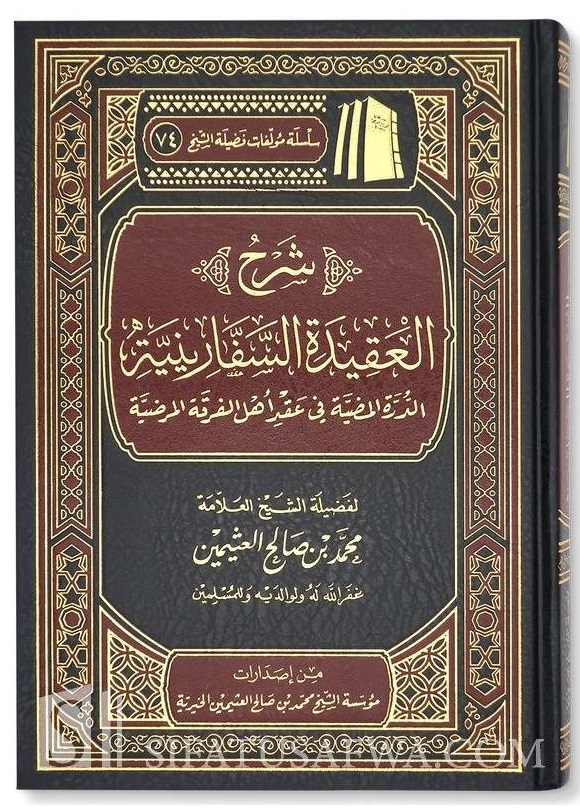
A beautiful benefit from the Sharh (explanation) of ‘Al-Aqeedah as-Safaariniyyah’ by Shaikh Muhammad bin Saleh Al-Uthaymeen (Rahimahullah, 9 March 1929 – 10 January 2001).
***
Shaikh Ibn Uthaymeen, may Allah have mercy on him, said:
“It is not possible to say that all matters of ‘Aqeedah (creed) must be upon Al-Yaqeen (certainty), because there are issues within `Aqeedah on which the scholars, may Allah have mercy on them, have differed. Any matter that is subject to scholarly disagreement cannot be said to be one upon Yaqeen (certainity), for certainty cannot be negated under any circumstances.
For instance, the scholars, may Allah have mercy on them, differed regarding the punishment of the grave: is it inflicted upon the body or the soul?
The scholars also differed, may Allah have mercy on them, concerning what will be weighed on the Day of Judgment: is it the deeds themselves, the records of deeds, or the person who performed the deeds?
They also differed, may Allah have mercy on them, regarding the Paradise that Adam was made to dwell in: was it the Paradise of eternity or a paradise in the Dunya (earth)?
Furthermore, the scholars, may Allah have mercy on them, differed about whether the Prophet ﷺ saw his Rubb (Lord Almighty) : did he see Him with his eyes—meaning in life—or did he see Allah with his heart?
They also differed regarding the Fire: is it eternal or does it eventually end?
All these issues pertain to Aqeedah. To claim that there is no disagreement in Aqeedah whatsoever – is incorrect, as there are matters of `Aqeedah where a person acts upon Dhann (conjecture and assumption, or a belief or opinion with the possibility that otherwise may also be true).
For example, in the Hadith Qudsi, Allah says: ‘Whoever draws near to Me by a handspan, I will draw near to him by an arm’s length.’ A person cannot be certain that the proximity (closeness) intended here is Hissi (physical, anything that can be felt) . For indeed, it undoubtedly occurs to a person’s mind that the intended closeness here is Ma’nawi closeness (metaphorical meaning of closeness).
Likewise, in the verse: ‘Whoever comes to Me walking, I will come to him running,’ one cannot assert with certainty that Allah physically runs. It is possible that what is meant is the hastening of reward, and that Allah is quicker to grant reward than a person is to act. This is why the scholars of Ahlus-Sunnah differed on this issue. Indeed, if you adopt either position, you do not hold it with the same certainty as you do for Allah’s descent, of which the Prophet ﷺ said: ‘Our Rubb descends to the lowest heaven,’ where there is no doubt that it is a real descent, just as there is no doubt that Allah’s statement: ‘The Most Merciful rose over the Throne’ (Surah Taha: 5) refers to a real rising.
In summary: not all matters of `Aqeedah require absolute Yaqeen (certainty). Certainty or Dhann (conjecture or supposition) depends on the strength of the evidence, and the strength of the evidence varies according to a person’s understanding and knowledge. What may seem like two (or more) conflicting evidence (on an issue) to one person may be entirely clear to another, leading the latter to have no confusion but complete certainty (on the issue), while the former (who felt that the evidences were conflicting) may remain unsure, and if he leans towards one side, he does so based on predominant Dhann (i.e. supposing and assuming that his side has stronger evidences than the other opinion, but the other opinion is not entirely wrong as well).
Therefore, we cannot say that all matters of Aqeedah require absolute certainty and are free from disagreement, for the reality is otherwise. (That is-) There are matters of Aqeedah in which there is disagreement, and there are matters in which one cannot be certain, but rather follows what is more likely (to be the truth according to him).
Thus, the statement that we often hear, that ‘there is no disagreement in matters of Aqeedah’, is not to be taken in absolute terms, because the reality contradicts this.”
[End quote from ‘Sharh Al-Aqeedah As-Safaariniyyah 1/307.]
(Translated by Mohammed bin Thajammul Hussain Manna [B.E (Aeronautical Engineering), B.A (Islamic Studies), M.A (Islamic Studies, Ongoing 2nd Year)].)
Do you know Ustadha Sule Yuksel Senler- The Hijab Activist of Turkey
Criticizing Oppressed Muslims When They’re In A State Of War- Shaikh Faisal bin Qazar Al-Jaasim
UNVEILING THE SILENT HEROES – Indonesia’s Invisible Bravery in the Heart of Bosnia’s Struggle
 Saheehus-Seerah