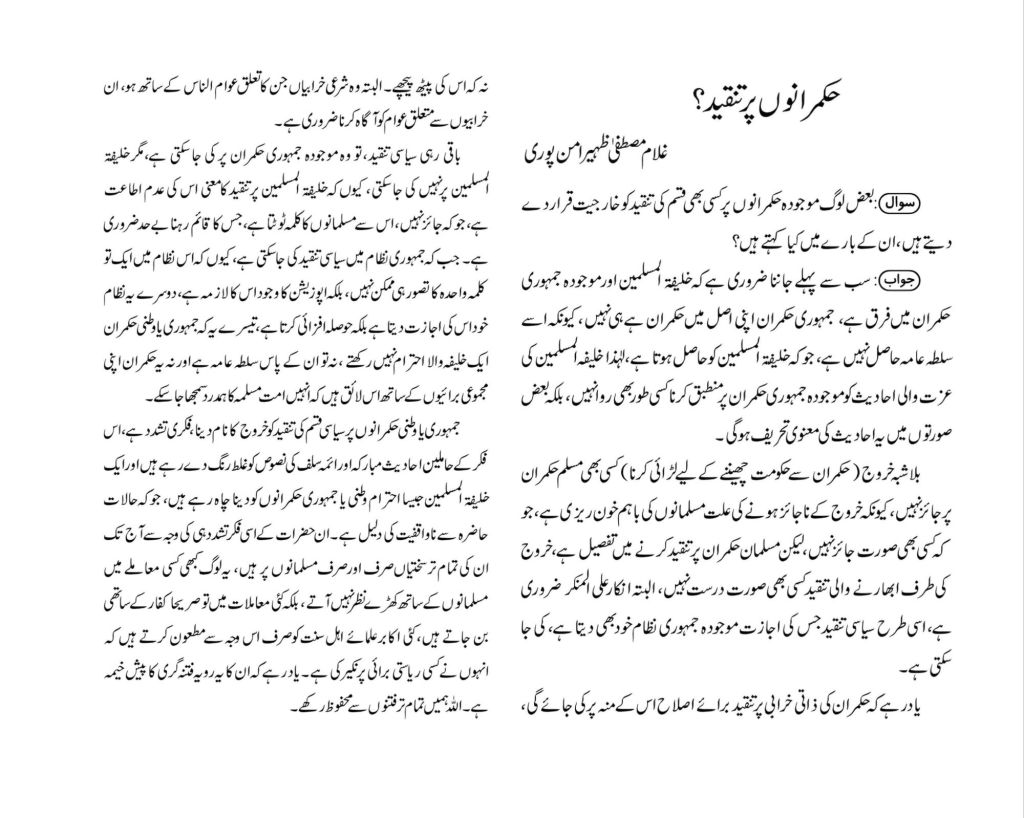
Q: Some people consider any kind of criticism of the current rulers to be Kharjism (a quality of the Khawarij sect), what do you say about them?
A: First of all, it is important to know that there is a difference between the Islamic caliph and the current democratic ruler. In reality , the democratic ruler is not even considered a ruler (Hākim) as he doesn’t have general authority which a Islamic Khalīfah would have. Therefore, adapting the Ahadith about the honour of Islamic Khalīfah to the current democratic ruler is not allowed in any way, but in some cases it will be a semantic distortion of the Hadiths.
Without a doubt, Khurooj (fighting to take away the government from the ruler) is not permissible for any Muslim ruler, because the reason for the illegitimacy of Khurooj is the bloodshed of Muslims, which is not permissible in any case, but regarding criticizing the Muslim ruler, there’s explanation for it. Yes, the criticism directed towards (or that which encourages) Khurooj is not correct in any case, however criticizing the Munkar (evil) is necessary, in the same way political criticism which is allowed by the current democratic system itself can be done.
Remember that criticism of the ruler’s personal faults for reform will be done to his face (infront of him), not behind his back. However, those Sharī’ errors related to public, it is important to inform the public about the defects.
Regarding political criticism, it can be directed at the current democratic ruler, but it cannot be directed at the Khalīfah, because criticizing him means disobedience to him which is not permissible as it breaks the unity of Muslims, which is very important to (continually) remain. While political criticism can be made in the democratic system, because the idea of unity of Muslims is not possible at the first place, but the existence of opposition party is necessary here.
Secondly, this system itself allows criticizing the government, rather encourages it.
Thirdly, the democratic or national rulers, neither hold the honour of being a Khalīfah, neither do they have public authority and nor are these rulers, with their gross evils, worthy of being considered as sympathizers of the Muslim Ummah.
Calling the political type of criticism of democratic or national rulers as Khurooj is ideological extremism and the holders of this thought are misrepresenting the blessed Ahadith and the texts of the Imams and Salaf, and they want to give respect of a Khalīfah of the Muslims to a democratic or a national ruler, which is proof of ignorance of the current situation.
Because of this ideological extremism, the concern of these people, till today all their strictness is only on Muslims. These people never stand with the Muslims in any matter, but in many cases they openly become the companions of the infidels.
These people have slandered many of the senior scholars of Ahlus Sunnah just because they criticised a political evil. It should be remembered that this behavior of theirs is a precursor to Fithna (trials and tribulations) . May Allah protect us from all evils. End quote.
-Answer by Shaykh Ghulam Mustafa Zaheer Hafidhahullah.
(Translated by Shuaib Ahmad bin Abdul Hameed, M.A (Arabic), The New College, Chennai (Tamil Nadu, India))
Shaykh Ghulam Mustafa Zaheer Amaanpuri (Hafidhahullah) is from amongst the senior Ahlul-Hadith scholars in Pakistan.
 Saheehus-Seerah