The Hadith:
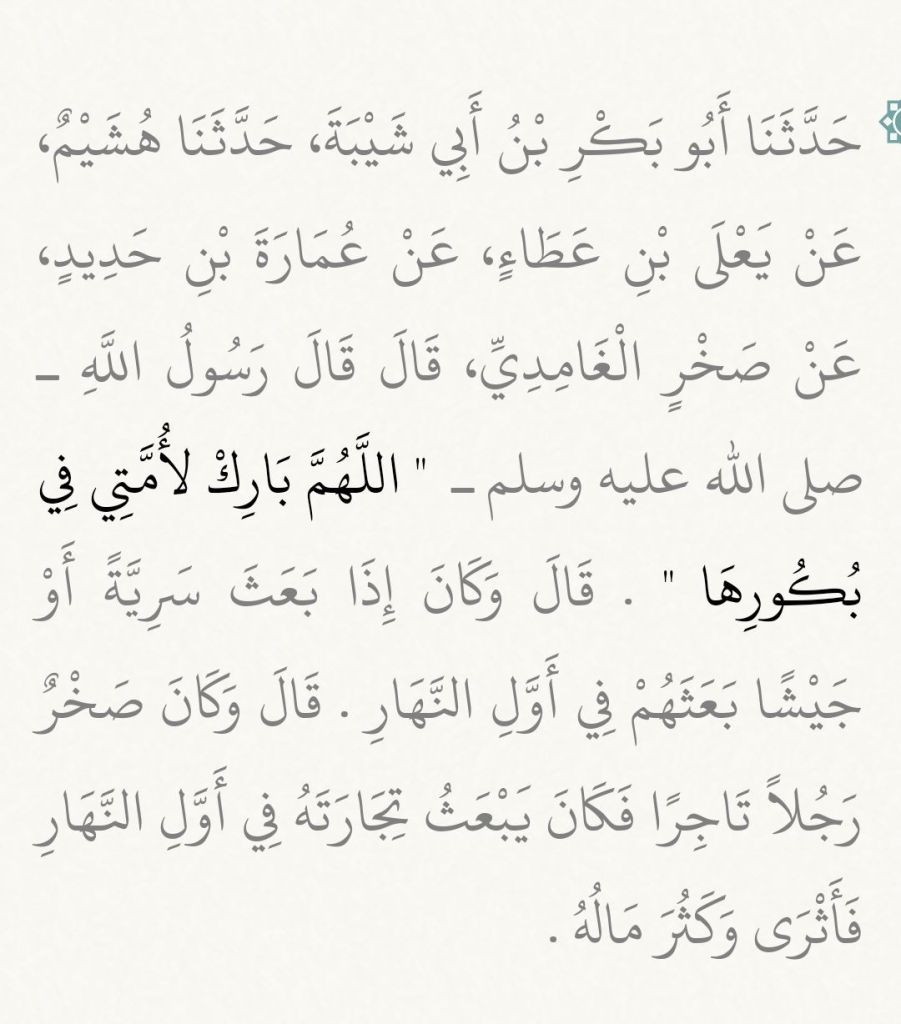
It was narrated from Sakhr Al-Ghamidi that the Messenger of Allah (ﷺ) said:
“O Allah, bless my Ummah in their early hours of the morning (i.e., what they do early in the morning).” He said: “When he sent out a raiding party or an army, he would send them at the beginning of the day.” He said: “Sakhr was a man engaged in trade, and he used to send his goods out at the beginning of the day, and his wealth grew and increased.”
(Sunan Ibn Majah 2236, translation from sunnah.com /Darussalam.)
Explanation of the Hadith from Dorar.net:
The Prophet (peace be upon him) was eager for the well-being of his Ummah, and part of his eagerness was that he would supplicate for them to be blessed and granted goodness. In this Hadith, it is reported that the Prophet (peace be upon him) said: “O Allah, bless my Ummah in the early hours of the morning.”
This supplication means: O Allah, increase the goodness and blessings for my Ummah, with abundance and growth, when they emerge in the morning to engage in their daily activities.
Sakhr ibn Wada’ah Al-Ghamidi, one of the narrators of the Hadith, said: The Prophet (peace be upon him) would dispatch a Sariyyah (a small military detachment or raiding party) or army, and by doing so, he would send them out early in the morning, in order to attain the blessings that are present at that time. A military detachment refers to a part of the army, which can consist of up to four hundred soldiers.
‘Umairah ibn Hadi, another narrator of the Hadith, said: Sakhr was a merchant who would send out his trade caravans early in the morning, acting upon the advice of the Messenger of Allah (peace be upon him), in order to attain the blessings of the Prophet’s supplication. As a result, Sakhr became wealthy and his wealth increased.
In this Hadith, there is an explanation of the Prophet’s eagerness for the goodness of his Ummah. It also encourages acting upon the Sunnah of the Messenger of Allah (peace be upon him) and adhering to his advice, as this is a means of attaining blessings. End quote.
Source In Arabic From Dorar.net.
The following question and answer was taken from islamweb.net and translated for further benefit.
Question: The Messenger of Allah (peace be upon him) said: “O Allah, bless my Ummah in the early hours of the morning” – So when does the time of Bukoor (early morning) begin and when does it end?
Answer: Alhamdulillah Was-Salatu Was-Salamu Ala Rasoolillah Wa Ala Aalihi Wa Sahbihi, Amma Ba’ad.
The Hadith was narrated by Abu Dawud, and At-Tirmidhi graded it as Hasan (good, acceptable), (was also reported by) Ibn Majah, and Ahmad, on the authority of Sakhr ibn Wada’ah Al-Ghamidi – may Allah be pleased with him – who reported that the Prophet (peace be upon him) said: “O Allah, bless my Ummah in their early hours of the morning (i.e., what they do early in the morning).” He said: “When he sent out a raiding party or an army, he would send them at the beginning of the day.” He (one of the narrators) said: “Sakhr was a man engaged in trade, and he used to send his goods out at the beginning of the day, and his wealth grew and increased.”
And “Bukoor” refers to the beginning and early part of the day. Abu Dawud, Ahmad, and An-Nasa’i narrated from the Hadith of An-Nu’man bin Muqarrin (May Allah be pleased with him) who said: “I was with the Messenger of Allah (ﷺ) when I witnessed that if he did not begin fighting in the early part of the day, he would postpone fighting till the sun had declined, the blowing of the breeze had blown and the victory from Allah had come.”
And in the wording of At-Tirmidhi: “He would wait.” And he (At-Tirmidhi) said: “Hasanun Sahih” (i.e., the Hadith is good and authentic, scholars have explained Hasanun Sahih in different ways).
And it has a supporting narration in Al-Bukhari, which is narrated in a connected chain (Musnad) from the Hadith of Abdullah ibn Abi Awfa. Al-Bukhari titled it with what is mentioned in the wording of the Hadith of An-Nu’man, and he narrated it in his Sahih in the Book of Jizyah from An-Nu’man with a different wording: “I witnessed battles with the Messenger of Allah (peace be upon him), and if he did not fight at the beginning of the day, he would wait until the winds blew and the prayers were performed.”
In the Hadith of An-Nu’man, there is evidence that between the end of the early part of the day and the time of noon, when the sun is at its peak, there is a period of time during which delay and waiting in battle are apparent. This period is not usually short. It appears that what is meant by “the beginning of the day” is the time from the dawn prayer (Fajr), after the spread of the true dawn light (Al-Fajr As-Sadiq) and the performance of the Fajr prayer, until the sunrise (Shurooq Ash-Shams, Tulu-e-Aftaab) and the rise of the sun and the beginning of the spread of its heat, i.e., until the beginning of the time of Duha.
Imam At-Tabari said in his Tafseer of Allah’s saying: “And glorify Him in the evening and in the early morning” (Aal-Imran: 41): “As for the early morning (Al-Ibkar), it is a noun derived from the saying of the one who says: ‘So-and-so hastened to his task,’ and he hastens with haste. This is when he goes out to perform his task from the time of the dawn until the time of Duha. This is what is called the early morning (Al-Ibkar). It is said in this context: ‘So-and-so hastened and hastened with haste.'”
And that is because the period between these two times was when people would begin their daily activities during the prophetic era and thereafter, until recent times. Therefore, it was specifically mentioned in the supplication.
Ibn Battal said: “The narration ‘O Allah, bless my Ummah in the early morning’ (Bakur) does not indicate that there is no blessing in other times. This is because every action of the Prophet (peace be upon him) contains blessings, and his Ummah has the greatest example in it. Rather, the Prophet (peace be upon him) specifically supplicated for blessings in the early morning, as opposed to other times – and Allah knows best – because it is the time when people intend to begin their daily activities. It is a time of vigor and rising from slumber. Therefore, he specifically supplicated for it, so that his entire Ummah may attain the blessings of his supplication.”
Ibn ‘Uthaymeen said in his explanation of Riyadh-us-Saliheen, while explaining this Hadith: “However, unfortunately, most of us today sleep during the early part of the day and do not wake up until Duha, thus missing out on the early part of the day that contains Barakah (blessings).”
And his statement: “thus missing out on the early part of the day that contains blessings” – means the specific blessings that the Prophet (peace be upon him) supplicated for during this time. And Allah knows best.
[Translated by Mohammed bin Thajammul Hussain Manna.]
 Saheehus-Seerah