The Giants of the Islamic Navy –The Barbarossa Brothers, Taken from the book ‘Mi’atu min ‘uzamā’i ummati al-Islām ghayyarū majra at-tārīkh’ by At-Turbani.[1]
[1] Pages 52-58.
Our admiral, the noble minister and mujāhid (one who strives in the path of Allah), Khayr al-Dīn, and Nāṣir al-Dīn—acting in the name of Islam, not merely for regional identity (al-Kinānah), and in the name of true knowledge, not out of caprice or the fleeting desires we often encounter—what a leader we have presented! He, along with many other truthful and sincere men whom we cannot enumerate, rescued countless souls from the hands of the disbelievers and polytheists, transporting them to the lands of Islam as an act of mercy and relief from terrible afflictions. (-A message sent by the people of Granada to Sultan Sulaymān al-Qānūnī, 1541 CE)[1]
The more I delve into this book and turn the forgotten pages of history, the more my conviction solidifies: our history, of which we ourselves are ignorant, is one where the very definition of knowledge has been distorted concerning the prominent figures of this Ummah (nation). These (distorters of our history) are the people who turned our lands into a playground for their whims for many long years—a stage crafted by an iron hand. Our leaders, the leaders of magnificent conquests, were eventually crushed in the very heartland of our jihād (struggle) and ‘aqīdah (creed). What reinforces this conclusion is not the fanciful thinking of a writer obsessed with conspiracy theories. I ask anyone who has watched pirate films produced by “Hollywood” about the name of the most famous pirate depicted in movies, stories, and even children’s television series. It would not take that person long to identify that renowned pirate: the one with the red beard, the severed head, and the wooden leg—Barbarossa. The truth I was reluctant to confront is that this Barbarossa, whom they portray to us in such a monstrous image, is none other than an unparalleled Islamic hero, a figure whose similitude is rare in all of human history. He was a man of complete honor, dignity, strength, and glory; a mujāhid in the path of Allah. He was not a bloodthirsty pirate as they depict him, but rather a hero working to save the lives of thousands of Muslims whose blood was about to be shed by the malevolent Crusaders!
The story begins with that meeting between the Ottoman Sultan Selim I (Selim Al-Awwal, may Allah have mercy upon him) and a formidable naval commander named ‘Arūj. He was an Ottoman commander, born to an Albanian father and a European Andalusian mother who had fled from the fires of the Crusader Inquisitions raging in the furnaces of Spain’s churches[2]. Allah willed that his Andalusian mother escape the clutches of the Crusader Inquisition in Andalusia to find protection under the care and patronage of a courageous Albanian Muslim man, who dedicated himself to her and to the protection of Muslims in Andalusia. Through these intertwined, almost poetic tales of Islamic valor, she narrated to them a foundational model of faith. They prioritized overcoming hardships over mere ritual worship. This mujāhidah[3] mother instilled the spirit of jihād into the hearts of her sons from their earliest youth. This highlights the role of the Muslim mother, the nurturer of generations. The magnanimous Ottoman Caliph, Selim I (may Allah be pleased with him), bestowed upon Commander Khayr al-Dīn Barbarossa the title of “Beylerbey” (Commander of Commanders). In truth, Sultan Selim I granted this title to both the Barbarossa brothers, making them commanders over the western Mediterranean, entrusting them with the mission of rescuing the Muslims of Andalusia from the vile churches. Selim I assigned him a task that, by worldly standards, was an impossible mission, and gave him the strategic directive for this endeavor:
The Impossible Mission
(1) To sail from the farthest eastern reaches of the Mediterranean in Turkey to its farthest western reaches in Andalusia, and to combat the combined Crusader naval fleets (Spanish, Portuguese, Italian, and the ships of the Knights of St. John).
(2) To successfully penetrate all those naval fortresses that formed a maritime wall around Andalusia, and to infiltrate and safely anchor in one of the Andalusian cities occupied by the Castilian Crusaders.
(3) To destroy the Spanish naval garrison of that city, neutralize the enemy’s defensive capabilities, land (the Muslim) forces, and engage in urban warfare against Spanish land troops in the alleys and streets of that city.
(4) The liberation of the Andalusian city anew, the raising of the Ottoman Islamic banner upon its citadels, and the sudden assault on the churches to prevent the escape of the Catholic priests who know the locations of the secret torture chambers.
(5) To immediately search all the dark cellars of the churches before the tortured Muslims could be smuggled away, and to successfully locate the secret chambers where Muslims were being tormented.
(6) Upon discovering the secret torture chambers, the Muslims were to be freed, ensuring they were not moved out from the cellars until sunset to prevent the captives from being blinded, as they had not seen sunlight for several years.
(7) The captives were to be carried to the Ottoman Islamic ships, taking into account the horrific physical condition in which they were found, and avoiding any burning of their frail skin during transport.
(8) To evacuate the city swiftly, ensuring the entire operation, from anchoring in the port to complete evacuation, does not exceed 6 hours, in order to avoid engagement with enemy reinforcements arriving from neighboring cities.
(9) To sail under the cover of darkness and successfully cripple the enemy’s naval movements during the return journey, bearing in mind that this time the return would not be towards Turkey, but rather towards Algeria via a different route, both to provide aid to the captives as quickly as possible and to deceive the enemy’s navy.
The Mission is Accomplished!
-Selim Al-Awwal.
Have you ever seen, heard, or read about a mission in human history more difficult than this mission?!
The remarkable thing is that Commander ‘Arūj executed this mission with unparalleled success! Even more astonishing is that he personally repeated it dozens of times. Those Albanian brothers, the “Barbarossas,” along with their brethren, saved tens of thousands of Andalusian Muslim souls from certain doom. Consequently, the name of ‘Arūj resounded throughout the seas of the world, and the streets of Catholic Europe buzzed with scattered tales of the heroism of an Ottoman admiral who sailed like a terrifying phantom, whom no one could ever stop. As for the Andalusian Muslims, they called him Bābā ‘Arūj or Bābā Arūj (Father ‘Arūj) in the language of European Andalusians, out of their profound admiration and appreciation for this hero who appeared in their time of tribulation to save them from the massacres of the Inquisition. The Italians then corrupted Bābā Arūj into “Barbarossa,” meaning “Redbeard” in Italian—the man with the red beard. Perhaps this is the secret behind the pirate who appears in their films having a red beard!
The crucial point is that Commander ‘Arūj was accompanied in his jihād by his brothers Isḥāq, Ilyās, and Khizr[4] (Khayr al-Dīn). Ilyās (may Allah have mercy upon him) was martyred in his jihād, and Khayr al-Dīn rose to fight the collaborating rulers allied with the Spanish Crusaders in the lands of Algiers. Meanwhile, ‘Arūj fell captive to the Knights of St. John on the island of Rhodes. However, the hero ‘Arūj, through a feat of incredible daring, managed to free himself. He then covertly made his way by sea to Italy. There, he seized a ship from the Crusader fleet after killing all the Crusader soldiers aboard. He then sailed it single-handedly from Italy to Egypt, where he met the Mamluk Sultan al-Ghūrī (may Allah have mercy upon him). Al-Ghūrī gifted him a ship with its armaments and mujāhidīn. With this, the formidable mujāhid ‘Arūj set forth to Algiers to meet his brother Khayr al-Dīn. The two brothers continued their campaign of jihād in the path of Allah with their few, modest ships. Within a mere few months, the name “Barbarossa Brothers” became one that struck terror into the hearts of the invading Crusader fleets across all the seas of the world, (this was) before one of the treacherous rulers loyal to Spain managed to open the gates of the city of Tlemcen to the Crusaders. The Spanish then demanded that Commander ‘Arūj and his accompanying mujāhidīn either surrender or flee. However, the heroic Commander ‘Arūj and his Turkish soldiers refused to flee or surrender, preferring to meet Allah as martyrs in His cause. So, ‘Arūj fought with unparalleled determination, single-handedly, having already lost his other hand previously while striving in the path of Allah to save Muslim women and children.
When the Spanish realized that it was Commander ‘Arūj himself who was fighting, they rushed in military reinforcements from Madrid to surround this hero from every direction. He fought on single-handedly, looking towards them, and towards Paradise where the martyrs who had preceded him awaited. The Crusaders then completely encircled him with their swords before they treacherously fell upon his body, hacking and tearing at him. Commander ‘Arūj raised his gaze to the heavens, remembering the smiles of the Andalusian children, smiles they had shared with him when he had rescued them and returned them to their mothers’ embrace.
And as the Crusaders plunged their swords into his heart, Commander ‘Arūj raised his two fingers high, moved his lips, and said: “Ashhadu an lā ilāha illā Allāh… wa ashhadu anna Muḥammadan Rasūlullāh” [I bear witness that there is no god worthy of worship except Allah… and I bear witness that Muḥammad is the Messenger of Allah]. And so, the heroic commander ‘Arūj fell. But with his death, the pillars of the lands of the Cross trembled with joy at his demise. For they were not content with merely killing him and drinking his blood; rather, those pirates cut off his head and took it to parade it through the cities of Catholic Europe, where church bells rang in celebration whenever the head of the nightmare-commander who had made them taste all forms of humiliation and disgrace—Barbarossa—passed by.
However, what matters in the Ummah of Islam is not who carries the banner, but that the banner itself remains forever raised!
For every time a hero from the heroes of the Islamic Ummah falls, another hero is instantly born within this Ummah! After the fall of Commander ‘Arūj, the heroic deeds of a great commander in the Ummah of Islam came to the fore: the heroic Commander Khayr al-Dīn Barbarossa, brother of Commander ‘Arūj, who resolved to avenge the blood of his martyred brother (may Allah have mercy upon him). He equipped his ships and sailed directly to Tunis to destroy the Spanish vessels there. He liberated Tunis from the Crusaders and their lackeys. Then, with his Ottoman Turkish soldiers, he proceeded to liberate Algiers. Not content with this, he went on to occupy the Spanish Balearic Islands after decimating the Spanish fleet there. When Pope Paul III in Rome heard of the victories of this Muslim commander, he declared from the “Vatican” a general call to arms throughout all corners of Catholic Europe. A massive Crusader alliance was formed, consisting of 600 ships carrying some sixty thousand soldiers, under the command of a legendary admiral, the greatest admiral Europe had known in the Middle Ages, Andrea Doria, with the aim of completely eradicating Islam from the Mediterranean Sea. In contrast, the Ottoman Islamic forces comprised only 122 ships carrying just twenty-two thousand soldiers. On the 4th of Jumādā al-Ūlā, 945 AH (September 28, 1538 CE), the two fleets met in the Battle of Preveza. Despite the Crusaders’ superiority in numbers and equipment, Commander Khayr al-Dīn Barbarossa, commander of the Muslim navy, achieved a resounding victory. Khayr al-Dīn Barbarossa utterly annihilated the allied European fleet. Their counterfeit admiral, Andrea Doria, fled the battlefield from a battle that lasted no more than five hours. And history books have mentioned nothing about him after that disgraceful defeat!
The Naval Battle of Preveza (The Largest Naval Battle in the History of Islam)
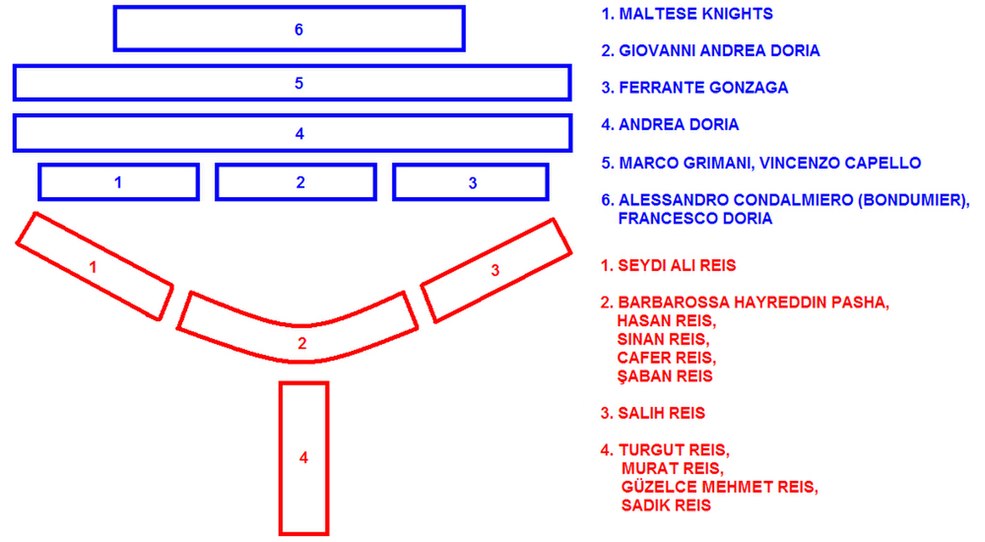
The Crusader Alliance
1- Knights of Malta
2- Giovanni Andrea Doria
3- Ferrante Gonzaga
4- Andrea Doria
5- Marco Grimani, Francesco Capello
6- Alessandro Condulmiero, Francesco Doria
The Mujahid Ottoman Islamic Navy
1- Seydi Ali Reis
2- Khayr al-Dīn Barbarossa, Ḥasan Reis, Sinān Reis, Ḥaḍır Reis, Sim‘ān Reis
3- Ṣāliḥ Reis
4- Ṭurghūd Reis (Turgut Reis)
Following this momentous Islamic victory, the intensity of fear and panic subsided across the Crusader principalities. The Ottoman Islamic navy became the undisputed master of the Mediterranean Sea for three consecutive centuries. Thanks to the triumph of the mujāhid commander Khayr al-Dīn Barbarossa, joy spread to Muslim lands everywhere. Happiness permeated the major Islamic cities such as Cairo, Baghdad, Makkah, Damascus, and Bursa; ululations filled the air and drums were beaten. By the grace of Allah, and then through the jihād of the lions of the sea from among the Muslim commanders—specifically, the heroism of the mujāhid commander Khayr al-Dīn Barbarossa—this came to pass. The esteemed Ottoman Caliph, son of the esteemed, Sulaymān al-Qānūnī, son of Sultan Selim I, received the news of this victory by prostrating in gratitude to Allah, having completed what his father, the mujāhid Selim I (may Allah have mercy upon him), had begun in rescuing the Muslims of Andalusia. He then appointed Commander Khayr al-Dīn Barbarossa as the supreme admiral of the Ottoman Islamic fleets deployed across all the seas of the world.
Barbarossa was not content with the glory he had achieved for Islam in that immortal battle. He immediately launched intensive campaigns to save the Muslims in Andalusia from the torture of the Inquisition courts. He sailed back and forth across the Mediterranean Sea, transporting Andalusian Muslim refugees, saving more than 70,000 Muslim men and women, including children, women, and the elderly. So much so that the people of Andalusia began to call him exclusively by the name Khayr al-Dīn (Goodness of the Faith) instead of his real name, Khiḍr, in gratitude for his benevolent actions.
So may Allah have mercy on the commander Khayr Ad-Din Barbarossa, and may Allah have mercy on his brother, the hero Aruj, before him, and all their Mujahidin brothers. For by Allah, the Barbarossa brothers were indeed the best of brothers. They did not compete for an inheritance they received from their father, nor for some fleeting worldly gain (lu’a’ah min ad-dunya). Rather, they competed as to which of them would be foremost in aiding Islam and rescuing innocent Muslims. And if these heroes were pirates, then how noble a type of pirate they were! But by Allah, they did not venture into the sea out of greed for a treasure buried at the bottom of the oceans, or for a ship sunk in the depths of the seas. Rather, they ventured into the sea out of longing for what is more precious than all the treasures of the world… Paradise!
To proceed… These were lines for our forgotten heroes. Indeed, the time has come for us to dust off the pages of our history, to extract from them the stories of our great heroes, and to present them to our youth. For the time when we would read what the enemies of the Ummah wrote for us has ended, and a time has come when we ourselves write our history.
And although I now understand the secret of the West’s terror of the name “Barbarossa” in their literature, we absolutely refuse the distortion of the images of our heroes and their branding as pirates. As for those in the West who are eager for stories of pirates and criminals, let them search for the origin of the founder of America’s largest bank, “Morgan Bank,” and let them read the stories of the pirate “American Morgan” and how he used to kill the Native Americans (referred to as Red Indians) and seize their wealth to build with it this bank that stands to this very day! As for our great heroes… they’re a red line!!!
But… in the midst of this Islamic-Crusader conflict in the western Islamic world, what were the remaining Safavid Shi’a planning in the eastern Islamic world? Did the Safavid Shi’a change their filthy habit of treachery and betrayal? Or did they leave the Muslims preoccupied in the West so that they themselves could execute their dangerous terrorist plot in the East? And what is the story of the great Battle of Mohacs, which is undoubtedly considered a (victorious) day from among the days of the Days of Allah The Eternal? And who is the great Ottoman Caliph whose kingdom surpassed that of Alexander the Great?
To answer these questions, we must sail on one of the ships of the massive Ottoman Islamic fleet to the capital of Islam at that time, Istanbul. So that we may follow together the story of a new great figure from among the great figures of Islam, whose kingdom many historians likened to the kingdom of the Prophet of Allah, Sulayman (‘alayhis salam). And our hero bore the same name … Sulayman!
To be continued………..
[1] Translator’s Note: The fall of Granada was in 1492. A message in 1541 CE would likely be from the Moriscos (Muslims forced to convert or live under Christian rule) appealing for aid.
[2] The Spanish Inquisition (1478-1834) targeted Muslims (Moriscos) and Jews, forcing conversions, confiscating properties, and executing those deemed heretics. After the Reconquista [Christian reconquest of Iberian Peninsula from Muslim rule], Spain sought to unify under Catholicism. Muslims faced expulsion (1609-1614), forced conversions, and cultural suppression. The Inquisition used torture, trials, and executions to enforce Catholic orthodoxy. Many Muslims were forced to flee or practice their faith in secret. This period significantly impacted Spain’s Muslim and Jewish populations, shaping the country’s history and cultural identity. The Inquisition’s legacy remains a complex and sensitive topic.
[3] Female soldier in the path of Allah.
[4] Brother At-Turbani wrote ‘Khusraw’ here, however that seems to be a mistake. Khayr al-Din Barbarossa’s actual name at birth was Khizr. And Allah knows best.
Read about – Sultan Selim Al-Awwal “The Destroyer of the Safavid State”
 Saheehus-Seerah