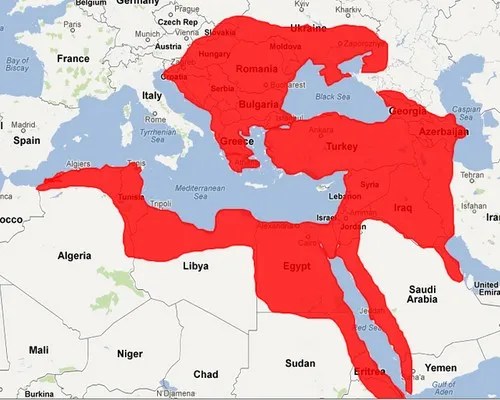
Taken from the book ‘Mi’atu min ‘uzamā’i ummati al-Islām ghayyarū majra at-tārīkh’ by At-Turbani.[1]
(He wrote : )
“Indeed, it is from Sulaymān, and indeed, it begins: In the Name of Allah, the Most Gracious, the Most Merciful} [An-Naml: 30]
I am the Sultan of the White Sea, the Black Sea, the Red Sea, Anatolia, Rumelia, Karaman of the Romans, the province of Dhū al-Qadr, Diyār Bakr, Kurdistan, Azerbaijan, Persia, the Levant, Egypt, Makkah, al-Madīnah, Jerusalem, all the Arab lands, Persia, the country of Hungary, the land of Caesar, and many other lands which the hand of my majesty has conquered with the sword of victory, and all praise is for Allah…. Allah is the Greatest.
I am Sultan Sulaymān, son of Sultan Selim, son of Sultan Bayezid. (In his letter to “François,” king of the province of France, and what follows…)”
The West calls him “Suleiman the Magnificent,” and many historians consider him the greatest monarch known to humankind in the history of the earth. He annexed to his kingdom the greatest capitals of the three continents of Asia, Africa, and Europe. He added to the Islamic Caliphate “Athens,” “Belgrade,” “Budapest,” “Bucharest,” “Cairo,” “Tunis,” “Algiers,” “Makkah,” “al-Madīnah,” “Jerusalem,” “Damascus,” “Beirut,” “Istanbul,” “Tabriz,” “Baghdad,” “Sofia,” “Rhodes,” and other capitals of the world. The famous German historian (Halmar) said of him: “This Sultan was a greater danger to us than Ṣalāḥ al-Dīn himself!”
Sultan Sulaymān al-Qānūnī, was the son of Sultan Selim I, some of whose great attributes we have already mentioned. This cub was indeed a match for that lion. He was a mujāhid (warrior in the cause of Allah) whose equal is rarely found in the history of Islam; he conquered and developed lands, spread justice, and codified the supreme Ottoman laws (the reason for his being named “al-Qānūnī,” the Lawgiver).He restored Jerusalem to the best of conditions, improved the state of Makkah and al-Madīnah, developed the roads, and established schools. He assumed the position of the Caliphate when he was only twenty-six years old. The enemies thought he would be an easy morsel and coveted the lands of the Islamic Caliphate, but he dashed their hopes. He took them by surprise with a counter-offensive, conquering the fortified city of “Belgrade,” which had defied the best of his predecessors like Muḥammad al-Fātiḥ before him.
This prompted Muḥammad al-Fātiḥ to leave it, praying at its walls and saying: “O Allah, grant the conquest of this city to a man from my lineage.” Sulaymān was that very man, and Belgrade was conquered at his hands. After this, al-Qānūnī turned his attention seaward with his soldiers toward the island of Rhodes, where the “Knights of Saint John” or “Knights Templar” were spreading corruption, destruction, and death against Muslims throughout the Mediterranean, after having been expelled from the mainland of Jerusalem by Ṣalāḥ al-Dīn al-Ayyūbī. Sulaymān utterly destroyed the dominion of the knights on Rhodes, leaving the island in ruins upon its inhabitants (the Knights of Saint John subsequently fled to the island of Malta, where they continue to rule to this day!). At that moment, the kings of Europe realized they were facing a new Turkish hawk cut from the same cloth as al-Fātiḥ. The European monarchs thus raced to pay the jizyah (tribute) to the capital of the Caliphate in Istanbul. However, one king, named Louis II of Hungary, killed the Ottoman Caliph’s envoy who had gone to collect the jizyah. This prompted al-Qānūnī to advance in person, accompanied by one hundred thousand heroic mujāhidīn from the elite Ottoman forces—the “Janissary Cavalry”—toward Hungary to discipline its king. The Church in Rome then declared a state of utmost emergency across Europe, and the Pope offered indulgences (certificates of forgiveness) to anyone who participated in fighting the Muslims. The armies of “Hungary,” “Croatia,” “Czechia,” “Spain,” “Germany,” and “Serbia” gathered into a single, massive army in the Valley of Mohács to fight the Muslims. At dawn on the day of the battle, the Ottoman Caliph Sulaymān al-Qānūnī prayed Fajr with his army, then looked upon them with immense pride and proclaimed:
“It is as if the Messenger of Allah (peace be upon him) is watching you right now!”
The soldiers erupted in tears, embraced one another, and pledged to die in the cause of Allah and meet in Paradise. The two armies clashed at Mohács on the 20th of Dhū al-Qa‘dah, 932 AH, corresponding to August 28, 1526 CE. There, the two forces met, and the Muslims were victorious under the leadership of Caliph Sulaymān al-Qānūnī. The allied Crusader army suffered a crushing defeat, and Louis II fled in terror, only to drown in the waters of the Danube!
The astonishing thing in the story of Mohács is that the Muslims discovered, by chance, a new form of Shī‘ī treachery in the very heart of the European plains, in Hungary! And the people at large knew nothing of this treachery from within the Muslims’ own ranks!
The Janissary soldiers discovered that the Safavid Shī‘ah were, as is their habit, secretly aiding the Crusaders from behind the lines of combat. At that point, al-Qānūnī ordered his soldiers to head east to discipline the Shī‘ah. The Muslims would then discover anew that the Shī‘ah had desecrated the grave of Imām Abū Ḥanīfah an-Nu‘mān in Baghdad and announced in the marketplaces that whoever wished to answer the call of nature should do it at the grave of Abū Ḥanīfah, the Imām of Ahl al-Sunnah wal-Jamā‘ah! It was then that the Muslims, led by the Turkish hero Sulaymān al-Qānūnī, pounced like lions upon the dogs of the Safavids. They utterly demolished their strongholds until they had purged Baghdad of the filth of the Safavid Shī‘ah for a period of over five centuries… before they returned to it once again in the year 2003 CE!
After these magnificent victories, al-Qānūnī continued in the caliphate of the Messenger of Allah on earth for a total of 46 years, which he spent in jihād until the very last breath of his life, before being martyred while striving in the cause of Allah despite his old age. So may Allah reward you with all good, O Qānūnī, for what you offered to Islam and the Muslims.
It is worth mentioning that Caliph Sulaymān al-Qānūnī would begin his letters with the noble verse: {Indeed, it is from Sulaymān, and indeed, it begins: In the Name of Allah, the Most Gracious, the Most Merciful} [An-Naml: 30], seeking blessings through the name of the Prophet of Allah, Sulaymān, who was sent to the lands of the Levant (Bilād al-Shām).
This blessed land… brought forth for the Ummah a new hero who bore the same name as that great Ottoman Sultan, to teach the mercenaries of Napoleon Bonaparte a lesson in the meaning of honor and sacrifice! So who is that Sulaymān? And what compels the “Museum of Man” in Paris to preserve his skull to this very day?!!
To be continued… (End of the write-up.)[2]
(From the book‘Mi’atu min ‘uzamā’i ummati al-Islām ghayyarū majra at-tārīkh’ by At-Turbani, page 60-62. Translated by Mohammed bin Thajammul Hussain Manna.)
[1] Pages 60-62.
[2] The next chapter of the book discusses about Sulaiman Al-Halabi, which we will translate, if Allah wills. In brief- Sulaiman Al-Halabi, a Syrian Kurd student, assassinated French General Jean-Baptiste Kléber in Egypt in 1800. He’s celebrated by the Muslim world for resisting French colonial rule and avenging injustices. After his execution by impalement, his skull was taken to France as a trophy and later displayed at the Musée de l’Homme, initially used in phrenology exhibits to illustrate “criminality and fanaticism.” Today, it remains a symbol of colonialism’s complex legacy and the spirit of resistance.
The First English Seerah Book Only Based On Authentic Hadiths! click here
PDF-Famous but Unauthentic stories from The Seerah of The Prophet Muhammad click here.
To read about Sultan Selim Al-Awwal click here.
To read about The Giants of the Islamic Navy- The Barbarossa Brothers click here.
Heroes of Islam – Revisiting The Life of Ameer Al-Khattabi click here.
UNVEILING THE SILENT HEROES – Indonesia’s Invisible Bravery in the Heart of Bosnia’s Struggle click here.
Virtuous Stories Of The Two Sons Of Kuwait … click here.
The Lion of the Battle of Boughafer (معركة بوغافر), Ossu Obsalaam (عسو أوبسلام) Rahimahullah click here.
[New PDF Booklet] Uncovering The Falsehood That Was Propagated In ‘The Kerala Story’ click here.
 Saheehus-Seerah