Question: 228745 (from Islamqa.info)
What is the meaning of the names ‘Āṣiyah, Āsiyah, and Shamsīyah? Are they names with good meanings? Despite the negative meaning of the name ‘Āṣiyah, I do not know why people use this name. And what is the meaning of the names: Bakar, Bukar, or Bakr?
Answer:
All praise is due to Allah, and may peace and blessings be upon the Messenger of Allah. To proceed-
Firstly: One should choose good names and avoid choosing ugly names. The Prophet (peace be upon him) used to consider the implication of a name and would change an ugly name to a good one.
Refer to Question No. (147252).
Names have indications regarding their referents, and there is a congruity between them.
Ibn al-Qayyim (may Allah have mercy on him) said: ‘Allah, in His wise decree, inspires people to give names that fit their meanings. This way, His wisdom ensures that words match what they describe, just like causes match their effects… In short: Bad qualities, actions, and behaviors deserve names that reflect them, and good ones deserve names that reflect them.'”
[End of quote from] “Tuḥfat al-Mawdūd” (pp. 146-147).
Secondly: “Shamsīyah”: This name is derived from ash-Shams (the sun). For instance, one says ‘sanah shamsīyah’ (solar year), referring to the sun, just as one says sanah qamarīyah (lunar year), referring to the moon.
It is stated in “Al-Mu‘jam al-Wasīṭ” (1/494):
“Shamsīyah: Pertaining to the sun. Ash-Shamsīyah also refers to an umbrella carried by hand to shield oneself from the sun.” End quote.
Perhaps those who name their daughters Shamsīyah consider some qualities of the sun and hope their daughters will embody them, such as widespread benefit, or the radiance, roundness, and beauty of the face, or similar attributes.
It is permissible to name a child “Shamsīyah,” given that the default rule for naming is permissibility.
It is stated in “Al-Mawsū‘ah al-Fiqhīyah” (11/332): “The fundamental principle is the permissibility of naming with any name, except for what has been explicitly prohibited.” End quote.
However, the legislated and recommended names offer ample sufficiency and richness.”
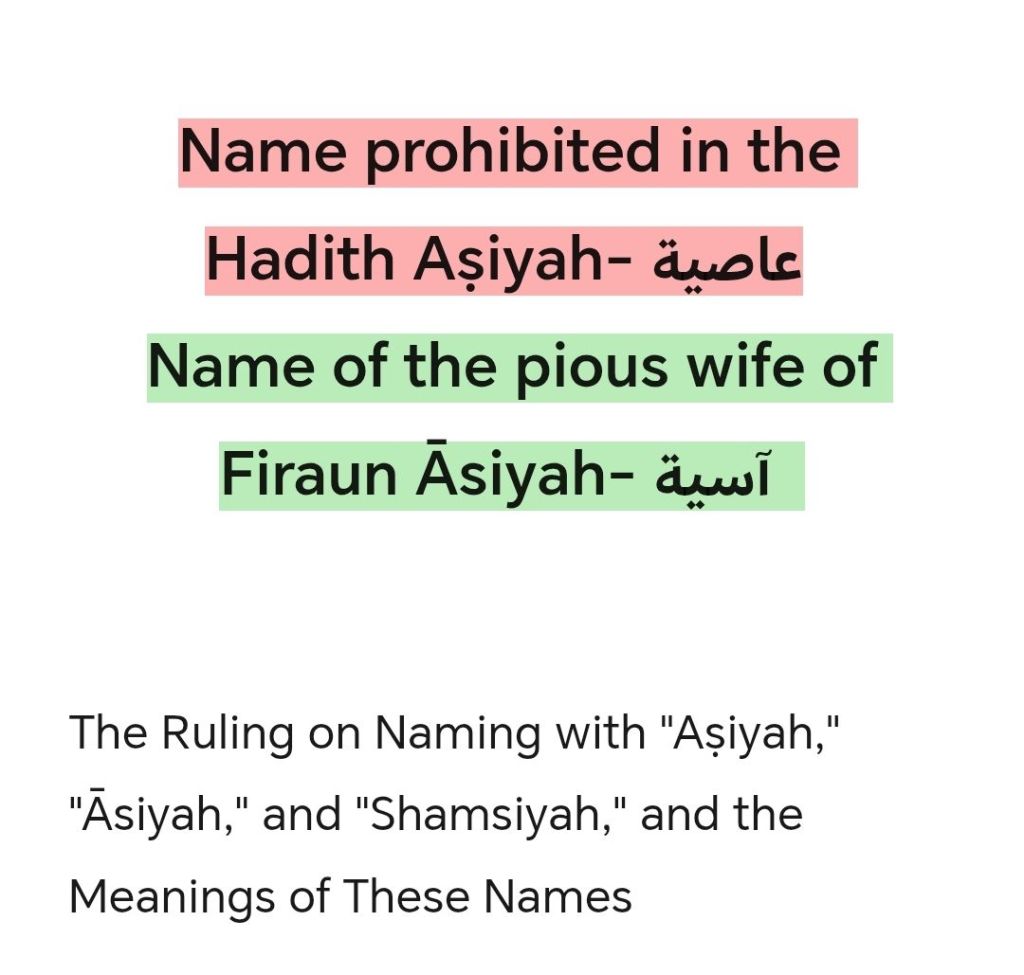
As for “Āsiyah”: It has several meanings in the Arabic language:
(Translator’s addition: This is referring to the name ‘Āsiyah’ mentioned in The Quran as the name of Firaun’s wife.)
It is stated in “Lisān al-‘Arab” (14/34):
“Al-Asā: Treatment and remedy, and it also means sorrow. Asā al-jurḥ: He treated the wound. Al-Asūw and al-Isā’, both mean medicine, and the plural is Āsiyah.” End quote.
Al-Āsiyah in construction refers to something firmly built, and al-Āsiyah also means a pillar or a female circumciser.
“Al-Qāmūs al-Muḥīṭ” (p. 1259)
And al-Āsiyah also means a column.
“Aṣ-Ṣiḥāḥ” (6/2269)
It is said that a column (sāriyah) was named Āsiyah because it supports and straightens the roof, derived from asawtu bayna al-qawm: I reconciled between the people.
“Tāj al-‘Arūs” (37/79)
Perhaps the name “Āsiyah” is derived from all these meanings, all of which are good. There is no objection to naming with it.
As for “‘Āṣiyah”: It comes from al-‘iṣyān (disobedience), which is the act of departing from obedience and violating a command. It is an ugly name. Indeed, Muslim (2139) narrated from Ibn ‘Umar: “The Messenger of Allah (peace be upon him) changed the name of ‘Āṣiyah and said: ‘You are Jamīlah (beautiful).'”
This Ḥadīth is sufficient to demonstrate the dispraise of this name and that it is disliked for a Muslim to name his daughter with it. This is in addition to the natural aversion people feel towards such a name and their discomfort with anyone who bears it.
As for Bakr: It refers to a young camel. It is stated in “Tāj al-‘Arūs” (10/241):
“Al-Bukr and al-Bakr: The offspring of a she-camel, or the young one among them; its status among camels is like that of a young person among humans.” End quote.
Thus, one who names with it perhaps considers the meaning of strength and youth. It is a well-known name among the Arabs, by which a group of the Companions (may Allah be pleased with them) were named, and Abū Bakr aṣ-Ṣiddīq (may Allah be pleased with him) was known by this kunyah (agnomen).
See: “Al-Iṣābah fī Tamyīz aṣ-Ṣaḥābah” by Al-Ḥāfiẓ Ibn Ḥajar (1/212-215).
For further benefit, refer to Question No. (1692) and Question No. (101401).
And Allah knows best.
[Translated by Mohammed bin Thajammul Hussain Manna.]
 Saheehus-Seerah