Explanation of The Above Ahadith From dorar.net-
The Prophet (peace and blessings be upon him) set the most magnificent examples in good character and pleasant company between a man and his household.
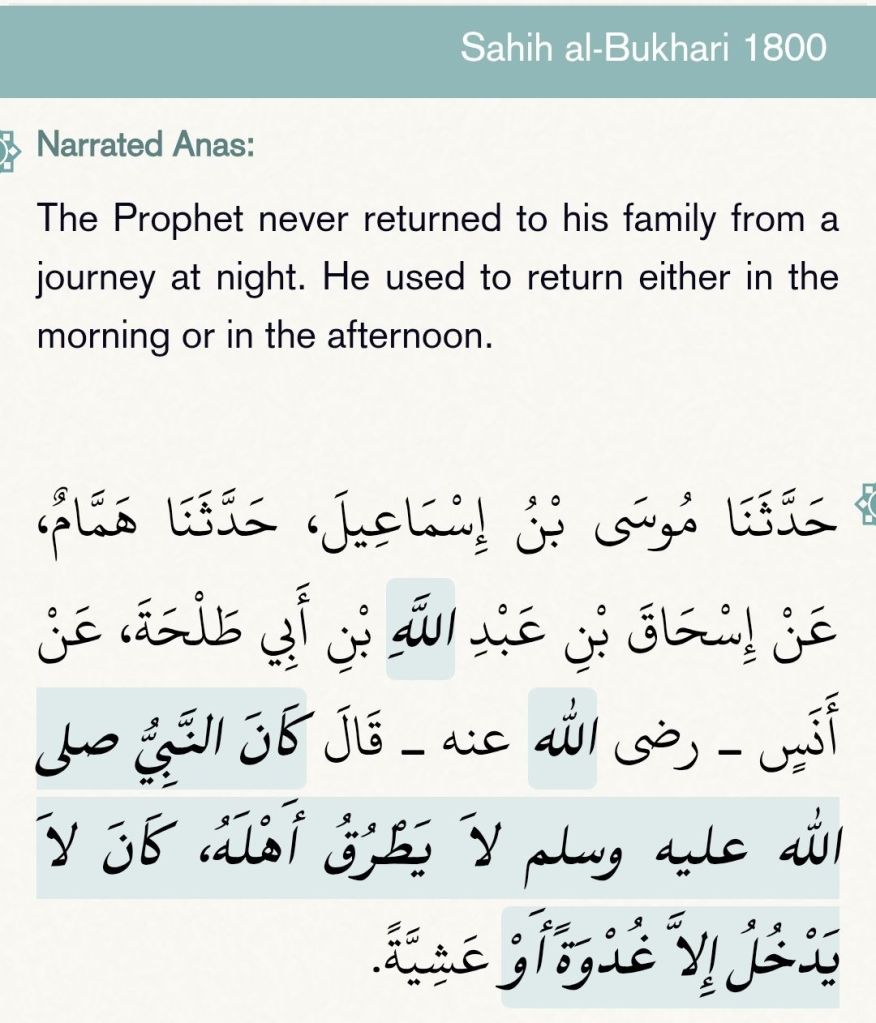
In this Hadith, Anas bin Malik (may Allah be pleased with him) narrates that the Prophet (peace and blessings be upon him) would not enter upon his family at night when he returned from a journey.
Instead, he would arrive in the early morning (Ghudwa), which is from the Fajr prayer until sunrise, or in the late afternoon/evening (Ashiyya), which is from the decline of the sun (the time of Dhuhr prayer) until its setting.
This is because a man’s arrival before his wife at night involves surprising her, and she may not be prepared to receive her husband, especially since he has been absent from her for a (long) period. Therefore, it was befitting that he not come to her suddenly at night.
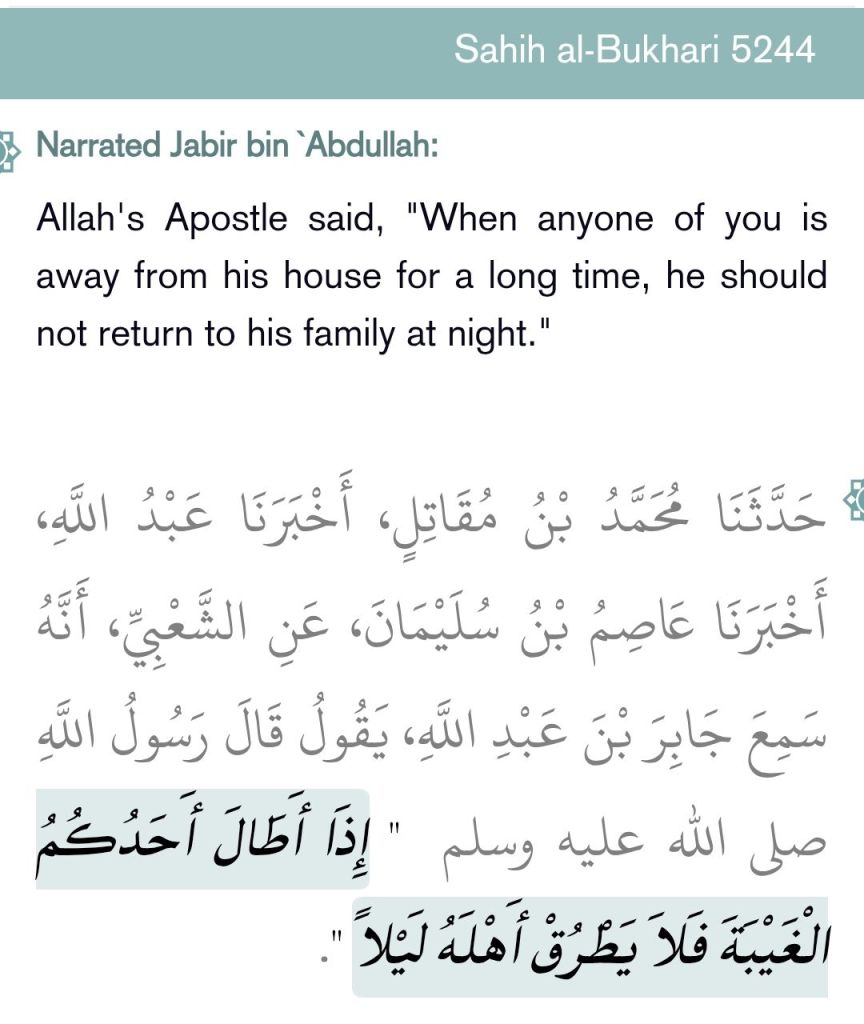
The Prophet (peace and blessings be upon him) forbade—as narrated by Muslim from the Hadith of Jabir (may Allah be pleased with him)—that a man should arrive at his home at night (yatruq), suspecting them of treachery (yatakhawwanahum), or seeking out their faults (yaltamisu ‘atharātihim). This means suspecting their betrayal and uncovering their secrets to determine if they have been unfaithful or not.
Thus, it is disliked (yukrahu) for one whose journey has been long to present himself to his wife suddenly at night. As for one whose journey was short, and whose wife expects his arrival at night, there is no harm in it. (End of the explanation.)
Translator’s Note: The order to ‘not return at night’ in this Hadith is not one of being ‘obligatory’, rather this is a ‘recommended etiquette’. If someone visits his wife at night after travel, or returns home at night after a travel, it is not ‘prohibited’ for him to go to his own house at that time of the night.
 Saheehus-Seerah