The Giant of Algeria- Ameer Abdul-Qadir al-Jazairi
[Taken from the book ‘Mi’atu min ‘uzamā’i ummati al-Islām ghayyarū majra at-tārīkh’ by At-Turbani. Pages 67-71]
“Indeed, the roar of bullets and the neighing of horses are more beloved for our ears than the soft, melodious voice.”- Ameer Abdul-Qadir al-Jazairi
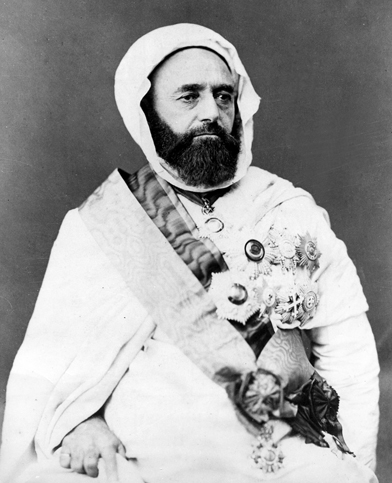
Initially, I must confess that the ancient and modern history of Algeria was personally somewhat obscure to me. Indeed, the history of Morocco, with its connections to Al-Andalus, and the history of Tunisia, with the tales and accounts preserved by the Zaytūnah University, were clearer to me than Algeria’s own history. Perhaps my ignorance even led me, at one point, to doubt the Arab identity of this nation and its belonging to Islam. The truth is, however, that when I turned the pages of history to uncover the story of this immense country, I discovered that Algeria possesses a history that can, at the very least, be described as one written in liquid gold! And because discussing Algeria’s history in supporting the religion of Allah is a matter whose explanation would be lengthy, I will focus in the following few lines on the story of a hero among the heroes of Algeria, one who embodied within his very being all the meanings of chivalry, heroism, and magnanimity.
Some historians attribute the beginning of the French campaign against Algeria to the year 1927 CE. However, I believe that the actual war against Algeria began much earlier, specifically in 1538 CE. This was the date of the immortal Battle of Preveza, which we discussed previously when mentioning the Ottoman victory, led by the heroic commander Khayr ad-Dīn Barbarossa, over the allied Crusader fleets. Following this monumental victory, Commander Barbarossa (may Allah have mercy on him) established a formidable Islamic fleet based in Algeria. Algeria thus transformed into the most powerful naval force in the entire world, leading the immense Ottoman Islamic fleet, and became known by a new designation: “Dār al-Islām (Abode of Islam) and Dār al-Jihād (Abode of Striving).” From that date onward, the Crusaders’ attention shifted specifically to Algeria.
To grasp the extent of power Algeria attained under the aegis of the Ottoman Islamic Caliphate, it suffices for us to recall that George Washington, the first President of the United States of America, paid a tribute (jizyah) to the Muslims amounting to 642,000 gold dollars and 1,200 Ottoman liras to the Ottoman fleet at the end of the eighteenth century. This was so that the Ottomans would agree to sign a non-aggression treaty with America! It is noteworthy that this agreement is the only one in the archives of the United States of America that was not written in English, but rather in Ottoman Turkish with Arabic script, at the personal request of the Ottoman Caliph. As for Britain, it paid 600 pounds annually to the Algerian treasury. Denmark provided the Muslims in Algeria with military equipment and machinery valued at 4,000 riyals Shenko each year, accompanied by precious gifts. Holland, meanwhile, paid 600 pounds to the Ottoman Caliphate’s fleet in Algeria, the Kingdom of Sicily paid 4,000 riyals, and the Kingdom of Sardinia paid 6,000 pounds. The United States of America offered military equipment and supplies valued at 4,000 riyals, plus another 10,000 riyals in cash, accompanied by valuable gifts. France sent valuable gifts when changing its consuls, Portugal offered gifts of the finest varieties, and Sweden and Norway supplied military naval equipment and ammunition worth large sums annually. The cities of Hanover and Bern in Germany paid 600 English pounds, and Spain presented the most exquisite gifts annually. Over three centuries of the Algerian-Ottoman fleet’s dominance over the Mediterranean Sea, the Crusaders awaited an opportune moment to exact revenge upon the Muslims. This led European nations to present the “Algerian Question” at their conferences. After being alluded to at the Congress of Vienna, it was formally presented at the Congress of Aix-la-Chapelle in 1818 CE. The question that circulated there became: when would the opportunity arise to pounce on Algeria? The truth is that this opportunity came in 1927 CE, the year the Algerian-Ottoman fleet was destroyed in the naval “Battle of Navarino.” Strangely, the French did not wait long, advancing to occupy Algeria in that very same year!
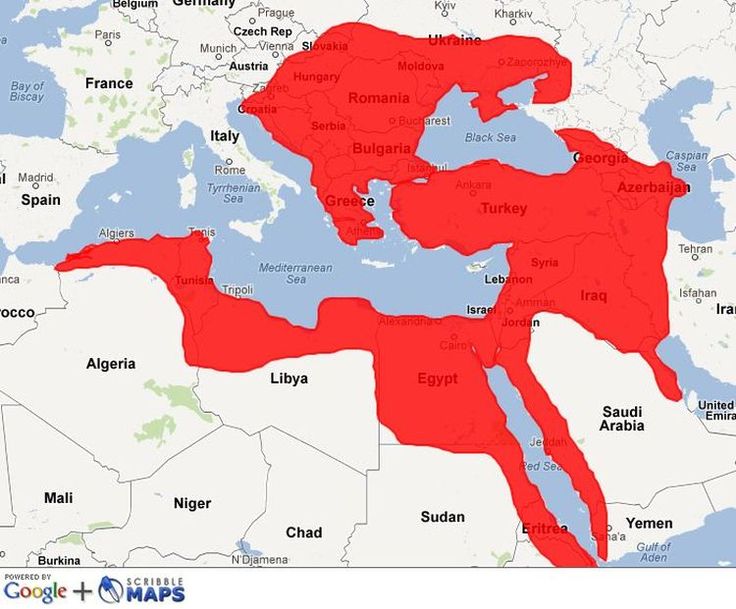
This explains why Algeria was specifically targeted. As for why France, in particular, was chosen to act on behalf of the other Crusader invasion forces, this is due to numerous reasons that will be detailed later in this book when discussing the Crusades and France’s role in them, ever since Pope Urbān II initiated the call for those Crusades in the French city of Clermont. And for anyone who might assume that France did not enter Algeria except only to eradicate ignorance and poverty, then they should know that the literacy rate in Algeria during that period was higher than in France. This is attested by the German traveler Wilhelm Schimper, who wrote upon visiting Algeria in December 1831 CE: “I deliberately sought a single Arab in Algeria who was illiterate, yet I found none, whereas I encountered such illiteracy frequently in the countries of Southern Europe, where one rarely finds anyone among those European populations who can read.”
Even more astonishing, France was at that time unable to settle its substantial debts to Algeria! As for those who believed that France had become secular in its inclinations after the French Revolution and had abandoned its Crusader animosities, they are profoundly mistaken in this assumption. Perhaps the words of the French themselves confirm this assertion, for France, after its revolution, felt itself to be the protector of Catholicism, and that achieving victory at Algeria’s expense was tantamount to a triumph of Christianity over the Islamic religion. This is what we infer from the statement of the French commander Klīrmūn dī Ṭūnīr (Clermont-Tonnerre) when he imposed a blockade on the Algerian coasts, declaring: “Perhaps luck will aid us on this occasion to spread civilization among the indigenous inhabitants, thereby bringing them into Christianity.” Similarly, the description provided by the commander of the French campaign, Dūbirmūn (Bourmont), at the celebration held in the “Qasbah courtyard” to mark the victory, stated: “My Lord, by this act of conquest, you have opened a door for Christianity on the shores of Africa.” As for the Jews, whom Algerian Muslims had hosted after their expulsion from Al-Andalus by the Catholics, they repaid this kindness to the Muslims by opening the gates of the capital, Algiers, to the French! It was then that France overtly displayed its Crusader animosity towards Islam. Consider that out of 112 mosques in the capital Algiers alone, the French preserved only 5, demolishing or converting the rest into warehouses or stables. Furthermore, the French completely banned the Hajj (pilgrimage), and French soldiers engaged in widespread looting and plunder in Muslim homes, even taking bracelets from wrists after severing the hands of Muslim women, without allowing them time to remove their jewelry! Indeed, some Frenchmen even took women’s earrings along with their ears, cutting them off with knives! For anyone enamored with “French etiquette,” they should read this brief story that reveals the true extent of French refinement: when 800 Algerian Muslims, accompanied by their livestock, sought refuge in one of Algeria’s caves, fleeing the soldiers’ brutality and fearing for Algerian girls from rape, these “etiquette-conscious” proponents of civilization set fire to the cave with everyone inside. The village youth, upon going the next morning to check on their families, found a horrifying sight!
They found the charred bodies of children amidst the remains of burnt livestock, for the French fire made no distinction between human and animal in its killing. Then they discovered something that caused many of them to collapse in horror from its sheer atrocity and savagery: a burnt corpse of a man, his hands still clinging to the charred horns of a bull that appeared to have been maddened by the intense smoke, charging towards the man who had fended it off with his bare hands. When the youth moved the man’s body, they found behind it the charred remains of a little girl in her mother’s embrace. This man had been her husband, who had sought to protect his daughter and wife from that enraged bull, grasping its horns to shield them before the entire family and the bull were consumed together by the fire of France!
I recount these tragedies not to reopen old wounds with France, but for two reasons. The first is France’s refusal to apologize to Algeria for the crimes it committed against Muslims in Algeria, which means the possibility of their recurrence against Muslims remains (and this is indeed what happened in Bosnia a few years ago when France lifted the siege on Catholic Croats and supplied them with weapons to kill Muslims in Bosnia!). The second reason is that mentioning this oppression and tyranny helps us appreciate the greatness of our hero, Ameer Abdul-Qadir al-Jazairi, who led the Jihād against the French Crusader occupier amidst these grim circumstances. The Algerian united the ranks of the tribes under his command and embarked on a struggle to expel the invaders. He inflicted severe hardships upon the French and caused them heavy losses in the Battle of Al-Muqaṭṭa‘ in 1835 CE. Amīr ‘Abd al-Qādir continued to deal the French various defeats before they eventually captured him, casting him into Parisian prisons, prior to exiling him to Istanbul. There, he was received and honored by the Caliph of the Muslims. The Amīr then moved to Damascus, and it was there, in the capital of the Umayyads, that it becomes clear why Ameer Abdul-Qadir al-Jazairi became one of humanity’s great figures. In 1860 CE, a bloody strife erupted between Muslims and Christians in Damascus, and astonishingly…! The Algerian Amīr protected the Christians and sheltered them in his home, despite what the French Christians had done to Muslims in his homeland!
On May 26, 1983 CE, the heroic Ameer Abdul-Qadir al-Jazairi passed away (transferred to the mercy of Allah the Almighty) in his exile in Damascus. France then seized the opportunity of his absence to transform Algeria into a French province, having abolished Islamic courts and systematically erased the Arabic language, replacing it with French. Amidst this grim situation and these dire circumstances that invited despair, and when France was confident that it had extinguished Islam in Algeria and made the people forget the language of Muḥammad ibn ‘Abd Allāh, a new Islamic luminary emerged from the wreckage of destruction and the ashes of despair. He refused to accept the bitter reality, so he carried the banner of Islam high in Algeria, transforming the land of Algeria into a mass of flames!
To be continued…
[Taken from the book ‘Mi’atu min ‘uzamā’i ummati al-Islām ghayyarū majra at-tārīkh’ by At-Turbani. Pages 67-71, -Translated by Mohammed bin Thajammul Hussain Manna]
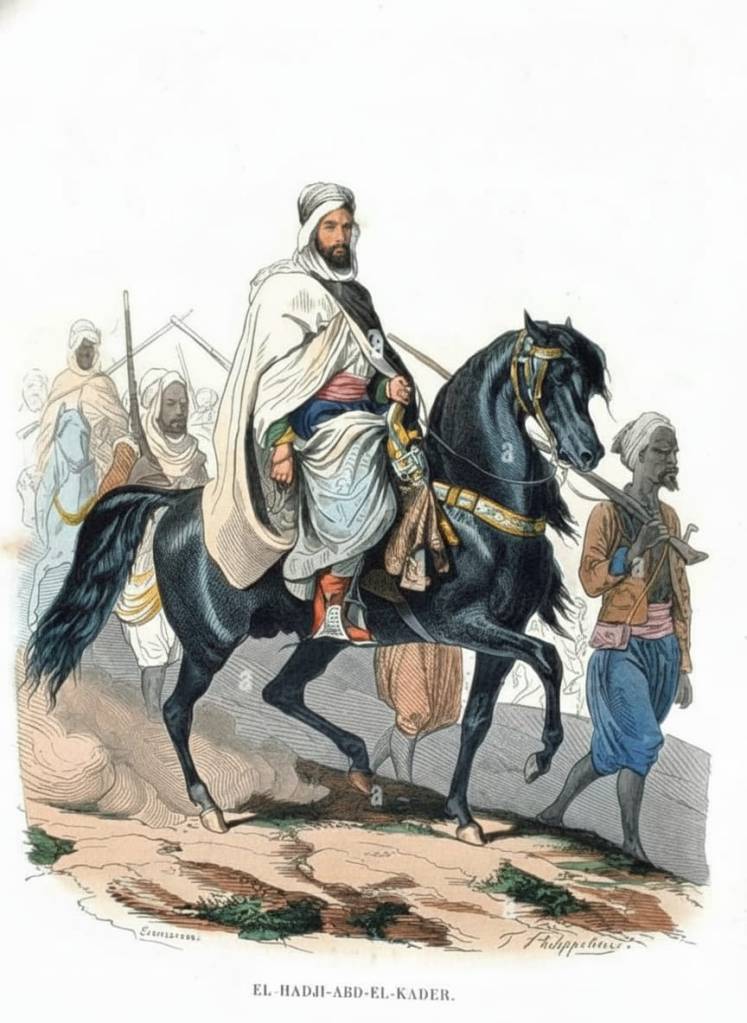
Ameer Abdul Qadir Al-Jazairi (1808-1883): The Saint-Warrior of the Ummah
(A summarized note on his life and times by Mohammed bin Thajammul Hussain Manna)
In the tumultuous history of the 19th century, when the dark clouds of European colonialism sought to engulf the Muslim world, a beacon of light emerged from the rugged terrain of North Africa. Ameer Abdul Qadir ibn Muhieddine Al-Jazairi (Rahimahullah), born in 1808 near Mascara, Algeria, was not merely a military commander; he was a towering scholar, an ascetic worshipper, and a man whose life embodied the true essence of Islamic chivalry (Futuwwa).
When the French forces launched their brutal invasion of Algiers in 1830, toppling the Ottoman rule, the land fell into chaos. The tribes of Western Algeria, desperate for a leader to defend the honor of Islam, initially turned to the Ameer’s father, the pious Shaykh Muhieddine. However, the Shaykh declined due to his advanced age. Instead, he pointed to his son, declaring that Abdul Qadir possessed the vigor, wisdom, and spiritual strength required for the Jihad (here- the struggle against the colonial forces).
Thus, in 1832, under the Elm tree in the plain of Ghriss, the tribes pledged allegiance (Bay’ah) to the 24-year-old Abdul Qadir. He accepted the heavy burden of leadership not for power, but as a religious duty, taking the title Nasir ad-Din (The Defender of the Faith).
The Lion in the Battlefield
The Ameer proved that the Tasbih (rosary) in the hand does not weaken the sword in the grip. His 15-year war of resistance (1832-1847) was not a single campaign but a relentless struggle of resistance that baffled the French generals. It is impossible to count every engagement, as his primary strategy relied on hundreds of lightning-fast guerrilla raids, ambushes, and supply line attacks that bled the colonial army dry.
Alongside this constant harassment, he commanded his forces in over fifteen major, conventional battles against the invaders. This relentless, multi-faceted war forced France to deploy one-third of its entire army to Algeria, yet for years, they could not subdue him.
His genius was displayed in full force during the Battle of Macta (June 28, 1835). Facing the arrogant French General Camille Trézel, the Ameer utilized his knowledge of the terrain to lure the French column into a marshy trap on the banks of the Macta river. As the heavy French wagons bogged down in the mud, the Mujahideen (troops of Abdul Qadir) struck with the speed of lightning. The Ameer’s cavalry cut through the French lines, turning their orderly retreat into a chaotic slaughter. Historical records confirm the French suffered over 500 casualties. The disaster was so humiliating that General Trézel was recalled in disgrace.
However, the Ameer also faced setbacks, such as the Battle of Sikkak (July 6, 1836), where the superior artillery of General Bugeaud inflicted a heavy defeat on his forces. This defeat only strengthened his resolve, teaching him to avoid open-field battles and master the art of guerrilla warfare.
The Smala: A Moving State
Unlike European monarchs who hid in stone castles, Ameer Abdul Qadir created a unique marvel of logistics known as the Smala (or Zmalah). It was a roving capital—a mobile city of over 30,000 people, including families, artisans, livestock, and even mobile libraries. Whenever the French armies approached, the Smala would vanish into the vast desert, carrying the heart of the Islamic State with it. This allowed the Ameer to protect the women, children, and scholars while his rapid cavalry harassed the exhausted French troops. It was a strategy that baffled the European generals for years, until its eventual capture in a surprise raid (May 16, 1843) while the Ameer was on an expedition—a devastating logistical blow that marked a turning point in the war.
The “Alamo” of Algeria
Even after the loss of his Smala, the Ameer’s resolve did not break. The most legendary encounter of this later period was the Battle of Sidi Brahim in September 1845. A French column of 450 men led by Lieutenant-Colonel Montagnac was hunting him. Instead of fleeing, the Ameer’s forces encircled them. On September 23, the Mujahideen struck. The French formation collapsed, and the remaining soldiers were cornered in a Marabout (a saint’s tomb). The Result: It was a total annihilation of the enemy column. Only a handful escaped. This victory sent shockwaves through Paris and proved that the spirit of Algerian resistance was far from extinguished.
Sayings on Resistance and Freedom
Throughout this struggle, the Ameer’s understanding of his resistance was rooted in high spirituality.
- When asked about his motivation, he famously said: “I fight the French because they are invaders, not because they are Christians.”
- In a letter to the French General Bugeaud, he displayed his reliance on Allah and his strategy of patience: “We will fight when we deem it appropriate… we will tire you, we will harass you, and we will destroy you in detail; the climate will do the rest.”
- Yet, he always longed for the spiritual life. He once remarked: “I was not born to be a warrior. I never stop praying to God to let me return to my vocation [of scholarship and worship].”
The Hero of Damascus
After his eventual surrender in 1847 to save his people from genocide, and subsequent exile, he settled in Damascus. It was here, in July 1860, that his character stunned the world. A sectarian mob sought to massacre the Christians of Damascus. Ameer Abdul Qadir (Rahimahullah) and his Algerian veterans rushed into the fray. He sheltered thousands of Christians in his own home, standing at the door with his sword drawn, shouting: “The Christians are my guests! You will have to kill me before you touch them!”
A Tribute from Abraham Lincoln
His defense of the innocent was so profound that it garnered global awe. Leaders from around the world sent him gifts of gratitude. Most notably, President Abraham Lincoln of the United States was so moved by the Ameer’s humanity that he sent him a pair of inlaid pistols as a tribute to the “friend of humanity.”
A Timeless Legacy Ameer Abdul Qadir passed away in 1883, leaving behind a legacy that transcends borders. He taught the Ummah that a true Mujahid is a protector of the weak, regardless of their faith. He was, as his contemporaries called him, a “Saint among the Princes, and a Prince among the Saints.”
Upon his passing in 1883, the Ameer was initially laid to rest in Damascus, beside the tomb of his Shaykh Ibn Arabi. However, his connection to his homeland remained unbroken even in death. On July 5, 1966, following Algeria’s hard-won independence, his remains were returned in a triumphant procession to Algiers. He was re-interred in the El Alia Cemetery, resting among the martyrs of the revolution—a final homecoming for the Father of the Nation.
May Allah, the Most Exalted, grant this noble defender of the faith the highest status in Jannah. Ameen.
***
Read about the other heroes of Islam in the links below, In sha Allah:
Sulaymān al-Ḥalabī -The Forgotten Muslim Hero of Anti-Colonial Resistance
Heroic Deeds For The Ummah: King Fahad’s Forgotten Stand For His Bosnian Brothers
UNVEILING THE SILENT HEROES – Indonesia’s Invisible Bravery in the Heart of Bosnia’s Struggle
Know your heroes: Imam Shamil of Chechenya
Heroes of Islam – Revisiting The Life of Ameer Al-Khattabi
The Giants of the Islamic Navy- The Barbarossa Brothers
Sultan Selim Al-Awwal “The Destroyer of the Safavid State”
Virtuous Stories Of The Two Sons Of Kuwait …
The Lion of the Battle of Boughafer, Ossu Obsalaam Rahimahullah
Sule Yuksel Senler- The Hijab Activist of Turkey
A Life of Servitude to The Book of Allah, Shaikh Khaleel-ur-Rehman Al-Kashmiri.
 Saheehus-Seerah