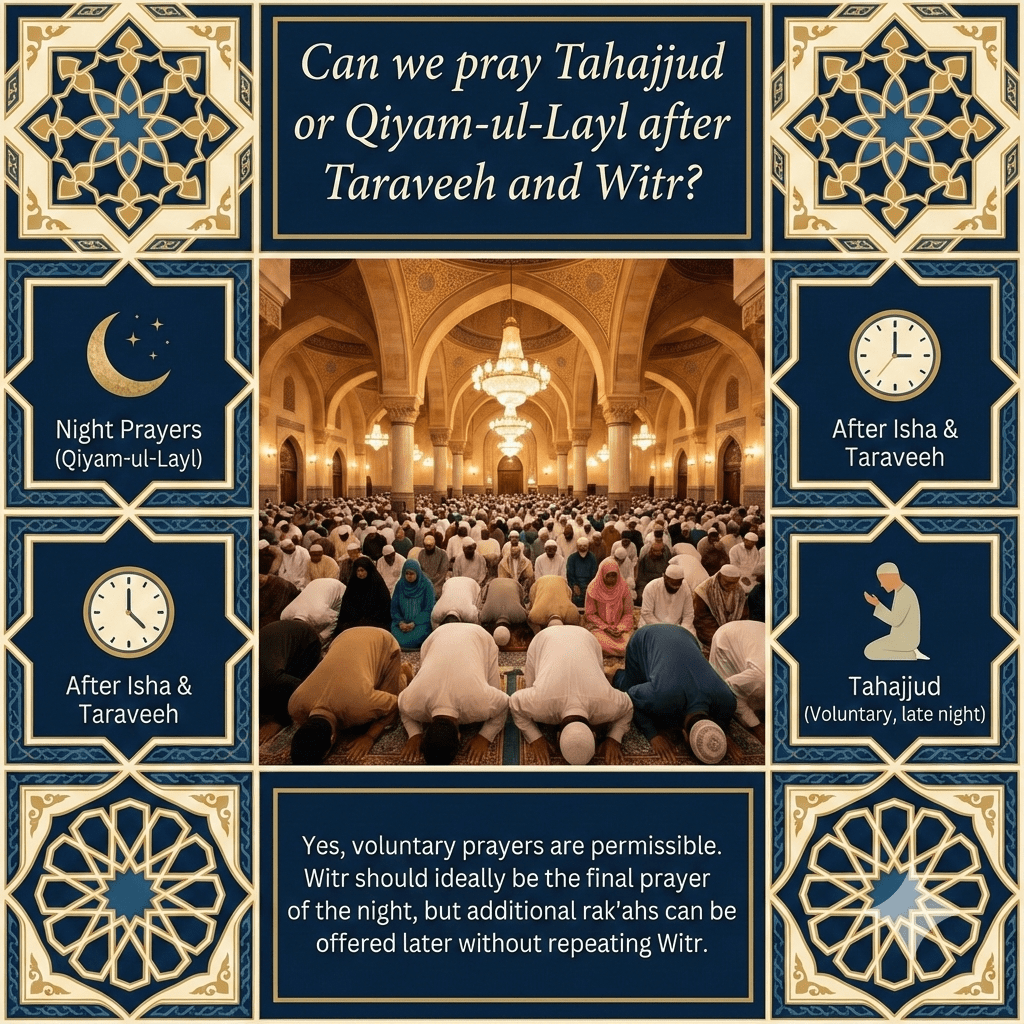
Whenever the question arises, ‘Can we pray Tahajjud or Qiyam-ul-Layl even after praying Taraweeh and Witr?’, many people reply:
“There is no need to pray because there is a hadith of the Prophet ﷺ which says that whoever offers the complete prayer with the Imam gets the reward equivalent to offering the prayer the entire night (Sunan An-Nasa’i, Saheeh [Al-Albani]).”
However, this answer is wrong from many angles.
First of all, is it permissible to offer any prayer after 11 rakats, which also includes Witr?
Yes. The Ahadith which says that Witr should be the last prayer, it does not mean that praying any Nafl salah (voluntary prayer) after Witr is completely Haram (forbidden). It means that Witr should generally be the last prayer. But if someone prays any Nafl or Sunnah of Isha after Witr, then there is no harm in it. For example, praying Tahajjud after Witr is proven from the Prophet ﷺ (and from the Sahaba, as will be seen soon InshaAllah).
Praying 2 Rakats after Witr by Prophet (Salallahu Alaihi Wa Sallam):
Abu Salamah narrates, “I asked Aisha (Radi Allahu Anha) about Prophet’s prayer.” She said: “He (Salallahu Alaihi Wa Sallam) used to pray thirteen (13) rakats. He (Salallahu Alaihi Wa Sallam) used to pray eight (8) rakats, then He prayed Witr. After that, he used to sit and pray two (2) rakats. Then, when He wanted to perform ruku, He would stand up and perform ruku. And alongside, He used to pray two (2) rakats between the Adhan and Iqamat of Fajr.” (Sahih Muslim)
Secondly- Is it correct to say that if you complete the entire taraweeh with the imam then you have earned the reward of praying the whole night and there is no need to pray any more?
This is a misunderstanding of the Prophet’s hadith. The meaning of this hadith is not to say, “Don’t pray extra prayers,” as neither the Prophet nor the companions understood it that way. The hadith describes the virtue of completing the taraweeh with the Imam. If there were no need to pray more than that because “it’s equivalent to praying all night,” then simply praying Isha and Fajr would be sufficient. Because the one who prays Isha and Fajr in congregation would not require to pray the Sunnah prayers at all as the person who prayed both the prayers would get the reward of praying the whole night according to the following hadith –
Uthman bin Affan (Radi Allahu Anhu) narrates that Messenger of Allah (Salallahu Alaihi Wa Sallam) said:
“The person who offers Isha prayer in congregation gets the reward of spending half the night in Qiyam. And the person who offers both Isha and Fajr prayers in congregation gets the reward of spending the entire night in Qiyam.”
[Jami At-Tirmidhi, 221, Sahih (Zubair Ali Zai)]
Thirdly- Did the companions pray in another jamaat (congregation) after one Taraweeh jamaat?
In the narration from Sunan Abi Dawood (1439), the companion Talq bin Ali (Radi Allahu Anhu) returns home and leads his family in prayer, including the Witr prayer. Afterwards, he goes to the masjid, leads the prayer, but does not pray the Witr prayer again. This suggests that one can pray after the Witr, but that the Witr prayer should not be repeated again, and one can also participate in two night-prayer congregations.
Qays ibn Talq narrates: Talq ibn Ali visited us on a day of Ramadan. He stayed with us till evening and broke the fast with us. Then he got up and lead the Witr prayer for us. After this he went to his masjid and offered the prayer there (for the people). Then when Witr prayer was left to be offered, he called forward another person and said: “Offer the Witr prayer for your people, because I heard the Messenger of Allah (Salallahu Alaihi Wa Sallam) saying, “There are no two Witrs in one night.”” (Abi Dawood, 1439, Sahih [Al-Albani], Hasan [Al-Arnaut])
Shaykh Saleh Al-Fawzan (May Allah preserve him) said:
“If a person prayed Taraweeh and prayed witr with the Imam, then stood in the night for tahajjud, then there is no preventative for that. And he does not repeat the witr, rather the witr he prayed with the Imam suffices him. He prays tahajjud in the night with what Allah makes easy for him and if he delays witr until the end of the night, then there is no harm. However, he will miss following the Imam and it is better to follow the Imam by praying witr with him due to the statement of the Prophet (Salallahu Alaihi Wa Sallam):
Indeed, whoever stands (praying) with the Imam until he finished, then it is recorded for him that he prayed the whole night. [Reported by Abu Dawood (2/51), Tirmidhi (3/147-148), Nasaai (3/83-84), Ibn Majah (1/420-421)]
So he follows the Imam and prays witr with him. This does not prevent him from standing at the end of the night and praying tahjjud with what is easy for him”. End.
[al-Muntaqaa min Fatawa Fawzan (no. 116), translation of Shaykh Saleh Al-Fawzan’s Fatwa was taken from torontodawah.com/the-ruling-on-praying-tahajjud-after-taraweeh/]
(Compiled by Mohammed bin Thajammul Hussain Manna, translated from Roman Urdu to English by Adeeb Sheriff.)
 Saheehus-Seerah