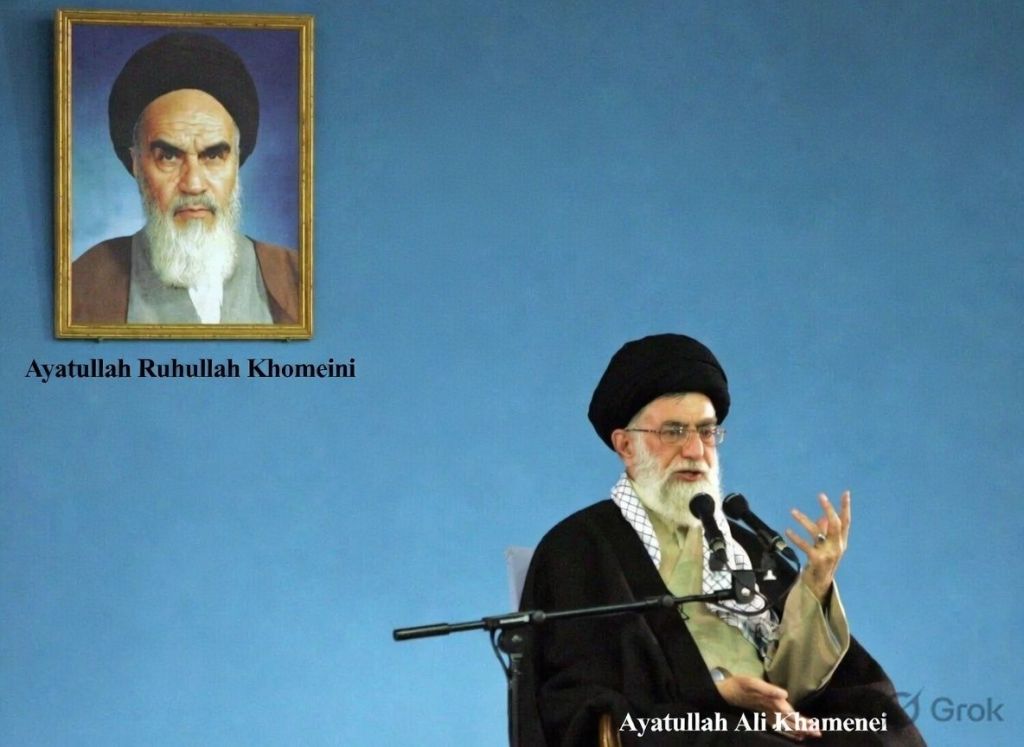
[Translator’s Note: Ayatollah Ruhollah Khomeini was the principal architect of the 1979 Iranian Revolution and the founder of the Islamic Republic of Iran, serving as its first Supreme Leader until his death in 1989. He established the country’s theocratic system based on Wilayat al-Faqih (Guardianship of the Islamic Jurist). Ali Khamenei (the one killed on 28th February 2026) was one of Khomeini’s most devoted students and trusted loyalists. Under Khomeini’s mentorship, Khamenei became a key political figure, serving as Iran’s President from 1981 to 1989. Upon Khomeini’s death, the Assembly of Experts selected Khamenei to succeed his mentor, making him the second Supreme Leader of Iran.]
In the Name of Allah, the Most Gracious, the Most Merciful.
Praise be to Allah, Lord of the Worlds, and peace and blessings be upon the most noble of prophets and messengers, our master Muhammad bin Abdullah, the trustworthy, and upon all his family and companions, and those who follow them in righteousness until the Day of Judgment. To proceed:
Praise be to Allah who has placed within this Ummah divine, Salafi scholars who proceed upon the Book of Allah, the Sunnah of the Prophet (Salallahu Alaihi Wa Sallam), and the understanding of the righteous predecessors (Salaf as-Salih), may Allah be pleased with them. There is no era except that heads of innovation emerge within it, calling to themselves and rendering the sword lawful; and Allah is the source of help. This is a discourse that clarifies the misguidance of Khomeini, his disparagement of the companions of the Messenger of Allah, and his complete contradiction of the religion of Islam. Would that his followers take heed of what we are about to say and quote; however, when whims and deeply rooted malice nest in the hearts, it is difficult for them to depart, except for one who listens with the eye of insight and seeks the truth. But the Rafidah (Rejectionists) are the furthest of people from that, and Allah is the source of help.
Indeed, Khomeini pursued divergent paths in rejecting the religion and the faith, all of which converge upon the religion of disbelief and misguidance. Here is the following:
First: Extremism in Rejection (Rafd) and Severe Enmity Towards Ahlus-Sunnah
1. Preferring the Shia Imams over all Prophets:
Khomeini adopts the path of the extremists (the extremist Rafidah) in Shiism. Evidence of this is his reliance on the extremists’ doctrine regarding the superiority of the Imams over the prophets and messengers of Allah.
Khomeini states: “It is one of the essential tenets of our sect that our Imams possess a station unreachable by any proximate angel or commissioned prophet… and it has been reported from them (peace be upon them) that: ‘We have states with Allah that no proximate angel or commissioned prophet can encompass.'” (Al-Hukumah Al-Islamiyyah, p. 52).
Regarding the Awaited Absent One (Al-Ghaaib Al-Muntazir, their Mahdi),
Khomeini says: “All the prophets came to establish the foundations of justice, but they did not succeed. Even the Prophet Muhammad, the seal of the prophets, who came to reform humanity… did not succeed in that. The person who will succeed in that is the Awaited Mahdi.” (From a speech delivered by the perished Khomeini on the occasion of the anniversary of the Mahdi’s birth, 15 Sha’ban 1400 AH).
Khomeini also stated in a speech delivered on the anniversary of the birth of Ar-Ridha, the seventh Imam of the Shia, on 9/8/1984: “I am regretful for two things: one of them is that the system of Islamic governance has not succeeded since the dawn of Islam up to our present day, not even during the era of the Messenger (Salallahu Alaihi Wa Sallam), and the system of governance was not established as it should have been.”
Furthermore, Khomeini accuses the Prophet (Salallahu Alaihi Wa Sallam) of failing to deliver the message properly. He says in Kashf al-Asrar (p. 55): “It is clear that had the Prophet conveyed the matter of the Imamate in accordance with what Allah commanded, and exerted efforts in this regard, all these differences, disputes, and battles would not have erupted in the Islamic countries, nor would differences have appeared in the fundamentals and branches of the religion.”
He also states in Kashf al-Asrar (p. 154): “Through the Imamate, the religion is perfected and the conveyance [of the message] is completed.”
He describes their Imams by saying: “Forgetfulness and heedlessness cannot be imagined of them.” (Al-Hukumah Al-Islamiyyah, p. 91).
Khomeini says: “The teachings of the Imams are like the teachings of the Quran.” (Al-Hukumah Al-Islamiyyah, p. 113).
Khomeini attributes the quality of divinity to them, saying: “For the Imam possesses a praiseworthy station and a creational vicegerency (Khilafah Takwiniyyah) to whose guardianship and dominion all the atoms of the universe submit.”
As for the prophets, he describes them as incapable, saying: “We say that the prophets were not successful in executing their objectives, and that Allah, the Exalted, will send a person at the end of time who will execute the affairs of the prophets.” (He means by this person their absent Imam, the one-eyed Dajjal).
2. His Assertion of the Alteration of the Quran:
Khomeini seeks Allah’s mercy for the Magian atheist, the author of the book Fasl al-Khitab, receives from his book Mustadrak al-Wasa’il, and uses it as evidence. Look at the explicit disbelief in the following statement from the book Kashf al-Asrar by the perished Khomeini:
Khomeni says, “Those who had no connection to Islam and the Quran except for the sake of leadership and worldly gain, and who used the Quran as a means for their corrupt objectives, could easily have altered this heavenly book if the name of the Imam had been mentioned in the Quran, wiped these verses from it, and attached this stigma of shame to the life of Muslims.” (Kashf al-Asrar, p. 114).
This is the Imam of the Rafidah whom they glorify and believe to be infallible; he curses the companions of the Messenger of Allah and believes that they were capable of altering the Holy Quran!!
3. His Excommunication (Takfir) of the Companions and all Ahlus-Sunnah:
Khomeini excommunicates the companions of the Messenger of Allah (Salallahu Alaihi Wa Sallam), labels them as Nawasib (enemies of the Prophet’s family), and adopts the most extreme views of his people regarding them, which is treating them as combatants (Harbi).
Khomeini says: “The stronger opinion is to attach the Nasibi to the people of war (Ahl al-Harb) regarding the permissibility of what is taken as spoils from them and the obligation of the Khums upon it. Rather, it appears permissible to take his wealth wherever it is found, and in whatever manner, and it is obligatory to extract its Khums.” (Tahrir al-Wasilah, 1/352).
(And the Nawasib according to them are you, the Sunni reader, me, and all of Ahlus-Sunnah, as we have explained in a previous note).
He also says: “As for the Nawasib and the Khawarij, may Allah Almighty curse them both, they are impure without a doubt.” (Tahrir al-Wasilah).
He does not hesitate to disassociate from the Companions and accuse them of disbelief and apostasy, saying: “Were it not for these great religious institutions, there would now be no trace of the true religion represented by the Shia sect, and these false sects, whose foundations were laid in the Saqifah of Bani Sa’idah with the aim of uprooting the true religion, would now occupy the positions of truth.” (Kashf al-Asrar, p. 193).
He is saying that he follows a religion contrary to the religion of the Companions! Therefore, he is not upon the religion of Islam!
Moreover, he considers secondary issues, such as prayer postures, a reason for calling Ahlus-Sunnah as disbelievers:
“Takfir [in the context of prayer posture] is placing one hand over the other, similar to what those other than us do, and it deliberately nullifies [the prayer], though there is no harm in it under the condition of dissimulation (Taqiyyah).” (Tahrir al-Wasilah).
[Translator’s Note: Khomeini means that placing the right hand over the left hand in prayer, nullifies it. And it can be done only if done for the sake of Taqiyyah, that is, hiding your reality in front of the masses.]
His excommunication is not limited to Ahlus-Sunnah but extends to other Shia sects that do not curse the Companions: “Shia sects other than the Twelvers, if they do not manifest enmity, hostility, and cursing towards the rest of the Imams whose Imamate they do not believe in, are pure. But if they do manifest that, they are like the rest of the Nawasib.” (Tahrir al-Wasilah).
4. His Refusal to Worship Allah, the Exalted:
“We do not worship a god who establishes a towering edifice for worship, justice, and religiosity, then destroys it himself, and seats Yazid, Muawiyah, Uthman, and other tyrants in positions of authority over the people, and does not determine the fate of the Ummah after the death of his Prophet.” (Kashf al-Asrar, p. 123).
This means Khomeini explicitly declares that he does not worship Allah the Exalted, who did not fulfill his requests and desires. This discourse speaks about Allah—Glory be to Him—and is devoid of etiquette, sanctification, and reverence. Look at how he dictates to Allah what He should will and desire! May Allah destroy the imams of disbelief and misguidance.
Second: His Belief in the Influence of Planets and Days on Human Actions
Khomeini claims that there are inauspicious days in every month during which a Rafidi must halt all work, and that the moon’s transit into certain zodiac signs has a negative effect on human actions, so a Rafidi must stop undertaking a specific project until the moon passes that specific sign. This is a disbelieving creed that takes one out of the religion, as is known to anyone who has studied even an atom of Tawhid!!
Testifying to this disbelieving tendency is what is mentioned in Tahrir al-Wasilah, where he says:
“It is disliked to execute it [meaning the marriage contract] when the moon is in the sign of Scorpio, during the waning of the month, and on any of the inauspicious days in every month, which are seven: the 3rd, 5th, 13th, 16th, 21st, 24th, and 25th day (and likewise in every month).” (Tahrir al-Wasilah, 2/238).
This is Khomeini’s belief regarding the planets, and it is disbelief itself, by the consensus of both Sunnis and Shias.
It is narrated from Ali bin Abi Talib (may Allah be pleased with him) in Nahj al-Balaghah (which is their most authentic book): “O people, beware of learning astrology except for that by which one is guided on land or sea, for it leads to divination. The astrologer is like the diviner, the diviner is like the sorcerer, the sorcerer is like the disbeliever, and the disbeliever is in the Fire…” (Nahj al-Balaghah, 1/157).
[Translator’s Note: The cancelled passage below was from the original Arabic article, but I cancelled it because it seems that the author misrepresented Khomeini here and misinterpreted his words.]Third: The Reality of Polytheism (Shirk) According to Khomeini
If the polytheism (Shirk) of the polytheists is not considered polytheism according to Khomeini, then what, one wonders, is polytheism to him?
He says: “There are many texts that describe every non-Islamic system as Shirk, and the ruler or authority within it as a Taghut (false deity). We are responsible for removing the traces of Shirk from our Muslim society and banishing them entirely from our lives.” (Al-Hukumah Al-Islamiyyah, p. 33-34).This is his concept of Shirk: that if anyone from Ahlus-Sunnah assumes authority over Muslim lands, its ruler is then a polytheist and its people are polytheists. This is why we see Shirk and its manifestations in the lands of the Rafidah, from circumambulating graves, offering sacrifices to them, and believing that the dead possess the power to benefit or harm!
Fourth: Extremism in Sufism (or Advocating Incarnation and Union)
Khomeini’s view of Sufism is represented in its clearest manifestations in his book Misbah al-Hidayah ila al-Khilafah wa al-Wilayah. Here is some of what is contained in this book:
1. His Advocacy of Specific Incarnation (Hulul Khass):
Khomeini says about the Commander of the Faithful, Ali, may Allah be pleased with him: “His successor (meaning the successor of the Prophet Salallahu Alaihi Wa Sallam), the one who stands in his place in the physical and spiritual realms (Mulk and Malakut), united with his reality in the presence of Omnipotence and Divinity (Jabarut and Lahut), the root of the tree of Tuba, the reality of the Lote Tree of the Utmost Boundary, the highest companion in the station of ‘or nearer’, the teacher of the spiritual beings, and the supporter of the prophets and messengers is Ali, the Commander of the Faithful.” (Misbah al-Hidayah, p. 1).
Look at this statement of his, which is exactly the statement of the Christians who claimed the union of the divine nature (Lahut) with human nature (Nasut). Previously, the extremist Rafidah claimed that Allah incarnated in Ali, and such extremist and atheistic ideas still nest in the minds of these sheikhs, as you can see.
From this premise, the perished Khomeini attributed to Ali the statement: “I was with the prophets inwardly and with the Messenger of Allah outwardly.” (Misbah al-Hidayah, p. 142).
Khomeini comments on this, saying: “For he, peace be upon him, is the possessor of absolute, universal guardianship, and guardianship is the esoteric essence of the vicegerency… He, peace be upon him, by virtue of his universal guardianship, maintains every soul according to what it has earned. He possesses a divine, shadow-like, sustaining companionship with all things, which is a shadow of the true, divine sustaining companionship; however, because guardianship was more prevalent in the prophets, he singled them out for mention.” (Misbah al-Hidayah, p. 142).
Look at how Khomeini comments on that statement—which is deeply steeped in extremism and falsely attributed to the Commander of the Faithful—with something even more extreme and radical. According to him, Ali is not only standing over the prophets but over every soul. There is no power nor strength except with Allah, the Most High, the Supreme.
Under the Almighty’s saying, (He directs the affair, He details the signs, that you may be certain of the meeting with your Lord), he says: “Meaning: your Lord, who is the Imam.” (Misbah al-Hidayah, p. 145).
This statement is an explicit deification of Ali, may Allah be pleased with him, and had Ali been present, he would have burned them with fire and killed them in the most severe manner, just as he did with their predecessors.
2. His Advocacy of Universal Incarnation and Union (Hulul and Ittihad Kulliy)
Khomeini moved beyond the stage of believing in partial incarnation, or specific incarnation in Ali, to advocating universal incarnation. Look at what he says after discussing Tawhid and its stations according to his perception:
“The result of all stations and unifications is the absence of seeing any action or attribute, even from Allah the Exalted, the complete negation of multiplicity, and the witnessing of pure unity…” (Misbah al-Hidayah, p. 134).
He then quotes one of his Imams as saying: “We have states with Allah where He is He and we are we, He is we, and we are He.” (Misbah al-Hidayah, p. 114).
He then comments: “The words of the people of esoteric knowledge, especially the Great Sheikh Muhyiddin, are filled with similar statements, such as his saying: ‘The Truth is creation, and creation is Truth; the Truth is Truth, and creation is creation.'”
He then quoted a passage from his sheikh and imam, the perished atheist Ibn Arabi (the nobody), saying: “There is no manifestation and no existence except for Him, Blessed and Exalted be He, and the world is an illusion to the free ones.” (Misbah al-Hidayah, p. 123).
You will see the perished Khomeini frequently citing the statements of the existentialist atheist Ibn Arabi to support his doctrine, describing him as the “Great Sheikh” (Misbah al-Hidayah, pp. 84, 94, 112, as examples and not exhaustively).
Through this, it becomes clear to us that Khomeini inherited the doctrine of incarnation from his Imams, Ibn Arabi and Al-Qunawi, both of whom were proponents of the “Unity of Existence” (Wahdat al-Wujud) and extremist Sufis.
Many scholars issued fatwas declaring the disbelief of Ibn Arabi, to the extent that Imam Burhan al-Din al-Biqa’i authored a book concerning him titled Tanbih al-Ghabi ila Takfir Ibn Arabi (Alerting the Ignorant to the Excommunication of Ibn Arabi).
Fifth: The Claim of Prophethood
The contaminations of Sufism and the fantasies of philosophy produced within him a strange, malicious claim and explicit disbelief, as he outlined four journeys for the spiritual seeker:
”The first journey ends at the station of annihilation (Fana’), wherein lies the hidden secret and the most hidden… and from it emerges the ecstatic utterance (Shatah), leading to a judgment of his disbelief. If divine providence then rescues him… he acknowledges servitude after having manifested lordship.” (Misbah al-Hidayah, p. 148).
The second journey, according to him, ends when:
”His guardianship becomes complete, and his essence, attributes, and actions are annihilated within the Essence of the Truth, His attributes, and His actions. In this, annihilation from annihilation is also achieved, which is the most hidden station, and the circle of guardianship is completed.” (Misbah al-Hidayah, pp. 148-149).
As for the third journey:
”Complete sobriety is achieved for him, he remains through Allah’s preservation, and he travels within the realms of Omnipotence, Sovereignty, and the Physical World (Jabarut, Malakut, and Nasut). He obtains a portion of prophethood, though not the legislative prophethood. At that point, the third journey concludes, and he embarks on the fourth journey.” (Misbah al-Hidayah, p. 149).
And in the fourth journey:
”He becomes a prophet with a legislative prophethood.” (Misbah al-Hidayah, p. 149).
Look at the explicit disbelief in Khomeini’s words and the naked atheism, a disbelief in prophethood and the prophets, and a departure from the religion of Islam. He has stated that “the Rafidi jurist is in the position of Moses and Jesus.” (Al-Hukumah Al-Islamiyyah, p. 95). An Iranian official even stated: “Khomeini is greater than the prophets Moses and Aaron.” The contemporary Rafidi (Muhammad Jawad Mughniyah) made an egregious comparison between Khomeini and the Prophet of Allah, Moses, a comparison that illustrates the extent to which they prioritize Khomeini and their love for him over the prophets of Allah the Exalted.
Moses, peace be upon him, is far too noble and great to be compared to the elite of the righteous, let alone have the perished Khomeini preferred over him. However, this is the logic of the extremists whose hearts have been emptied of love for the prophets and saturated with love for Khomeini and the Imams, to the point that they elevated them above the prophets of Allah—we seek refuge in Allah from a terrible end. Look with the eye of insight at the words of the perished Khomeini, which contain not an atom of knowledge, but rather a philosophy he inherited from father to grandfather, from his Imam and sheikh Ibn Arabi (the nobody), the existentialist atheist!!
Sixth: The Pagan Trend
In his book Kashf al-Asrar, Khomeini appeared calling to polytheism and defending the religion of the polytheists. He says, under the heading “Seeking Needs from the Dead is Not Shirk”: “It may be said that seeking a means of nearness (Tawassul) to the dead and seeking needs from them is Shirk, because the Prophet and the Imam are nothing but inanimate objects, so benefit and harm are not expected from them. The answer: Shirk is seeking a need from other than Allah while believing that this other entity is a god and a lord. As for seeking a need from another without this belief, that is not Shirk!! There is no difference in this regard between the living and the dead. Therefore, if someone were to seek his need from a stone or a clod of earth, it would not be Shirk, even though he has committed a futile act. On the other hand, we seek aid from the sacred souls of the prophets and the Imams to whom Allah has given power. It has been established by definitive proofs and precise transmitted evidence that the soul lives after death, and that souls have complete encompassment over this world.” (Kashf al-Asrar, p. 30).
Look at this disbelieving statement, the author of which believes that supplicating to stones and shrines besides Allah is not Shirk unless the supplicant believes they are the God and Lord. This is falsehood and forgery; rather, it is the Major Shirk itself, for which Allah sent the messengers and revealed the books to nullify, and it is the exact same Shirk of the polytheists against whom the Messenger of Allah (Salallahu Alaihi Wa Sallam) fought.
Seventh: Khomeini’s Plundering of People’s Wealth
It is worth noting that the official Iranian newspaper Kayhan London reported that Khamenei said in a sermon at Khomeini’s grave: “The late Imam spent one hundred million Tomans of his personal wealth on the needy.” On the other hand, Khomeini, as he claimed, had sent a list of his assets during his lifetime to the Chief Justice, mentioning the names of his brothers from the Pasandideh and Hindi Zadeh families.
For the record, his mother married four times, and his aforementioned brothers are from a different father. Yet, the aforementioned index published in “Kayhan London” does not contain 1% of the mentioned truth. Therefore, we would like to know who is the liar: is it Khamenei, or Khomeini when he presented a picture of his personal wealth?! Conversely, the Iranian radio broadcasted during his lifetime that he gave one hundred million Tomans as a loan to the government. There is no doubt that his personal assets do not include the millions they own and control, which they harvest from the Khums. Outwardly, their religious authorities (Maraji’) live like ascetics, while their accounts and pockets are filled with millions that come from the corners of the earth from the Shia, sacrificed in the name of the Khums for the Imam of the Age. This is their claimed poverty and asceticism.
Eighth: Khomeini’s Anomalies (Strange opinions, Shudhudhat)
Khomeini said: “The water used for cleaning oneself after relieving oneself (Istinja), whether from urine or feces, is pure.”
“The funeral prayer is valid from one in a state of major ritual impurity (Junub).”
“The well-known and stronger opinion is the permissibility of having intercourse with one’s wife in the anus” (meaning sodomy with her).
“It is not permissible to have vaginal intercourse with a wife before she completes nine years of age. As for other forms of enjoyment, such as touching with desire, embracing, and placing the penis between the thighs (Tafkhidh), there is no objection to them, even with a nursing infant.”
“It is not permissible to marry a niece in addition to a paternal aunt, nor a niece in addition to a maternal aunt, except with their permission. However, it is permissible to marry a paternal or maternal aunt in addition to nieces.”
Regarding Mut’ah (temporary marriage): “It is permissible to engage in Mut’ah with an adulteress,” and “It is permissible for him and her to stipulate intercourse either by night or by day, and to stipulate the occurrence once or multiple times, while specifying the duration by time.” (Source: Tahrir al-Wasilah, Vol. 2, pp. 241-291)
—***—***—***—***—-
This is but a drop in the ocean of Khomeini’s statements, which I have transmitted to you, referenced by volume and page from his books that have filled the market—books that contain explicit disbelief and apostasy from Islam, we seek refuge in Allah. For further reading, one should consult the book ‘Khomeini and the Iranian Revolution by Sheikh Sa’id Hawwa, and the book And Then Came the Turn of the Magians by Sheikh Muhammad Surur’.
This is intended for whoever possesses a sound heart and a conscious mind that comprehends the reality of matters. As for the one whose heart has been sealed and whose vision Allah has veiled, there is no benefit whatsoever in presenting this discourse to him. He merely receives from his Imams, who have rendered him deaf of ear, and blind of sight and insight to everything except their words; for him, the only valid statement is what they have said, and the only valid opinion is what they have opined and decreed.
Source: The Books and Writings of Imam Khomeini
(Translated by Mohammed bin Thajammul Hussain Manna.)
 Saheehus-Seerah