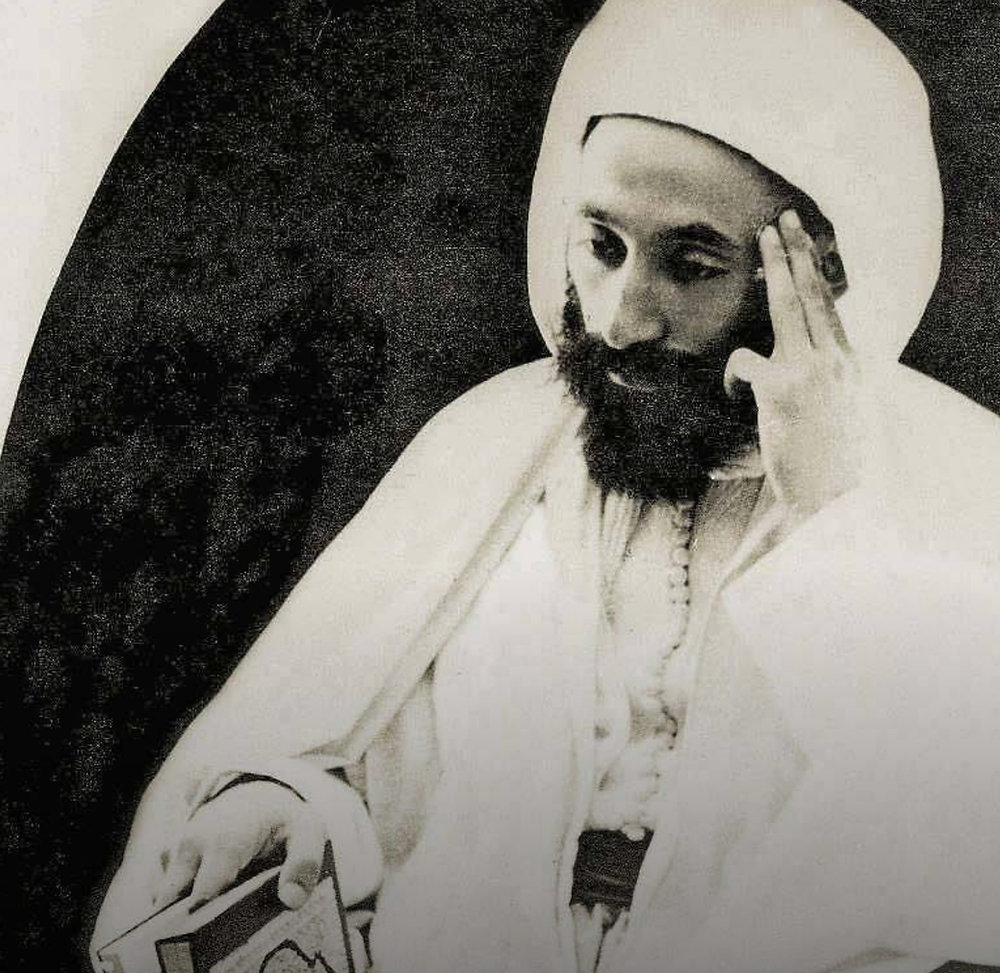
Imam Abdul-Hameed Ibn Badees (1889–1940)
“The people of Algeria are Muslim, and to Europeanness they do not belong,
Whoever said otherwise has strayed from his origins, or spoke and lied, thereby losing all.“
(Imam Abdul-Hameed Ibn Badees)
Some err in calling Algeria “the land of one million martyrs,” and even more err in calling it “the land of one million and a half martyrs.” The historical truth is that Algeria offered one and a half million martyrs in merely seven and a half years — solely during the last Algerian revolution, between 1954 and 1962. As for the total of what the Muslims of Algeria offered throughout three centuries of French colonial occupation, it exceeded six million martyrs — we count them as such, though we do not sanctify any of Allah’s servants before Him. As for the gravest error, it is the French colonial designation of “colonialism” (isti’mār), for the word is derived from the Arabic root ‘a-ma-ra, meaning to build and to populate. France and other states came not to build and populate, but rather to destroy and to kill. How revealing it is that those who claim to be heralds of civilization and progress — the French — burned every book of the “Qustantīna” Library, which contained rare manuscripts from the Islamic Andalusian heritage. The purpose of mentioning these details is not merely historical narration — though that too is important — but rather the true and principal aim is to draw lessons and benefit from them so as to rebuild this nation and bring it out of its state of defeat into a state of victory. For if some today are despairing over the present condition of the Islamic nation, and the current situation in Palestine after sixty years of Zionist colonialism, then the condition in Algeria was a thousand times worse than the situation prevailing in my beloved homeland Palestine. Yet Algeria attained its independence after all this oppression and persecution, and the Palestinians shall attain their independence if they follow the same path that their Algerian brethren followed — for it is the immutable law of Allah in His creation, and you will never find any change in the law of Allah.
Our great hero was not a fighting warrior who bore arms, but he was a mujāhid whom God had endeared to the entire Algerian people. Imam Abdul-Hameed Ibn Badees alone was an entire nation unto himself. And Imam Abdul-Hameed Ibn Badees is the scion of a family of mujāhidīn on the land of Algeria; his greatest ancestor is the great Islamic hero al-Mu’izz Ibn Badees, who purified Algeria from the evil of the Rāfiḍī Shī’a and the Ubaydid Fāṭimids. As for Imam Abdul-Hameed Ibn Badees, he appeared at a time when despair had extinguished hope in the hearts of people, a time when resistance had dimmed and degradation had crept in — yet it was also a time in which genuine men of truth appeared, gleaming like precious metals of authentic origin. The story of wholesome nurturing begins when God blesses a person with righteous parents who teach him the Book of God, the Sunnah of His Prophet, the love of the homeland, and striving in the cause of Allah. Thus Ibn Badees was raised as a guardian of the Qur’ān, who memorized the Sunnah of the Prophet Muḥammad ﷺ. His father then sent him to the University of az-Zaytūna to draw from its scholars’ knowledge. From there he traveled to the Ḥijāz to perform the obligatory pilgrimage, and in the illuminated city of Medina he met an Indian man who came to have merit over every Algerian until the Day of Judgment — the Shaykh al-Hindī (Ḥusayn al-Hindī) — may Allah reward him with all good. The Indian Shaykh advised him to return to Algeria and focus on bringing the people back to the religion of Allah — to place Allah first before thinking of anything else — and both the Indian and Algerian were speaking in service of Islam. Indeed, Imam Ibn Badees took the counsel of Shaykh Ḥusayn al-Hindī to heart, and traveled to Algeria where he taught the people Arabic language and Islam. He established newspapers and schools to nurture the rising generation; for scholars play a pivotal role in the building of nations — construction must be sound from the outset in order to guarantee continuity and survival, rather than emerging suddenly and vanishing, as is the case with many Islamic movements. Imam Abdul-Hameed cultivated the seed, watered it, and exercised patience with it until it bore fruit. In the year 1931, Shaykh Ibn Badees founded the “Association of Algerian Muslim Scholars,” and the scholars of Algeria elected him as its president. It combated innovations (bid’ah) that had spread throughout Algeria under French patronage, fought the deviant Sufi orders that were immersed in dancing and singing, invoking the dead and seeking intercession from them (entities) other than Allah, and propagated authentic Islam as it had been practiced by the Messenger ﷺ and his noble Companions. And when the Shaykh reached the age of fifty-one, he passed away — may Allah have mercy on him — without witnessing independence with his own eyes. Yet the generation that Imam Abdul-Hameed Ibn Badees had nurtured was itself the very generation that ignited the revolution of independence, sending fighters forth after fighters in resistance against the French. In the year 1962, after more than one hundred and thirty-two years of French colonial occupation, Algeria attained its independence, and Allah confounded the scheming of the Crusaders who had plotted throughout that entire period to Christianize the Algerians. Algeria today is a country in which the percentage of Muslims exceeds 99% — Alahmdulillah, to Whom belongs all grace and gratitude.
May Allah have mercy on the heroic mujāhidīn of Algeria, and the righteous martyrs of Algeria, and may Allah have mercy on Imam Ibn Badees, who recited before surrendering his soul to Allah:
“When I perish, let my morning cry be: long live Algeria and the Arabs!”
[Taken from the book ‘Mi’atu min ‘uzamā’i ummati al-Islām ghayyarū majra at-tārīkh’ by At-Turbani. Pages 72-74]
 Saheehus-Seerah