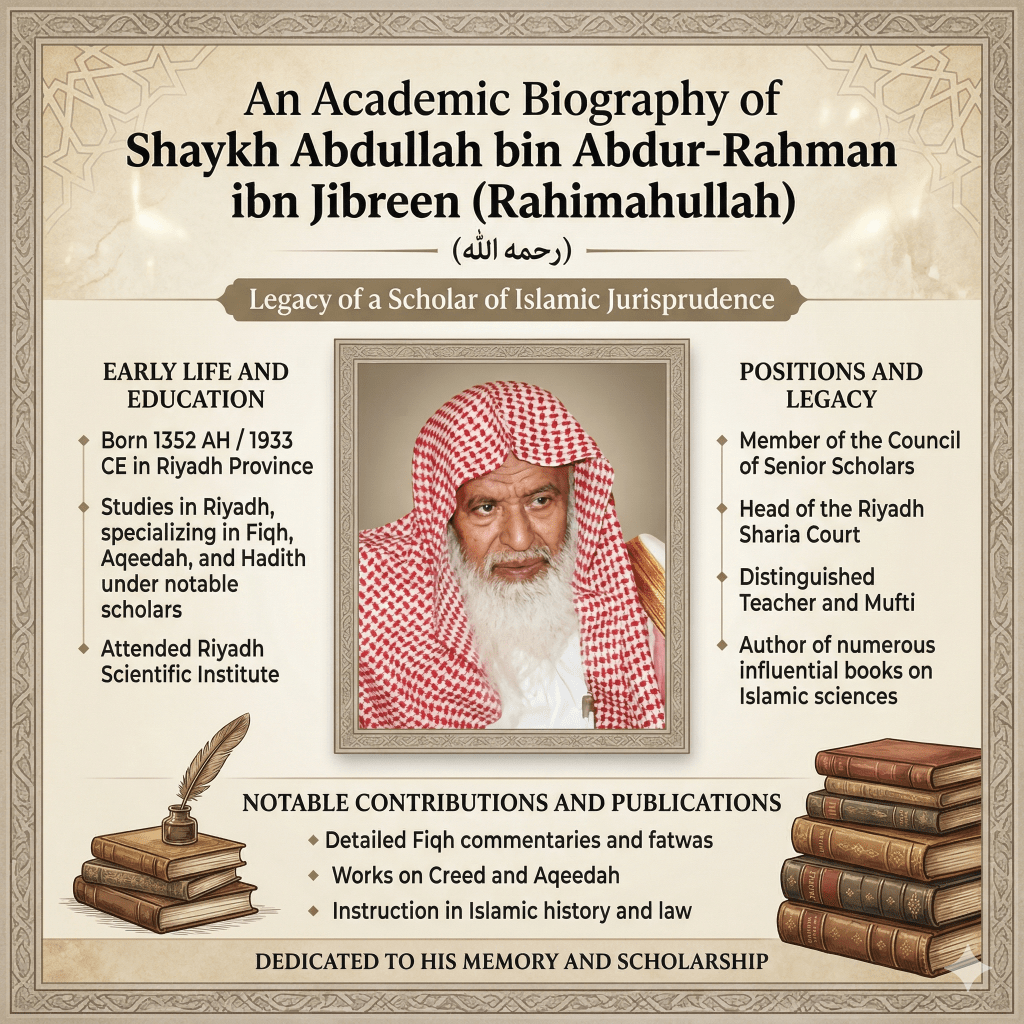
Name and Lineage
He is ‘Abdullah ibn ‘Abdur-Rahman ibn ‘Abdullah ibn Ibrahim ibn Fahd ibn Hamd ibn Jibreen, of Aal-Rasheed, who are a branch of ‘Atiyyah ibn Zayd. Banu Zayd is a well-known tribe in Najd. Their original homeland was the city of Shaqra’; then some of them migrated to the town of Al-Quway’iyyah in the heart of Najd, where they acquired property.
His Family
This family included men of mention and widely circulated reports, though these were not recorded in the books of history because of the scant attention paid to such reports in their own time. His fourth grandfather, Hamd ibn Jibreen, became especially well known. This was in the middle of the thirteenth century AH, when judicial authority, governorship, and leadership in the city of Al-Quway’iyyah came under his charge. He enjoyed rank and standing among his people: he was their preacher, their leader, and their judge, in addition to the abundance with which Allah had endowed him in knowledge and wealth. He owned wells and revived uncultivated lands, as is indicated by title deeds bearing his name and the names of his sons after him. He also transmitted abundant knowledge, for he had scribes and workers who copied newly produced books for payment, and many of these are still extant as endowments in the possession of some of his descendants.
After him, his grandson Ibrahim ibn Fahd became well known. He acquired knowledge and met Shaykh ‘Abdur-Rahman ibn Hasan Aal ash-Shaykh, Shaykh ‘Abdullah Abu Butayn, and Shaykh Hamd ibn Mu’ammar. He read, copied, and memorized abundant knowledge, and left behind manuscripts bearing his name, some copied in his own hand and others which he had acquired. He assumed the duties of leading prayer, delivering sermons, issuing legal verdicts, teaching, and instructing people in the Qur’an and Hadith. He died at the end of the thirteenth century AH.
After him came his son ‘Abdullah, who memorized the Qur’an and studied with his father and with some of the scholars of his town and others besides them. He served as imam, preacher, and teacher in the village of Miz’al At-Tabi’ah to Al-Quway’iyyah. He copied books in his own hand and endowed them after him. He died in 1344 AH.
After him, his son Muhammad ibn ‘Abdullah assumed the imamate and preaching. He had studied under his father, traveled in search of knowledge, memorized many didactic texts, and copied books in his own hand. He died in 1355 AH.
As for the father of the subject of this biography, he was one of the seekers of knowledge and memorizers of the Qur’an. He was born in 1321 AH and assumed the imamate after his brother. He then moved to the town of Ar-Rayn in order to seek knowledge from its judge, ‘Abdul-‘Azeez ash-Shithri, known by the kunyah Abu Habib. He remained there until, after the death of Shaykh Abu Habib, he traveled to Riyadh. He died in 1397 AH.
His Upbringing
Shaykh ‘Abdullah ibn Jibreen was born in 1352 AH in one of the villages of Al-Quway’iyyah and was raised in the town of Ar-Rayn. He began his education in 1359 AH. Since there were no regular schools there, he was delayed in completing his studies, but he mastered the Qur’an by the age of twelve. He learned writing and the rudimentary rules of orthography, then began memorization and completed it in 1367 AH.
Before that, he had already studied the rudiments of the sciences. In grammar, he read the beginning of Al-Ajurrumiyyah with his father, as well as Matn ar-Rahabiyyah in inheritance law. In Hadith, he memorized An-Nawawi’s Forty Hadith and part of ‘Umdat al-Ahkam.
After completing his memorization of the Qur’an, he began reading with his second Shaykh after his father, namely Shaykh ‘Abdul-‘Azeez ibn Muhammad ash-Shithri, known as Abu Habib. Most of his reading with him was in the books of Hadith, beginning with Sahih Muslim, then Sahih al-Bukhari, then the abridgment of Sunan Abi Dawud, and parts of Sunan at-Tirmidhi together with its commentary Tuhfat al-Ahwadhi. He read all of Subul as-Salam, the commentary on Bulugh al-Maram. He also read Ibn Rajab’s commentary on the Forty Hadith, entitled Jami’ al-‘Ulum wa al-Hikam fi Sharh Khamsin Hadithan min Jawami’ al-Kalim. He read part of Nayl al-Awtar on Muntaqa al-Akhbar, and he read Tafsir Ibn Jarir, which is full of transmitted Hadiths and connected reports, as well as Tafsir Ibn Kathir. He read ‘Kitab at-Tawhid Alladhi Huwa Haqqullahi Ta’ala ‘Alal ‘Abeed’, and mastered the memorization of its Hadiths, reports, and proofs, and read some of its commentaries. In Hanbali jurisprudence, he memorized Matn az-Zad and read most of its commentary. He also read other works in literature, history, and biography.
This continued until the beginning of the year 1374 AH, when he moved with his Shaykh Abu Habib to Riyadh and enrolled as a student in Ma’had Imam Ad-Da’wah al-‘Ilmi. There he studied at the secondary level for four years and received his secondary certificate in 1377 AH, ranking second among the fourteen students who passed. He then enrolled in the higher division of the same institute, also four years in duration, and was awarded his university certificate in 1381 AH, ranking first among the eleven successful students. This certificate was considered equivalent to a degree from the College of Shari’ah.
In 1388 AH he enrolled in the Higher Institute of Judiciary, where he studied for three years and obtained a master’s degree in 1390 AH with the grade of Mumtaz (Very Good). Ten years later, he registered at the College of Shari’ah in Riyadh for the doctorate and obtained the degree in 1407 AH with an Excellent grade and honors.
During this period, and even before it, he studied under senior scholars, attended their circles, discussed matters with them, questioned them, and benefited from his colleagues and their Shaykhs through study sessions, ordinary gatherings, scholarly discussions, journeys, and customary meetings that were never devoid of benefit, investigation of evidence, correction of opinions, and the like.
Social Status
He married the daughter of his full paternal uncle—may Allah have mercy on her—at the end of 1370 AH. In addition to being his relative, she was a woman of religion, righteousness, sincere counsel, and devotion. She exerted herself in service and in fulfilling the rights of her Lord and her husband. She died in 1414 AH.
He was blessed through her with twelve children, male and female. Some died in childhood. Those surviving are three sons and six daughters. All of them married, and most of them have children of their own, both sons and daughters. They continue to visit their father, serve him, and observe the legal rights and religious etiquettes.
As for his domestic circumstances, at first he was under his father’s guardianship, so he served him and did whatever he could in dutifulness and in fulfilling his right over him in person and property. He did not keep his earnings independently, nor did he reserve wealth for himself. When he moved to Riyadh and enrolled in Ma’had Imam Ad-Da’wah al-‘Ilmi, he was given a monthly stipend, and whatever exceeded his own need he would give to his father, who spent on his children and grandchildren.
After three years, he was compelled to bring his wife and children, rent a small house, furnish it, and support them. The stipend sufficed for this despite its smallness, though only with restriction to essential needs. He continued renting one house after another for eight years. Thereafter Allah enabled him to purchase a house made of clay and sturdy timber, and there he settled, living in it for seventeen years in moderate circumstances, neither extravagant nor miserly. He did not expand into luxuries and comforts because of limited means. Then in 1402 AH he moved to his present home, which he built with assistance from the Real Estate Development Bank, and he lived in it as his peers lived in those times.
His Creed
As for creed and legal school, he was raised upon sound belief, received from fathers, grandfathers, and sincere scholarly Shaykhs. Thus he learned the creed of Ahlus-Sunnah wal-Jama’ah and the Salaf As-Saleh (Pious Predecessors). He read and memorized what he was able from works of creed, such as Al-Wasitiyyah by Shaykh al-Islam Ibn Taymiyyah—may Allah have mercy on him—and received its explanation from his Shaykhs from whom he studied the Islamic sciences, for they would explain its unfamiliar expressions, clarify its meanings, and show the indications of the revealed texts.
He followed—praise be to Allah—the method of our Shaykhs in teaching the books of Salafi creed. Students read with him many concise and extended works on creed, such as the commentaries on Al-Wasitiyyah by Al-Harras, Ibn Salman, and Ibn Rashid; Sharh at-Tahawiyyah; Lum’at al-I’tiqad; the commentaries on Kitab at-Tawhid; as well as the more extensive books of Shaykh al-Islam Ibn Taymiyyah, Ibn al-Qayyim, Hafiz al-Hakami, and others who wrote on creed. He discussed the evidences and elaborated upon them.
At Imam Muhammad ibn Saud Islamic University, in the Department of Creed and Contemporary Schools (Al-Aqeedah wal-Madhahib Al-Muasirah), he taught the books of creed and supervised research papers and dissertations submitted to the university in this field. He also participated in the defense of master’s theses and doctoral dissertations and directed students to useful references on the subject. He continued up to the present supervising many dissertations and maintaining ties with the university, in addition to the students desirous of this field of study.
As for legal affiliation in subsidiary rulings, the Shaykhs from whom he studied jurisprudence were specialists in the school of Ahmad ibn Hanbal and generally did not depart from it. He restricted himself to it and read extensively in Hanbali books, annotating them. It is well known that the school of Ahmad is the broadest of the schools because of the abundance of narrations within it, many of which agree with the other schools. Thus whoever studies this school deeply gains knowledge of most of the schools, except for hypothetical matters and rare questions that jurists merely assume. Such matters are of no great importance to study, for if they do occur, their ruling may be known by analogy with the closest similar case.
His Shaykhs
As for the Shaykhs and scholars under whom he studied, the first of them was his father—may Allah Most High have mercy on him—who began teaching him reading and writing in 1359 AH. His father was among the seekers of knowledge and people of sincere counsel, devotion, and affection. He benefited greatly from his sound upbringing, instruction, and concern that students combine knowledge with action. He died in 1397 AH.
Among the greatest Shaykhs who influenced him was his eminent teacher ‘Abdul-‘Azeez ibn Muhammad Abu Habib ash-Shithri, with whom he read most of the principal works in Hadith, Tafsir, Tawhid, creed, jurisprudence, literature, grammar, and inheritance law. He memorized many didactic texts under him and received from him their explanations and notes on the commentaries. His study with him began in 1367 AH and continued until the Shaykh died in Riyadh in 1397 AH—may Allah Most High have mercy on him—though his reading with him decreased after graduation because of preoccupation with teaching and similar duties.
Among the scholars from whom he read and from whose company he benefited was the eminent Shaykh Salih ibn Mutlaq, who had been imam and preacher in one of the villages of Ar-Rayn, then judge in Hafr al-Batin, after which he retired, settled in Riyadh, and died in 1381 AH. He was blind, but Allah granted him strong memory and understanding. Rarely would anyone, old or young, sit with him except that he benefited from him. He read with him some books in creed and Hadith and attended his gatherings, in which senior scholars and others would participate, and in which he would produce remarkable and unusual insights. In short, he was a wonder of his time—may Allah have mercy on him and ennoble his resting place.
Among the most famous Shaykhs whose lessons he followed and under whom he studied was His Eminence Shaykh Muhammad ibn Ibrahim Aal ash-Shaykh, whose renown renders introduction unnecessary. He received from him, together with the students, formal lessons when Ma’had Imam Ad-Da’wah was opened in Safar 1374 AH. He undertook teaching the division in which the subject of this biography was enrolled in most of the Islamic sciences, such as Tawhid, jurisprudence, Hadith, and creed. In Hadith he taught Bulugh al-Maram twice, in both the secondary and higher divisions. In jurisprudence he taught Matn Zad al-Mustaqni’ and its commentary Ar-Rawd al-Murbi’ twice as well, usually with substantial elaboration upon each phrase while the students followed and wrote down important benefits.
In Tawhid and creed he taught Kitab at-Tawhid and its commentary Fath al-Majid, Kitab al-Iman by Shaykh al-Islam Ibn Taymiyyah, Matn al-‘Aqidah al-Hamawiyyah, Al-‘Aqidah al-Wasitiyyah, also by him, Sharh at-Tahawiyyah by Ibn Abi al-‘Izz, and other works besides. His Eminence continued teaching them until they completed the higher division at the end of 1381 AH, after which he stopped formal teaching and devoted himself to issuing legal opinions and presiding over the judiciary, until he died in Ramadan of 1389 AH—may Allah Most High have mercy upon him.
In formal study he also read with a number of scholars, such as Shaykh Isma’il al-Ansari in Tafsir, Hadith, grammar, morphology, and legal theory from 1375 AH until graduation; and Shaykh ‘Abd al-‘Aziz ibn Nasir ibn Rashid in inheritance law for three years. He also studied jurisprudence with him during the master’s stage in 1388 AH. He was—may Allah have mercy on him—among the jurists of the land and had well-known works, among them ‘Uddat al-Bahith bi-Ahkam at-Tawaruth and At-Tanbihat as-Sunniyyah, a commentary on Al-‘Aqidah al-Wasitiyyah, which was the first comprehensive commentary on that creed.
He also read with Shaykh Hammad ibn Muhammad al-Ansari, Shaykh Muhammad al-Bayhani, and Shaykh ‘Abdul-Hameed ‘Ammar al-Jaza’iri in various disciplines and arts. During the master’s stage, he studied with many senior scholars, such as His Eminence Shaykh ‘Abdullah ibn Muhammad ibn Humayd, who died in 1402 AH, from whom he studied methods of adjudication in jurisprudence. He attended his gatherings from the time he came to Riyadh and benefited greatly from him in legal rulings, narratives, lessons, history, and counsel, as is well known of him.
He studied with Shaykh ‘Abdur-Razzaq ‘Afifi—may Allah have mercy on him—who was famous and one of the major scholars. A great multitude in this land—judges, teachers, callers to Allah, and others—studied under him and benefited from him. He was among those upon whom Allah opened the doors of knowledge and inspired with sciences by which he surpassed many scholars of this age. He had deep mastery in Tafsir and deriving rulings from verses, likewise in Hadith and knowledge of its rare vocabulary, and likewise in the newer sciences and their people.
Likewise Shaykh Manna’ Khalil al-Qattan—may Allah have mercy on him—who taught them Tafsir in that stage with breadth and clarity. They benefited greatly from his company and lectures, as he would present many benefits derived from the verses or evidences. He had numerous works in diverse fields.
Likewise Shaykh ‘Umar ibn Matrakh—may Allah Most High have mercy on him—who was among the earliest Saudi holders of the doctorate. He studied with him in jurisprudence, Hadith, and Tafsir. He paid close attention to evidences and legal reasoning, had complete knowledge of newly emerging transactions, and spoke about them at length. He benefited greatly from him.
Among them also was Shaykh Muhammad ‘Abdul-Wahhab al-Buhayri—may Allah have mercy on him—an Egyptian by nationality, who taught Hadith. He would elaborate in explanation, mention disputed questions, and strive to reconcile and prefer among opinions, thereby benefiting him in many important places. Among them too was Muhammad al-Jundi—may Allah have mercy on him—also an Egyptian, who remained only part of a year before falling ill, returning to Egypt, and dying there. Among them also were Muhammad Hijazi—may Allah have mercy on him—the author of At-Tafsir al-Wadih, and Taha ad-Dasuqi al-‘Arabi—may Allah have mercy on him—also an Egyptian, who possessed broad knowledge, wide acquaintance, strong memory, eloquence, and clarity, and others besides them.
He also benefited from other Shaykhs through non-formal study, the most famous of them being His Eminence Shaykh ‘Abdul-‘Azeez ibn ‘Abdullah ibn Baz—may Allah have mercy on him—whose lessons he attended in most of the study circles he held in the Great Masjid of Riyadh after ‘Asr and after Fajr and Maghrib, attended by great numbers. There he taught diverse disciplines from texts, commentaries, and authored works, annotating phrases, clarifying issues, and drawing attention to errors.
Among them also was Shaykh Muhammad ibn Ibrahim al-Muhayza’—may Allah have mercy on him—who was among the teachers and judges and who held lessons in his mosque and in his home, from whom many benefited. Among them too was Shaykh ‘Abdur-Rahman ibn Muhammad ibn Huwaymil, one of the judges of Riyadh. He studied with him in the mosque and elsewhere, and although his annotations were few, he would point out errors and clarify some subtle issues. In the latter part of his life his hearing became heavy and his illness severe, then he died—may Allah Most High have mercy on him—in 1415 AH.
He also benefited from colleagues and close companions with whom he was fortunate to be associated during his studies and with whom he was enabled to read and review on most nights and during examination periods. Among them were Shaykh Fahd ibn Humayn al-Fahd, Shaykh ‘Abdur-Rahman Muhammad al-Muqrin—may Allah have mercy on him—Shaykh ‘Abdur-Rahman ibn ‘Abdullah ibn Furayyan, Shaykh Muhammad ibn Jabir—may Allah have mercy on him—and others besides them who had preceded him in reading with the Shaykhs and had learned much of what he had missed, which he then acquired through them. He would read commentaries to them, receive correction of some linguistic errors, investigate disputed questions, learn useful books on various subjects, and learn how to locate Masail (issues) in related Hanbali books, as well as how to benefit from the books of language and the specialization of each work by subject matter, and similar matters that escape one who studies alone. For this reason he advised the beginner to accompany in review and study those more advanced than himself, so that he might add what they possess to what he himself possesses.
We have already mentioned that the earliest of these Shaykhs was Shaykh ‘Abdul-‘Azeez ash-Shithri—may Allah have mercy on him—and he praised him highly. When he moved to Riyadh in 1374 AH, he took him with him and informed His Eminence Shaykh Muhammad ibn Ibrahim—may Allah Most High have mercy on him—of some of what he had studied with him and the level he had reached. This led the Shaykh to place him among the most advanced students when they were divided into years at Ma’had Imam Ad-Da’wah al-‘Ilmi. One consequence of his admiration was that he asked him that same year to assume a judicial post, but he excused himself on account of his studies and his longing for them, and so he excused him.
Positions He Held
The first of these was that he was sent with the body of preachers to the northern borders at the beginning of 1380 AH by the order of King Saud, on the suggestion of His Eminence Shaykh Muhammad ibn Ibrahim and under the leadership of Shaykh ‘Abdul-‘Azeez ash-Shithri—may Allah Most High have mercy on them—together with some Shaykhs, for a period of four months. This began from the Kuwaiti border and extended along the borders of Iraq and Jordan and the northern and western frontiers of the Kingdom, as well as many regions within the Kingdom. They engaged in calling to Allah, teaching, and distributing useful copies on creed and the pillars of Islam, for most of the inhabitants were Bedouins living in deep ignorance. They knew little beyond the name of Islam, prayer, fasting, and the like; they were ignorant of the obligations and the conditions of valid prayer, and they fell into many means and forms of shirk. The body exerted great effort in teaching them, and Allah benefited many of those for whom He willed good.
He was then appointed a teacher in Ma’had Imam Ad-Da’wah in Sha’ban 1381 AH and remained there until 1395 AH. During this period he taught many subjects such as Hadith, jurisprudence, Tawhid, Tafsir, Hadith terminology, grammar, and history. He wrote notes on the Hadiths of ‘Umdat al-Ahkam, mentioning the topic, the general meaning, explanation of difficult words, and legal benefits. He also wrote notes on jurisprudence, Tawhid, and Hadith terminology, many of which remain preserved among students or in the scientific institutes.
Then in 1395 AH he moved to the College of Shari’ah in Riyadh and undertook teaching Tawhid to the first-year students, namely Matn at-Tadmuriyyah, for which he wrote annotations as an index of topics and headings for research, and he also taught the beginning of Sharh at-Tahawiyyah.
Then in 1402 AH he moved to the Presidency of Scholarly Research, Ifta’, Da’wah, and Guidance as a member of the fatwa body. There he handled oral and telephone legal verdicts, wrote some brief fatwas, divided inheritance cases, examined the fatwas of the Permanent Committee suitable for publication, and read the research submitted to the journal to determine what was suitable for publication and what was not. He continued in this capacity until his death. His period of service in Dar al-Ifta’ ended on the first of Rajab 1418 AH.
As for other duties, he was appointed imam in Masjid Al-Hamad in Riyadh in Shawwal 1389 AH and remained so until the mosque and the entire quarter were demolished in 1397 AH. Two years later he was appointed a reserve khatib to deliver the sermon when needed, and he remained so until the present, delivering the Friday sermon and prayer in many congregational mosques when the regular khatib was absent or before one had been appointed. At times he would continue in one mosque for months or years and would also lead the ‘Id prayer on some occasions.
He also volunteered to teach in mosques, beginning with a lesson in inheritance law in 1387 AH for a small number, then teaching Tawhid, Al-Usul ath-Thalathah, Kashf ash-Shubuhat, Al-‘Aqidah al-Wasitiyyah, and similar texts to a large number in Masjid Aal-Hammad at the end of 1389 AH. There was great public response to these circles, and most of the students were from the Qur’an memorization school, having come from the south of the Kingdom and from Yemeni expatriates who had come seeking knowledge. He held these lessons after Fajr for more than an hour or two, likewise after Zuhr, often after ‘Asr, and from Maghrib until ‘Isha’. This continued until the aforementioned mosque was demolished, after which the lessons were moved to Masjid Aal-Hammadi, where students flocked in large numbers at most times to study the Islamic sciences such as Hadith, Tawhid, jurisprudence, legal theory, Hadith terminology, and others.
Then in 1398 AH, His Eminence Shaykh ‘Abdul-‘Azeez ibn ‘Abdullah ibn Baz requested him to lead the prayers in his absence in Al-Jami’ Al-Kabeer Mosque as an imam for the five daily prayers. He did so, leading them in every prayer except the Friday sermon and prayer. Thereafter the lessons were transferred to the mosque later known as Jami’ al-Imam Turki ibn ‘Abdullah—may Allah have mercy on him. Whenever His Eminence the Shaykh was present, he would lead the two evening prayers (Maghrib and Isha) there and deliver lessons between them and at other times. He also frequently delivered lessons at the Aal-Hammadi Mosque after the Asr, Maghrib, and usually after the Fajr prayers.
Also in 1398 AH, some young men requested that he hold an evening lesson in the home after ‘Isha’ concerning Aqeedah. He responded to their request and began with the creed text written by Shaykh Ibn Sa’di and printed in the introduction to his book Al-Qawl as-Sadeed. The number of students increased and they came from distant places, and they have continued until now. In 1402 AH, when he moved to his present home in As-Suwaydi, he transferred the lesson there on two nights each week. During that period they read Nazm Sullam al-Wusul and its commentary Ma’arij al-Qabul in two volumes, Risalat ash-Shafa’ah by Al-Wadi’i, Kitab at-Tawhid by Shaykh Muhammad ibn ‘Abd al-Wahhab, and its commentary on Al-Usul ath-Thalathah. In jurisprudence they also read Nazm ar-Rahabiyyah in inheritance law and Manar as-Sabil Sharh ad-Dalil by Ibn Duwayyan until it was completed, praise be to Allah.
When the house became too small, the lesson was moved to the neighboring mosque known as Masjid Al-Barghash, to which the weekly lessons after Fajr and after Maghrib were also transferred after the demolition of the Great Mosque in 1408 AH. At those times they read many major works, such as the two Sahihs, Sharh at-Tahawiyyah, the commentaries on Al-Wasitiyyah by Ibn Salman and Ibn Rashid, part of Zad al-Ma’ad, all of Bulugh al-Maram, Zad al-Mustaqni’, parts of Sunan Abi Dawud and at-Tirmidhi, Muwatta’ Malik, Riyad as-Salihin, part of Nayl al-Awtar Sharh Muntaqa al-Akhbar, part of Sunan ad-Darimi, Tarteeb Musnad at-Tayalisi, the complete commentary on Muntaqa al-Akhbar by Abul-Barakat, and Kitab ad-Din al-Khalis by Siddiq Hasan Khan. In Hadith terminology they read Matn Nukhbat al-Fikar and Matn al-Bayquniyyah; in grammar, Matn Al-Ajurrumiyyah and part of Alfiyyat Ibn Malik; in legal theory, Matn al-Waraqat by Imam al-Haramayn; and many other texts and commentaries.
In 1382 AH, some benefactors established a charitable school called Dar al-‘Ilm, to which large numbers of students, young and old, came. The Shaykh undertook teaching there in religious subjects such as Hadith, Tawhid, and jurisprudence according to the students’ capacities. The young men also held a weekly club there after ‘Isha’ every Friday night for two hours, which he usually attended, giving some remarks and answering religious and social questions.
In 1398 AH he established there a weekly lesson attended by large numbers, and it continued until this year, when it was moved to the nearest mosque around it, where it still continues. They completed the reading of the two Sahihs there and began Sunan at-Tirmidhi. The reading to him was undertaken by the eminent Shaykh Ibrahim ibn ‘Abdullah ibn Ghayth, joined at first by Shaykh Dr. Muhammad ibn Nasir as-Suhaybani until the latter moved to the Islamic University in Madinah. He was then succeeded by Shaykh Dr. Fahd as-Salamah until he became occupied with teaching at King Fahd Security College. The method was that the chapter would be read, then he would explain it by clarifying the author’s intent and the indications of the Hadiths.
Around 1403 AH, some young men from the residents of the Al-‘Ulayya district requested that he give them a weekly lesson in creed and another in Hadith. He began the lesson in a medium-sized mosque in the district for some months, then they moved to Masjid Al-Muluwi for a long period, then to Masjid As-Salim where the lesson continued for years, then he moved with them to Masjid Malik ‘Abdul-‘Azeez, and then to Jami’ Malik Khalid. During this period they completed Matn Lum’at al-I’tiqad, Al-‘Aqidah al-Wasitiyyah, Kitab at-Tawhid, Matn at-Tadmuriyyah, parts of Bulugh al-Maram, Sharh ‘Umdat al-Fiqh in the section of acts of worship, and part of Ar-Rawd al-Murbi’, reading and commentary.
In 1409 AH, some brothers requested that he establish a weekly lesson, reading and commentary, in Sulayman ar-Rajhi Mosque in the Ar-Rabwah district, since the mosque was well known and surrounded by densely populated neighborhoods full of people who loved knowledge. He responded to their request and began with Sharh at-Tahawiyyah, which he completed; then ‘Umdat al-Ahkam in Hadith, which he also completed; then Kitab as-Sunnah by Al-Khallal; then Kitab as-Sunnah by ‘Abdullah ibn Ahmad, which he continued reading. The reading was usually undertaken by the mosque’s imam, Salih ibn Sulayman al-Habdan, or by the muezzin. He would conclude the lesson shortly before the iqamah by answering questions submitted by those present. The attendance at this lesson grew until it sometimes exceeded five hundred, and it only paused during examination periods, after which it resumed.
Also in 1409 AH, His Eminence Shaykh Ibn Baz—may Allah have mercy on him—requested that he deliver a lesson in the Masjid Souq Al-Khidar in ‘Utayqah because of the large number of people who prayed there. He responded to his wish and established there a weekly lesson, though only a few students attended because the market people were occupied with their trade. This lesson continued in jurisprudence and Tawhid.
Likewise in these years he spent most weeks delivering lectures in the outlying mosques of Riyadh where worshippers were numerous but no lessons were given. Large numbers usually attended these lectures, which dealt with acts of worship, transactions, and matters needed by the people. He also participated in the weekly seminars held in the Great Congregational Mosque known as Jami’ al-Imam Turki, which had begun more than twenty years earlier and upon which His Eminence Shaykh ‘Abdul-‘Azeez ibn Baz—may Allah have mercy on him—would usually comment, and now His Eminence Shaykh ‘Abdul-‘Azeez Al ash-Shaykh—may Allah preserve him—comments upon them.
When the ‘Abdullah ar-Rajhi Mosque was established in Shubra, in As-Suwaydi, it became suitable to gather there the lessons that had been dispersed among different mosques—after Fajr, after Maghrib, and after ‘Isha’ on most days. Housing was also established around it for students from outside the area.
Among the other works he undertook was teaching at the Higher Institute of Judiciary affiliated with Imam Muhammad ibn Saud Islamic University in 1408 AH, when he was assigned the jurisprudence course for the first year, called As-Siyasah ash-Shar’iyyah, dealing with transactions and rulings of exchange, at the rate of two lessons per week. At the end of the year he prepared examination questions and corrected the answers as usual. In the following year he taught this course along with another for the second year known as personal status law, which had three periods per week. His method of instruction was to select passages from the prescribed text, mention the disagreements found in them, list the proofs of the various opinions along with reconciliation, preference, and the basis for choosing one over another. In the following year he restricted himself to the first course only, namely As-Siyasah ash-Shar’iyyah, and then stopped this teaching afterward.
Also among his works was supervising master’s and doctoral dissertations affiliated with the aforementioned university throughout those years. That is, after moving from the university to the Presidency of Scholarly Research, as mentioned earlier, he did not abandon his university duties. Every year he would commit himself to supervising three or four dissertations, directing the student and guiding him to the major research references according to his knowledge, reading what the student submitted each month from his research, indicating the errors and deficiencies in it, and usually meeting with him every week or so. He would submit a report to the university on the student’s progress and what hindered him. At the end he would write about the dissertation and the extent of its suitability for submission, and he would attend the defense and evaluation of the dissertation.
He also participated in the discussion of some dissertations submitted to the university as a member of the examining committee, presenting his observations and attending the evaluation of the dissertation as usual.
Also among these works was carrying out Da’wah within the Kingdom by delivering lectures, sermons, or answering questions every month or two. He would visit regions near Riyadh, delivering a lecture in an institute or summer center and in a congregational mosque, meeting with the local people and discussing with them the problems of their region and their remedies. Sometimes the journey would continue for a week or more, touring remote regions and visiting some governmental offices for sincere advice and guidance. He would meet with acceptance, encouragement, and requests to continue. Sometimes the visit would be official, with its duration determined by the Da’wah Center or the Department of Internal Da’wah.
Also among them was participation in Hajj awareness programs during the period when he was affiliated with the university until 1403 AH, explaining the benefits of Hajj and ‘Umrah, clarifying the aims of these acts, examining their effects after their completion, and answering questions related to the situation there, for a full month. He was unable to continue this after joining the Presidency because of the pressing need for his presence in the office. In later years he performed Hajj with some local groups carrying pilgrims from Riyadh and would answer questions for them and deliver guiding remarks once or twice each day. He would also visit some of the other groups during the season, and they would rejoice at that.
His Writings
The first of them was the dissertation submitted for the master’s degree in 1390 AH, Akhbar al-Ahad fi al-Hadith an-Nabawi. It earned a distinction grade, despite having been written in a short period and despite the required references not being available to him. It was printed in 1408 AH at Dar Taybah Press, then reprinted again, and it is well known and available. He was unable to expand it before printing because it needed review and supplementation. What moved him to write it was his love of Hadith and its excellence, and what he had seen in the books of the theologians and legal theorists of distrust toward solitary (Ahaad) reports, especially when related to matters of creed. He preferred their acceptance in fundamentals just as in subsidiary matters.
In 1398 AH he was commissioned to write on intoxicants and narcotics for a conference held by the Islamic University that year. He wrote a study entitled Smoking: Its Substance and Its Ruling in Islam. It is a medium-length study containing benefits and rulings beyond what others had written. The participating Shaykhs in the topic of tobacco admired it. Dar Taybah Press printed it several times, and it became famous and widely circulated. Though concise, it proved beneficial for those for whom Allah willed good.
In 1402 AH, statements by one of the scholars of Egypt were brought to him in which he denied the affirmation of the divine attributes, rejected the evidences, imagined that they led to anthropomorphism, inclined toward grave-related shirk, and praised the Sufis. Some brothers summarized his statements in four pages and sent them for discussion. He wrote a clear response, following his Shubuhaat (doubts) one by one and showing the errors into which he had fallen, in clear language and calm discussion. This study was printed in Majallat al-Buhuth al-Islamiyyah, issue nine. Some young men later published it separately as an independent epistle entitled Al-Jawab al-Fa’iq fi ar-Radd ‘ala Mubaddil al-Haqa’iq. It is available and circulated, printed by Mu’assasat Asam Lin-Nashr.
He also wrote an article concerning the meaning of the two testimonies of faith and what each of them entails. It was printed in Majallat al-Buhuth, issue seventeen. Some students later published it independently under the title Ash-Shahadatan: Ma’nahuma wa ma Tastalzimuhu Kullu Wahidah Minhuma, printed in 1410 AH by Dar Taybah Press in ninety small-format pages. In this work, as in others, he adhered to care for the Hadiths used as proof, documenting them and briefly mentioning their grading.
In 1391 AH he taught Matn Lum’at al-I’tiqad by Ibn Qudamah to the students of Ma’had Imam Ad-Da’wah al-‘Ilmi and wrote for it brief questions and answers suited to the ability of those students at the intermediate stage. Even so, it was beneficial, and therefore some young men wished to print it. It was printed under the title At-Ta’liqat ‘ala Matn al-Lum’ah in 1412 AH by Safir Press, published by Dar as-Sumay’i for Publishing and Distribution. Errors did occur in it where he had followed the apparent wording of the text and the evidences, but it was reprinted after some of those errors were corrected. In it he documented the Hadiths cited by Ibn Qudamah with a medium level of detail appropriate to the students’ abilities.
In 1399 AH he enrolled in the College of Shari’ah for the doctorate and chose Tahqiq Sharh az-Zarkashi ‘ala Mukhtasar al-Khiraqi, which is the most famous of its commentaries and, after Al-Mughni of Ibn Qudamah, reaches some three hundred pages. In the dissertation he restricted himself to the beginning of the commentary up to the chapter of marriage, in both study and critical edition. The dissertation was defended as previously mentioned. He then completed the critical edition of the book, and it was printed by Al-Obeikan Publishing and Distribution in seven large volumes and distributed and sold in most local bookstores. It is available and circulated, praise be to Allah.
In this commentary he paid great attention to documenting the many Hadiths and reports cited by the commentator and numbered them. As stated at the end of the seventh volume, their number reached 3,936, though with some slight repetition. He exerted great effort in this documentation by reviewing the major sources and the books of chains of transmission available to him. Most of these were printed works. He mentioned the Hadith number when the book was numbered, otherwise the volume and page. He also noted differences in wording when the wording differed from what the commentator had cited, and he mentioned those among the early authorities who authenticated or weakened a Hadith, such as at-Tirmidhi, al-Hakim, adh-Dhahabi, Ibn Hajar, and al-Haythami. If the Hadith was found in one of the two Sahihs, he did not mention what had been said about it because of confidence in them.
Since he began his studies in childhood with the books of Hadith, as already mentioned, this left him with a longing to write in Hadith. Thus he was eager to acquire old books whose authors paid attention to Prophetic Hadiths and cited them with their connected chains. He also loved everything related to Hadith, such as the books of terminology, the defects of Hadith, the books of al-jarh wa at-ta’dil, and the like. This is because this field constitutes the second proof-source of the Shari’ah after the Book of Allah Most High, and because the scholars of the Ummah gave it complete care, to the point that some of them said that the science of Hadith is among the sciences that have been so thoroughly cultivated as to reach full maturity. Also, some people introduced into it what did not belong to it by narrating Hadiths with no basis in soundness, so Allah raised for it critical scholars whom He endowed with knowledge of the authentic and the weak by which they were distinguished from others. Through this we have come to know their effort, endurance, patience in hardship, long travel, fatigue, and great expenses, all of which they undertook out of concern to preserve the Sunnah of the Prophet—Allah bless him and grant him peace—and to purify it from what did not belong to it.
Allah has made easy in our age the printing, indexing, and arrangement of these books, such that the burden has become lighter and access to the book and the places of research easier without great cost, praise be to Allah.
He had also delivered a number of lectures on various subjects, which were recorded on tapes. Some students took interest in transcribing and preparing them for print. Two epistles were printed: the first, entitled Islam between Excess and Negligence, in fifty-nine pages; and the second, Seeking Knowledge and the Merit of the Scholars, in fifty-one pages. Both were printed in 1313 AH by Safir Press and published by Dar as-Sumay’i for Publishing and Distribution.
As for audio recording, the students paid it great attention by following the lessons and lectures, recording them on tapes, preserving them, and then transcribing what they could for circulation and printing. There were recordings of the commentary on Zad al-Mustaqni’, the commentary on Bulugh al-Maram, the commentary on Al-Waraqat in legal theory, the commentary on Al-Bayquniyyah in Hadith terminology, the commentary on Manar as-Sabil in jurisprudence, the commentary on at-Tirmidhi, Al-Usul ath-Thalathah, Matn at-Tadmuriyyah, and many others besides. Many of these tapes were sold in Islamic recording stores in Riyadh and elsewhere. A great number of them were later transcribed and printed under various titles dealing with fasting, Hajj, prayer, Zakah, and other subjects.
As for brief written responses, they were many. Numerous students were eager to obtain his answer to a question or fatwa on some issue and would submit it to him. After he wrote the answer and signed it, they would publish it in mosques, offices, and schools, where it would circulate and receive acceptance and tangible benefit because of their trust in the writer. Likewise, many young men gifted with knowledge, when one of them wrote an epistle or booklet, would ask him to write a foreword or commendation, and they would mention his name in the title of the epistle, which made it more likely to circulate, attract interest, and be beneficial.
Some scholars also contributed to spreading these pamphlets when they related to particular occasions, such as prayer violations, issues concerning following the imam, violations in fasting, Hajj, the acts of the first ten days of Dhu al-Hijjah, the article on tayammum and when it is permitted, and similar topics. They would be printed in their proper seasons and distributed in many thousands in the hope that people might benefit from them. Some scholars took these pamphlets and included them in their own works, such as Shaykh ‘Abdullah ibn Jarallah—may Allah have mercy on him—and others who wrote on such topics and incorporated some of what the subject of this biography had written for the sake of benefit.
As for the senior scholars, those who examined the dissertation on Akhbar al-Ahad after approving it wrote a useful report on it, obtainable from the aforementioned institute, having written it in 1390 AH. Likewise those who examined the book Sharh az-Zarkashi—namely Shaykh Salih ibn Muhammad al-Luhaydan and Shaykh ‘Abdul-‘Azeez ibn ‘Abdullah Aal ash-Shaykh, together with the supervisor Dr. ‘Abdullah ibn ‘Ali ar-Rukban—approved the portion they examined, from the beginning of the commentary to the chapter of marriage, and wrote of its suitability for publication. Many were eager to obtain it before it was printed, and senior scholars received it favorably and approved the work he had done on it, among them His Eminence Shaykh ‘Abdul-‘Azeez ibn ‘Abdullah ibn Baz and the rest of the Council of Senior Scholars. They may be consulted concerning its evaluation, the points noticed in it, and the features by which it was distinguished. No one is known to have criticized the method he followed in these books dealing with Hadith and Hadith terminology.
As for methodology, in his edition of Az-Zarkashi he followed the plan outlined in the prospectus and found in the introduction. He was careful to investigate the Hadiths used as proof and to compare them with their original sources. He was likewise careful to annotate whatever required annotation, whether of quotation, contradiction, or disagreement in a legal issue.
As for the other commentaries—such as the older commentary on Al-Lum’ah, Al-Bayquniyyah, Al-Waraqat, At-Tawhid, Al-Bulugh, Al-Muntaqa, and the like—he delivered them extemporaneously. He would clarify the wording of the text through examples, mention the well-known disagreement, indicate the opinion he deemed strongest so that the student would not fall into confusion, and at times elaborate in explanation by mentioning matters related to that Hadith or that issue.
These books and commentaries were distinguished by clarity of expression, mention and discussion of the evidences, legal reasoning where present, the wisdom behind the legislation of a ruling, and abundant examples. It is therefore no wonder that they were received with great enthusiasm. Many students transcribed some of those tapes, such as the commentary on Manar as-Sabil, producing several volumes, and many were keen to photocopy and acquire them because they found in them real-life issues, treatment of entrenched social problems, and warnings against certain stratagems and deceptions exploited by some people, along with many other advantages.
As for exhaustive investigation when writing, this occurs in the extemporaneous commentaries, such as the explanation of the Hadiths of Muslim, at-Tirmidhi, and Muntaqa al-Akhbar. In actual writing, however, he usually restricted himself to the amount required by the question, without exhaustive expansion in the answer. The same applies to dictated responses when the answer was given extemporaneously, as happened in the questions printed under the title Hiwar Ramadani, published by Mu’assasat Asam in 1312 AH in twenty-eight small-format pages. Likewise in questions related to Ramadan, the night prayer, recitation therein, the supplication of completing the Qur’an, and similar matters, some young men submitted thirty-six questions, to which he wrote medium-length answers. The questioner, Sa’d ibn ‘Abdullah as-Sa’dan, then edited them and documented their Hadiths, and they were printed under the title Al-Ijabat al-Bahiyyah fi al-Masa’il ar-Ramadaniyyah, published by Dar al-‘Asimah, Al-Jumu’ah Electronic Press, in 1413 AH, 103 pages.
In any case, the motives for writing and the condition of the intended beneficiary differed. As for difficulties: the first dissertation, namely Akhbar al-Ahad, was written in a short time, and references were few or unavailable to him. Naturally, he faced difficulty in locating the places of the issues and was compelled to be concise, despite questions from the supervisor and others.
As for Sharh az-Zarkashi, he also encountered difficulty because of the breadth of the book, the abundance of its citations, the rarity of the books from which it quoted, and the absence of some references for the Hadiths it cited, relying as it did on books of the jurists that do not attribute Hadiths to their original sources. This created the difficulty of searching through indexes and takhrij works that mention only the more famous evidences, not the rarer ones. But Allah aided him in much of this, and he had to suspend judgment in some cases whose original sources he could not locate, such as the beginning of Sunan Sa’eed ibn Mansur, Sunan al-Athram, Musnad Ishaq, and the like. Even where he found someone to copy from them, it was with deficiency and abridgment.
As for the science of Hadith terminology, its references are many and its books are readily available, and they generally agree, though some may contain additional particulars. Therefore brevity is possible in it, and expansion is also possible by mentioning examples. He did not write in it anything besides the commentary on Al-Bayquniyyah, which he was then critically revising and preparing for publication. It is merely a clarification of the definitions mentioned in the poem, and it has now been printed and published.
As for the problems faced by one who writes in the science of Hadith terminology, they include the abundance of books on the subject, which entails the abundance of definitions and the distinctions between them, until the writer may become perplexed in choosing what suits the context. Yet the eminent Hadith scholars have discussed the technical definitions and mentioned what may be objected to in them and the answers to such objections. However, reading all of that requires a long time. Thus, if the student confines himself to the concise works written by the leading authorities of this discipline—such as An-Nukhbah, Al-Bayquniyyah, and the Alfiyyahs of al-‘Iraqi and as-Suyuti—he will find in that sufficiency and satisfaction.
Because scholars have authored many books on this subject, the most famous among the books containing what clarifies and explains its meanings are the expansive works, such as Tadrib ar-Rawi, the commentary on Taqrib an-Nawawi by as-Suyuti; Tawjih an-Nazar by one of the scholars of Algeria; and Tawdih al-Afkar by al-Amir as-San’ani, even though some of these works were copied from one another. Among contemporaries, Shaykh Subhi as-Salih wrote a work on the sciences of Hadith and its terminology, mentioning matters beyond what the earlier scholars had written because of the many references available to him and the evidences he was able to employ. In any event, the researcher in this field should acquaint himself with the books of the early scholars who laid down this terminology and then those who came after them.
His Death
The Shaykh—may Allah have mercy on him—suffered a health crisis in the month of Safar in 1430 AH, after which he was admitted to hospital and underwent an operation to replace arteries in the heart. He began recovering after the operation, but Allah decreed that he should then be afflicted with pneumonia, after which he was transferred to Germany by the directive of the Custodian of the Two Holy Mosques, King ‘Abdullah ibn ‘Abdul-‘Azeez. This was the first time he had ever left the Kingdom of Saudi Arabia. He then returned to the Kingdom to complete his treatment, but death overtook him on the twentieth of Rajab in 1430 AH, and he was buried in Al-‘Uud Cemetery in Riyadh. We ask Allah, Glorified and Exalted, to forgive him, have mercy on him, and pardon him, and to place him in the highest Firdaws of Paradise. Truly, He is the One who grants that and the One fully capable of it.
[Source. Translated by Mohammed bin Thajammul Hussain Manna. Series: Heroes of Islam]
 Saheehus-Seerah