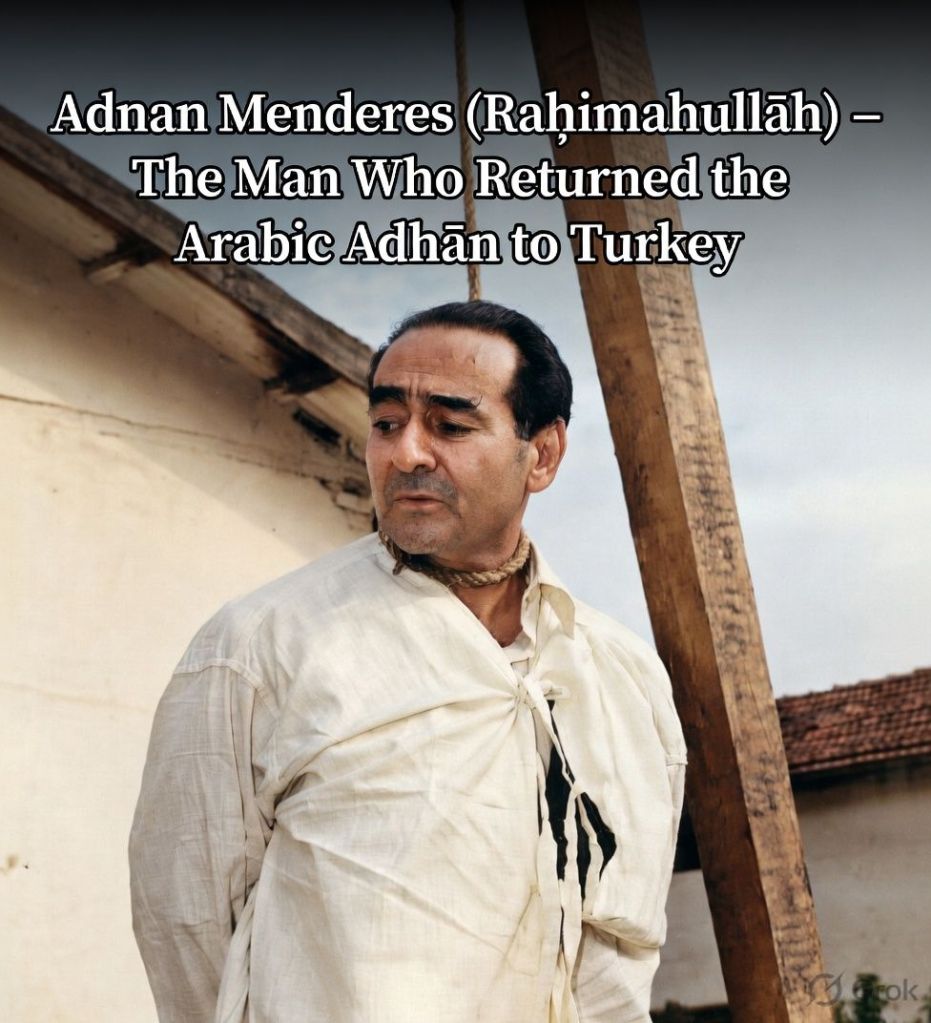
All praises and thanks be to Allah, and peace and salutations be upon The Messenger of Allah, his noble household, his companions and all those who follow him with excellence till The Day of Judgement.
My dear brothers and sisters in Islam, history is not only the story of kings, armies and changing borders. It is also the story of those men through whom Allah causes relief to come to His religion after years of hardship. Some men leave behind wealth. Some leave behind speeches. Some leave behind only arguments. But some leave behind a deed so mighty that the believers continue to remember them with love long after they are gone. Adnan Menderes was one of those men. He lived in a difficult age, ruled in a dangerous age, fell in a tragic age, and yet Allah wrote for him a service to Islam that caused his name to remain alive in the hearts of many Muslims.[1]
His roots in Aydın and the hardships of childhood
Adnan Menderes was born in 1899 in Aydın. His father was İbrâhim Ethem Bey, and his mother Tevhide Hanım came from a notable family of Crimean Turkish background. He lost both parents early and was raised by his grandmother Fıtnat Hanım. A child who grows up tasting loss early is often made older than his years. And a child raised close to an elder, especially a religious elder, often carries something of that discipline into his later life. The Turkish Islamic reference works on him note that he spent his childhood with his grandmother and was remembered by those around him as a man attached to his religion.
He studied first in Aydın and later at the Kızılçullu American College in İzmir. Even in the environment of modern schooling and foreign influence, accounts connected to his life suggest that he remained sensitive in religious matters. This is important, because the man who would later restore the Arabic Adhān did not emerge from nowhere. The concern for religion was not suddenly manufactured in old age. Its seeds were present earlier.[2]
A young man of war, resistance and sacrifice
Toward the end of the First World War, Menderes was conscripted as a reserve officer. After training in İstanbul, he was sent to Palestine. When the Armistice of Mudros ended Ottoman participation in the war, he returned. But the humiliation of the Muslims and Turks had not ended. During the Greek occupation of İzmir, Adnan Bey, then in Aydın, founded the Ayyıldız resistance organization with some companions in June 1919 when the Greeks were preparing to attack Aydın. He later joined the War of Independence in Söke as an infantry regiment adjutant and was awarded the Independence Medal with red ribbon for his service.[3]
So before he was a prime minister, he was already a man who had seen invasion, collapse and struggle. This matters. It means he was not merely a man of offices and furniture. He belonged to a generation formed by war, by occupation and by the feeling that a nation can be pushed to the edge and only survive by courage and resolve.
From farming to parliament
After the early years of the Republic, Menderes engaged in farming in Aydın. But Allah had written for him a wider role. In 1930 he helped organize the Free Republican Party in Aydın and became its provincial chairman. When that party was dissolved, he joined the Republican People’s Party and later entered parliament in 1931 as a deputy for Aydın. During his years as deputy, he completed legal studies at Ankara University. He served in parliament for years, but over time he became estranged from the political direction of the ruling elite.
This estrangement finally became clear in 1945. Alongside Celâl Bayar, Refik Koraltan and Fuad Köprülü, he signed the famous “Motion of the Four”, demanding a more democratic political life, fuller rights and freedoms, and a more genuine parliamentary order. The motion was rejected. They were driven out. But from that rejection came something new: the Democrat Party, founded in 1946. Many great changes begin when a man is no longer willing to keep silent inside a suffocating order.[4]
The man who understood the people
In the elections of 14 May 1950, the Democrat Party won a huge victory. Celâl Bayar became president, and Adnan Menderes was asked to form the government. He became prime minister on 22 May 1950 and remained the face of that era until the military coup of 27 May 1960. Bayar regarded him as the man in the party who best understood the inclinations of the people, especially the peasants, and who most possessed the qualities needed to lead Turkey forward. He was also known as an effective speaker and a powerful polemicist.
This is one reason Menderes became beloved to the common masses. Some rulers understand ministries but do not understand the people. Others understand the mood of the streets, villages, farms and markets. Menderes had that quality. He spoke in a way that connected with ordinary people, and many of them saw him as their man in a system that had long ignored or disciplined them.
Turkey before him – when even the Adhān was attacked
My dear brothers and sisters in Islam, to understand why Menderes is remembered with such emotion, one must first understand the darkness that came before him. Turkey had reached a point where the Arabic Adhān had been banned and replaced by Turkish wording.[5] Think about that! The call that had risen from the minarets of the Muslims for centuries, the call by which people are summoned to the worship of Allah, was altered by state force. Allah said: “And whoever honors the symbols [i.e., rites] of Allāh – indeed, it is from the piety of hearts…” Allah also said: “And who are more unjust than those who prevent the name of Allāh from being mentioned [i.e., praised] in His mosques and strive toward their destruction.”[6] So what then of those who wage war against the very public symbols of Islam?[7]
The deed for which he will always be remembered
Then Allah decreed good for the Muslims of Turkey through Adnan Menderes. In June 1950, after the Democrat Party came to power, the Arabic Adhān was restored. Allahu Akbar! This was not a small amendment in a legal code. This was not a minor policy correction. This was the restoration of a mighty symbol from the symbols of Islam. The Ummah heard again from the minarets of Turkey the very words by which the believers are called to prayer in the language of revelation.[8]
This act of restoring the Arabic Adhan deeply affected the religious public. The Muslims of Turkey treated the restoration of the Arabic Adhān as Menderes’s defining deed, and students from Istanbul University sent him messages of gratitude, describing it as the first step toward true freedom of conscience and this won him the love of the Muslim masses. That jubilant reaction of the Muslim masses to this tells us the size of the wound and the size of the relief.[9]
He did not stop at the Adhān
But it would be unfair to reduce his entire religious legacy to that one act alone, even if that one act was enormous. Under his government, religious broadcasts began on state radio. Religion classes were incorporated into the school curriculum in a more formal and visible way. Imam-Hatip schools were reactivated from 1951 onward in order to meet the public’s need for religious officials. These were not imaginary changes. They were concrete openings after a period of religious suffocation.[10]
The Muslims celebrated the inclusion of religious lessons for children as one of the most joyful events of those days, portraying it as a rescue of the younger generation from growing up cut off from religion. It also highlights the deep impact of religious programming on state radio, describing the return of religious sound and sacred speech to public broadcast as one of the unforgettable features of the Menderes years.
What he openly said about Islam
In 1951, in a speech in İzmir, Menderes was presented as declaring: “Turkey is a Muslim state and will remain Muslim. All requirements of Islam will be fulfilled.” Whether quoted exactly as preserved in the press reports of the time or through later transmission in that press tradition, the meaning is clear: he was willing to speak publicly in a language that reassured religious Muslims that their faith would not remain imprisoned forever beneath the slogans of the secular elite.[11]
My dear brothers and sisters, words alone do not make a man righteous. But there are times when even a public word in defense of Islam becomes a comfort to the believers, especially in a land where religion had been cornered, humiliated and restrained.
Scenes that show how the people felt
Another highly revealing anecdote concerns the opening of the Adapazarı Sugar Factory. At the ceremony, sacrifices were offered, and thousands of people joined together in takbīr and du‘ā’. This is significant because it reflects the spirit of the age as experienced by the religious public. Public ceremonies were no longer remembered only as cold secular rituals. Some of these occasions had begun to feel like gatherings in which the people could once again breathe as Muslims.
The same study notes that Islamist writers contrasted the pre-1950 climate with the more open atmosphere under Menderes, even describing the return of visible religious dignity to public life. In such writings, the reappearance of clerics in their turbans and robes at public occasions was treated not as a trivial matter, but as a sign that religion was no longer being driven from sight. Even where the language of these journals is clearly partisan, it still reveals something important: for many believers, Menderes was not merely administering a state; he was loosening a suffocating grip around Islam’s place in public life.[12]
A wider life than one issue
At the same time, Menderes was not a single-issue leader. His years in office also witnessed major economic and developmental changes. Turkey moved away from an overwhelmingly statist model toward a more semi-liberal system that gave greater room to private enterprise. Agriculture was rapidly mechanized. Roads, dams, ports, and a range of public services expanded. Villages and towns were drawn more deeply into the life of the nation.[13]
There were also important developments in foreign policy. Turkey sent troops in support of South Korea, entered NATO in 1952, and later took part in regional alignments such as the Balkan Pact and the Baghdad Pact. Important agreements concerning Cyprus were also concluded in 1959. This means that Menderes was not merely a symbolic religious figure within Turkey; he stood at the center of a state attempting to position itself in a dangerous Cold War world.
The burdens, the crises and the decline
But, as with many rulers, his story was not one of ease alone. The same large-scale development policies that impressed many people also brought financial strain, foreign debt, and inflation. From 1955 onward, unrest increased, economic pressures became more difficult to manage, and opposition intensified. The 6–7 September events, political fractures, student demonstrations, and growing bitterness between government and opposition all pushed the country toward a dangerous edge.[14] [15]
The plane crash and his sense of Allah’s favor
In 1959, while traveling to London over the Cyprus issue, Menderes survived a plane crash. He regarded this survival as a grace from Allah. Indeed, a man who walks away from death often emerges with the sense that his remaining days are no longer ordinary. Such moments deepen in people’s hearts the belief that Allah has preserved someone for a purpose, even if that purpose will later culminate in trial.
The coup and Yassıada
Then came the coup of 27 May 1960. Menderes, Bayar, and other leading figures of the Democrat Party were arrested and taken to Yassıada. Before his hearings began, Menderes was held in harsh isolation. He was allowed only restricted contact, and communication with his family was tightly limited. At one point, under the weight of everything, he even attempted suicide before being saved. Such details are heartbreaking when one remembers that this was the same man who had once stood at the head of the state, cheered by crowds and watched by the world.
The trial lasted for months. Many were tried. Death sentences were handed down. Serious concerns were later raised about the fairness of the proceedings, the independence of the court, and the overall atmosphere in which the trial was conducted. For this reason, Yassıada remained a wound in public memory rather than a closed chapter of history.[16]
The Last Hours of Adnan Menderes: Dignity at the Edge of the Gallows
And then came the darkest hour. The same man who had once stood before the people as the elected leader of a nation was now placed before a junta intoxicated with revenge. They stripped him of office, isolated him, tried him, and marched him toward the rope as though they could also strip him of honour. But there are some men whom humiliation cannot truly break, because Allah places in their hearts a stillness that tyrants cannot reach. When the sentence of hanging was read to Adnan Menderes, he did not collapse. He did not spit venom. He did not beg men for mercy. With a calm that seemed to rise from somewhere deeper than politics, he said only: “May Allah protect our nation.”
Turkish accounts further report that in the final hours before the execution, Menderes was subjected to a degrading prostate examination.[17] [18] Later journalists, witnesses, and legal commentators described this not as a necessary act of care, but as an additional humiliation laid upon a man already sentenced to die. Whether in the courtroom, the prison cell, or the examination room, the same spirit of cruelty seemed to persist: to punish the body and to wound the dignity. Yet even if men were able to injure his frame, they could not command his soul. They could prepare the gallows, but they could not touch the decree of Allah.
Then came the moment for his final words. And what words they were. Not the words of a bitter man. Not the words of one drunk on rage. Not the words of someone crushed by fear at the sight of death approaching. His heart turned instead to his family, his people, his homeland, and to Allah.
He said: “At this very moment when I am departing from life, tell my family and children that I remember them with compassion. May Allah bless our homeland and nation with eternal welfare.”[19]
These are not the words of a man spiritually defeated. These are the words of a man leaving the world with mercy on his tongue and concern for others still alive in his chest.
On 17 September 1961, Adnan Menderes was executed by hanging. The International Commission of Jurists urged clemency and protested the death sentences, but the regime pressed on. He was buried on İmralı beside his two companions, Fatin Rüştü Zorlu and Hasan Polatkan. Yet the story did not end at the gallows, nor was it buried in the earth with them. The public conscience was not pacified. A deep sense remained among the people that something profoundly unjust had taken place. Years later, in 1990, his honour was formally restored, and his remains were transferred with a state ceremony to the mausoleum prepared on Vatan Avenue in Istanbul. Thus history itself bore witness that men may be condemned by one age and vindicated by another.
This too is from the strange unfolding of Allah’s decree: generals may pass sentences, newspapers may inflame, courts may sign their names beneath injustice, and regimes may imagine they have closed the matter forever. But the real reckoning is not with judges, uniforms, or bayonets. The real reckoning is with Allah. And for many believers, the gallows did not make Menderes smaller. They made the crime against him larger, his patience clearer, and his memory heavier upon the conscience of the nation.
The praise of the people of religion
Among the strongest points mentioned in his favor is the praise of Shaykh Bediüzzaman Said Nursi, who referred to him in as “one of the heroes of Islam” and as “the Hero of Islam.” This was not casual praise. It came from a man who knew imprisonment, exile, and oppression for the sake of religion. When such a man praises a statesman for reopening doors to Islam, that praise deserves to be remembered.[20]
Shaykh Ali Haydar Efendi[21] was reported to have said: “I began studying from the age of six, and for at least six hours a day a book would not leave my hand. Since then I have devoted myself to worship and obedience. But as for what Menderes did — restoring the adhān to its original form — for the reward of that one day’s deed, if it was accepted, I would be ready to give the reward of all the worship I have performed up to this age.”[22]
A further valuable point emerges here: Religious journals repeatedly presented Menderes as a man carrying a spiritual responsibility, almost warning him that if he served Islam sincerely, his name would be remembered with gratitude and honor. This is extremely useful for understanding not only Menderes himself, but also the way the religious public of that time viewed him. They did not see him merely as a prime minister. They saw him as a man standing at a point of testing between repression and relief.[23]
A lesson from his life
My dear brothers and sisters in Islam, the lesson of Adnan Menderes is not that every politician is righteous, nor that every ruler who speaks the language of religion should be followed uncritically. No. The lesson is that Allah sometimes uses imperfect men to render great services to His religion. A man may carry political weaknesses, burdens, and contradictions, and yet Allah may still write through him a deed by which millions are relieved.
The Messenger of Allah ﷺ said: “Whoever relieves a believer of a hardship from the hardships of this world, Allah will relieve him of a hardship from the hardships of the Day of Resurrection.”[24] If Allah used Menderes to relieve the Muslims of Turkey from the wound of the ‘banned’ Arabic Adhān, from the constriction of religious instruction, and from the suffocation of public Islamic life, then that is no small matter.
Final words
So remember this name well: Adnan Menderes. Remember him not only as the man through whom the Arabic Adhān returned to Turkey, though that alone would have been enough to make many believers love him. Remember him also as the orphan of Aydın, the young man of resistance, the veteran of the War of Independence, the parliamentarian who broke with a suffocating order, the founder of a new political path, the leader who understood the common people, the ruler who reopened doors for religion, the survivor of a plane crash who saw Allah’s favor in his survival, and the prisoner of Yassıada who ended on the gallows.
May Allah forgive Adnan Menderes, have mercy upon him, accept the good that he did for Islam, pardon his mistakes, and grant him the highest levels of Jannah. Āmīn.
***
Acknowledgement of Sources: This essay is an original synthesis based on materials consulted from TDV İslâm Ansiklopedisi (“Menderes, Adnan”), Encyclopaedia Britannica (“Adnan Menderes”), BBC Türkçe (biographical coverage of Adnan Menderes and the Yassıada process), Anadolu Agency (including reports on Menderes, his execution, and the restoration of the Arabic adhān), International Commission of Jurists (regarding objections to the death sentences), the Cihannüma article PDF and the BBE Journal study cited in the footnotes (for the religious reception of the Menderes period), Cevaplar.org and the Türkiye Yazarlar Birliği (TYB) interview preserving Emin Saraç Hocaefendi’s transmission of Ali Haydar Efendi’s words about Menderes, and, for scriptural citations, Quran.com and Sunnah.com.
[1] Summarized from https://www.britannica.com/biography/Adnan-Menderes and https://islamansiklopedisi.org.tr/menderes-adnan .
[2] See TDV İslâm Ansiklopedisi.
[3] TDV İslâm Ansiklopedisi.
[4] TDV İslâm Ansiklopedisi.
[5] Under Mustafa Kemal Atatürk, the Republic of Turkey implemented “Lā’iklik”—a militant form of secularism aimed at the total Westernization of society. This was not merely a separation of mosque and state, but a systematic state control over religion. Key reforms included the abolition of the Caliphate (1924), the closure of Sufi lodges, and the Hat Law (1925), which banned traditional religious headwear. Most provocatively, the Arabic Adhān was banned in 1932 and replaced with a Turkish version (Tanrı uludur), a policy enforced by the force of arms. These measures sought to strip Islam from public identity and replace it with a singular, secular Turkish nationalism.
[6] Sahih International, Quran.com 22:32, 2:114.
[7] Read ‘ISTANBUL AND THE ADHAN’ to know more about the history of the Adhan in Turkey. The entire essay ‘Istanbul And The Adhan’ by Mustafa İsmet Uzun has been presented at the end of this essay. [Source: https://istanbultarihi.ist/544-istanbul-and-the-adhan%5D
[8] See Istanbul Tarihi, Anadolu Agency, TDV İslâm Ansiklopedisi.
[9] Cihannüma article PDF İslamci Basinda Adnan Menderes İmaji.
[10] TDV İslâm Ansiklopedisi, BBE Journal.
[11] Cihannüma article PDF.
[12] See Cihannüma article PDF.
[13] See Britannica and TDV İslâm Ansiklopedisi.
[14] The 6-7 September events (or Istanbul Pogrom) refer to state-sponsored mob attacks on September 6-7, 1955, primarily targeting the ethnic Greek, Armenian, and Jewish minorities in Istanbul. Triggered by fabricated news that the Greek consulate in Thessaloniki (Mustafa Kemal Atatürk’s birthplace) had been bombed, the two-day riots resulted in dozens of deaths and the widespread destruction of minority-owned homes, businesses, and churches. For Prime Minister Adnan Menderes, the events became a fatal political crisis born of a severe miscalculation. Historical evidence indicates his government orchestrated the initial spark, intending to manufacture a limited, controlled protest to pressure Greece over the Cyprus dispute and distract from a failing domestic economy. However, the mobilized nationalist mobs quickly spiraled out of state control, transforming the intended “minor fire” into a catastrophic, full-scale pogrom. This devastating violence sparked international outrage, shattered the government’s credibility, and crippled the local economy as minority populations fled. Menderes’s role in instigating the crisis was later weaponized against him during the Yassıada military tribunals following the 1960 coup d’état. While these tribunals are widely condemned by historians as highly politicized sham trials designed to retroactively legitimize the military takeover, the charge of his complicity in the pogrom remained central to his conviction and subsequent execution by hanging in 1961.
[15] See Britannica and TDV İslâm Ansiklopedisi.
[16] See International Commission of Jurists (https://www.icj.org/resource/execution-of-turkish-ministers/) and TDV İslâm Ansiklopedisi.
[17] See https://www.aa.com.tr/en/europe/turkeys-hanged-pm-adnan-menderes-in-his-own-words/1490690.
[18] A prostate examination usually refers to a digital rectal examination (DRE), in which a doctor inserts a gloved, lubricated finger into the rectum in order to feel the prostate gland for enlargement or abnormalities. Although medically routine in proper clinical settings, it is an intimate and physically uncomfortable procedure; when imposed on a prisoner immediately before execution, it may reasonably be understood as an act of humiliation as well as examination.
[19] https://www.aa.com.tr/en/europe/turkeys-hanged-pm-adnan-menderes-in-his-own-words/1490690.
[20] Rasael al-Nour Muslim Heritage PDF Köprü Dergisi.
[21] Shaykh Ali Haydar Efendi (1870–1960), known as Ahıskalı Ali Haydar Efendi, was one of the most respected late Ottoman and early Republican Turkish scholars, renowned for his mastery of Islamic law and his lifelong devotion to teaching, worship, and scholarship. He was remembered by later scholars as a leading faqīh of his age, deeply revered even by major religious authorities such as Ömer Nasuhi Bilmen and remembered as the teacher of influential figures in Turkey’s Islamic scholarly tradition.
[22] Ali Haydar Efendi, as recalled by Muhammed Emin Saraç in an interview with Salih Okur, “Emin Saraç Hocaefendi ile Son Devir Âlimlerimiz Üzerine..(1),” Cevaplar.org, February 15, 2007, https://www.cevaplar.org/content/emin-sarac-hocaefendi-ile-son-devir-alimlerimiz-uzerine-1.
[23] See Cihannüma article PDF.
[24] Sunnah.com – Ibn Mājah 225.
 Saheehus-Seerah