Shaikh Saifullah Mohammadi ka radd aur Ali (Radi Allahu Anhu) ko ‘Mawla Ali’ kehne ka jawaz


(Asal Title: Saifullah Mohammadi Sahab ki Nasbiyat!- Shahriyar Ali Shaikh ki taraf se Urdu mein likhi gayi aur Facebook se copy ki gayi.)

(Tarjuman ki wazahat: Ye mazmoon Shahriyar Ali Shaikh ki Facebook post se liya kiya gaya hai, jis mein unhon ne Moulana Saifullah Mohammadi ka ek aham masle par radd kiya hai. Hum ne isko yahan Roman Urdu mein tarjuma kiya hai takay is ke fawaid se log mustafeed ho saken. Hum zati tour par Moulana Saifullah Mohammadi ko ‘Nasibi’ ya ‘Nasibiyat se mutasir’ kehne ki taeed nahi karte. Allah se dua hai ke hamare achche aamal qubool farmaye aur hamari khataon ko maaf kare.)

Shahriyar Ali Shaikh likhte hain:

(Pasemanzar/Context: Ek video ke mutalliq, jismein Shaikh Saifullah Mohammadi se poocha gaya ke kya hum Ali (Radi Allahu Anhu) ko ‘Mawla Ali’ keh sakte hain? Unhon ne jawab diya ke ye kehna bilkul jaiz nahi hai. Yahan is baat ka radd ho raha hai, InshaAllah.)

Jis tarah Saifullah Mohammadi sahab Ráfiziyon ke propaganda par bade gaur-o-khauz karte hain, toh kabhi yeh Násibiyon ke propaganda par bhi gaur farma lete. Lekin wahan kyun gaur karenge? Kyunki yeh khud Násibiyon ke propaganda mein shamil hain.

Saifullah Mohammadi sahab ne sawal karne wale par bilawajah aur bebuniyad ilzam-tarashi ki hai. Halanke sawal karne wale ne mehez yeh poocha tha ke: “Hazrat Ali (Radi Allahu Anhu) ko Maula kehna kaisa hai?” aur sath mein us ne yeh hadees bhi zikr ki: “Man kuntu maulah fa hazá Ali mauláhu”.

Ab sawal yeh hai ke sirf is sawal ki buniyad par kisi ko Shiyat se mutassir qarar dena kahan ka insaf hai? Kya Saifullah Mohammadi sahab ko yeh maloom nahin ke sharan kisi Musalman par jhoota ilzam lagana, tohmat bandhna aur bohtan tarashna intehai sangeen gunah aur haram amal hai?

Nabi (Salallahu Alaihi Wa Sallam) ne farmaya: “Man qala fi mu’minin ma laisa fihi, askanahu Allahu radghatal khabal hatta yakhruja mimma qal.”

“Jis ne kisi momin ke baare mein koi aisi baat kahi jo us mein nahin thi, toh Allah Ta’ala us ka thikana jahannamiyon ki peep mein bana dega, hatta ke woh apni baat se baaz aa jaye (ruju kar le).📚 (Sunan Abi Dawood: 3597)

Pehla Aitraz– Saifullah Mohammadi sahab ne kaha: Rasool Allah ﷺ ne farmaya: “Jis ka main Maula hoon, us ka Ali Maula.” aur phir yeh sawal uthaya: “Kya tum ne kabhi kisi ko Rasool Allah ﷺ ko Maula kehte hue suna hai?” Yeh aitraz hi be-buniyad hai. Qur’an mein Allah Ta’ala ne Nabi ﷺ ki kayi sifát zikr ki hain, lekin Sahaba-e-Kiram ne har lafz ke sath Nabi ﷺ ko nahin pukara. Misal ke taur par: Allah ne Nabi ﷺ ko “Rahmat-ul-lil-álamín” kaha hai, lekin kya Sahaba ne kabhi “Ya Rahmatal-lil-álamín” keh kar bulaya? Nahin. Lehaza yeh sawal hi be-buniyad hai.

Dusra Aitraz– Saifullah Mohammadi sahab ne kaha ke Rasool Allah ﷺ ne Syedna Zayd bin Harithah (Radi Allahu Anhu) ko bhi Maula kaha hai. Ji haan! kaha hai. Aur agar koi Syedna Zayd bin Harithah (Radi Allahu Anhu) ko Maula keh de toh is mein koi qabahat nahin. Masla toh yeh hai ke agar koi Syedna Ali ko Maula keh de toh aap (Saifullah Mohammadi) ko masla kyun hai?

Teesra Aitraz– Jahan Násibiyat khul kar samne aati hai. Unhon ne kaha: “Maula ka ma’ana dost hai, aur Rasool Allah ﷺ ne farmaya: Agar main kisi ko haqeeqi dost banata toh Abubakar ko banata. Is liye Syedna Ali ko Maula kehna najáiz hai.” Inna lillahi wa inna ilayhi rajioon. Yahan Saifullah Mohammadi sahab ne shadeed khalt-e-mabhas (confusion of the issue) kiya hai. Hadees mein hai: “Lau kuntu muttakhizan khálílan lat-takhaztu Aba Bakrin khálílan, wa lakin akhí wa sahibí.” “Agar main kisi ko Khalíl banata toh Abubakar ko banata, lekin woh mera bhai aur mera saathi hai.” Yahan lafz Khalíl aaya hai, jis ka matlab hai gehra dost, sab se a’ala darje ka rafeeq. Yeh hadees Hazrat Abubakr (Radi Allahu Anhu) ki fazilat bayan karti hai, is se yeh kaise sabit ho gaya ke Syedna Ali (Radi Allahu Anhu) ko Maula kehna najáiz hai? Aur jo mafhoom is hadees se Saifullah Mohammadi akhz kar rahe hain kya salaf ne bhi yahi mafhoom akhz kiya jo Saifullah Mohammadi akhz kar rahe hain?? “Khalíl” aur “Maula” do alag mafoom hain. Inhein khalt-malt karna jahálat hai.

Aur sab se ahem baat- agar waqai Syedna Ali ko Maula kehna najáiz hota toh phir Syedna Abu Ayyub Ansari (Radi Allahu Anhu) ne kyun Syedna Ali ko “Maula” kaha? Syedna Zayd bin Harith (Radi Allahu Anhu) ko toh Sahaba se Maula kehna sabit nahin. Lekin Hazrat Ayyub al-Ansari (Radi Allahu Anhu) se Syedna Ali ko “Ay mere Maula, aap par salamati ho” kehna bilkul sabit hai.

Rabaah bin Harith (Rahimahullah) farmate hain: “Jab Ali (Radi Allahu Anhu) Rahbah mein baithe hue the toh ek shakhs safar ke asaar ke sath aaya aur kaha: “As-Salamu `alayka ya Maulaí” (Ay mere Maula, aap par salamati ho). Toh Ali (Radi Allahu Anhu) ne farmaya: “Yeh kon hai?” Logon ne kaha: “Yeh Abu Ayyub al-Ansari (Radi Allahu Anhu) hain.” Toh Abu Ayyub (Radi Allahu Anhu) ne farmaya: “Main ne Rasool Allah (Salallahu Alaihi Wa Sallam) ko farmate hue suna: Jis ka main Maula hoon, us ke Ali bhi Maula hain.”

📚 Ibn Abi Shaybah (32736) aur Ahmad (23959) ne riwayat kiya hai, aur Al-Hasani ne apni kitaab “Al-Jami’ Al-Musnad As-Sahih” (2796) mein is ki tasheeh ki hai.

Ab sawal yeh hai: Saifullah Mohammadi sahab jin ka da’wa hai ke woh “Manhaj-e-Salaf” par hain, woh is bare mein kya kahenge ke Syedna Abu Ayyub al-Ansari (Radi Allahu Anhu) ne toh khud Syedna Ali ko Maula kaha? Kya woh bhi (na’oozu billah) najáiz laqab istemal kar rahe the? [End.]

(Tarjuman ki wazahat: Abu Ayyub al-Ansari ki riwayat Shahriyar Ali Shaikh ke Urdu maqalay se tarjuma ki gayi thi, asal Urdu matan mein Ali ke naam ke baad ‘Alaihis Salam’ likha gaya tha. Main ne isko ‘Radi Allahu Anhu’ kar diya taa-ke log ek aur masle, yaani ‘Kya hum Sahaba ya Ahlul-Bayt ke liye Alaihis Salam ka istemal kar sakte hain?’ ke baare mein uljhan mein na padh jaen. Is ka jawab ‘Haan’ hai, lekin hamein is baat ki tafseel mein abhi nahi jana hai.)

-Shahriyar Ali Shaikh. (Mohammed bin Thajammul Hussain Manna ne Urdu se Roman Urdu mein tarjuma kiya hai).

Refutation of Shaikh Saifullah Mohammadi and The Permissibility of Giving Ali The Title of ‘Mawla Ali’ (Radi Allahu Anhu)


(Original Title:) The Nasibism of Saifullah Mohammadi Sahib! – authored by Shahriyar Ali Shaikh in Urdu and copied from Facebook.

(Translator’s Note: The article below was translated from the Facebook post of brother Shahriyar Ali Shaikh refuting Moulana Saifullah Mohammedi on an important issue. We have translated it into English here because of the benefits it contains. We do not endorse calling Moulana Saifullah Mohammedi a Nasibi or ‘Nasibi influenced’. May Allah accept our good deeds and forgive our mistakes.)

Brother Shahriyar Ali Shaikh wrote:

(Context: Regarding a video of Shaikh Saifullah Mohammedi wherein he was asked can we call Ali (Radi Allahu Anhu) as ‘Mawla Ali’? He answers that it is impermissible. Language: Urdu.)

Just as Saifullah Mohammadi Sahib meticulously delves into the propaganda of the Rafidhis, he ought to also consider the propaganda of the Nasibis. But why would he consider it? Because he himself is involved in the Nasibi propaganda.

Saifullah Mohammadi Sahib has baselessly and unfairly leveled accusations against the questioner. The questioner had merely asked: “What is the ruling on calling Hazrat Ali (Radi Allahu Anhu) as ‘Mawla’?” and also mentioned the Hadith: “Man kuntu Mawlahu fahadha Ali Mawlahu” (Whosever’s Mawla I am, Ali is also his Mawla).

Now, the question is: where is the justice in accusing someone of being influenced by Shi’ism based solely on this question? Does Saifullah Mohammadi Sahib not know that, Islamically, falsely accusing a Muslim, slandering, and calumniating are extremely grave sins and forbidden acts?

The Prophet (Salallahu Alaihi Wa Sallam) said: “Whoever says something about a believer that is not in him, Allah will make him dwell in the filth of the inhabitants of Hell until he retracts what he said.” 📚 (Sunan Abi Dawud: 3597)

First Objection: Saifullah Mohammadi Sahib stated that the Messenger of Allah (Salallahu Alaihi Wa Sallam) said: “Whosever’s Mawla I am, Ali is also his Mawla.” He then questioned: “Have you ever heard anyone refer to the Messenger of Allah (Salallahu Alaihi Wa Sallam) as ‘Mawla’?” This objection is unfounded (and baseless). The Quran mentions several attributes of the Prophet (Salallahu Alaihi Wa Sallam), but the Sahaba (companions) did not address the Prophet with every single word. For example, Allah called the Prophet (Salallahu Alaihi Wa Sallam) “Rahmatun lil-‘alamin” (Mercy to the worlds), but did the Sahaba ever call out “Ya Rahmatan lil-‘alamin”? No. Therefore, this question is baseless.

Second Objection: Saifullah Mohammadi Sahib claimed that the Messenger of Allah (Salallahu Alaihi Wa Sallam) also referred to Sayyiduna Zayd ibn Harithah (Radi Allahu Anhu) as ‘Mawla’. Yes, he did. And if someone calls Sayyiduna Zayd ibn Harithah (Radi Allahu Anhu) ‘Mawla’, there is no harm in it. The problem is, if someone calls Sayyiduna Ali ‘Mawla’, why does he (Saifullah Mohammadi) have an issue?

Third Objection: This is where Nasibism openly manifests. He said: “‘Mawla’ means friend, and the Messenger of Allah (Salallahu Alaihi Wa Sallam) said: ‘If I were to take a close friend (Khaleel), I would have taken Abu Bakr.’ Therefore, calling Sayyiduna Ali ‘Mawla’ is impermissible.” Inna lillahi wa inna ilayhi raji’un (Indeed, to Allah we belong and to Him we shall return). Here, Saifullah Mohammadi Sahib has caused severe confusion of concepts. The Hadith states: “If I were to take a Khalil (intimate friend), I would have taken Abu Bakr as a Khalil, but he is my brother and my companion.” Here, the word Khalil is used, which means an intimate friend, a highest-grade companion. This Hadith states the virtue of Hazrat Abu Bakr (Radi Allahu Anhu); how does it prove that calling Sayyiduna Ali (Radi Allahu Anhu) ‘Mawla’ is impermissible? And did the Salaf (pious predecessors) derive the same meaning from this Hadith as Saifullah Mohammadi is deriving? “Khalil” and “Mawla” are two distinct concepts. Confusing them is ignorance. And most importantly: if calling Sayyiduna Ali ‘Mawla’ was indeed impermissible, then why did Sayyiduna Abu Ayyub al-Ansari (Radi Allahu Anhu) call Sayyiduna Ali ‘Mawla’? It is not proven that the Sahaba referred to Sayyiduna Zayd ibn Harithah (Radi Allahu Anhu) as ‘Mawla’ in this specific manner. However, it is absolutely proven from Hazrat Abu Ayyub al-Ansari (Radi Allahu Anhu) that he addressed Sayyiduna Ali as “Peace be upon you, O my Mawla.”

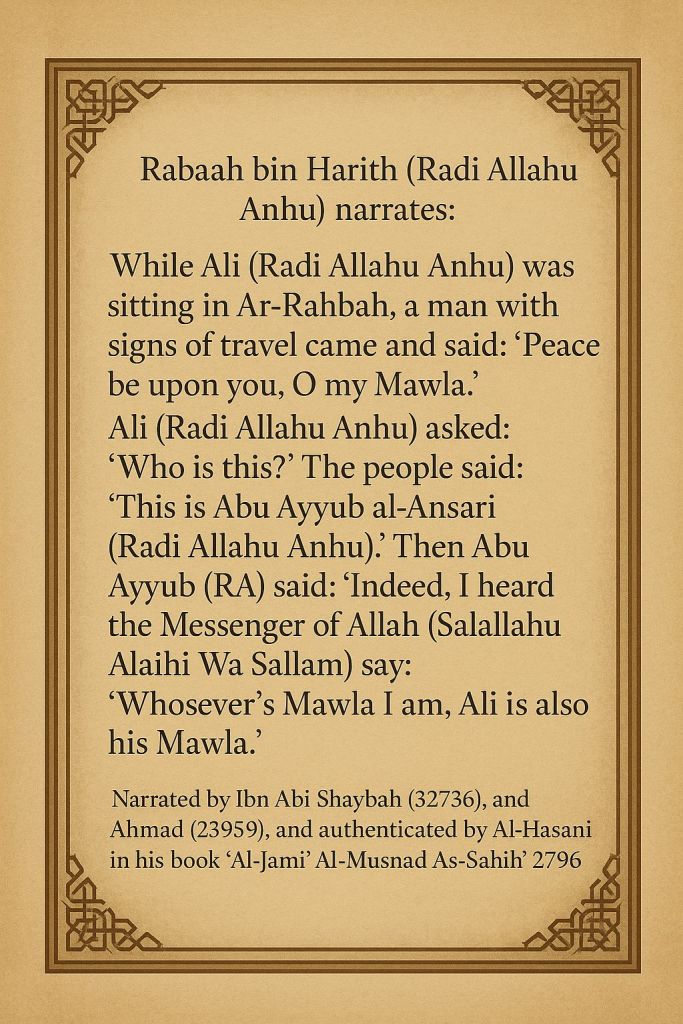
Rabaah bin Harith (Radi Allahu Anhu) narrates: “While Ali (Radi Allahu Anhu) was sitting in Ar-Rahbah, a man with signs of travel came and said: ‘Peace be upon you, O my Mawla.'” Ali (Radi Allahu Anhu) asked: “Who is this?” The people said: “This is Abu Ayyub al-Ansari (Radi Allahu Anhu).” Then Abu Ayyub (RA) said: “Indeed, I heard the Messenger of Allah (Salallahu Alaihi Wa Sallam) say: ‘Whosever’s Mawla I am, Ali is also his Mawla.'”

📚 (Narrated by Ibn Abi Shaybah (32736), and Ahmad (23959), and authenticated by Al-Hasani in his book “Al-Jami’ Al-Musnad As-Sahih” 2796)

Now the question is: What will Saifullah Mohammadi Sahib, who claims to be on the “Manhaj of the Salaf” (methodology of the pious predecessors), say about the fact that Sayyiduna Abu Ayyub al-Ansari (Radi Allahu Anhu) himself called Sayyiduna Ali ‘Mawla’? Was he also (Allah forbid) using an impermissible title? End of the note.

[Translator’s Note: The narration of Abu Ayyub al-Ansari was translated from Urdu, in the original urdu text after Ali’s name ‘Alaihis Salam’ was mentioned. I made it ‘Radi Allahu Anhu’ to not confuse the people regarding another issue, i.e. ‘Can we use Alaihis Salam for the Sahabah or Ahlul-Bayt?’, the answer is ‘Yes’, but this isn’t the place to discuss that.]

Shahriyar Ali Shaikh. (Translated by Mohammed bin Thajammul Hussain Manna from Urdu to English.)

The video in question.

The Three Categories of Scholars- Shaykh Muhammad bin Saleh Al-Uthaymin

Shaykh al-‘Uthaymīn (may Allah have mercy on him) said: “Scholars are of three types: A scholar of the religion (millah), a scholar of the state (dawlah), and a scholar of the people (ummah).”

As for the scholar of the religion (al-millah): he is one who propagates the religion of Islam and issues religious verdicts (fatwas) based on sound Islamic knowledge, without caring whether what the Divine Law (Shar‘) indicates aligns with people’s desires or not.

As for the scholar of the state (al-dawlah): he is one who observes what the state (the government) desires and then issues religious verdicts (fatwas) in accordance with the state’s wishes, even if that involves distorting the texts of the Book of Allah and the Sunnah of His Messenger (peace be upon him).

And as for the scholar of the people (al-ummah): he is one who observes what pleases people. If he sees people inclined towards something, he issues a verdict that satisfies them, and then he attempts to distort the texts of the Book (Qur’an) and the Sunnah in order to conform to people’s desires. We ask Allah to make us among the scholars of the religion who act upon it.”

[Sharḥ Riyāḍ aṣ-Ṣāliḥīn, 4: 307,308]

Miraculous Discovery: 1500-Year-Old “Moon Split” Painting Leads Art Appraiser to Islam!

Alhamdulillah! We bring forth joyous news that will undoubtedly strengthen the faith of every believer and open the hearts of those searching for truth! In a truly awe-inspiring turn of events, a renowned art appraiser, Brother Vikram Negi, has embraced Islam, and the story of his journey is a testament to Allah’s undeniable signs!

Brother Vikram, an expert in the scientific study and forensic analysis of ancient paintings, shared a profound experience that led him to the light of Islam. He shared this on an online QnA session with Mufti Yasir Nadeem Al-Wadiji (Hafidhahullah). He likened his experience to that of the magicians in the time of Prophet Moses (peace be upon him), who, upon witnessing an undeniable miracle from Allah, immediately recognized the truth and embraced Islam. This analogy itself is a beautiful reflection of how divine truth becomes self-evident to those with genuine knowledge and insight in their fields.

The very next day after a conversation with the respected Mufti, Brother Vikram, along with his colleagues, embarked on a mission to China to appraise a collection of 40 ancient paintings found in a 150-year-old building. Among these historical treasures, a simple yet profoundly significant rough sketch was discovered.

Through rigorous scientific methods, including evaluation of the frame (estimated to be 350 years old), detailed analysis of the papyrus-like material and ink composition (coal powder and egg white, a technique used for rough sketches during that era), and carbon dating, Brother Vikram and his team concluded that this sketch was an astonishing 1400-1500 years old!

And what did this ancient sketch depict? A serene scene of a tiger family drinking water by a waterfall, with one astonishing detail: the moon in the sky was split in two! The collection included a subsequent frame of the same scene, showing the moon whole again. This undeniable visual evidence, dated to a period when such an event could have been witnessed and recorded, resonated deeply with Brother Vikram. Upon seeing this, he immediately exclaimed, “There is no God worthy or worship but Allah, and Prophet Muhammad (peace be upon him) is the Messenger of Allah. There is no doubt about it!” SubhanAllah!

This extraordinary discovery serves as a powerful historical record of the miracle of the splitting of the moon, attributed to our beloved Prophet Muhammad (peace be upon him). It is a clear sign for humanity, confirming the truth of Islam to those who reflect. While this priceless artifact currently remains with a private collector, the desire to bring this monumental evidence to the world is strong, and efforts are underway to make this possible.

Brother Vikram’s journey is a beacon of hope and a powerful reminder that Allah guides whom He wills. Let us pray for Brother Vikram, for his family, and for the entire Ummah, that this incredible revelation may serve as a means of strengthening our Iman and inviting more souls to the ultimate truth! Indeed, Allah’s signs are everywhere for those who observe and ponder!

Story reported from here.

Do Not Look Down Upon the Sinner with Arrogance

Abū Isḥāq ash-Shīrāzī, the Shāfi‘ī jurist (may Allah have mercy on him), said:
“My father and I were imprisoned, and we prayed while the other prisoners were asleep. So I said, ‘None of these people got up to pray two units of prayer!’ He replied, ‘O my son, if you had died, it would have been better for you than falling into [criticizing] people.'”

Your uprightness does not grant you the right to mock the misguidance of others. Therefore, do not look down upon the sinner with a gaze of superiority, for hearts are between two fingers of the Most Merciful, He turns them as He wills. When Allah chose you for the path of His guidance, it was not because you are special or due to any obedience from your part; rather, it was a mercy from Him that encompassed you, and He may withdraw it from you at any moment. Thus, do not be deluded by your deeds or your worship, and do not look with disdain upon those who have strayed from His path, for were it not for Allah’s mercy upon you, you would be in their place.

And do not imagine that steadfastness upon uprightness is one of your personal achievements, for Allah said to His Prophet (peace be upon him), the best of mankind: {And if We had not strengthened you, you would have almost inclined to them a little.} [Al-Isrā’: 74] So, what about you?!

‘Umar ibn ‘Abd al-‘Azīz said: “We found the predecessors (Salaf) not considering worship to be merely in fasting or prayer, but rather in refraining from [speaking ill of] people’s honor. For the one who fasts by day and prays by night, if he does not guard his tongue, he will be bankrupt on the Day of Judgment.”

[From the telegram channel of Ash-Shaikh Uthman Ahmad Uthman. Benefit translated from Arabic to English.]

Check authenticseerah.com for more benefits.