(Please do not print a hardcopy of this PDF and let it remain as a soft copy.)
The main aim of our site is to purify The Seerah of Prophet Muhammad ﷺ from weak and fabricated narrations using the works of the scholars of Islam. We may add other beneficial material as well.
(Please do not print a hardcopy of this PDF and let it remain as a soft copy.)
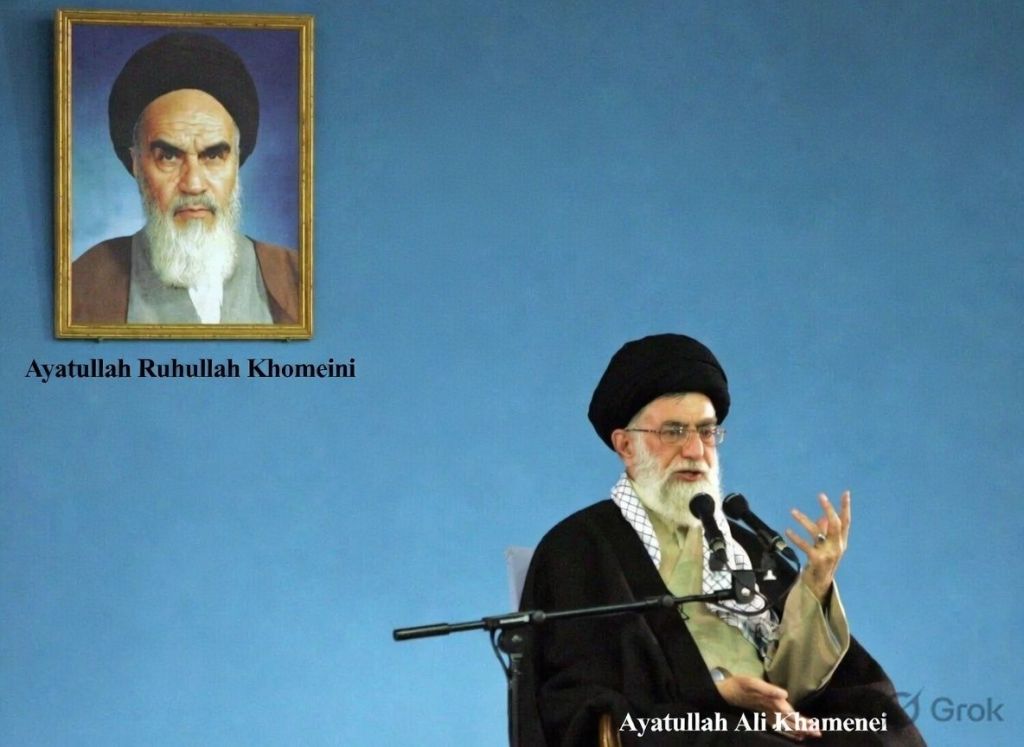
[Translator’s Note: Ayatollah Ruhollah Khomeini was the principal architect of the 1979 Iranian Revolution and the founder of the Islamic Republic of Iran, serving as its first Supreme Leader until his death in 1989. He established the country’s theocratic system based on Wilayat al-Faqih (Guardianship of the Islamic Jurist). Ali Khamenei (the one killed on 28th February 2026) was one of Khomeini’s most devoted students and trusted loyalists. Under Khomeini’s mentorship, Khamenei became a key political figure, serving as Iran’s President from 1981 to 1989. Upon Khomeini’s death, the Assembly of Experts selected Khamenei to succeed his mentor, making him the second Supreme Leader of Iran.]
In the Name of Allah, the Most Gracious, the Most Merciful.
Praise be to Allah, Lord of the Worlds, and peace and blessings be upon the most noble of prophets and messengers, our master Muhammad bin Abdullah, the trustworthy, and upon all his family and companions, and those who follow them in righteousness until the Day of Judgment. To proceed:
Praise be to Allah who has placed within this Ummah divine, Salafi scholars who proceed upon the Book of Allah, the Sunnah of the Prophet (Salallahu Alaihi Wa Sallam), and the understanding of the righteous predecessors (Salaf as-Salih), may Allah be pleased with them. There is no era except that heads of innovation emerge within it, calling to themselves and rendering the sword lawful; and Allah is the source of help. This is a discourse that clarifies the misguidance of Khomeini, his disparagement of the companions of the Messenger of Allah, and his complete contradiction of the religion of Islam. Would that his followers take heed of what we are about to say and quote; however, when whims and deeply rooted malice nest in the hearts, it is difficult for them to depart, except for one who listens with the eye of insight and seeks the truth. But the Rafidah (Rejectionists) are the furthest of people from that, and Allah is the source of help.
Indeed, Khomeini pursued divergent paths in rejecting the religion and the faith, all of which converge upon the religion of disbelief and misguidance. Here is the following:
First: Extremism in Rejection (Rafd) and Severe Enmity Towards Ahlus-Sunnah
1. Preferring the Shia Imams over all Prophets:
Khomeini adopts the path of the extremists (the extremist Rafidah) in Shiism. Evidence of this is his reliance on the extremists’ doctrine regarding the superiority of the Imams over the prophets and messengers of Allah.
Khomeini states: “It is one of the essential tenets of our sect that our Imams possess a station unreachable by any proximate angel or commissioned prophet… and it has been reported from them (peace be upon them) that: ‘We have states with Allah that no proximate angel or commissioned prophet can encompass.'” (Al-Hukumah Al-Islamiyyah, p. 52).
Regarding the Awaited Absent One (Al-Ghaaib Al-Muntazir, their Mahdi),
Khomeini says: “All the prophets came to establish the foundations of justice, but they did not succeed. Even the Prophet Muhammad, the seal of the prophets, who came to reform humanity… did not succeed in that. The person who will succeed in that is the Awaited Mahdi.” (From a speech delivered by the perished Khomeini on the occasion of the anniversary of the Mahdi’s birth, 15 Sha’ban 1400 AH).
Khomeini also stated in a speech delivered on the anniversary of the birth of Ar-Ridha, the seventh Imam of the Shia, on 9/8/1984: “I am regretful for two things: one of them is that the system of Islamic governance has not succeeded since the dawn of Islam up to our present day, not even during the era of the Messenger (Salallahu Alaihi Wa Sallam), and the system of governance was not established as it should have been.”
Furthermore, Khomeini accuses the Prophet (Salallahu Alaihi Wa Sallam) of failing to deliver the message properly. He says in Kashf al-Asrar (p. 55): “It is clear that had the Prophet conveyed the matter of the Imamate in accordance with what Allah commanded, and exerted efforts in this regard, all these differences, disputes, and battles would not have erupted in the Islamic countries, nor would differences have appeared in the fundamentals and branches of the religion.”
He also states in Kashf al-Asrar (p. 154): “Through the Imamate, the religion is perfected and the conveyance [of the message] is completed.”
He describes their Imams by saying: “Forgetfulness and heedlessness cannot be imagined of them.” (Al-Hukumah Al-Islamiyyah, p. 91).
Khomeini says: “The teachings of the Imams are like the teachings of the Quran.” (Al-Hukumah Al-Islamiyyah, p. 113).
Khomeini attributes the quality of divinity to them, saying: “For the Imam possesses a praiseworthy station and a creational vicegerency (Khilafah Takwiniyyah) to whose guardianship and dominion all the atoms of the universe submit.”
As for the prophets, he describes them as incapable, saying: “We say that the prophets were not successful in executing their objectives, and that Allah, the Exalted, will send a person at the end of time who will execute the affairs of the prophets.” (He means by this person their absent Imam, the one-eyed Dajjal).
2. His Assertion of the Alteration of the Quran:
Khomeini seeks Allah’s mercy for the Magian atheist, the author of the book Fasl al-Khitab, receives from his book Mustadrak al-Wasa’il, and uses it as evidence. Look at the explicit disbelief in the following statement from the book Kashf al-Asrar by the perished Khomeini:
Khomeni says, “Those who had no connection to Islam and the Quran except for the sake of leadership and worldly gain, and who used the Quran as a means for their corrupt objectives, could easily have altered this heavenly book if the name of the Imam had been mentioned in the Quran, wiped these verses from it, and attached this stigma of shame to the life of Muslims.” (Kashf al-Asrar, p. 114).
This is the Imam of the Rafidah whom they glorify and believe to be infallible; he curses the companions of the Messenger of Allah and believes that they were capable of altering the Holy Quran!!
3. His Excommunication (Takfir) of the Companions and all Ahlus-Sunnah:
Khomeini excommunicates the companions of the Messenger of Allah (Salallahu Alaihi Wa Sallam), labels them as Nawasib (enemies of the Prophet’s family), and adopts the most extreme views of his people regarding them, which is treating them as combatants (Harbi).
Khomeini says: “The stronger opinion is to attach the Nasibi to the people of war (Ahl al-Harb) regarding the permissibility of what is taken as spoils from them and the obligation of the Khums upon it. Rather, it appears permissible to take his wealth wherever it is found, and in whatever manner, and it is obligatory to extract its Khums.” (Tahrir al-Wasilah, 1/352).
(And the Nawasib according to them are you, the Sunni reader, me, and all of Ahlus-Sunnah, as we have explained in a previous note).
He also says: “As for the Nawasib and the Khawarij, may Allah Almighty curse them both, they are impure without a doubt.” (Tahrir al-Wasilah).
He does not hesitate to disassociate from the Companions and accuse them of disbelief and apostasy, saying: “Were it not for these great religious institutions, there would now be no trace of the true religion represented by the Shia sect, and these false sects, whose foundations were laid in the Saqifah of Bani Sa’idah with the aim of uprooting the true religion, would now occupy the positions of truth.” (Kashf al-Asrar, p. 193).
He is saying that he follows a religion contrary to the religion of the Companions! Therefore, he is not upon the religion of Islam!
Moreover, he considers secondary issues, such as prayer postures, a reason for calling Ahlus-Sunnah as disbelievers:
“Takfir [in the context of prayer posture] is placing one hand over the other, similar to what those other than us do, and it deliberately nullifies [the prayer], though there is no harm in it under the condition of dissimulation (Taqiyyah).” (Tahrir al-Wasilah).
[Translator’s Note: Khomeini means that placing the right hand over the left hand in prayer, nullifies it. And it can be done only if done for the sake of Taqiyyah, that is, hiding your reality in front of the masses.]
His excommunication is not limited to Ahlus-Sunnah but extends to other Shia sects that do not curse the Companions: “Shia sects other than the Twelvers, if they do not manifest enmity, hostility, and cursing towards the rest of the Imams whose Imamate they do not believe in, are pure. But if they do manifest that, they are like the rest of the Nawasib.” (Tahrir al-Wasilah).
4. His Refusal to Worship Allah, the Exalted:
“We do not worship a god who establishes a towering edifice for worship, justice, and religiosity, then destroys it himself, and seats Yazid, Muawiyah, Uthman, and other tyrants in positions of authority over the people, and does not determine the fate of the Ummah after the death of his Prophet.” (Kashf al-Asrar, p. 123).
This means Khomeini explicitly declares that he does not worship Allah the Exalted, who did not fulfill his requests and desires. This discourse speaks about Allah—Glory be to Him—and is devoid of etiquette, sanctification, and reverence. Look at how he dictates to Allah what He should will and desire! May Allah destroy the imams of disbelief and misguidance.
Second: His Belief in the Influence of Planets and Days on Human Actions
Khomeini claims that there are inauspicious days in every month during which a Rafidi must halt all work, and that the moon’s transit into certain zodiac signs has a negative effect on human actions, so a Rafidi must stop undertaking a specific project until the moon passes that specific sign. This is a disbelieving creed that takes one out of the religion, as is known to anyone who has studied even an atom of Tawhid!!
Testifying to this disbelieving tendency is what is mentioned in Tahrir al-Wasilah, where he says:
“It is disliked to execute it [meaning the marriage contract] when the moon is in the sign of Scorpio, during the waning of the month, and on any of the inauspicious days in every month, which are seven: the 3rd, 5th, 13th, 16th, 21st, 24th, and 25th day (and likewise in every month).” (Tahrir al-Wasilah, 2/238).
This is Khomeini’s belief regarding the planets, and it is disbelief itself, by the consensus of both Sunnis and Shias.
It is narrated from Ali bin Abi Talib (may Allah be pleased with him) in Nahj al-Balaghah (which is their most authentic book): “O people, beware of learning astrology except for that by which one is guided on land or sea, for it leads to divination. The astrologer is like the diviner, the diviner is like the sorcerer, the sorcerer is like the disbeliever, and the disbeliever is in the Fire…” (Nahj al-Balaghah, 1/157).
[Translator’s Note: The cancelled passage below was from the original Arabic article, but I cancelled it because it seems that the author misrepresented Khomeini here and misinterpreted his words.]Third: The Reality of Polytheism (Shirk) According to Khomeini
If the polytheism (Shirk) of the polytheists is not considered polytheism according to Khomeini, then what, one wonders, is polytheism to him?
He says: “There are many texts that describe every non-Islamic system as Shirk, and the ruler or authority within it as a Taghut (false deity). We are responsible for removing the traces of Shirk from our Muslim society and banishing them entirely from our lives.” (Al-Hukumah Al-Islamiyyah, p. 33-34).This is his concept of Shirk: that if anyone from Ahlus-Sunnah assumes authority over Muslim lands, its ruler is then a polytheist and its people are polytheists. This is why we see Shirk and its manifestations in the lands of the Rafidah, from circumambulating graves, offering sacrifices to them, and believing that the dead possess the power to benefit or harm!
Fourth: Extremism in Sufism (or Advocating Incarnation and Union)
Khomeini’s view of Sufism is represented in its clearest manifestations in his book Misbah al-Hidayah ila al-Khilafah wa al-Wilayah. Here is some of what is contained in this book:
1. His Advocacy of Specific Incarnation (Hulul Khass):
Khomeini says about the Commander of the Faithful, Ali, may Allah be pleased with him: “His successor (meaning the successor of the Prophet Salallahu Alaihi Wa Sallam), the one who stands in his place in the physical and spiritual realms (Mulk and Malakut), united with his reality in the presence of Omnipotence and Divinity (Jabarut and Lahut), the root of the tree of Tuba, the reality of the Lote Tree of the Utmost Boundary, the highest companion in the station of ‘or nearer’, the teacher of the spiritual beings, and the supporter of the prophets and messengers is Ali, the Commander of the Faithful.” (Misbah al-Hidayah, p. 1).
Look at this statement of his, which is exactly the statement of the Christians who claimed the union of the divine nature (Lahut) with human nature (Nasut). Previously, the extremist Rafidah claimed that Allah incarnated in Ali, and such extremist and atheistic ideas still nest in the minds of these sheikhs, as you can see.
From this premise, the perished Khomeini attributed to Ali the statement: “I was with the prophets inwardly and with the Messenger of Allah outwardly.” (Misbah al-Hidayah, p. 142).
Khomeini comments on this, saying: “For he, peace be upon him, is the possessor of absolute, universal guardianship, and guardianship is the esoteric essence of the vicegerency… He, peace be upon him, by virtue of his universal guardianship, maintains every soul according to what it has earned. He possesses a divine, shadow-like, sustaining companionship with all things, which is a shadow of the true, divine sustaining companionship; however, because guardianship was more prevalent in the prophets, he singled them out for mention.” (Misbah al-Hidayah, p. 142).
Look at how Khomeini comments on that statement—which is deeply steeped in extremism and falsely attributed to the Commander of the Faithful—with something even more extreme and radical. According to him, Ali is not only standing over the prophets but over every soul. There is no power nor strength except with Allah, the Most High, the Supreme.
Under the Almighty’s saying, (He directs the affair, He details the signs, that you may be certain of the meeting with your Lord), he says: “Meaning: your Lord, who is the Imam.” (Misbah al-Hidayah, p. 145).
This statement is an explicit deification of Ali, may Allah be pleased with him, and had Ali been present, he would have burned them with fire and killed them in the most severe manner, just as he did with their predecessors.
2. His Advocacy of Universal Incarnation and Union (Hulul and Ittihad Kulliy)
Khomeini moved beyond the stage of believing in partial incarnation, or specific incarnation in Ali, to advocating universal incarnation. Look at what he says after discussing Tawhid and its stations according to his perception:
“The result of all stations and unifications is the absence of seeing any action or attribute, even from Allah the Exalted, the complete negation of multiplicity, and the witnessing of pure unity…” (Misbah al-Hidayah, p. 134).
He then quotes one of his Imams as saying: “We have states with Allah where He is He and we are we, He is we, and we are He.” (Misbah al-Hidayah, p. 114).
He then comments: “The words of the people of esoteric knowledge, especially the Great Sheikh Muhyiddin, are filled with similar statements, such as his saying: ‘The Truth is creation, and creation is Truth; the Truth is Truth, and creation is creation.'”
He then quoted a passage from his sheikh and imam, the perished atheist Ibn Arabi (the nobody), saying: “There is no manifestation and no existence except for Him, Blessed and Exalted be He, and the world is an illusion to the free ones.” (Misbah al-Hidayah, p. 123).
You will see the perished Khomeini frequently citing the statements of the existentialist atheist Ibn Arabi to support his doctrine, describing him as the “Great Sheikh” (Misbah al-Hidayah, pp. 84, 94, 112, as examples and not exhaustively).
Through this, it becomes clear to us that Khomeini inherited the doctrine of incarnation from his Imams, Ibn Arabi and Al-Qunawi, both of whom were proponents of the “Unity of Existence” (Wahdat al-Wujud) and extremist Sufis.
Many scholars issued fatwas declaring the disbelief of Ibn Arabi, to the extent that Imam Burhan al-Din al-Biqa’i authored a book concerning him titled Tanbih al-Ghabi ila Takfir Ibn Arabi (Alerting the Ignorant to the Excommunication of Ibn Arabi).
Fifth: The Claim of Prophethood
The contaminations of Sufism and the fantasies of philosophy produced within him a strange, malicious claim and explicit disbelief, as he outlined four journeys for the spiritual seeker:
”The first journey ends at the station of annihilation (Fana’), wherein lies the hidden secret and the most hidden… and from it emerges the ecstatic utterance (Shatah), leading to a judgment of his disbelief. If divine providence then rescues him… he acknowledges servitude after having manifested lordship.” (Misbah al-Hidayah, p. 148).
The second journey, according to him, ends when:
”His guardianship becomes complete, and his essence, attributes, and actions are annihilated within the Essence of the Truth, His attributes, and His actions. In this, annihilation from annihilation is also achieved, which is the most hidden station, and the circle of guardianship is completed.” (Misbah al-Hidayah, pp. 148-149).
As for the third journey:
”Complete sobriety is achieved for him, he remains through Allah’s preservation, and he travels within the realms of Omnipotence, Sovereignty, and the Physical World (Jabarut, Malakut, and Nasut). He obtains a portion of prophethood, though not the legislative prophethood. At that point, the third journey concludes, and he embarks on the fourth journey.” (Misbah al-Hidayah, p. 149).
And in the fourth journey:
”He becomes a prophet with a legislative prophethood.” (Misbah al-Hidayah, p. 149).
Look at the explicit disbelief in Khomeini’s words and the naked atheism, a disbelief in prophethood and the prophets, and a departure from the religion of Islam. He has stated that “the Rafidi jurist is in the position of Moses and Jesus.” (Al-Hukumah Al-Islamiyyah, p. 95). An Iranian official even stated: “Khomeini is greater than the prophets Moses and Aaron.” The contemporary Rafidi (Muhammad Jawad Mughniyah) made an egregious comparison between Khomeini and the Prophet of Allah, Moses, a comparison that illustrates the extent to which they prioritize Khomeini and their love for him over the prophets of Allah the Exalted.
Moses, peace be upon him, is far too noble and great to be compared to the elite of the righteous, let alone have the perished Khomeini preferred over him. However, this is the logic of the extremists whose hearts have been emptied of love for the prophets and saturated with love for Khomeini and the Imams, to the point that they elevated them above the prophets of Allah—we seek refuge in Allah from a terrible end. Look with the eye of insight at the words of the perished Khomeini, which contain not an atom of knowledge, but rather a philosophy he inherited from father to grandfather, from his Imam and sheikh Ibn Arabi (the nobody), the existentialist atheist!!
Sixth: The Pagan Trend
In his book Kashf al-Asrar, Khomeini appeared calling to polytheism and defending the religion of the polytheists. He says, under the heading “Seeking Needs from the Dead is Not Shirk”: “It may be said that seeking a means of nearness (Tawassul) to the dead and seeking needs from them is Shirk, because the Prophet and the Imam are nothing but inanimate objects, so benefit and harm are not expected from them. The answer: Shirk is seeking a need from other than Allah while believing that this other entity is a god and a lord. As for seeking a need from another without this belief, that is not Shirk!! There is no difference in this regard between the living and the dead. Therefore, if someone were to seek his need from a stone or a clod of earth, it would not be Shirk, even though he has committed a futile act. On the other hand, we seek aid from the sacred souls of the prophets and the Imams to whom Allah has given power. It has been established by definitive proofs and precise transmitted evidence that the soul lives after death, and that souls have complete encompassment over this world.” (Kashf al-Asrar, p. 30).
Look at this disbelieving statement, the author of which believes that supplicating to stones and shrines besides Allah is not Shirk unless the supplicant believes they are the God and Lord. This is falsehood and forgery; rather, it is the Major Shirk itself, for which Allah sent the messengers and revealed the books to nullify, and it is the exact same Shirk of the polytheists against whom the Messenger of Allah (Salallahu Alaihi Wa Sallam) fought.
Seventh: Khomeini’s Plundering of People’s Wealth
It is worth noting that the official Iranian newspaper Kayhan London reported that Khamenei said in a sermon at Khomeini’s grave: “The late Imam spent one hundred million Tomans of his personal wealth on the needy.” On the other hand, Khomeini, as he claimed, had sent a list of his assets during his lifetime to the Chief Justice, mentioning the names of his brothers from the Pasandideh and Hindi Zadeh families.
For the record, his mother married four times, and his aforementioned brothers are from a different father. Yet, the aforementioned index published in “Kayhan London” does not contain 1% of the mentioned truth. Therefore, we would like to know who is the liar: is it Khamenei, or Khomeini when he presented a picture of his personal wealth?! Conversely, the Iranian radio broadcasted during his lifetime that he gave one hundred million Tomans as a loan to the government. There is no doubt that his personal assets do not include the millions they own and control, which they harvest from the Khums. Outwardly, their religious authorities (Maraji’) live like ascetics, while their accounts and pockets are filled with millions that come from the corners of the earth from the Shia, sacrificed in the name of the Khums for the Imam of the Age. This is their claimed poverty and asceticism.
Eighth: Khomeini’s Anomalies (Strange opinions, Shudhudhat)
Khomeini said: “The water used for cleaning oneself after relieving oneself (Istinja), whether from urine or feces, is pure.”
“The funeral prayer is valid from one in a state of major ritual impurity (Junub).”
“The well-known and stronger opinion is the permissibility of having intercourse with one’s wife in the anus” (meaning sodomy with her).
“It is not permissible to have vaginal intercourse with a wife before she completes nine years of age. As for other forms of enjoyment, such as touching with desire, embracing, and placing the penis between the thighs (Tafkhidh), there is no objection to them, even with a nursing infant.”
“It is not permissible to marry a niece in addition to a paternal aunt, nor a niece in addition to a maternal aunt, except with their permission. However, it is permissible to marry a paternal or maternal aunt in addition to nieces.”
Regarding Mut’ah (temporary marriage): “It is permissible to engage in Mut’ah with an adulteress,” and “It is permissible for him and her to stipulate intercourse either by night or by day, and to stipulate the occurrence once or multiple times, while specifying the duration by time.” (Source: Tahrir al-Wasilah, Vol. 2, pp. 241-291)
—***—***—***—***—-
This is but a drop in the ocean of Khomeini’s statements, which I have transmitted to you, referenced by volume and page from his books that have filled the market—books that contain explicit disbelief and apostasy from Islam, we seek refuge in Allah. For further reading, one should consult the book ‘Khomeini and the Iranian Revolution by Sheikh Sa’id Hawwa, and the book And Then Came the Turn of the Magians by Sheikh Muhammad Surur’.
This is intended for whoever possesses a sound heart and a conscious mind that comprehends the reality of matters. As for the one whose heart has been sealed and whose vision Allah has veiled, there is no benefit whatsoever in presenting this discourse to him. He merely receives from his Imams, who have rendered him deaf of ear, and blind of sight and insight to everything except their words; for him, the only valid statement is what they have said, and the only valid opinion is what they have opined and decreed.
Source: The Books and Writings of Imam Khomeini
(Translated by Mohammed bin Thajammul Hussain Manna.)
Chapter: Is the ‘Aqiqah Legislated with [Animals] Other Than Sheep, Such as Camels and Cows?
On the authority of Ibn Abi Mulaykah, who said: A boy was born to ‘Abdur-Rahman bin Abi Bakr. It was said to ‘A’ishah: “O Mother of the Believers, sacrifice a camel (jazur) as an ‘Aqiqah for him.” She replied: “Maadh Allah (God forbid)! Rather, [we do] what the Messenger of Allah (Salallahu Alaihi Wa Sallam) said: ‘Two comparable sheep (shatan mukafa’atan).'”
Hasan: Recorded by At-Tahawi in Sharh al-Mushkil (1042) and Al-Bayhaqi (9/301) through the route of ‘Abdul-Jabbar bin Ward al-Makki, who said: I heard Ibn Abi Mulaykah say… and he mentioned it.
Its chain of narration (isnad) is Hasan because of ‘Abdul-Jabbar bin al-Ward, as he is truthful (saduq) and has good narrations (hasan al-hadith).
‘Abdur-Razzaq recorded in his Musannaf (7956) on the authority of Ibn Jurayj, who said: Yusuf bin Mahak informed us, saying: Ibn Mulaykah and I entered upon Hafsah bint ‘Abdur-Rahman bin Abi Bakr. She had given birth to a boy for Al-Mundhir bin Az-Zubayr. I said: “Why do you not sacrifice a camel as an ‘Aqiqah for your son?” She replied: “Maadh Allah (God forbid)! My aunt ‘A’ishah used to say: ‘For a boy, two sheep, and for a girl, one sheep.'” Its chain of narration is Sahih.
Ibn al-Qayyim said in Tuhfat al-Mawdud (pp. 136-137): The jurists (fuqaha’) have differed regarding whether [animals] other than sheep can take their place in the ‘Aqiqah.
Ibn al-Mundhir said: They differed concerning the ‘Aqiqah with other than sheep. We have been narrated from Anas bin Malik that he used to sacrifice a camel as an ‘Aqiqah for his child.
And from Abu Bakrah, that he slaughtered a camel for his son ‘Abd al-Rahman, and fed the people of Basra. Then he relayed from Al-Hasan, who said: Anas bin Malik used to sacrifice a camel as an ‘Aqiqah for his child. Then he mentioned from the hadith of Yahya bin Yahya: Hushaym informed us, on the authority of ‘Uyaynah bin ‘Abd al-Rahman, from his father: that Abu Bakrah had a son born to him [named] ‘Abd al-Rahman, and he was the first newborn in Basra. So, he slaughtered a camel as an ‘Aqiqah for him and fed the people of Basra.
However, some of them rejected that, saying: The Messenger of Allah (Salallahu Alaihi Wa Sallam) ordered two sheep for a boy, and one sheep for a girl. It is not permissible to perform the ‘Aqiqah with anything else…
Ibn al-Mundhir said: Perhaps the evidence (hujjah) for those who consider the ‘Aqiqah to be fulfilled with camels and cows is the statement of the Prophet (Salallahu Alaihi Wa Sallam): “With the boy is his ‘Aqiqah, so spill blood on his behalf.” He did not specify one [type of] blood over another; therefore, whatever is slaughtered for the newborn, based on the apparent meaning of this report, suffices.
He [Ibn al-Mundhir] said: And it is permissible for one to say: “This is general (mujmal), whereas the statement of the Prophet (Salallahu Alaihi Wa Sallam) : ‘For the boy are two sheep and for the girl is one sheep’ is explicit (mufassar), and the explicit takes precedence over the general.”
Malik said: Sheep for the ‘Aqiqah are more beloved to me than cows, and sheep/goats are more beloved to me than camels; however, cows and camels for the Hady (pilgrimage sacrifice) are more beloved to me than sheep/goats, and camels for the Hady are more beloved to me than cows.
I say (Shaykh Dr.Diya-ur-Rahman, as a conclusion): There is another observation regarding preferring sheep over camels and vice versa, which is the benefit of those being fed. If they are many, then a camel is better; and if they are few, then a sheep is better, taking into consideration their preference for the type of meat.
End of the chapter.
[6/680, 37-Kitab Al-‘Aqeeqah, 5-Is the ‘Aqiqah Legislated with [Animals] Other Than Sheep, Such as Camels and Cows? (From Al-Jami Al-Kamil Fee Ahadith As-Sahih Ash-Shamil of Shaykh Dr.Diya-ur-Rehman Al- Azami Rahimahullah)]
(Translated by Mohammed bin Thajammul Hussain Manna.)
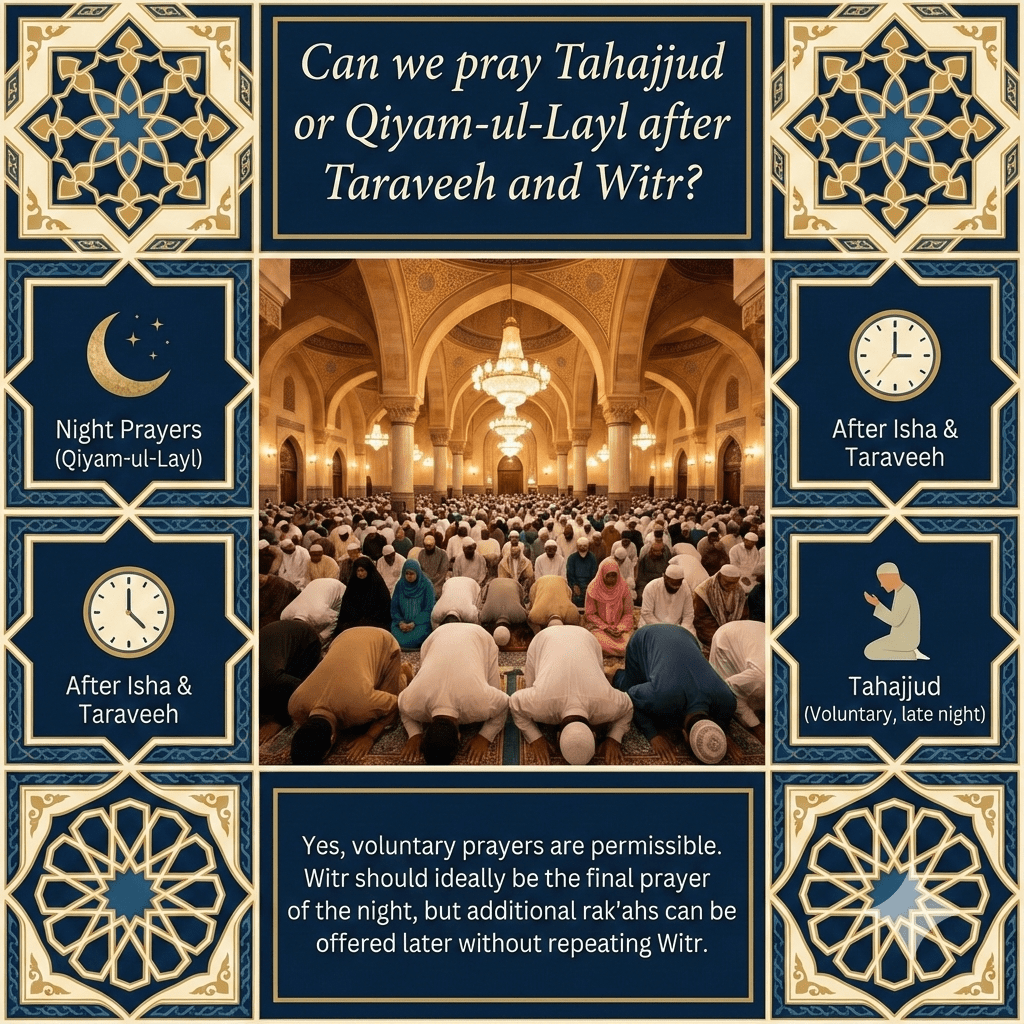
Whenever the question arises, ‘Can we pray Tahajjud or Qiyam-ul-Layl even after praying Taraweeh and Witr?’, many people reply:
“There is no need to pray because there is a hadith of the Prophet ﷺ which says that whoever offers the complete prayer with the Imam gets the reward equivalent to offering the prayer the entire night (Sunan An-Nasa’i, Saheeh [Al-Albani]).”
However, this answer is wrong from many angles.
First of all, is it permissible to offer any prayer after 11 rakats, which also includes Witr?
Yes. The Ahadith which says that Witr should be the last prayer, it does not mean that praying any Nafl salah (voluntary prayer) after Witr is completely Haram (forbidden). It means that Witr should generally be the last prayer. But if someone prays any Nafl or Sunnah of Isha after Witr, then there is no harm in it. For example, praying Tahajjud after Witr is proven from the Prophet ﷺ (and from the Sahaba, as will be seen soon InshaAllah).
Praying 2 Rakats after Witr by Prophet (Salallahu Alaihi Wa Sallam):
Abu Salamah narrates, “I asked Aisha (Radi Allahu Anha) about Prophet’s prayer.” She said: “He (Salallahu Alaihi Wa Sallam) used to pray thirteen (13) rakats. He (Salallahu Alaihi Wa Sallam) used to pray eight (8) rakats, then He prayed Witr. After that, he used to sit and pray two (2) rakats. Then, when He wanted to perform ruku, He would stand up and perform ruku. And alongside, He used to pray two (2) rakats between the Adhan and Iqamat of Fajr.” (Sahih Muslim)
Secondly- Is it correct to say that if you complete the entire taraweeh with the imam then you have earned the reward of praying the whole night and there is no need to pray any more?
This is a misunderstanding of the Prophet’s hadith. The meaning of this hadith is not to say, “Don’t pray extra prayers,” as neither the Prophet nor the companions understood it that way. The hadith describes the virtue of completing the taraweeh with the Imam. If there were no need to pray more than that because “it’s equivalent to praying all night,” then simply praying Isha and Fajr would be sufficient. Because the one who prays Isha and Fajr in congregation would not require to pray the Sunnah prayers at all as the person who prayed both the prayers would get the reward of praying the whole night according to the following hadith –
Uthman bin Affan (Radi Allahu Anhu) narrates that Messenger of Allah (Salallahu Alaihi Wa Sallam) said:
“The person who offers Isha prayer in congregation gets the reward of spending half the night in Qiyam. And the person who offers both Isha and Fajr prayers in congregation gets the reward of spending the entire night in Qiyam.”
[Jami At-Tirmidhi, 221, Sahih (Zubair Ali Zai)]
Thirdly- Did the companions pray in another jamaat (congregation) after one Taraweeh jamaat?
In the narration from Sunan Abi Dawood (1439), the companion Talq bin Ali (Radi Allahu Anhu) returns home and leads his family in prayer, including the Witr prayer. Afterwards, he goes to the masjid, leads the prayer, but does not pray the Witr prayer again. This suggests that one can pray after the Witr, but that the Witr prayer should not be repeated again, and one can also participate in two night-prayer congregations.
Qays ibn Talq narrates: Talq ibn Ali visited us on a day of Ramadan. He stayed with us till evening and broke the fast with us. Then he got up and lead the Witr prayer for us. After this he went to his masjid and offered the prayer there (for the people). Then when Witr prayer was left to be offered, he called forward another person and said: “Offer the Witr prayer for your people, because I heard the Messenger of Allah (Salallahu Alaihi Wa Sallam) saying, “There are no two Witrs in one night.”” (Abi Dawood, 1439, Sahih [Al-Albani], Hasan [Al-Arnaut])
Shaykh Saleh Al-Fawzan (May Allah preserve him) said:
“If a person prayed Taraweeh and prayed witr with the Imam, then stood in the night for tahajjud, then there is no preventative for that. And he does not repeat the witr, rather the witr he prayed with the Imam suffices him. He prays tahajjud in the night with what Allah makes easy for him and if he delays witr until the end of the night, then there is no harm. However, he will miss following the Imam and it is better to follow the Imam by praying witr with him due to the statement of the Prophet (Salallahu Alaihi Wa Sallam):
Indeed, whoever stands (praying) with the Imam until he finished, then it is recorded for him that he prayed the whole night. [Reported by Abu Dawood (2/51), Tirmidhi (3/147-148), Nasaai (3/83-84), Ibn Majah (1/420-421)]
So he follows the Imam and prays witr with him. This does not prevent him from standing at the end of the night and praying tahjjud with what is easy for him”. End.
[al-Muntaqaa min Fatawa Fawzan (no. 116), translation of Shaykh Saleh Al-Fawzan’s Fatwa was taken from torontodawah.com/the-ruling-on-praying-tahajjud-after-taraweeh/]
(Compiled by Mohammed bin Thajammul Hussain Manna, translated from Roman Urdu to English by Adeeb Sheriff.)
Ruling on Eating Meat Sold in Markets of Non-Muslim Countries- Shaykh Ibn Baaz
Question: What is the ruling on eating meat sold in the markets of non-Muslim countries? Is it permissible (halal) or forbidden (haram)?
Answer: The scholars of Islam are unanimously agreed upon the prohibition of the slaughtered meat of the polytheists, idol worshipers, atheists, and all similar categories of disbelievers, except for the Jews, Christians, and Zoroastrians (Majus). They are also unanimously agreed upon the permissibility of the slaughtered meat of the People of the Book (Jews and Christians).
They differed, however, regarding the slaughtered meat of the Zoroastrians (Majus) – the fire worshipers. The four Imams and the majority of scholars hold that it is prohibited, likening the Zoroastrians to idol worshipers and all other categories of disbelievers who are not from the People of the Book. Some scholars held that their slaughtered meat is permissible, likening them to the People of the Book.
This latter view is very weak, rather it is false. The correct view is that of the majority of scholars: the prohibition of the slaughtered meat of the Zoroastrians, like the slaughtered meat of all other polytheists, because they are of their kind, except concerning the Jizyah (poll tax). The Zoroastrians only resemble the People of the Book in that the jizyah is accepted from them.
The evidence for this is the saying of Allah the Exalted in His Noble Book, in Surat Al-Ma’idah (5:5): “This day [all] good foods have been made lawful, and the food of those who were given the Scripture (Jews and Christians) is lawful for you and your food is lawful for them.”
He the Exalted explicitly states that the food of the People of the Book is lawful for us. Their “food” refers to their slaughtered meat, as stated by Ibn ‘Abbas and other scholars.
The implication of the verse is that the food of those disbelievers who are not from the People of the Book is forbidden to us. This is the view held by all scholars, except for the aforementioned aberrant and weak difference of opinion regarding the slaughtered meat of the Zoroastrians.
Now that this is established, the meat sold in the markets of non-Muslim countries: If it is known that it comes from the slaughtered meat of the People of the Book, then it is permissible for Muslims, as long as it is not known that it was slaughtered in a manner contrary to Islamic law. The principle is its permissibility based on the Qur’anic text, and one should not deviate from this except for a verified matter that necessitates its prohibition.
However, if the meat comes from the slaughtered meat of the rest of the disbelievers, then it is forbidden to Muslims, and it is not permissible for them to eat it, based on the textual evidence and consensus. Mentioning Allah’s name over it during washing or during eating is not sufficient.
As for the argument some might raise based on the Hadith, that narration pertains to a group of Muslims who were new to faith. Some Companions, may Allah be pleased with them, asked the Prophet (Salallahu Alaihi Wa Sallam) about this, saying: “O Messenger of Allah, people who are new to faith bring us meat, and we do not know whether they mentioned the name of Allah over it or not.” This was narrated by Al-Bukhari in the Hadith of ‘A’ishah, may Allah be pleased with her. This Hadith cannot be used as a pretext by those who permit eating meat brought to markets from the slaughter of disbelievers other than the People of the Book by merely mentioning Allah’s name over it. This is because the aforementioned Hadith of ‘A’ishah pertains to Muslims, not to disbelievers; thus the ambiguity is removed. The affairs of a Muslim are assumed to be correct and upright as long as the contrary is not known. Perhaps the Prophet (Salallahu Alaihi Wa Sallam) commanded those who asked him to mention Allah’s name when eating, as a precaution and to nullify the whisperings of Satan, not because that permits what was forbidden from their slaughtered meat. And Allah the Exalted knows best.
Regarding a Muslim in those non-Muslim countries finding it difficult to obtain meat slaughtered according to Islamic law, or becoming weary of eating chicken meat and the like, this and similar reasons do not make it permissible for him to eat forbidden meat, nor does it place him in the category of one under duress, by consensus of the Muslims.
It is essential to pay attention to this matter and beware of unjustified leniency.
This is what has become apparent to me concerning this issue, which has become widespread. I ask Allah to grant success to the Muslims in what is beneficial for their religion and their worldly affairs, to fill their hearts with fear of Him and reverence for His sanctities, and to beware of what contradicts His Law.
—
[1] Narrated by Al-Bukhari, no. 5083 (Book of Slaughtering and Hunting), Chapter on the Slaughtered Meat of Bedouins and the Like.
[2] Published in the Journal of the Islamic University in Madinah. (Collection of Fatawa and Articles of Shaykh Ibn Baz 23/13).
Ruling on Eating from the Slaughtered Meat of the People of the Book
Question: This question is sent by the listener Al-ʿUmari Muhammad, a Moroccan national residing in France. He has two questions, the first of which is: He says, “You know that the custom of those who were given the Scripture differs from the custom of the Arabs in slaughtering animals. However, we eat from their beef, mutton, and goat meat. Is there any sin upon us for that or not?”
Answer: Allah the Exalted has permitted for us the food of the People of the Book. He said (interpretation of the meaning): “This day [all] good foods have been made lawful, and the food of those who were given the Scripture is lawful for you and your food is lawful for them.” [Al-Mā’idah: 5]. The People of the Book are the Jews and Christians. They had altered and substituted [scripture] before the mission of the Prophet (Salallahu Alaihi Wa Sallam), and they have distorted [it]. Despite that, Allah permitted for us their food and the chaste women from among them.
This indicates that there is no harm for us in eating their food. Their food means their slaughtered meat. As for fruits and similar items, these may be eaten from all categories of people, even from those not among the People of the Book. Even the polytheists of various kinds, there is no harm in eating their fruits, grains, and produce—no problem. What is prohibited is the slaughtered meat. Slaughtered meat from those other than the People of the Book, such as polytheists, Zoroastrians, and those with no religion, is forbidden. The slaughtered meat of these individuals is not permissible for Muslims at all. Rather, what is permitted for us is specifically the slaughtered meat of the People of the Book: the Jews and Christians.
If you do not know how they slaughtered [the animal], then eat, and praise be to Allah. Do not ask, as long as you know that this is from the slaughtered meat of the People of the Book, the Jews or Christians, for it is lawful for you.
However, if you come to know that they (the Jews and the Christians) slaughtered it in an un-Islamic manner—for example, if they strangled it to death, then do not eat it. For they are not better than the Muslims. If a Muslim were to strangle an animal, it would be forbidden; if he struck its head until it died, it would be forbidden; if he struck its belly until it died, it would be forbidden, and he is a Muslim. So how about a Jew or Christian? The Jew or Christian is less than a Muslim. So if they are negligent in slaughter, and you know that—that he slaughtered it in an un-Islamic way, such as strangling it or beating it until it died—then it is not permissible.
Host: Or by electrical means, for example.
Shaykh: Or by electrical means, extracting its blood, draining the blood from its veins until it died, or striking its head until its skull was crushed—then it is not permissible.
Likewise, if he engaged in some other method besides these known methods, other than proper slaughter, or if he slaughtered it for other than Allah, dedicating it to the Messiah, or to Ezra, or to other idols, then it is not permissible. Because Allah has forbidden that which is dedicated to other than Allah.
As for when you do not know, then you may eat. Or if you know that they slaughtered it according to Islamic slaughter—[cutting] the throat (ḥalqūm), the esophagus (marī’), and the two jugular veins (wadajayn). Islamic slaughter is like this: cutting the throat, esophagus, and the two jugular veins. This is complete slaughter. If he cuts the throat and esophagus, it suffices. If he cuts along with them one of the two jugular veins, that is good. However, perfection in slaughter is to cut the throat, the esophagus, and both jugular veins altogether. These are the two veins surrounding the neck. If the slaughterer cuts these four things, it is most complete. If he suffices with the throat and esophagus, it is permissible according to the correct view. If he cuts along with them one of the two jugular veins, it is likewise permissible. If he cuts them—cuts all four—this is the most complete form of slaughter.
The Sunnah is that he should say the tasmiyah: “Bismillah.” Rather, this is obligatory at the time of slaughter, to mention the name of Allah. If he forgets it or is unaware of the ruling, there is no harm if he slaughtered and did not say the tasmiyah out of ignorance or forgetfulness, whether he is Muslim or a disbeliever. There is no harm. Yes.
Host: May Allah reward you with good.

(Translated by Mohammed bin Thajammul Hussain Manna.)

 Saheehus-Seerah