The main aim of our site is to purify The Seerah of Prophet Muhammad ﷺ from weak and fabricated narrations using the works of the scholars of Islam. We may add other beneficial material as well.
His Eminence, our revered father, Shaykh ʿAbdul-ʿAzeez ibn ʿAbdullāh ibn Baaz, Grand Mufti of the Kingdom—may Allah protect him from all harm.
Peace, mercy, and blessings of Allah be upon you. To proceed:
I have a question for which I kindly request Your Eminence’s answer. The question is:
What is the ruling on wiping the face with the hands after supplication, especially after the supplication of qunūt and after supererogatory prayers? May Allah preserve and reward you. Peace, mercy, and blessings of Allah be upon you.
Answer:
And upon you be peace, mercy, and blessings of Allah. To proceed:
Its ruling is that it is recommended (mustaḥabb), based on what al-Ḥāfiẓ (Ibn Hajr Al-Asqalani) mentioned in Bulūgh al-Marām in the chapter on remembrance and supplication—the final chapter of the work—that several hadiths have been narrated concerning it, the aggregate of which indicate that it is a ḥasan hadith. May Allah grant success to all. Peace be upon you.
A personal question answered by His Eminence on 12/9/1419 AH. (Majmūʿ Fatāwā wa-Maqālāt ash-Shaykh Ibn Baaz, 26/148).
(12/9/1419 AH corresponds to Wednesday, 30 December 1998 CE. This was around 5 months before his death in 13 May 1999. We must note that he had previous Fatwas where he said that wiping the face after Dua isn’t a prescribed Sunnah.)
This note presents a series of AI-assisted historical map reconstructions of the Arabian Peninsula, tracing the transition from the fragmented Najdi political landscape before the Dirʿiyyah alliance to the First, Second, and Third Saudi States.
The aim is explanatory rather than polemical: to visualize changing centers of power, campaigns, rival dynasties, and external pressures across Arabia in a chronological way. These maps are not archival maps from the periods themselves, but modern visual reconstructions generated with AI from historically grounded prompts and then checked against published historical reference works.
The written notes and map specifications were based chiefly on the Library of Congress country study on Saudi Arabia, the University of Leeds / White Rose thesis on the First Saudi State, and reference material from Britannica and Cambridge for chronology and regional context. To keep terminology and dynastic framing closer to indigenous Saudi usage, I also consulted Saudipedia, especially its entries on the First Saudi State, Second Saudi State, and the unification of Saudi Arabia. In that sense, the project combines AI image generation with a source-guided historical framework rather than presenting the visuals as unmediated historical originals. [See: Library of Congress Cambridge, Saudipedia: First Saudi State, Saudipedia: Second Saudi State, Saudipedia: Unification of Saudi Arabia]
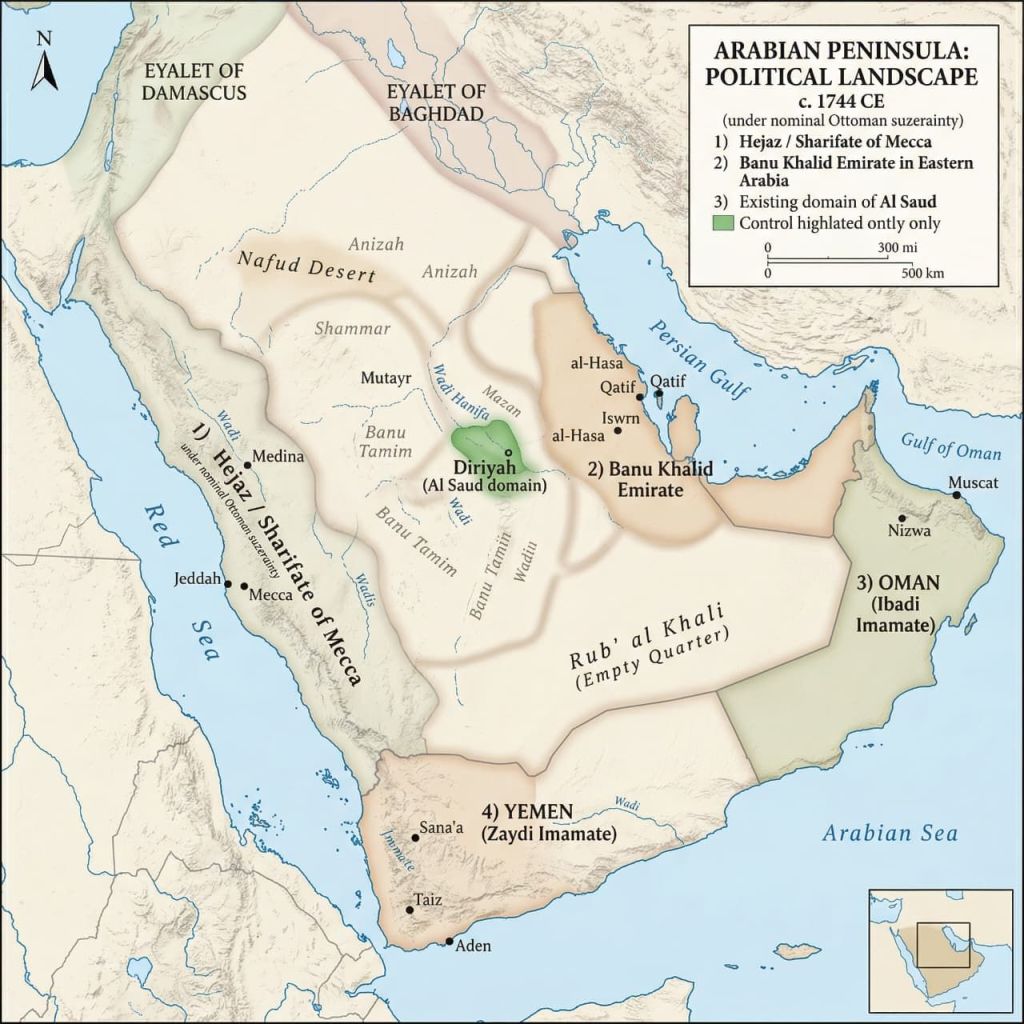
Map 1
The State of Ad-Diriyyah, the small citydom of Aal-Saud in 1744 CE, when Muhammad bin Abdul Wahhab (Rahimahullah, born 1703 CE) began his Dawah.
Who was Muhammad bin Abdul Wahhab bin Sulaiman At-Tameemi?
Muhammad bin Abdul Wahhab (1703–1792) was an eighteenth-century Najdi Hanbali scholar and reformer, originally from al-ʿUyaynah who became the religious architect of the movement that later allied with the House of Saud (Aal-Saud). After early study in Najd, he traveled to the Hejaz, Madinah, Basra, Iraq, and eastern Arabia, then returned to Najd preaching against saint-veneration, shrine practices, and what he saw as later religious innovations. His message presented itself as a return and revival to orthodoxy and pure Islam: a call to restore the beliefs, worship, and moral order of the early Muslim community. Among the main scholars who shaped his learning were Shaykh ʿAbdullah ibn Ibrahim ibn Saif, Shaykh Muhammad Hayat as-Sindi al-Madani, and Shaykh Muhammad al-Majmuʿi. He was very much influenced by the works of Imam Ibn Taymiyah and Imam Ibn al-Qayyim (May Allah’s mercy be upon them all). In 1744, his alliance with Muhammad bin Saud in Dirʿiyyah gave this reform project political protection and state-building force.
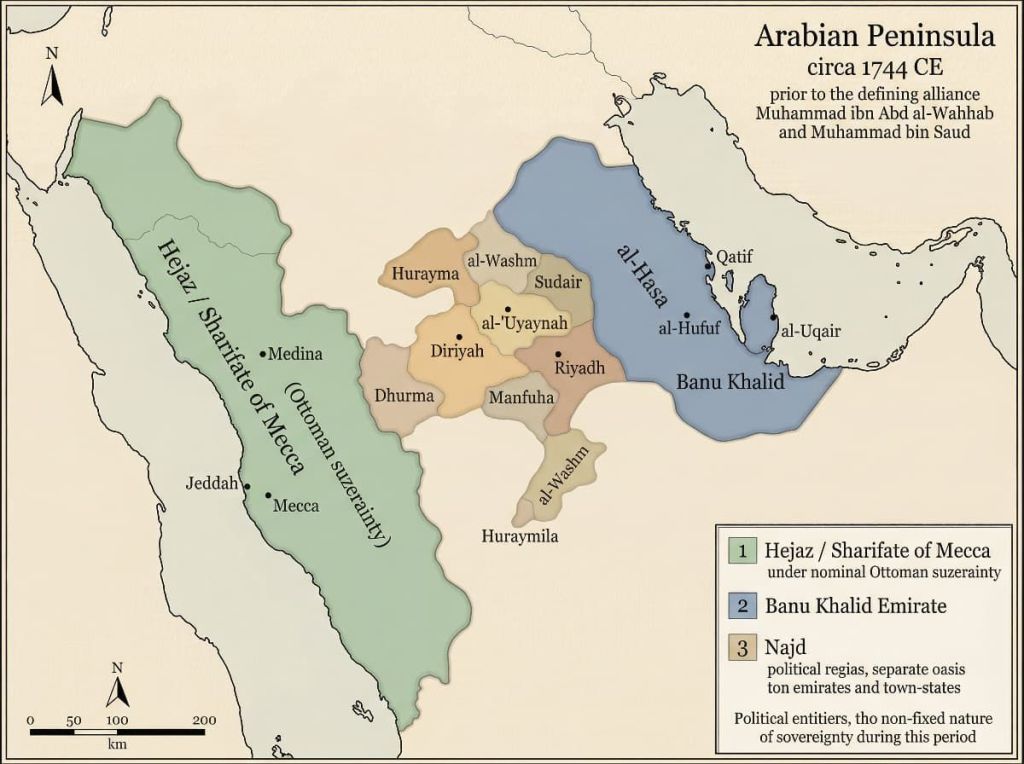
Map 2
Muhammad bin Abdul Wahhab (Rahimahullah) was born in the city state of Al-Uyaynah. You can see the different kingdoms in the Arabian Peninsula.
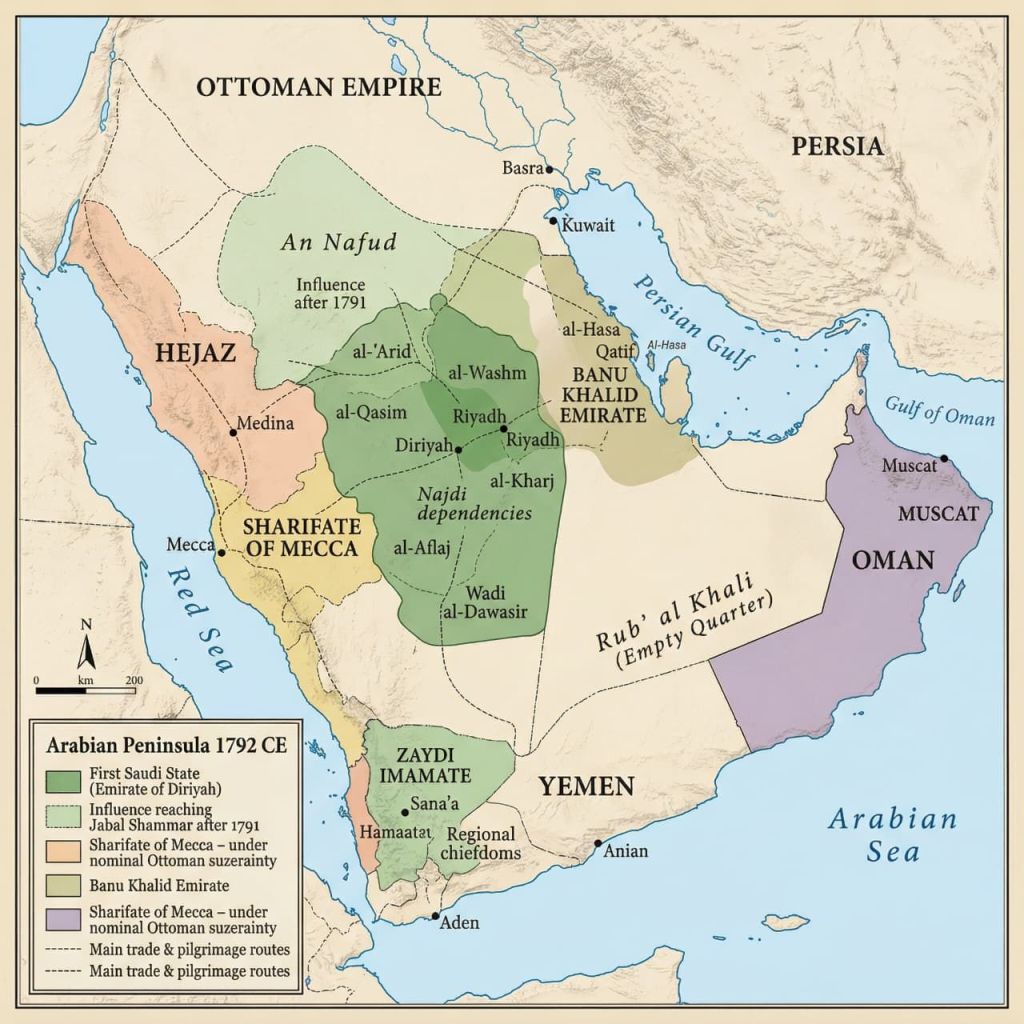
Map 3
The first Saudi state (Name: The Emirate of Ad-Diriyyah) at the death of Muhammad bin Abdul Wahhab Rahimahullah (1792 CE). The dark green area shows the regions captured by them.
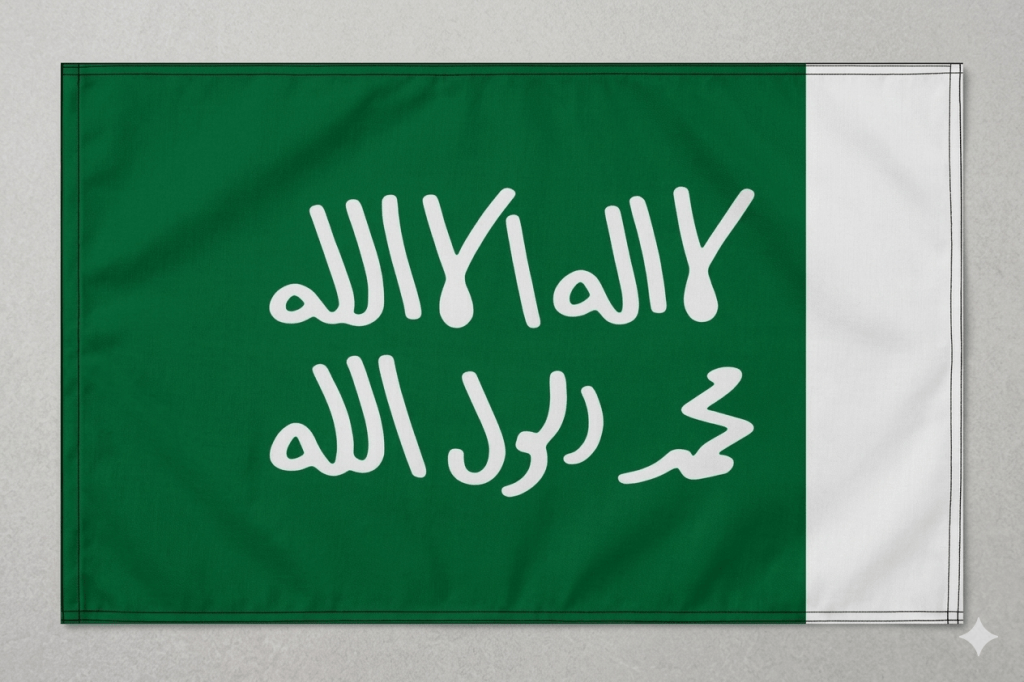
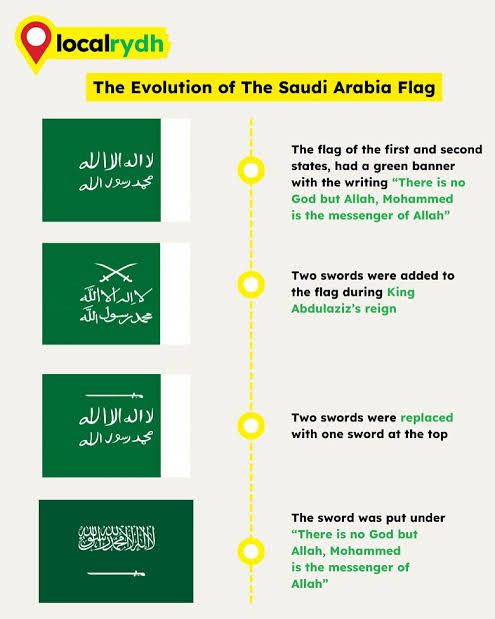
The flag of the Emirate of Ad-Diriyah (1744-1818), or you may call it ‘The First Saudi Flag’.
Map 4
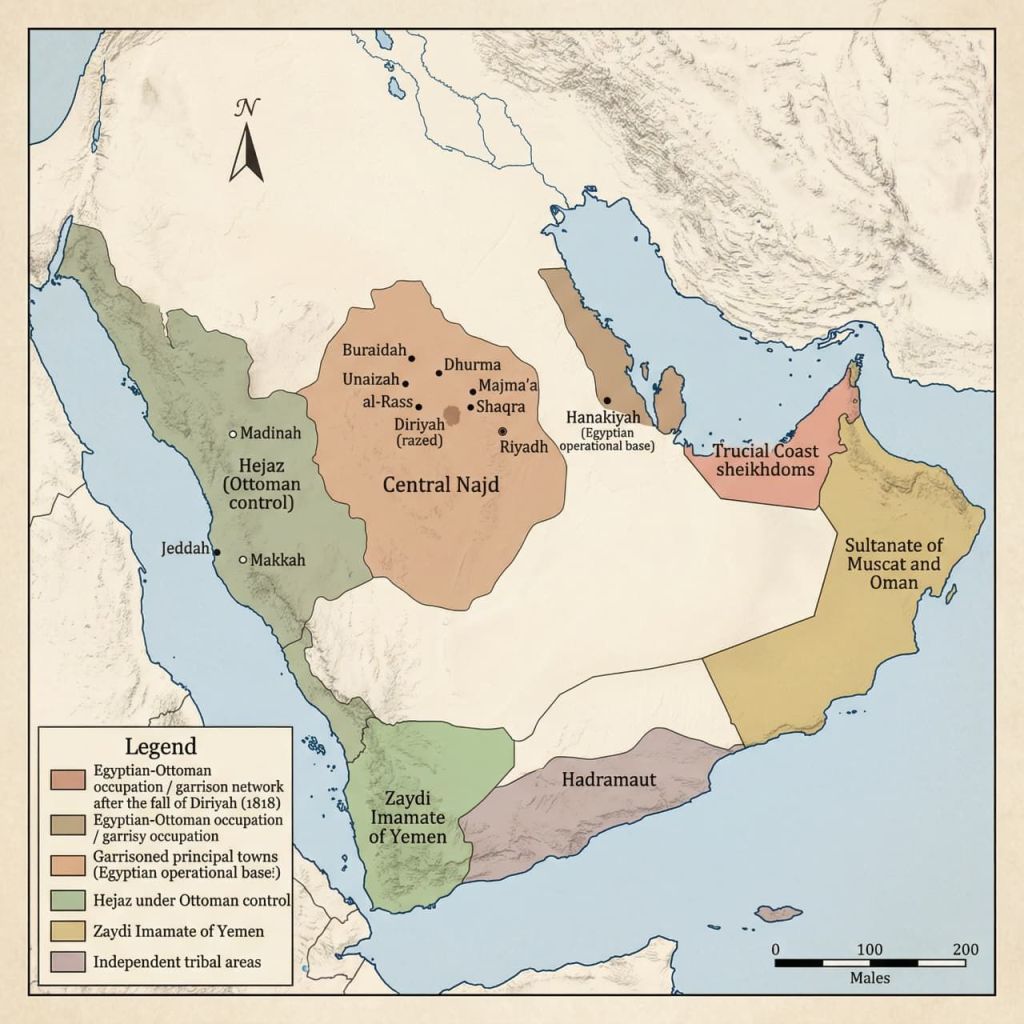
By 1818 CE the 1st Saudi state (The Emirate of Ad-Diriyyah) was destroyed and erased from the Arabian Peninsula by the Egyptian-Ottoman forces.
Map 5
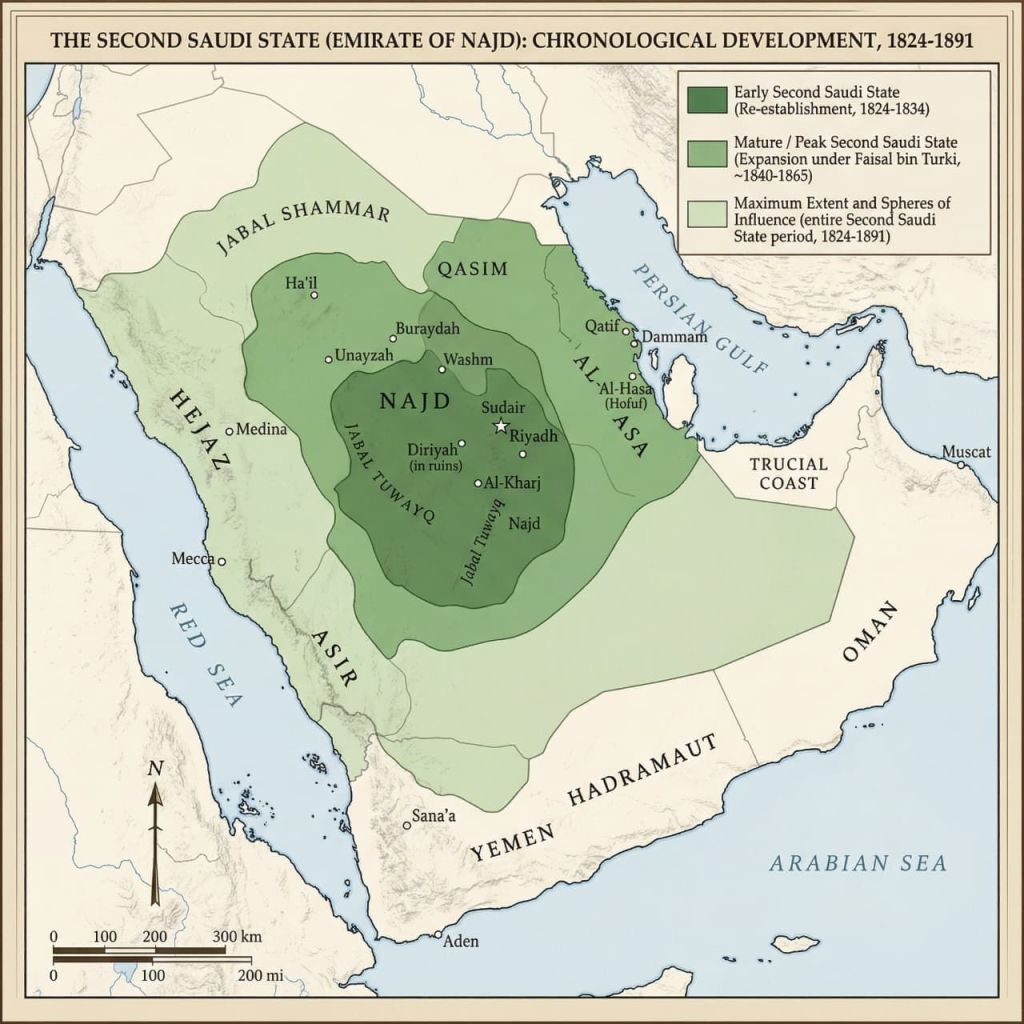
‘The Emirate of Najd’-name of the 2nd Saudi state. This map shows the phases of the 2nd Saudi State: the early re-established core under Turki bin Abdullah Aal-Saud, the broader mature phase under Faisal bin Turki Aal-Saud, and the contracted late territory before collapse in 1891.
Map 6
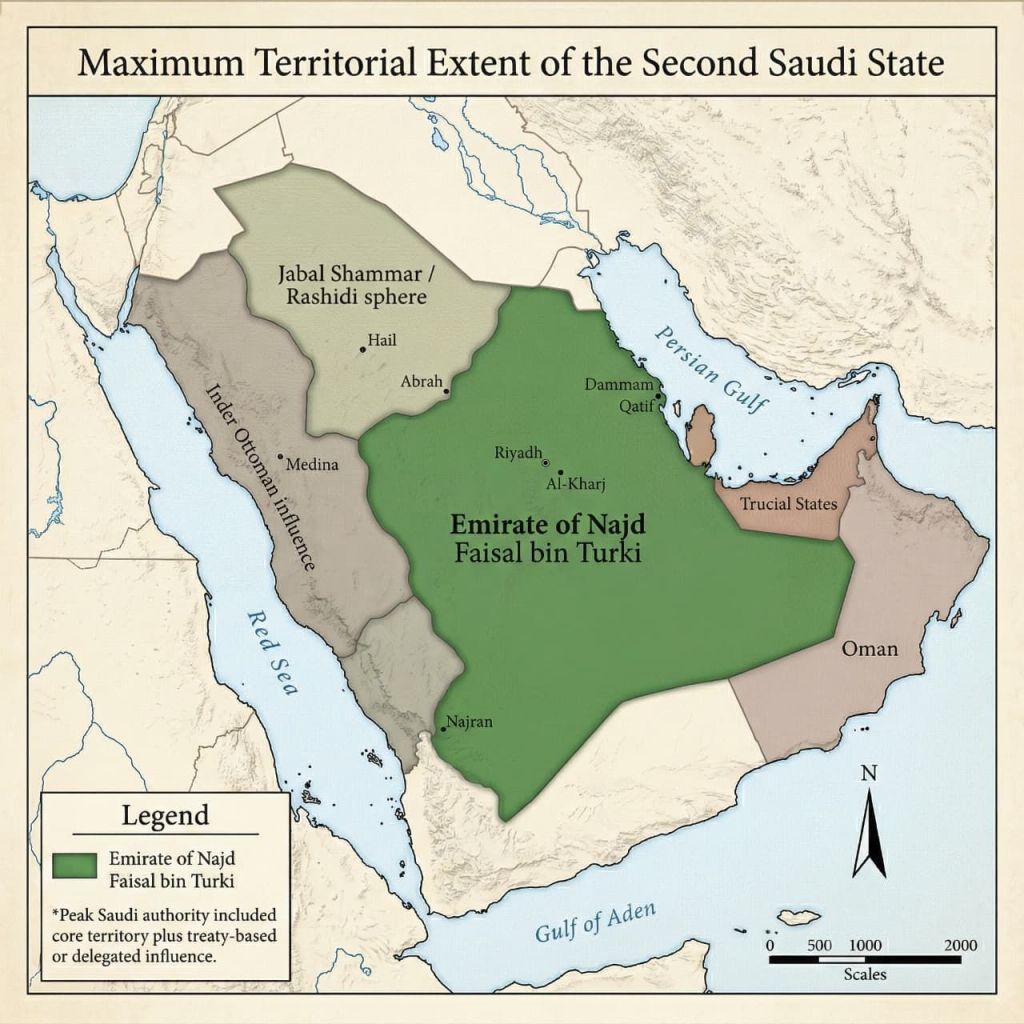
The Emirate of Najd (2nd Saudi state), maximum territories captured, under Faisal bin Turki Aal-Saud before its collapse.
Map 7
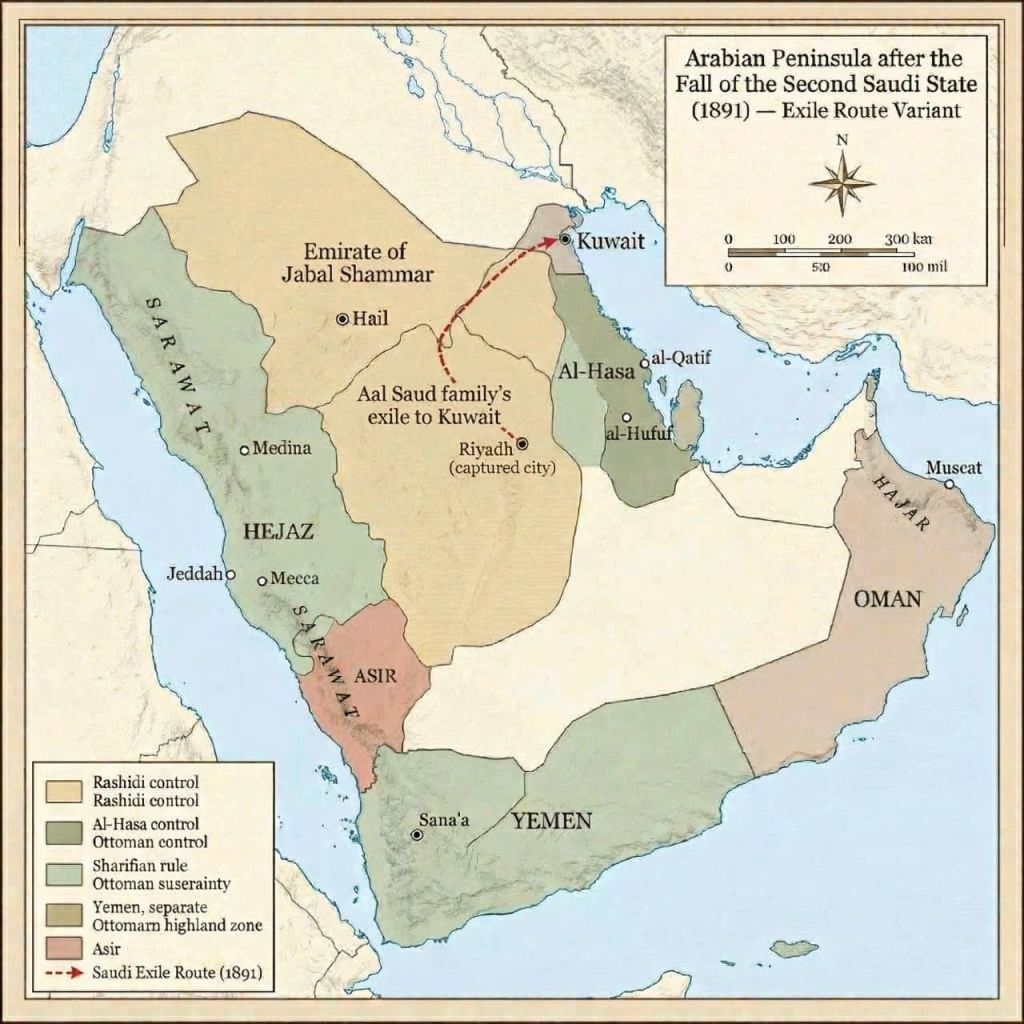
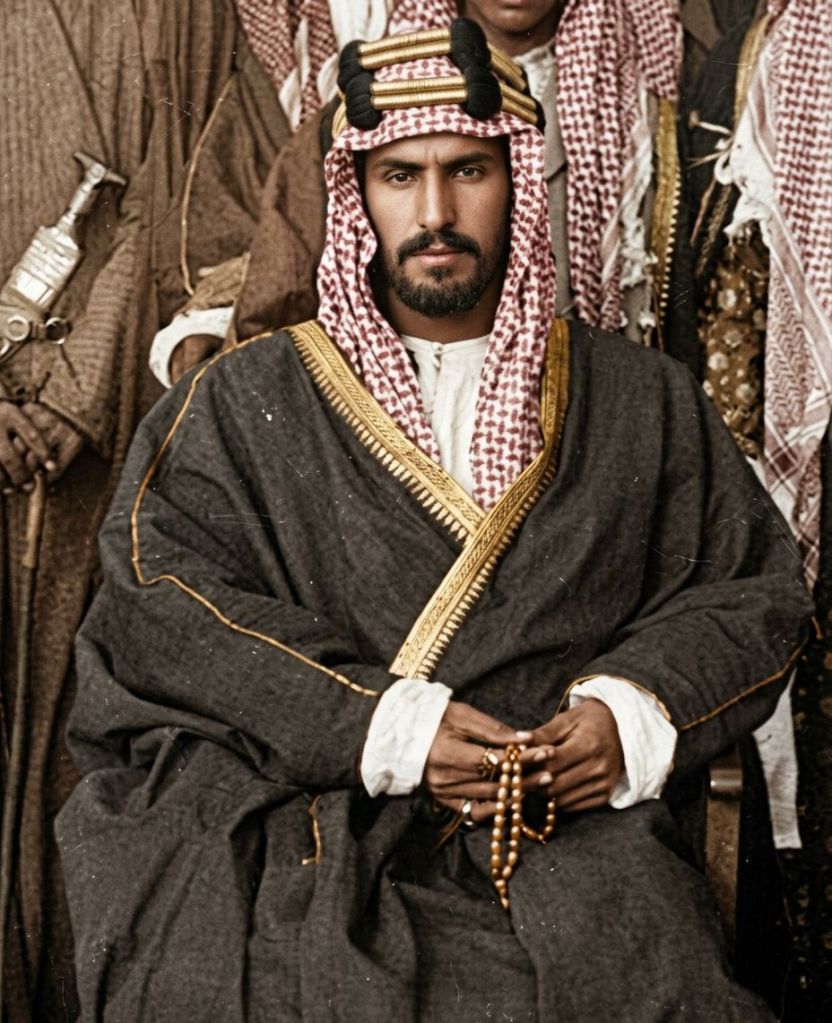
When Abdul Azeez bin Abdur Rahman Aal-Saud (born Jan 15, 1876) was around 15 years old, the Aal-Saud family escaped penniless to Kuwait to save their lives. They lived under the Kuwaiti ruler Shaykh Mubarak Al-Sabah’s protection. Helping them served Kuwait’s interests by using Abdul Azeez in the future to counter Muhammad Ibn Abdullah ar-Rashid (King of Emirate of Jabal Shammar), improving Kuwait’s regional position, and supporting Abdul Azeez’s eventual return to Riyadh in 1902 CE.
This image of King Abdul Azeez was originally black and white, I used AI to colourise it.
The entry of Abdul Azeez bin Abdur Rahman Aal-Saud
Abdul Azeez bin Abdur Rahman Aal Saud was the warrior-founder of the Third Saudi State (Father of the current King Salman). Driven into exile with his family after the fall of Riyadh in 1891, he grew up in Kuwait with the memory of a lost capital and a broken dynasty. Then, still a young man at 21, he returned in 1902 with a small strike force—a night assault with just 15 warriors—and captured the Riyadh fort in the raid that changed Arabian history. From that moment, Abdul Azeez was no longer only an exile or claimant, but a battlefield leader, state-builder, and unifier whose campaigns would eventually bring Najd, Hail, and the Hejaz under one rule. Was he perfect, or was he evil? No rather he was a man from the Muslims, a commander, a ruler, a gray figure with more goodness than evil, merciful at times and ruthless at times, Salafi in Aqeedah.
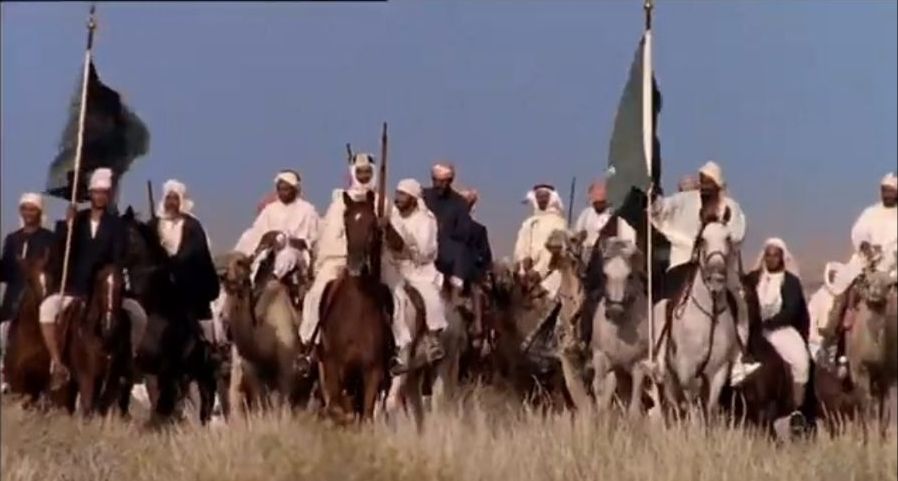
(A still from the movie King Abdul Azeez – Unity Part 1.)
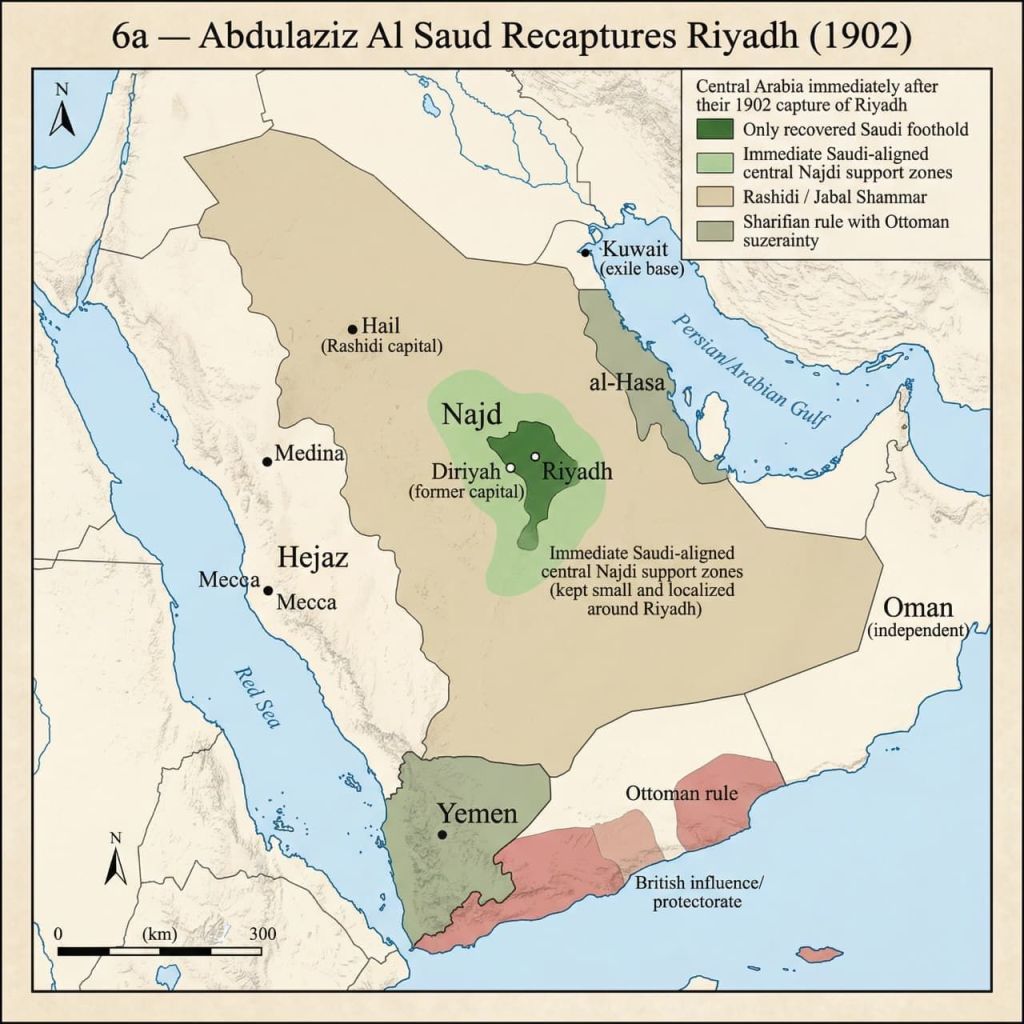
Map 8 (‘6a’ as marked during image generation)
Abdul Azeez Aal-Saud at 21 years of age captures Riyadh (dark green) from the Emirate of Hail (Jabal Shammar) and starts expanding (light green).
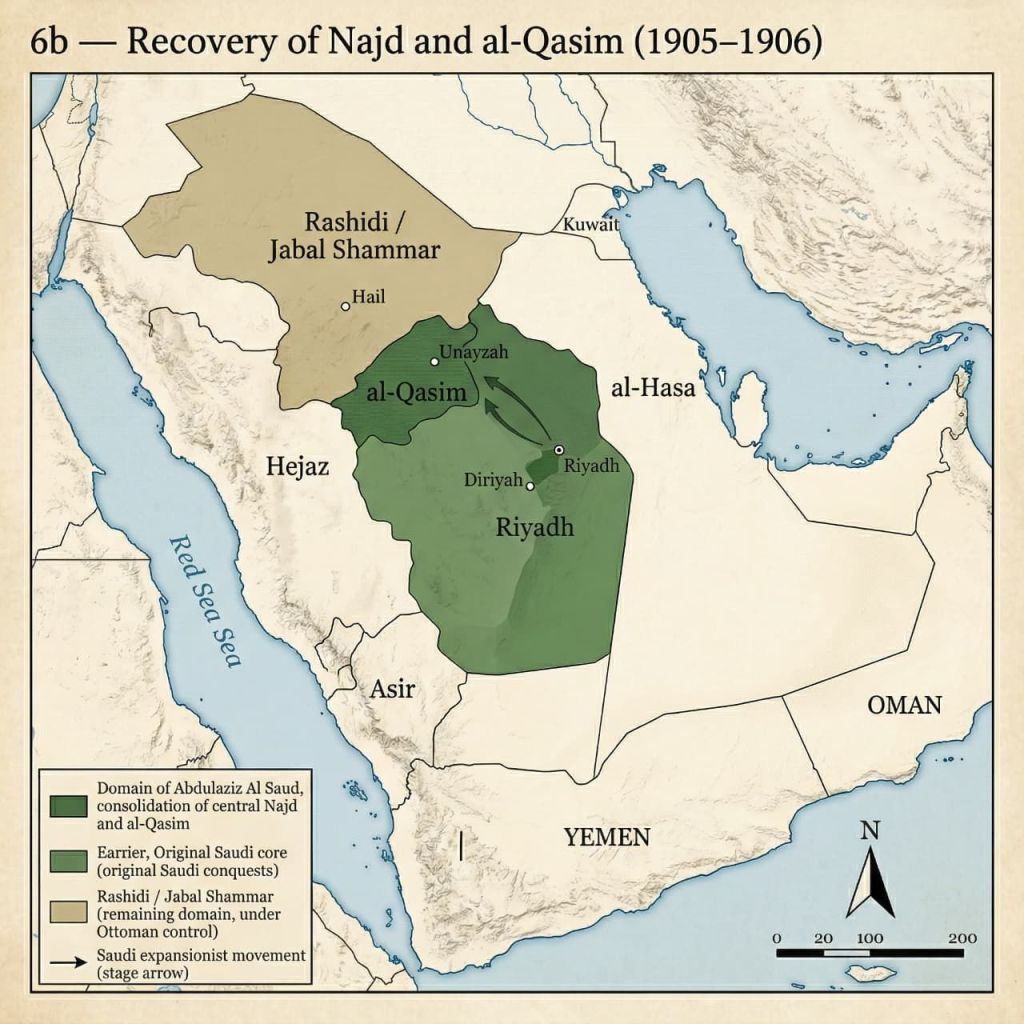
Map 9 (6b)
By age 30 he captures almost a half of the Emirate of Hail.
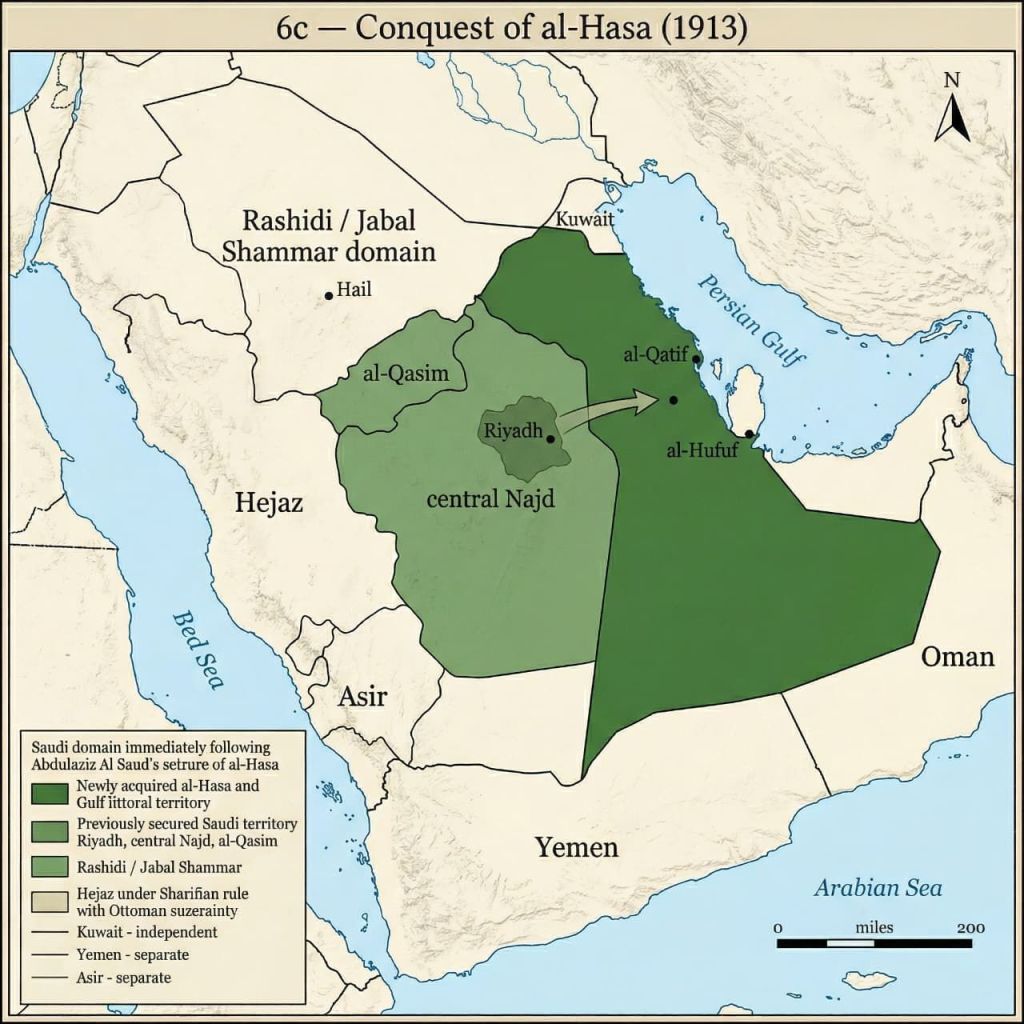
Map 10 (6c)
By age 37, a lot of region in the eastern side of the Arabian Peninsula is under Abdul Azeez.
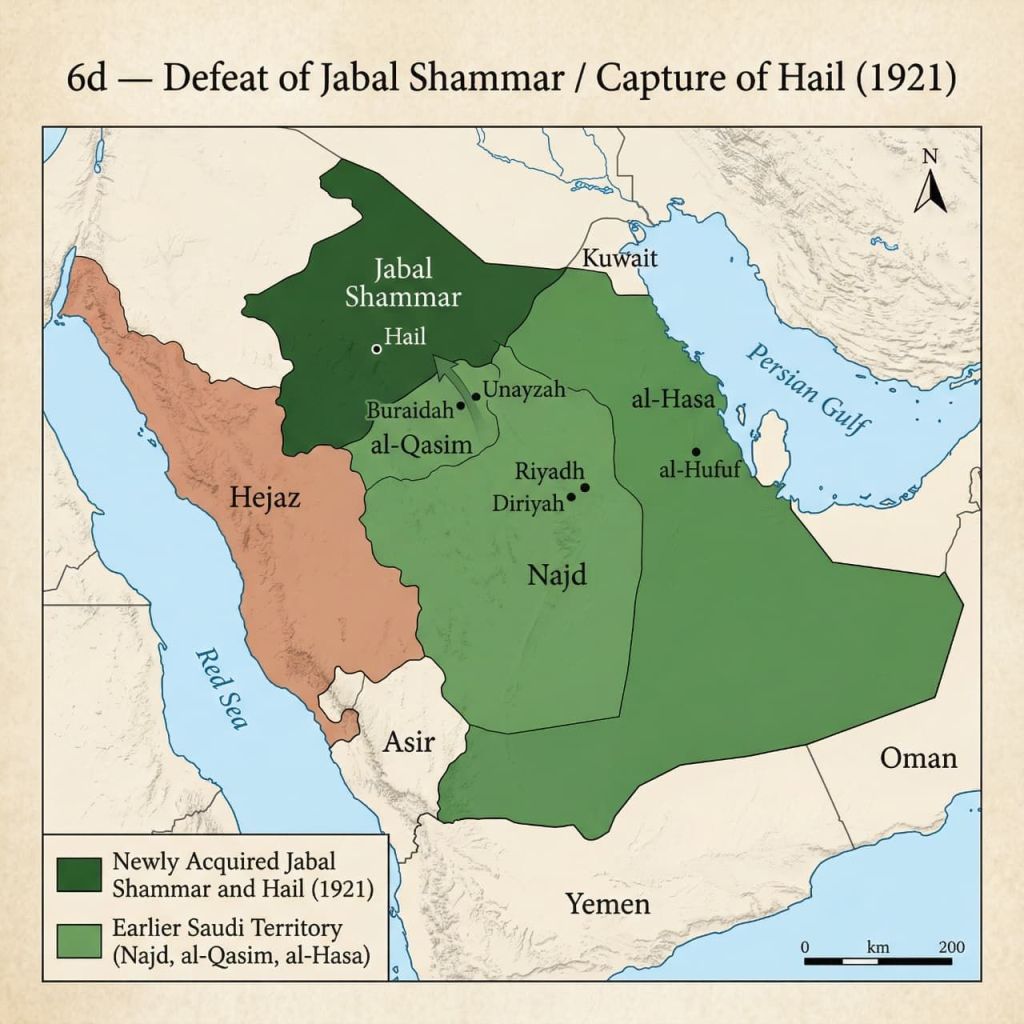
Map 11 (6d)
By age 45, Abdul Azeez totally captures what was called the Emirate of Jabal Shammar (Emirate of Hail). Makkah, Madina and Taif (Hijaz) is still not under his control.
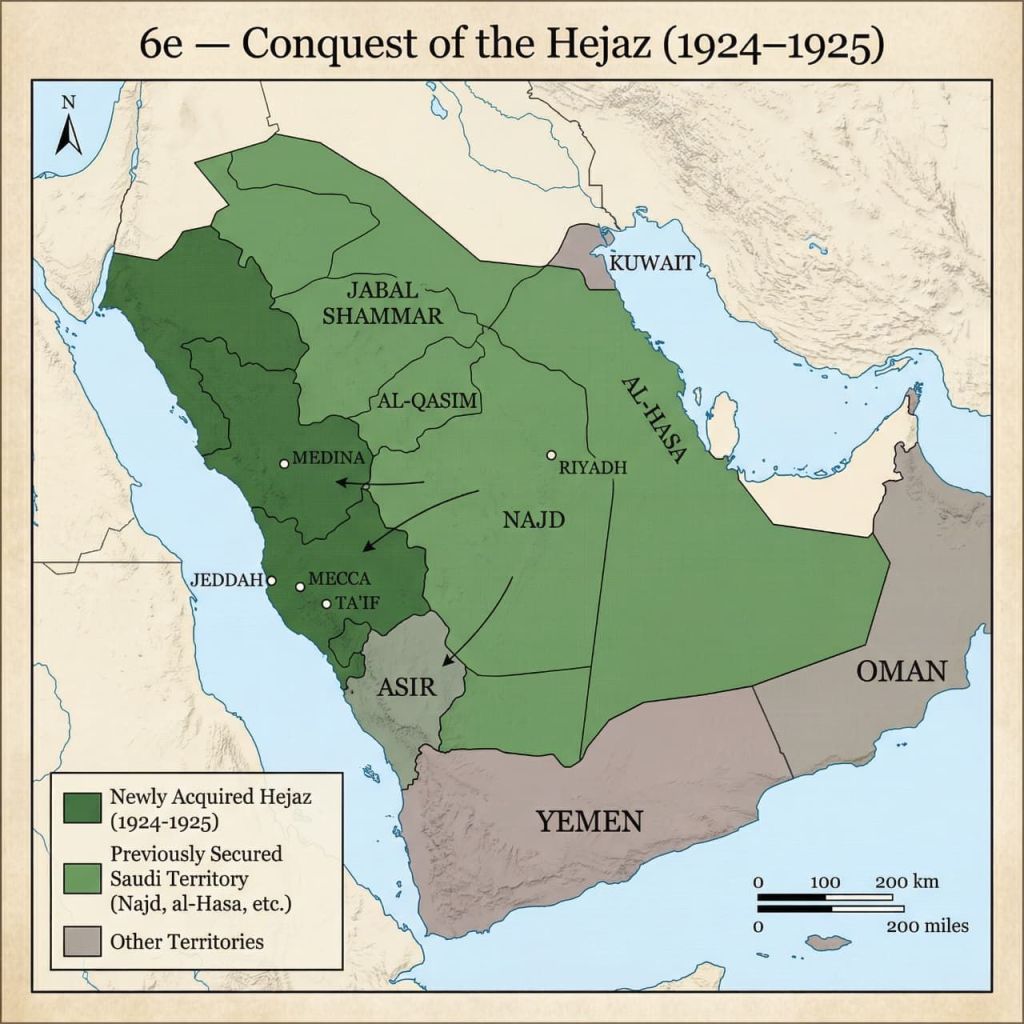
Map 12 (6e)
Finally Makkah, Madina, Taif and Jeddah were captured.
The map 12 (6e) shows the capture of the Hejaz and the transfer of the holy cities to Abdul Azeez Aal Saud. Sharif Husayn ibn Ali, (the Sufi) Governor of Makkah (under the Ottomans) had rebelled against the Ottomans in the Arab Revolt of 1916 and made himself King of the Hejaz. But by the mid-1920s, the balance of power in Arabia had changed. Abdul Azeez, advancing from Najd with the a powerful army, struck westward; Makkah was taken in 1924, and Madinah and Jeddah were taken when their populations surrendered in 1925. With that, Husayn’s order collapsed, and Abdul Azeez emerged not just as a conqueror of territory, but as master of Arabia’s most symbolically powerful region.
Map 13
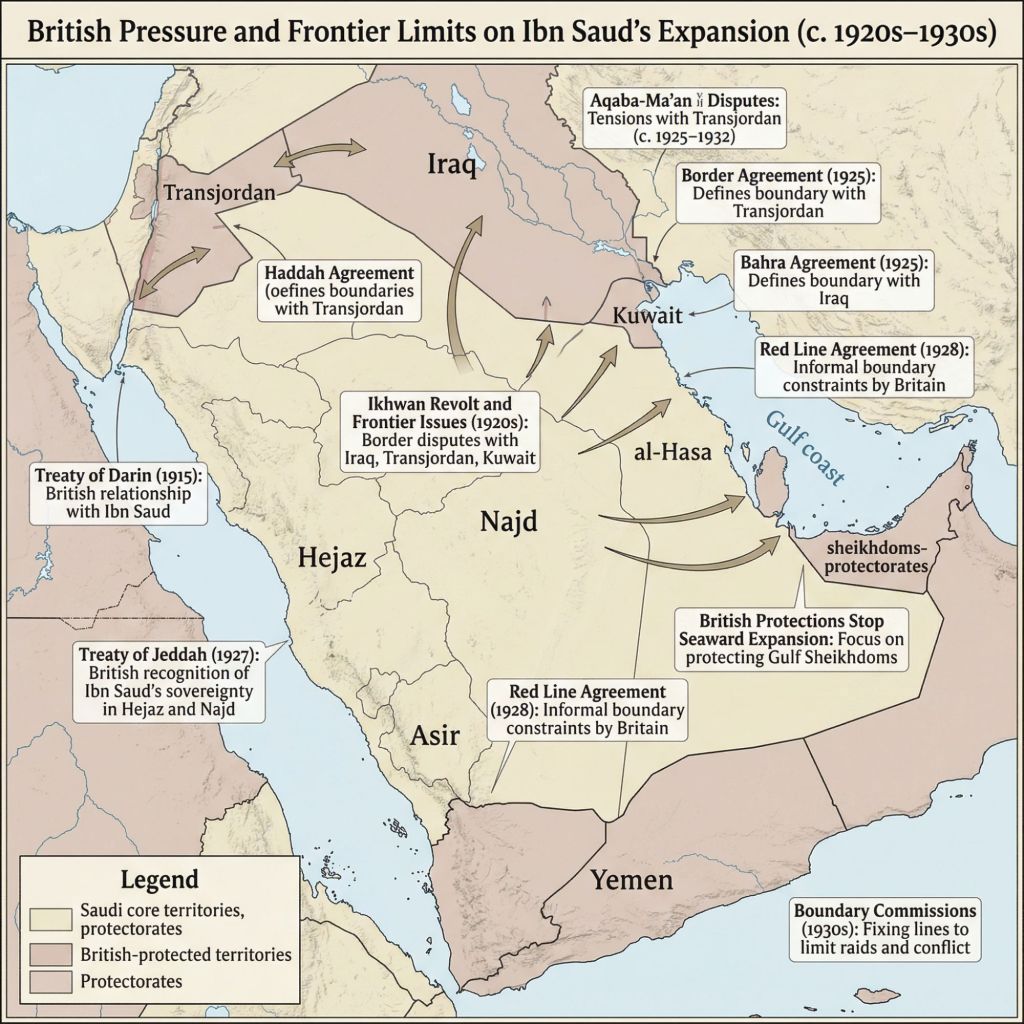
Why didn’t King Abdul Azeez expand the Saudi state further?
Not that he didn’t try. In modern-state terms, the places Abdul Azeez Aal-Saud or forces acting under his banner tried to capture, raid and attack, or dominate beyond the territory of present-day Saudi Arabia included Iraq, Jordan/Transjordan, Kuwait, Yemen, and later Oman / Abu Dhabi in today’s UAE through the Al-Buraymi dispute. The clearest full military success outside his final kingdom was against Yemen in 1934, which ended with the Treaty of At-Taif and confirmed Saudi possession of Asir and other disputed areas. By contrast, raids into Iraq and Transjordan did not lead to conquest, Kuwait was attacked and pressured but not annexed, and the Saudi move into Al-Buraymi was later reversed. Reason: The British protected these areas and forced Abdul Azeez to stop expansion.
British intervention was a major reason these conquests stopped. By the late 1920s, the lands beyond Abdul Azeez’s frontier—especially Iraq, Transjordan, Kuwait, and much of the Gulf coast—fell inside the British imperial sphere or under rulers protected by British treaties. Britain opposed further Saudi expansion, enforced borders, negotiated settlements such as al-ʿUqayr with Kuwait, and in some cases used direct force: British aircraft repelled the Ikhwan army (Saudi tribal military forces, not the Ikhwan-ul-Muslimeen group) raids into Iraq, and British-backed forces later drove Saudi troops out of Al-Buraymi. This pressure, combined with Abdul Azeez’s need to suppress the Ikhwan (Saudi tribal troops under him) and stabilize his new kingdom, changed Saudi policy from frontier conquest towards consolidation of whatever they already had.
Who were the Ikhwan army?
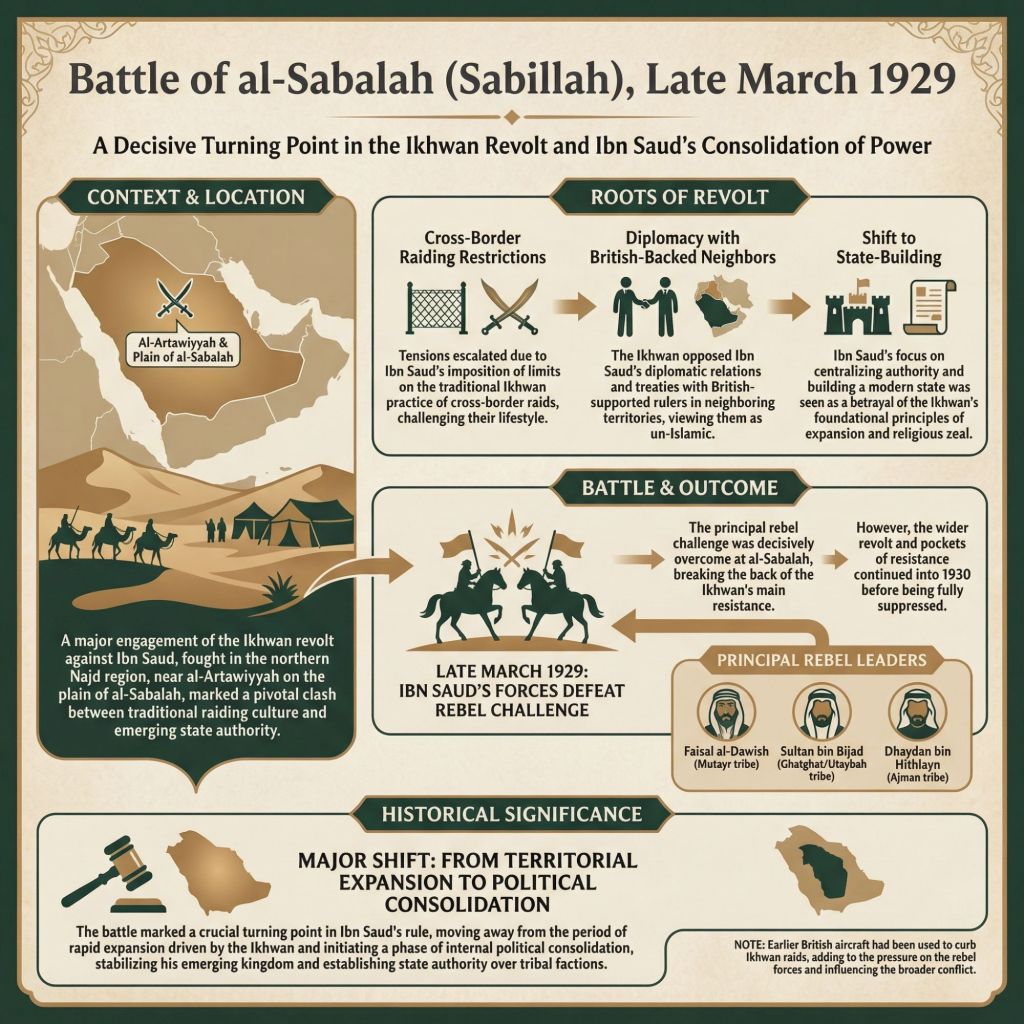
The Ikhwan were King Abdul Azeez Aal-Saud’s warrior-brethren. Bedouin fighters reshaped into a religious army by Abdul Azeez and unleashed to forge his kingdom across Arabia. They helped him attack rivals, seize Hail, overrun the Hejaz, and bring Makkah, Madinah, and Jeddah under his rule. But once the kingdom began to take shape, the alliance cracked. The Ikhwan wanted endless jihad beyond the frontier—into Iraq and Transjordan, they wanted to establish an Islamic state modelled like the Caliphs—while Abdul Azeez chose diplomacy, borders, and modern state-building. The Ikhwan were also against King Abdul Azeez agreeing to the British limits on Saudi expansion calling it un-Islamic.
Eaelier the British aircraft had already punished Ikhwan raids into Iraq in order to stop Saudi expansion at their hands.
At Sabilla in 1929, the Ikhwan army and its scholars rebelled against King Abdul Azeez. King Abdul Azeez shattered their revolt and crushed the Ikhwan, ending the age of Saudi expansion by this holy-war cavalry.
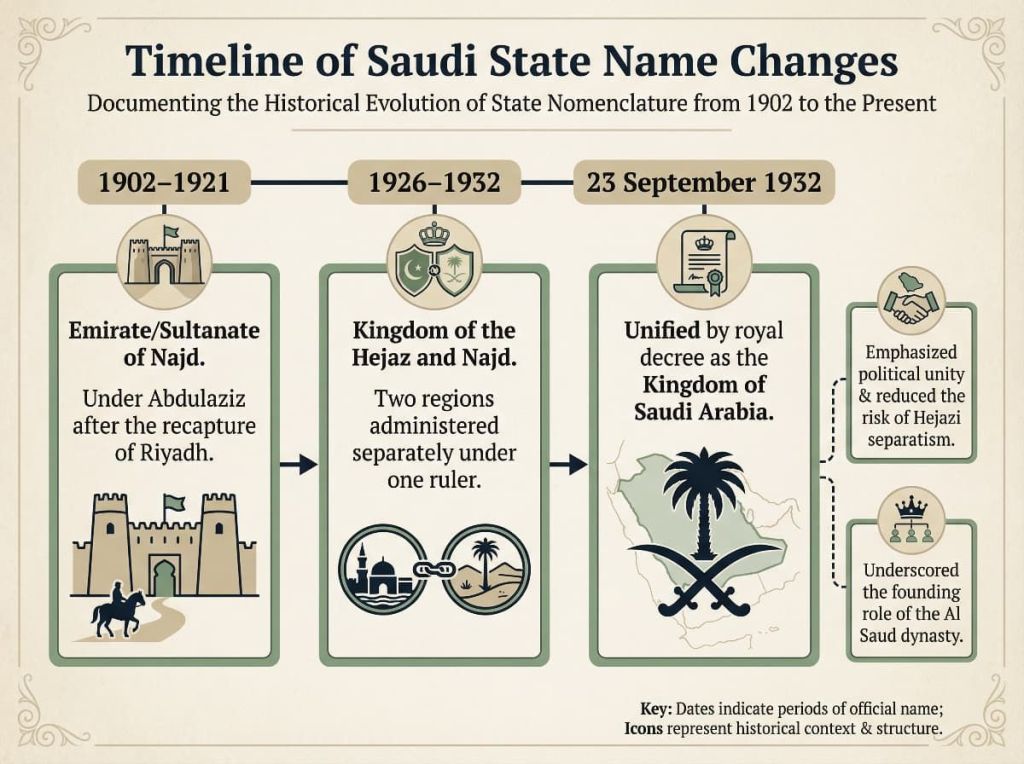
This was the beginning of the modern nation state phase of the Kingdom of Saudi Arabia.
The Third Saudi State had two names before being finally named ‘The Kingdom of Saudi Arabia’.
[The End.]
[Compiled and written by Mohammed bin Thajammul Hussain Manna.]
Shaykh Saleh Al-Fawzan had been asked this exact question regarding minority Muslims in the West and other non-Muslim nations. In one recorded audio fatwa explaining this specific Hadith, a questioner asked:
“(Question:) Concerning the author’s statement, may Allah have mercy on him, ‘It is not permissible for anyone to spend the night without having a pledge of allegiance upon his neck,’ then how is this, Your Eminence, when we reside in the lands of the unbelievers? To whom is the pledge of allegiance upon our necks due?
(Answer:) “This is among the disadvantages of residing in the lands of the unbelievers; this is among the disadvantages of residing in the lands of the unbelievers. Therefore, do not reside there except only out of necessity, and only to the extent required by that necessity. But if you have an alternative, then it is not permissible for you to reside there. (As Allah says in The Quran:) {Indeed, those whom the angels take in death while wronging themselves—they will say, ‘In what circumstances were you?’} [Qur’an 4:97]. ‘In what circumstances were you?’—that is, they ask them in which place they were. Among the disadvantages of residing in the lands of the unbelievers is that there is no Muslim imam (ruler) there, and that the rulings of the unbelievers are applied to him. But if one is compelled to this (i.e living in Non-Muslim lands), if one is compelled to this, then he remains only to the extent of necessity.” [End of the answer.]
Shaykh Muhammad bin Saleh Al-Uthaymeen touches upon this in his explanation, Al-Sharh Al-Mumti’ ‘ala Zad Al-Mustaqni’. He clarifies that since the Muslim world fractured centuries ago, the ruler of any specific region takes the exact legal ruling of the General Imam (Muslim ruler) for the people living within those borders, rendering a singular worldwide bay’ah (pledge of allegiance) non-applicable.
Shaykh Ibn Uthaymeen’s explanation:
“His statement, ‘or if the imam mobilizes him’: this is the third circumstance.
If ‘he mobilizes him (for fighting the enemy),’ that is, he says: Go forth.
And his statement, ‘the imam’ means the highest authority in the state. It is not a condition that he be a general imam for all Muslims, because the universal imamate has long since ceased to exist. The Prophet (Salallahu Alaihi Wa Sallam), said: ‘Hear and obey, even if an Abyssinian slave is appointed over you.’ If a person assumes authority over a certain region, he takes the position of the general imam; his word becomes enforceable and his command obeyed. Since the time of the Commander of the Faithful, ʿUthmān ibn ʿAffān, may Allah be pleased with him, the Muslim community began to fragment: Ibn az-Zubayr in the Hijaz, Banū Marwān in ash-Sham, and al-Mukhtār ibn ʿUbayd and others in Iraq. Thus the community became divided, yet the imams of Islam have continued to hold that loyalty and obedience are due to whoever has assumed authority in their respective region, even if he does not possess the universal caliphate.
By this we come to know the error of a faction that has arisen saying: ‘There is no imam for the Muslims today, so no bayʿah is due to anyone!’ We ask Allah for well-being. I do not know whether these people want affairs to become chaotic, with no leader to govern the people, or whether they want it to be said: every person is his own ruler.
If such people die without a bayʿah, they die a death of jāhiliyyah—Allah’s protection is sought—because the practice of the Muslims for long ages has been that whoever gains control over a region and holds the highest word therein is its imam. The scholars have explicitly stated this, such as the author of Subul al-Salām.”
(The Hadith above: “Reported by al-Bukhārī in Kitāb al-Adhān, Bāb Iqāmat al-ʿAbd wa’l-Mawlā (no. 693), from Anas, may Allah be pleased with him. Its wording is: ‘Hear and obey, even if an Abyssinian slave is appointed over you, whose head is like a raisin.’”)
[Ibn ʿUthaymeen, ash-Sharḥ al-Mumtiʿ ʿalā Zād al-Mustaqniʿ, 1st ed. (Dār Ibn al-Jawzī, 1422–1428 AH), vol. 8, pp. 9–10.]
The Hadith in discussion is a part of a longer Hadith from Sahih Muslim: “… “One who withdraws his hand from obedience (to the ruler) will meet Allah on the Day of Resurrection without any proof (in his defense), and whoever dies without having a pledge of allegiance (bay’ah) on his neck, dies a death of ignorance (jahiliyyah).” (Sahih Muslim, 1851)
The other famously quoted Hadith, that is: ‘Anyone who dies without knowing the Imam of his time will die the death of one belonging to Jahiliyyah’. The Hadith in this wording was fabricated by the Shiites and falsely ascribed to the Prophet (peace be upon him). (See here)
The benefits (Fawa’id) derived regarding the topics of leadership (Imamah) and the pledge of allegiance (Bay’ah) from the speech of the two Shaykhs:
Benefit 1: The Cessation of the Universal Imamate (Universal leadership):
Shaykh Ibn Uthaymeen clarifies a historical and jurisprudential reality that the Universal Caliphate (Al-Imamah Al-‘Ammah) encompassing the entire Muslim world ceased to exist centuries ago, beginning with the early fragmentation during the era of the Companions and their successors.
Benefit 2: Regional Rulers Hold the Status of the General Imam (the Muslim ruler):
Despite the absence of a single global Caliph or ruler, the concept of Islamic leadership remains entirely valid. Whoever gains authority, power, and the highest word over a specific region takes the exact legal position of the General Imam for the people of that region.
Benefit 3: Bay’ah is Geographically Bound to Jurisdiction:
The obligation of Bay’ah (pledge of allegiance) is tied to actual authority and jurisdiction. A Muslim is only required to hold a pledge of allegiance to the ruler who holds authority over the specific region in which that Muslim resides.
Benefit 4: The Absence of Bay’ah for Minorities in Non-Muslim Lands:
As derived from Shaykh Al-Fawzan’s answer, because Muslims residing in non-Muslim lands do not live under the jurisdiction of a Muslim ruler, the specific obligation of having a Bay’ah upon their necks is fundamentally suspended. It is an obligation tied to capability and circumstance.
Benefit 5: The Invalidity of Cross-Border Pledges: Combining the principles from both scholars, it becomes evident that pledging allegiance to a foreign ruler (such as a Muslim in India pledging to the ruler of Saudi Arabia) is invalid. The foreign ruler does not possess authority or the ability to enforce laws and protect the blood and wealth of people outside his borders.
Benefit 6: The Danger of the Kharijite Ideology Regarding Leadership:
Shaykh Ibn Uthaymeen issues a severe warning against groups who claim that because there is no Universal Caliph, there is no Bay’ah owed to anyone today. This is an erroneous and dangerous methodology intended to create chaos and rebellion, contradicting the established practice of the scholars (Imams) of Islam for centuries.
Benefit 7: The Correct Application of the Hadith on the “Death of Jahiliyyah”:
The severe warning of dying a death of pre-Islamic ignorance applies specifically to a person who lives in a region governed by a Muslim ruler but refuses to recognize or pledge allegiance to that established authority. It does not apply to a Muslim living in a non-Muslim land where no such Islamic authority exists.
(What causes the Bay’ah to be cancelled? Read here to know more.)
(Translated and benefits added by Mohammed bin Thajammul Hussain Manna.)
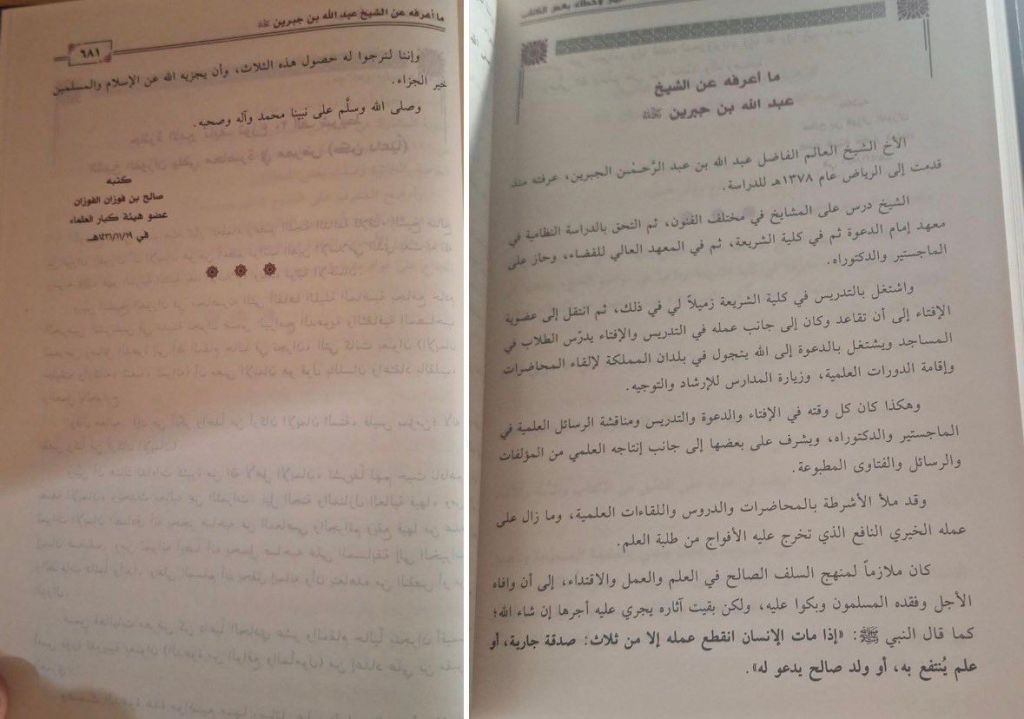
My brother, the virtuous scholar, Shaykh Abdullah bin Abdulrahman Al-Jibreen; I have known him since I arrived in Riyadh in the year 1378 AH to pursue my studies.
The Sheikh studied under various scholars across diverse disciplines. He subsequently enrolled in formal education at the Imam Ad-Da’wah Institute, followed by the College of Sharia, and then the Higher Institute for the Judiciary, ultimately earning his Master’s and Doctorate degrees.
He engaged in teaching at the College of Sharia, serving as my colleague in that capacity, before transitioning to membership in the Permanent Committee for Scholarly Research and Ifta until his retirement. Alongside his official duties in teaching and issuing religious verdicts (Ifta), he taught students in mosques and actively engaged in Da’wah (calling to Allah). He traveled throughout the cities of the Kingdom to deliver lectures, conduct scholarly courses, and visit schools to provide guidance and direction.
Consequently, his entire time was devoted to Ifta, Da’wah, teaching, and examining academic dissertations at the Master’s and Doctoral levels, while also supervising several of them. This was in addition to his scholarly output, which comprised authored books, treatises, and published fatwas.
He recorded numerous audio cassettes containing lectures, lessons, and scholarly academic sessions. He steadfastly continued his beneficial and philanthropic endeavors, under which successive cohorts of students of knowledge graduated.
He adhered strictly to the methodology of the Pious Predecessors (Salaf as-Salih) in knowledge, practice, and emulation, until his appointed time arrived. The Muslims mourned his loss and wept for him; however, his legacy endures, and its reward continues to accrue to him, by the will of Allah.
This is in accordance with the saying of the Prophet ﷺ: “When a human being dies, his deeds come to an end except for three: ongoing charity, knowledge from which others benefit, or a righteous child who supplicates for him.”
We sincerely hope that he attains all three of these merits, and that Allah grants him the best of rewards on behalf of Islam and the Muslims.
May the peace and blessings of Allah be upon our Prophet Muhammad, his family, and his companions.
Written by, Saleh bin Fawzan Al-Fawzan Member of the Council of Senior Scholars On 19/1/1431 AH
From Shaykh Muhammad bin Saleh Al-Uthaymeen’s official website.Source
Question:
A listener, Muḥammad Ḥamd Allāh Bātī, asks: Is it permissible to dedicate the reward of prayers offered after the obligatory prayer to one’s deceased father or mother?
Answer:
Ash-Shaykh: The stronger view according to us is that this is permissible, and that a person may gift the reward of non-obligatory righteous deeds to whomever he wishes among the Muslims.
However, even so, this is not something that ought to be done, nor is it from the Sunnah; that is to say, it is not something required of a person to do. If he does so, there is no harm in it.
Supplicating for one’s parents is better than gifting acts of devotion to them, because supplication is a legislated matter by agreement and beneficial by the agreement of the people of knowledge, whereas gifting acts of devotion is a matter concerning which the scholars have differed.
We advise our brothers who wish to benefit their parents or other Muslims to benefit them by supplicating for them for forgiveness, mercy, and divine good pleasure, for that is more effective and more beneficial by the consensus of the Muslims.
[End of the answer.]
***
Imam ash-Shāfiʿī (Rahimahullah)-
“Rūḥ ibn al-Faraj informed me; he said: I heard al-Ḥasan ibn aṣ-Ṣabāḥ az-Zaʿfarānī ask ash-Shāfiʿī about reciting at the grave, and he said: ‘There is no harm in it.’”
“As for reciting the Qur’an and gifting it to him (the deceased) voluntarily without payment, this reaches him, just as the reward of fasting and ḥajj reaches him. If it is said: This was not known among the Salaf, and the Prophet (Salallahu Alaihi Wa Sallam) did not direct them to it — the answer is: if the one raising this objection already admits that the reward of ḥajj, fasting, and supplication reaches the deceased, then it is said to him: what is the difference between that and the reward of Qur’an recitation reaching him? The mere fact that the Salaf did not do something is not itself proof that it cannot reach; from where do we get such a universal negation? And if it is said: the Messenger of Allah (Salallahu Alaihi Wa Sallam) guided them to fasting, ḥajj, and charity, but not to recitation — the answer is: he (Salallahu Alaihi Wa Sallam) did not initiate those rulings without being asked; rather, they came as answers to questions. One asked him about performing ḥajj for his deceased relative, so he allowed it. Another asked him about fasting on behalf of the deceased, so he allowed it. He did not forbid anything else besides that. And what difference is there between the reward of fasting — which is merely intention and abstention — and the reward of recitation and remembrance?”
(Ibn al-Qayyim, al-Rūḥ, p. 142–143)
***
Imam Mansur al-Buhuti (Rahimahullah)-
“Any act of devotion — such as supplication, seeking forgiveness, prayer, fasting, ḥajj, Qur’an recitation, and other than that — if a Muslim performs it and assigns its reward to a deceased Muslim or a living Muslim, that benefits him. Aḥmad said: The deceased receives every kind of good, due to the transmitted texts regarding this, as mentioned by al-Majd and others. He added: Even if it were gifted to the Prophet (Salallahu Alaihi Wa Sallam) it would be permissible and the reward would reach him, though one should not single him out for that, because every act of worship performed by someone from his Ummah already brings him the like of its reward without reducing the reward of the doer in the least.”
(Manṣūr ibn Yūnus al-Buhūtī, al-Rawḍ al-Murbiʿ Sharḥ Zād al-Mustaqniʿ, Kitāb al-Janāʾiz, in the section discussing gifting reward to the deceased; in some printed editions around p. 192.)
 Saheehus-Seerah