The main aim of our site is to purify The Seerah of Prophet Muhammad ﷺ from weak and fabricated narrations using the works of the scholars of Islam. We may add other beneficial material as well.
Question: Do righteous acts performed during the month of Ramadan receive a greater reward and multiplication of virtues compared to other days of the year?
Answer:
Al-Ḥamdu lillāhi, was-Ṣalātu was-Salāmu ʿalā Rasūli Allāhi, wa ʿalā Ālihi wa Ṣaḥbihi, ammā baʿd. (Praise be to Allah, and peace and blessings be upon the Messenger of Allah, and upon his family and companions. To proceed…)
Indeed, the reward for righteous deeds is multiplied during Ramadan more than in any other month or day. It is stated in ‘Mataalib Uuli An-Nuha’ (by Mustafa bin Sa’ad As-Suyuti): ‘Good and evil deeds are multiplied in virtuous locations such as Makkah, Madinah, and the Al-Aqsa Mosque, as well as in (other) mosques. Similarly, deeds are multiplied during virtuous times, such as Friday, the sacred months, and Ramadan.”
As for the multiplication of good deeds (Al-Hasanaat), there is no disagreement regarding this matter. However, regarding the multiplication of evil deeds (As-Sayyiaat), a group of scholars, following Ibn ‘Abbas and Ibn Mas’ud, held this opinion… Some researchers stated that Ibn ‘Abbas and Ibn Mas’ud’s statement regarding the multiplication of evil deeds meant that the intensity (Kayfiyyah) of the evil deeds is multiplied, not their quantity (Kamiyyah).” End quote.
In “Kashshaaf Al-Qina'”, combined with the text of “Al-Iqna'”, it is stated: “It is recommended during Ramadan to increase recitation of the Quran, Dhikr, and charity, due to the multiplication of good deeds during this month.”
And in “Al-Mubdi'”, it is mentioned: “… Ibrahim (An-Nakhai) said: ‘A single Tasbih (glorification of Allah) in Ramadan is better than a thousand Tasbih in other months.'”
Dr. Marouf Al-Dawalibi, may Allah have mercy upon him (who was advisor to King Faisal), recounted an important conversation in his memoirs between the King, may Allah have mercy upon him, and French President Charles de Gaulle.
Part of the conversation went as follows:
De Gaulle said, “Your Majesty, people are talking arrogantly, (that) you want to throw Israel into the sea. (But) This Israel has become a reality. And no one in the world accepts the perpetuation (and existence) of this reality.”
The King replied, “Your Excellency, the President, I am astonished by your words! Hitler occupied Paris, and his occupation became a reality. All of France surrendered except for you. You withdrew with the British army and continued to work to resist the reality until you overcame (became victorious over) it (victorious over Hitler). Neither you nor France surrendered to the reality.”
(King Faisal continued:) “Nor did your nation surrender, so I am astonished that you are now asking me to accept the status quo, and woe to you, Your Excellency, when the weak are occupied by the powerful, they (the powerful) then demand the golden rule of General de Gaulle, which is: ‘Occupation becomes legitimate when it becomes a reality’ .”
De Gaulle was astonished by King Faisal’s quick wit and changed his tone. He said: “Your Majesty, the Jews say that Palestine is their original homeland, and their greatest forefather, Israel, was born there.”
King Faisal replied: “Your Excellency, the President, I admire you because you are a religious man who believes in your religion, and you undoubtedly read the Bible. Have you not read that the Jews came from Egypt as invaders? They burned cities and killed men, women, and children.”
“So how can you say that Palestine is their country, when it belongs to the Arab Canaanites, and the Jews are colonizers? And you want to reinstate the colonization that Israel achieved 4,000 years ago? Why don’t you also reinstate the colonization of France by Rome, which occurred only 3,000 years ago? Are we going to redraw the world map for the benefit of the Jews, but not for the benefit of Rome?”
“We Arabs spent 200 years in southern France, whereas the Jews only lived in Palestine for 70 years, and then they were expelled.”
De Gaulle said, “But they say their father was born there.”
King Faisal replied, “Strange! You now have 150 embassies in Paris, and most ambassadors have children born in Paris.
So if these children become heads of state and demand their birthright in Paris, poor Paris, I wonder who it will belong to?!”
De Gaulle fell silent, rang the bell to summon his Prime Minister Pompidou, who was sitting outside with Prince Sultan and Rashad Foraun.
De Gaulle said (to his Prime Minister), “Now I understand the Palestinian cause. Stop the arms exports to Israel,” and Israel at that time was fighting with French, not American, weapons.
– Memoirs of Dr. Marouf Al-Dawalibi. [Taken from the Twitter account of Shaikh Abdul Azeez bin Abdullah Al-Faalih @ALfalehaaa]
Additional notes:
1. King Faisal bin Abdul Azeez Aal-Saud (1905-1975) was the third King of Saudi Arabia, reigning from 1964 until his assassination in 1975. He implemented various modernization reforms, expanding education, healthcare, and infrastructure. King Faisal also played a key role in promoting Islamic solidarity and opposing colonialism. He was a strong supporter of the Palestinian cause and a vocal critic of the Israeli occupation. His leadership and vision helped shape Saudi Arabia into the modern nation it is today, earning him the title “The Reformer.”
2. Charles de Gaulle (1890-1970) was a French general, statesman, and writer who played a pivotal role in shaping modern France. He led the Free French Forces against Nazi Germany and Hitler during WWII. As President of France (1959-1969), he founded the Fifth Republic, promoting national sovereignty and independence. De Gaulle was also a vocal advocate for Palestinian rights, criticizing Israeli occupation and championing self-determination. His legacy embodies French resistance, leadership, and a commitment to justice and human rights.
(Translated by Mohammed bin Thajammul Hussain Manna.)
Tawheed Al-Asma was-Sifath: Allah ke Naam aur Sifaat ki Tawheed.
Tawheed Al-Asma was-Sifath ka matlab hai Allah ke Naam aur Sifaat ki Wahdaniyat. Yeh us haqeeqat par zor deta hai ke Allah ne apne liye Quran aur sahih Sunnat mein jo be-misal aur kaamil Naam aur Sifaat bayan kiye hain, unko bila tahrif (without changing), bila inkar aur bila kisi makhlooq se tashbeeh (comparison) ke, bil-yaqeen tasleem kiya jaye.
Yeh Tawheed ka aik darja hai jo Allah ke liye ibadat ke haq (Tawheed Al-Uluhiyyah) aur khalq (creation) par uski Rububiyyat (Tawheed Ar-Rububiyyah) ke aqeeday ko complete karta hai.
Tawheed Al-Asma was-Sifath ke Bunyadi Usool
1. Ithbat (Tasdeeq): Musalman Quran aur Nabi Muhammad (Salallahu Alaihi Wa Sallam) ki hadith mein bayan kiye gaye Allah ke har Naam aur Sifat ko tasdeeq karte hain. Masalan, Allah Al-‘Aleem (Har Cheez ka Ilm Rakhnay Wala), Al-Qadeer (Qaadir-e-Mutlaq), aur Ar-Rahman (Bada Reham Wala) hai. Inko haqeeqat ke tor par qabool kiya jata hai, bila kayf (without asking ‘kaise’?) ke sawal ke, kyunke Allah ki zaat insani fehm se paar hai.
2. Allah mein kisi tarha ki kami se Inkaar (Yaani Allah mein koi kami koi kamzori koi aib nahi hai) : Allah har aib se paak hai. Quran (42:11) mein farmaya: “Us jaisa koi nahi”, jo uski kisi makhlooq se mushabihat ko radd karta hai.
3. Majazi (Metaphorical) explanation se Inkaar: Allah ke Naam aur Sifaat ko unke zaahir aur sahih lughavi ma’ani mein samjha jata hai, lekin makhlooq se tashbeeh (comparison) ke baghair. Masalan, Allah ka “Yad” (Haath) ek haqeeqi Sifat hai, lekin insani haathon se bilkul mukhtalif.
Ghaur Talab Points
Aik ahem point Ithbat (agreeing, affirming) aur Inkaar ka tawazun hai. Momin Allah ki Sifaat ko tasdeeq karte hain, lekin sath hi har nuqsaat aur makhlooq se tashbeeh ko naamanzoor karte hain. Masalan, Quran (20:5) mein bayan kiye gaye Allah ke “Arsh par Istiwa” ko tasdeeq kiya jata hai, lekin iski haqeeqi kaifiyat maloom nahi, jaisa ke Salaf (pious predecessors) ne kaha: “Kaise? Yeh samajh se paar hai, lekin haqeeqat ko tasleem karna zaroori hai.” Yeh rawaiya (attitude) tashbeeh (anthropomorphism) aur inkaar dono se bachata hai.
Tawheed Al-Asma was-Sifath mein “Na Karne ke Kaam”
1. Allah ki Sifaat ka Inkaar na karein (Ta’teel): Allah ne apne liye jo Sifaat bayan ki hain (jaise Rehmat ya Ilm waghaira), unko radd karna gunah-e-azeem hai. Yeh uski kamali ko khatam karta hai.
2. Allah ko Makhlooq se Na milayein (Tashbih/Tamtheel): Allah ki Sifaat ko insanon ya makhlooq se tashbeeh dena uski be-misaliyat ke khilaf hai. Woh har hadd se aala hai.
3. Ma’ani ko Badalna nahi (Tahreef): Allah ke Naam ya Sifaat ke ma’ani ko ghuma dena ya alag mana dena (jaise “Yad” ko “qudrat” ka mana dena, aur ‘hand’ ka mana nahi dena) ilahi haqeeqat ko insani gumaan se badal deta hai.
4. “Kaise?” ke Sawal na karein (Takyeef): Allah ki Sifaat ke kaifiyat (jaise “Woh kaise sunta hai?”) poochna makhlooq ki hadd uspar lagana hai, jo batil hai.
Allah ke Naam aur Sifaat ke Dars o Tadrees ke Faiday-
1. Iman ki Gehrai (Iman): Allah ki kamaliyat ko uske Naam aur Sifaat se samajhna insan ka Allah se talluq mazboot karta hai. Uski Rehmat se umeed aur Insaaf se hisaab aur adl ka ehsaas paida hota hai.
2. Ibadat ki Islaah (Ibadah): Allah ko uske Naamon se pehchanna (jaise Al-Ghaffar, Al-Hakeem) ibadat ko khauf, muhabbat aur ta’azeem se bharta hai.
3. Gumrahi se Bachana: Tawheed ka yeh darja aisi theological (Aqeeday ki) ghaltiyon se bachata hai jaise Sifaat ka inkaar ya tashbeeh, jo firqon jaise Mu’tazila aur Mushabbiha ko gumrah kar chuke hain.
4. Aajizi paida karna: Allah ki azmat ko samajh kar insan apni mehdoodiyat (limitation) yaad karta hai, jis se aajizi (humility) aur Allah par tawakkul barhta hai.
Conclusion-
Tawheed Al-Asma was-Sifath na sirf aik ilmi mawzu nahi, balke aik aisa aqeedah hai jo Musalman ke Allah se rishte ko badalta hai. Quran aur Sunnah ko pakad kar, ghalat tareeqe se bachte hue, aur Allah ki kamaliyat (excellence) par ghaur karte hue, momin apne Iman ko raushan aur apne Rab se qareeb paate hain.
Ek shakhs Imam Malik ke paas aaya aur kaha: “Aye Abu Abdullah! Allah ne farmaya: {Ar-Rahman Arsh par Istawa huwa}, un ka Istiwa kaise hua?”
Imam Malik ne apna sar jhuka liya aur unhe zor se pasine aane lagay, phir unhon ne kaha: «Istiwa maloom hai, Kayf (kaise) ka samajhna mumkin nahi, is par eemaan laana farz hai, aur is ke baare mein sawal karna bid’at hai, aur mujhe nahi lagta ke tum is ke siwa kuch ho, magar ek bidati.»
Allah hum sab ko apni Tawheed ko ilm aur amal ke sath qaim rakhne ki taufeeq de. Ameen.
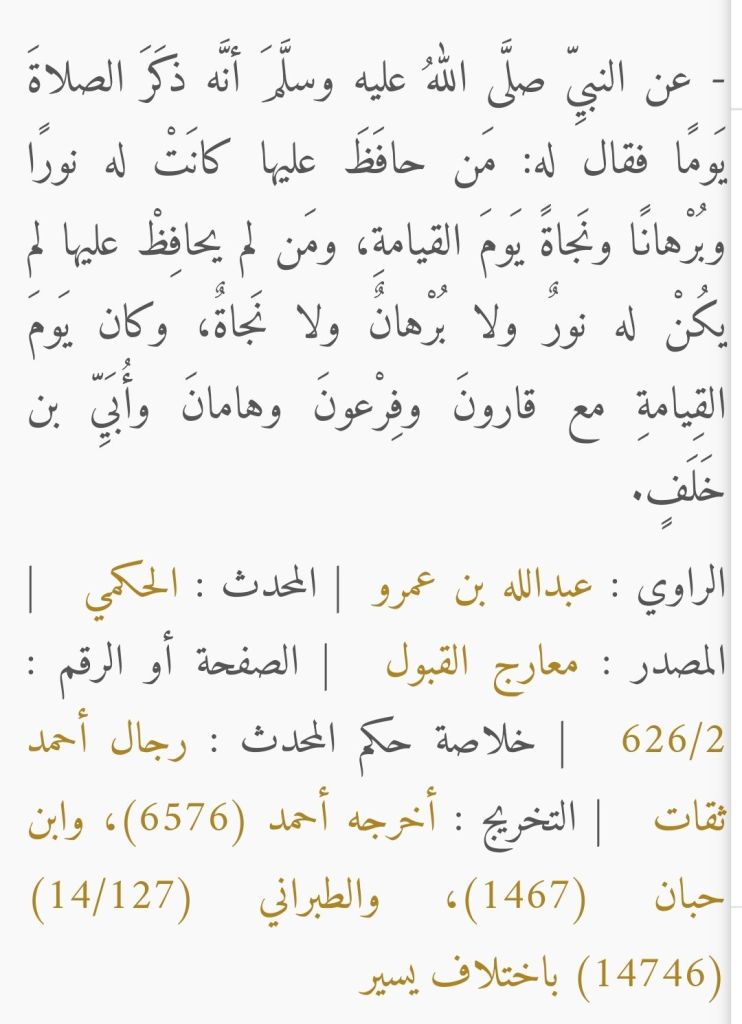
Abdullah bin Amr narrated from the Prophet (Salallahu Alaihi Wa Sallam), that he mentioned prayer one day among his companions, saying: “Whoever preserves it (prayer) will have Noor (light), Burhan (proof), and Najaah (salvation) on the Day of Resurrection. Whoever does not preserve it will have no light, no evidence, and no salvation. And he will be resurrected on the Day of Resurrection with Pharaoh, Hāmān, Qārūn, and Ubayy ibn Khalaf.”
(Musnad Ahmad 6576, Sahih Ibn Hibban 1467, At-Tabarani 14/127. Shaikh Abdul Azeez bin Abdullah bin Baaz said in his Majmua Fatawa Ibn Baaz 29/164, ‘Its chain is Jayyid (good)’.)
Explanation:
The Prophet (Salallahu Alaihi Wa Sallam), loved prayer, magnified its importance, advised with it, and clarified its virtue and lofty status. In this Hadith, Abdullah ibn Amr (Radi Allahu Anhu), reports from the Prophet, that “he mentioned prayer one day,” meaning he intended to mention its virtue and honor. He said, “Whoever preserves it,” meaning performs it regularly and persistently, without neglecting it, “it will be a Noor (light) for him.” This means that prayer itself illuminates its performer in the darkness of the gathering before him. It is also said that due to it, the light of the believer’s face is elevated. Additionally, it is said that the Noor (light) is metaphorical, as prayer prohibits indecency and wrongdoing, guiding towards correctness, protecting from destruction, and leading to the path of salvation, just as one is guided by light.
It will also be “Burhan (evidence, proof)” for him, a clear proof, and “Najaah (salvation) until the Day of Resurrection,” meaning it will save him from punishment on the Day of Resurrection.
“Whoever does not preserve it,” by falling short in performing it, not persisting in it, neglecting it, and abandoning it, “will have no light, no evidence, and no salvation.”
On the Day of Resurrection, he will be “with Pharaoh, Hāmān,” Pharaoh’s minister, “Qārūn,” and “Ubayy ibn Khalaf,” the enemy of the Prophet (Salallahu Alaihi Wa Sallam), whom the Prophet killed with his own hand on the day of Uhud. He was a polytheist.
This implies that whoever preserves prayer will be with the prophets, the truthful, the martyrs, and the righteous. This Hadith contains severe reproach and great warning for those who neglect preserving prayer.
1- Jo Shakhs Masjid Mein Apne Farz Namazon Ki Hifazat Karega, Use Jannat Mein Mehmaan Nawazi Naseeb Hogi:
Sahihain (Sahih Al-Bukhari aur Sahih Muslim) mein Abu Hurairah (Radi Allahu Anhu) se riwayat hai ke Nabi (Sallallahu Alaihi Wa Sallam) ne farmaya:
“Jo shakhs subah ko Masjid ki taraf jaaye aur shaam ko wapas aaye, Allah uske liye har baar jab subah jaaye aur shaam ko wapas aaye, Jannat mein ek rehne ki jagah tayyar karta hai (jis tarah mehmaan ke liye tayyari ki jaati hai).” [Sahih Al-Bukhari 662, Sahih Muslim 669]
2- Masjid Ki Taraf Chal Kar Jana Gunahon Ka Kaffara Aur Darjaat Mein Bulandi Ka Sabab Hai:
Imam Muslim ne Abu Hurairah (Radi Allahu Anhu) se riwayat kiya hai ke Rasoolullah (Sallallahu Alaihi Wasallam) ne farmaya:
“Jo shakhs apne ghar mein wuzu kare, phir Allah ke gharon mein se kisi ghar ki taraf chale, taa’ke Allah ki farz ki hui kisi ibaadat ko ada kare, to uske do qadam is tarah likhe jaate hain: ek qadam ek gunaah mitaata hai aur doosra qadam ek darja buland karta hai.” [Sahih Muslim 666]
3- Masjid Janay Aur Wapas Aane Ka Sawab Neki Ke Meezan Mein Likha Jata Hai:
Imam Muslim ne Ubayy bin Ka’b (Radi Allahu Anhu) se riwayat kiya hai: Ek shakhs tha jo sabse zyada doori par rehta tha, lekin kabhi namaz nahi tark karta tha. Logon ne us se kaha, ya main ne us se kaha: “Agar tum ek gadha le lete taake andheray aur shadeed garmi mein sawari kar sako?” Usne jawab diya: “Main yeh pasand nahi karta ke mera ghar masjid ke paas ho, kyunki main chahta hoon ke masjid tak chal kar jaana aur phir wapas aana, yeh sab kuch (neki ke taur par) mere liye likha jaaye.”
Rasoolullah (Sallallahu Alaihi Wasallam) ne farmaya: “Allah ne tumhare liye yeh sab kuch jama kar diya hai (yani tumhein poora ajar milega).” [Sahih Muslim 663]
4- Fajr Aur Isha Ki Namaz Ke Liye Masjid Chal Kar Jana Qiyamat Ke Din Noor Banega:
Imam Abu Dawud ne is hadis ki riwayat ki, aur Shaikh Al-Albani ne ise Sahih qarar diya, Buraydah (Radiyallahu Anhu) se riwayat hai ke Nabi (Sallallahu Alaihi Wasallam) ne farmaya:
“Andheray mein masjidon ki taraf chal kar jaaney walon ko basharat do ke unke liye Qiyamat ke din mukammal roshni hogi.” [Sunan Abi Dawud 561]
(Shaikh Waheed Abdus Salam Baali ka maqala yahan khatam huwa. Neeche ek aur hadith Jumuah ke din masjid chal kar jaanay ki fazilat par is maqalay ke tarjuman ki taraf se mazeed malumat ke liye.)
5- Jumuah Ki Namaz Ke Liye Masjid Chal Kar Jaanay Ka Ajar:
Aws ibn Aws Ath-Thaqafi (Radi Allahu Anhu) se riwayat hai ke Rasoolullah (Sallallahu Alaihi Wasallam) ne farmaya: “Jo shakhs Jumuah ke din ghusl kare, khud ko paak saaf kare, jaldi aaye, imam ke qareeb baithe, dhyan se (khutbah) sune aur (khutbay ke douran) khamosh rahe, to uske har qadam par ek saal ke roza aur ek saal ke qiyam ka ajar milega.” [Sunan Al-Tirmidhi 496, Sahih Al-Tirmidhi 410]
Al-Qari ne Mirqat Al-Mafatih (3/1035) mein kaha: “Ek bade alim ne kaha: Humne Islam ki taleemaat mein kisi aur sahih hadith mein is qadar azeem ajar ke baare mein nahi suna, yani: is amal ki pabandi karni chahiye taa’ke is ajar ko paaya ja sake.”
Allah Ta’ala humse yeh qabool kare, aur humein is par amal karne ki taufeeq de. Aur pyare Nabi (Sallallahu Alaihi Wasallam) par salamti, rehmat aur barkat nazil ho.
(Translator: Mohammed bin Thajammul Hussain Manna.)

 Saheehus-Seerah