The main aim of our site is to purify The Seerah of Prophet Muhammad ﷺ from weak and fabricated narrations using the works of the scholars of Islam. We may add other beneficial material as well.
Jab bhi sawal ata hai ki ‘kya Taraveeh aur Witr ke baad bhi Tahajjud ya Qiyam-ul-Layl padh sakte hain?’, tho kayi hazraat jawab mein keh dete hain ki
‘Padne ki zarurat hi nahi hai kyunki Nabi Salallahu Alaihi Wa Sallam ki Hadis hai ki Jisne Imam ke sath puri namaz ada ki, wo saari raat namaz ada karne ke barabar hai. (Sunan An-Nasai, Saheeh (Al-Albanil).
Lekin ye jawab ghalat hai kayi noiyat (angles) se.
#1) Sabse pehli baat ye, ke kya 11 Rakat, jismein witr bhi shamil hai, uske baad koi bhi namaz padna jayaz hai?
Jee haan, jayaz hai. Jin ahadith mein hai ki witr ko aakhri namaz banawo, uska matlab ye nahi ke witr ke baad namaz padna bilkul HARAM hai. Uska matlab hai ki witr ko aam tour par akhri namaz banani chahiye. Lekin agar koi witr ke baad raat ki koi Nafil ya sunnat padh le tho ismein koi harj naji hai. Jaise ke Nabi e Kareem Salallahu Alaihi Wa Sallam se witr ke baad Tahajjud padhna sabit hai (aur Sahabah se bhi).
Witr ke baad Nabi Salallahu Alaihi Wa Sallam ka 2 Rakat Padhna:
Abu Salamah bayan karte hain, “Main ne Hazrat Aisha se Nabi (Salallahu Alaihi Wa Sallam) ki namaz ke baare mein poocha.” Unhon ne farmaya: “Aap (raat mein) terah (13) rakat parha karte thay. Aap aath (8) rakat parhte, phir Witr parhte. Iske baad aap ﷺ baith kar do (2) rakat parhte thay. Phir jab ruku karne ka irada hota, toh kharay ho kar ruku farmate. Aur iske sath sath, aap Fajr ki Azan aur Iqamat ke darmiyan do (2) rakat parhte thay.” (Sahih Muslim)
#2) Kya ye kehna sahih hai ki Imam ke sath puri Taraveeh mukammal kar li tho sari raat namaz ka sawab mil gaya, abhi aur padhne ki zarurat nahi hai?
Ye Nabi Salallahu Alaihi Wa Sallam ki hadis ki ghalat samajh hai. Us hadis ka matlab ye nahi ke aur namaz mat padho, na Allah ke nabi ne aisa samjha na sahaba ne. Wo hadis fazail bayan kar rahi hai imam ke sath taraveeh mukammal karne ki. Agar ‘saari raat namaz ada karne ke barabar hone se’ aur zyada namaz padhne ki zarurat nahi hoti, tho sirf Isha aur Fajr ki Farz padna hi kaafi ho jata. Kyunki jo Isha aur Fajr jamaat se padhe use waise bhi saari raat qiyaam (namaz mein khade hone) ka sawab mil jata hai. (Lekin aisa tho bilkul nahi hai.)
Uthman bin Affan riwayat karte hain ke: Allah ke Rasool (Salallahu Alaihi Wa Sallam) ne farmaya: “Jo shakhs Isha ki namaz jamaat ke sath aada karta hai, toh usey aadhi raat qiyaam karne ka sawab milta hai. Aur jo shakhs Isha aur Fajr dono namazein jamaat ke sath parhta hai, toh usey poori raat qiyaam mein guzarne ka sawab milta hai.” [Jami At-Tirmidhi, 221, Sahih (Zubair Ali Zai)]
#3) Kya Sahaba ek Taraveeh ki jamaat ke baad aur ek Jamaat mein padhte thay?
Sunan Abi Dawood 1439 ki riwayat mein Sahabi Talq bin Ali (Radi Allahu Anhu) apne ghar aate hain aur ghar walon ko namaz padhate hain witr ke sath. Uske baad Masjid jakar dubara Imamat karwate hain, lekin dubara Witr nahi padhte. Isse pata chalta hai ki witr ke baad bhi namaz (Taraveeh/Tahajjud) padh sakte hain, lekin witr repeat nahi honi chahiye, aur do (2) jamat mein participate bhi kar sakte hain.
Qays ibn Talq bayan karte hain ke: Hazrat Talq ibn Ali Ramadan ke kisi din hamare paas tashreef laye. Wo shaam tak hamare sath rahay aur hamare sath roza iftar kiya. Phir unhon ne kharay ho kar humein Witr ki namaz parhai. Iske baad wo apni masjid mein gaye aur wahan (logon ko) namaz parhai. Phir jab Witr baqi reh gaye, toh unhon ne ek aur shakhs ko aage kiya aur farmaya: “Apne sathiyon ko Witr ki namaz parhao, kyunki main ne Allah ke Rasool ﷺ ko farmate hue suna hai: ‘Ek raat mein do (2) Witr nahi hote.'” (Abi Dawood, 1439, Sahih (Al-Albanil), Hasan (Al-Arnaut))
Shaikh Saleh Al-Fawzan (Mufti e Azam Saudi Arab, Hafidhahullah) farmate hain:
“Agar koi shakhs Imam ke sath Taraweeh aur Witr parh le, aur phir raat mein Tahajjud ke liye khara ho, toh is mein koi manai (rukawat) nahi hai. Aur wo Witr ko dobara nahi parhega, balkay jo Witr usne Imam ke sath parh liye hain, wahi uske liye kafi hain.
Wo raat mein Tahajjud utni parh le jitni Allah uske liye asaan kare, aur agar wo Witr ko raat ke aakhri hissay tak muakhar (delay) karta hai, toh is mein bhi koi harj nahi hai.
Lekin, is tarah wo Imam ki iqtida (sath parhne k sawab) se mehroom reh jayega, aur behtar yahi hai ke Imam ki pairwi karte hue uske sath hi Witr parhe, kyunki Nabi ﷺ ka farman hai:’ Beshak jo shakhs Imam ke farigh hone tak uske sath (namaz mein) khara rehta hai, toh uske liye poori raat ki ibadat likh di jati hai.’ [Sunan Abu Dawood (2/51), Jami At-Tirmidhi (3/147-148), Sunan An-Nasaai (3/83-84), Sunan Ibn Majah (1/420-421)]
Lihaza, wo Imam ki pairwi kare aur uske sath Witr parhe. Yeh cheez usey raat ke aakhir mein kharay hone aur jitna asaan ho utni Tahajjud parhne se nahi rokti.” [Al-Muntaqa min Fatawa Fawzan (No. 116)]
In the name of Allah, the Most Gracious, the Most Merciful. Peace and blessings be upon our beloved Prophet Muhammad, his pure family, and his noble Companions.
There is a cancer growing in our Ummah. Muslim women—our mothers, sisters, and daughters—are increasingly embracing secular feminism. As an orthodox Muslim, I (and generally all of us) hold that feminism is a poisonous Western ideology that opposes our Fitrah (innate nature), destroys the family unit, and places the creation’s desires above the Creator’s commands.
But let us pause. Let us engage in serious self-reflection.
If Islam truly grants women God-given rights—the right to choose a spouse, the right to education, the right to financial maintenance, the right to inheritance, the right to seek divorce from oppression—then why are our women walking away? Why do they see feminism as their only refuge?
The painful answer is this: We have presented them with two Islams. There is the pure, just, and balanced Islam of Prophet Muhammad (Salallahu Alaihi Wa Sallam). And then there is the twisted, patriarchal, culture-ridden “Islam of the subcontinent”—Desi Islam. And tragically, it is this second Islam that our women experience in their homes, their marriages, and their communities.
The Great Hypocrisy: Talking Rights, Denying Reality
We Desi Muslims love to deliver sermons on women’s rights in Islam. We proudly declare that Islam gave women their rights 1400 years ago. But when our own daughter sits before us, we force her into a marriage with a man she does not want. When our sister’s husband abuses her, we tell her to be patient. When our niece asks for her inheritance, we call her greedy and manipulative. This is the norm in most Desi families.
We have become masters of hypocrisy. We speak the language of the Quran, but we practice the language of our forefathers’ customs.
The Marriage Trap: Blackmail in the Name of Parental Honour and Love
Narrated Abu Huraira: The Prophet (Salallahu Alaihi Wa Sallam) said, “A matron should not be given in marriage except after consulting her; and a virgin should not be given in marriage except after her permission.” The people asked, “O Allah’s Messenger! How can we know her permission?” He said, “Her silence (indicates her permission). (Sahih al-Bukhari 5136.)
Aisha reported: A young woman entered her home and she said, “My father married me off to his brother’s son to raise his status, but I was unwilling.” Aisha said, “Sit here until the Prophet, peace and blessings be upon him, comes.” The Messenger of Allah came and she told him about it, so he sent for her father, who gave her the decision. She said, “O Messenger of Allah, I have allowed what my father did, but I rejected it so I could know if women have any say in the matter.” (Sunan an-Nasā’ī 3269, Sahih (authentic) according to Al-Arna’ut. Hadith translation from abuaminaelias.com)
Shaykh al-Islam Ibn Taymiyyah said, “As for marrying her off despite her unwillingness, this contradicts fundamental principles and sound reasoning. Allah did not allow her guardian to force her into buying or renting unless she consents, nor to eat, drink, or wear something she does not want. How can he force her to be intimate and interact with a man she does not want to be intimate with? Or to live with a man she does not want to live with? Allah has placed love and mercy between spouses. If a marriage cannot be contracted unless she hates him and he is repulsive to her, then where is the love and mercy in that?” (Majmū’ al-Fatāwá 32/25, abuaminaelias.com)
Yet in our Desi culture, a girl’s consent is trampled upon using the weapon of parental blackmail. When a daughter expresses her choice—perhaps she wishes to marry a pious young man, or she refuses a proposal due to genuine incompatibility—the parents unleash emotional terrorism. “We raised you for twenty-five years, and this is how you repay us?” “We will never show our face in society if you refuse this proposal.” “Your younger siblings’ marriages will be ruined if you say no.” “If you don’t marry this person, we will cut off all ties with you.”
We use the “rights of parents” card not as the Prophet (Salallahu Alaihi Wa Sallam) taught—with mercy and wisdom—but as a weapon to crush our daughters’ wills. We disregard the Hadith of choice completely. We ignore that the Prophet permitted a woman who was given in marriage without her consent to nullify the marriage entirely. We behave as if our daughters are property to be transferred, not souls entrusted to us by Allah.
At times, we throw away the principle of Kufu (compatibility) entirely. We marry our less religious daughters to extremely practicing men, thinking this will “fix” them. We marry our hijabi, Quran-memorizing daughters to modern, liberal men who drink and neglect prayers, thinking “he will provide well.” When the marriage inevitably collapses due to fundamental incompatibility, we blame the girl. We blame fate. We blame everyone except our own willful ignorance of the Prophet’s teachings and our own emotional blackmail that forced her into that situation.
The Prison of Nikah: Talaq, Khula, and the Forgotten Door of Faskh
Let us understand the Islamic framework for separation:
Talaq: The right given by Allah to the husband to pronounce divorce. It is not a toy to be played with.
Khula: The right of the woman to seek separation by offering compensation to the husband, usually returning the Mahr. Allah says: “If you fear that they will not maintain the limits of Allah, then there is no blame upon either of them concerning that by which she ransoms herself.” (Surah Al-Baqarah, 2:229).
Faskh-e-Nikah (Al-Faskh, Annulment): This is a unilateral divorce granted by an Islamic authority. When a husband refuses to give Talaq and rejects Khula, despite the woman suffering cruelty, abuse, neglect, or harm, a qualified Mufti or Qadhi can dissolve the marriage. This is her Islamic right.
However, here lies the tragedy of the Muslims in the subcontinent, since the vast majority of them are Hanafis. Due to the absence of an Islamic state and an over-cautious approach in later juristic tradition, the Hanafi Madaris and their Ulama stopped authorizing their Muftis to perform Faskh. Effectively locking the door of escape.
So a woman trapped in an abusive marriage goes to her local Mufti. He tells her, “Khula is only possible if your husband agrees.” She goes to her husband; he laughs and refuses or completely absconds. She returns to the Mufti. He says, “Be patient, pray more, perhaps Allah will change his heart.” She suffers for years, bearing beatings, verbal abuse, and psychological torture, all in the name of “preserving the marriage.”
The great scholar Maulana Ashraf Ali Thanvi (Rahimahullah) recognized this crisis. He explicitly permitted, within the Hanafi madhhab, the adoption of the Maliki position to authorize select Muftis to perform Faskh for women in dire situations. Alhamdulillah, some organizations are now doing this, but the progress is agonizingly slow. Most women don’t even know this option exists.
After years of running in circles, of being failed by the very people who should represent the Shariah, she finally walks into a secular court. The judge grants her a divorce in months. And then the Muslim community blames ‘her’ for going to the secular system! Who pushed her? We did. We failed to provide the Islamic solution, so she took whatever solution was available.
The Evil of Pre-Planned Halala: Playing with Allah’s Boundaries
Among the most disgusting practices that has crept into our society is that of pre-planned Halala.
When a man pronounces three divorces upon his wife in a single sitting—whether in anger, under the influence, or even in jest—according to the Hanafi madhhab, the divorce is binding and irrevocable. The woman becomes completely forbidden to him. She cannot return to him unless she marries another man in a ‘genuine’ marriage, the marriage is consummated, and then that second marriage ends naturally through death or divorce.
But what do we see in our society? A couple fights. The husband screams “Talaq, Talaq, Talaq!” in one breath. The next day, they regret it. But instead of accepting the consequence of their sin and ignorance, they look for shortcuts.
They find an “arranger” who brings a man to perform a temporary, fake marriage. They agree beforehand: “Marry her for one night, consummate it, divorce her in the morning, and we will pay you.” This man marries her, spends the night with her, and then divorces her. She then becomes halal for her first husband.
This is pre-planned Halala. This is a mockery of the Deen of Allah.
The Prophet (Salallahu Alaihi Wa Sallam) cursed the one who does Halala and the one for whom Halala is done. (Sunan Abi Dawud, Sunan al-Tirmidhi, Ibn Majah). In some narrations, he referred to such people as “adulterers.”
Think about this, brothers. We subject a Muslim woman—our sister—to the indignity of being passed between men like a commodity. We reduce marriage, which the Quran calls a ‘mithaqan ghaleezan’ (a solemn covenant), to a legal loophole. We destroy her honor, her self-respect, and her connection to the Deen. And then we wonder why she becomes bitter? Why she questions whether Islam truly respects her?
The fault lies in the ignorance of men who throw three divorces without knowledge. If they had learned the Fiqh of marriage before entering it, they would know that divorce is a process, not a game. They would know that even a single pronouncement of Talaq is enough as a separation, that still gives a chance for reconciliation. But we don’t learn. We don’t study. And our women pay the price.
The Abandoned Children: Deadbeat Fathers in Our Midst
Another silent crime is the abandonment of children after divorce. Islam places the financial responsibility of children squarely on the father.
Allah says: “But the father of the child shall bear the cost of the mother’s food and clothing on a reasonable basis.” (Surah Al-Baqarah, 2:233). This obligation continues until the children reach puberty and can support themselves, and it continues for daughters until they are married.
Yet how many men in our society, after divorcing their wives, simply stop spending on their own children? The mother is left struggling, working, begging, or relying on her own family, while the father moves on to a new marriage as if his previous children never existed.
And what does our community do? Nothing. We don’t boycott such men. We don’t shame them. We don’t hold them accountable. We still invite them to our gatherings, marry our daughters to their sons, and treat them as respectable members of society. We have removed the social punishment that should accompany such open disobedience to Allah’s command.
Inheritance: Robbing Women in the Name of Love
Allah has clearly specified the shares of inheritance in Surah An-Nisa. The daughter, the sister, the mother, the wife—all have fixed, God-given rights to property. Yet in our culture, we systematically deprive women of these rights.
We use emotional blackmail: “We spent so much on your wedding.” “Your brother has a large family to support, he needs it more.” “Your uncle is poor, be generous and give it up.” “If you take your share, your brothers will be angry and won’t look after you.”
We manipulate our mothers, sisters, and daughters into surrendering what Allah has decreed for them. We steal from them with words of love. And then we wonder why they grow resentful? Why they look at secular laws that enforce inheritance and think, “At least the court gives me justice”?
The Triple Talaq Epidemic
Perhaps nothing has damaged the image of Islam among women more than the casual, ignorant use of triple Talaq. Men who have never studied a single book or chapter on marriage, are entering this sacred union with the assumption that they will learn it naturally!?
The Prophet (ﷺ) said: “Seeking knowledge is an obligation upon every Muslim.” (Ibn Majah). Yet we enter the most serious contract of our lives—marriage—without any knowledge of its rules, its responsibilities, or its proper dissolution.
A man gets angry. He shouts three divorces. The next day, he regrets it. But according to the Hanafi madhhab, which we follow, the divorce is complete and irrevocable. His wife is now a stranger to him. His children are now from a broken home. All because he never learned that divorce should be given one at a time, during a period of purity, with a waiting period.
And in this ignorance, the woman suffers most.
The Moment of Realization
Brothers, let us stand back and look at the picture we have painted.
A young girl grows up watching her mother’s choices ignored in marriage decisions through emotional blackmail. She sees her aunt trapped in an abusive marriage with no way out, the Mufti offering only empty platitudes. She hears of a cousin subjected to the humiliation of Halala. She watches another relative struggle alone with children while the father lives freely without consequence. She herself is pressured to give up her inheritance for the sake of “family harmony.”
Then she goes online. She reads about feminism. Feminism tells her: “You are strong. You are independent. You don’t need a man. The patriarchal system is oppressing you. Break free.”
And she thinks, “They’re right. My religion didn’t protect me. My community didn’t protect me. My own family didn’t protect me. So why should I stay?”
She doesn’t realize that she was never shown real Islam. She was shown Desi culture wearing an Islamic mask. She rejected the mask, and in doing so, she also turned away from the beautiful face of the Deen beneath it.
The Path Forward: Advice to the Ummah
1. To the Men: Fear Allah Regarding Your Women. The Prophet (ﷺ) said in his Farewell Sermon: “Fear Allah concerning women. Verily, you have taken them as a trust from Allah, and their intimacy has been made lawful to you by the word of Allah.” (Sahih Muslim). You are shepherds responsible for their welfare. Justice is not optional, it’s obligatory.
2. Learn Before You Act. Study the Fiqh of marriage before you marry. Study the rules of divorce before you utter a single word. Knowledge precedes action in Islam. If you don’t know, ask. If you’re angry, stay silent. One moment of ignorance can destroy lives.
3. Implement Faskh-e-Nikah Fully. Our Ulama and Muftis must rise to the occasion. We must establish systems where women in genuine distress can obtain Islamic divorces without waiting years. We must follow the permission granted by our own scholars to use other madhahib when necessary for genuine need. Let us open the doors of the Shariah before our sisters run to the doors of the secular courts.
4. Boycott the Oppressors. If a man abandons his children, refuses maintenance, or deprives his sister of inheritance, he should face social consequences. Do not marry into such families. Do not do business with such men. Do not honor them in gatherings. Let them feel the weight of community disapproval until they repent and fulfill their obligations.
5. Stop the Halala Evil. Pre-planned Halala is a curse upon our Ummah. We must educate our communities regarding the proper way of separation in Islam. We’ve to close the doors that lead to the preplanned Halala market.
6. Return to the Sunnah in All Things. Let us consciously examine every practice in our families. Ask: Is this from the Quran and Sunnah, or is it from Desi culture? If it is from culture and contradicts the Shariah, abandon it immediately, no matter how “normal” it seems.
Conclusion
We do not need “Islamic feminism.” We do not need to import Western ideologies to reform our communities. What we need is to return to the authentic, balanced, and just Islam of Prophet Muhammad (Salallahu Alaihi Wa Sallam). We need to strip away the layers of ignorant cultural patriarchy that has suffocated the Deen.
When we implement the Shariah in its fullness—not just the parts convenient for us—our women will see that Islam is their greatest protector, not their oppressor. They will see that the Prophet (Salallahu Alaihi Wa Sallam) honored women, consulted them, and defended their rights in ways the world had never seen.
Let us fix ourselves. Let us hold ourselves accountable. Let us be the men that Allah described as Qawwamun— not tyrants, but protectors, maintainers, and caretakers. Let us be the ones who implement justice, so that our mothers, sisters, and daughters never feel the need to seek justice elsewhere.
A lot more needs to be written, but this much will suffice for now, InshaAllah.
So, the engagement (or the Nikah date) is set. The hall is booked, the outfits are tailored, and the sweets are ordered. You’ve spent lakhs (or maybe crores!) on the preparations. Your parents are glowing with pride. The entire community is waiting for the invitation cards and calls.
And you? You’re sitting with a heavy heart, because you’ve started seeing the red flags in your future spouse. Maybe it’s the anger. The disrespect. The unreasonable demands. The way they isolate you or dismiss your feelings. Or perhaps their social media presence and past life! Or the realization that this individual is not the ‘pious’ one that you imagined and dreamt of…
You tell yourself: “The Nikah is in two months.” “It’s been 8 months (or whatever) since we fixed it.” “What will people say?” “We’ve already spent so much money.” “I can’t do this to my parents.” “Dad and mom will be humiliated if I break the relationship at this point.” etc etc.
Stop. Right. There.
Let’s speak the hard truth today, even if it makes us uncomfortable.
1. The Money is Gone. Your Future Doesn’t Have to Be.
Yes, you spent money. Yes, it hurts to see that go down the drain. But let’s compare that loss to the cost of a lifetime of misery. Is 5 or 10 lakhs or 1 crore worth more than your mental health, your safety, and your peace? That money is a sunk cost. Don’t throw your life into the sunken ship just because you paid for the ticket.
2. The Shame is Temporary. The Abuse is Permanent.
“Log kya kahenge?” (What will people say?) They will talk for a few weeks. There will be whispers. But here is the reality: Those same people will be silent when you are suffering in your marriage. They won’t be there at 2 a.m. when you are crying. They won’t feel the bruises on your soul or body. They move on to the next gossip. You are the one who has to live the reality.
3. The “Parents’ Happiness” Trap.
This is the most dangerous one in our culture. We are raised to be “good” children who don’t cause trouble. We tell ourselves, “If I break this off, my father will have a heart attack,” or “My mother will be so humiliated, she’ll never recover.”
Let me be clear: Your parents’ love for you is not a license for them to hand you over to a ‘red flag’ (regardless of you being a guy or girl). Yes, they will be sad. Yes, they will be embarrassed. They might even be angry at first. But a parent’s ultimate duty is the safety of their child. If they are good parents, they will eventually thank you for having the courage to step back from a cliff.
If they force you into a marriage knowing it will destroy you, then you need to ask yourself why you are protecting that dynamic at the cost of your own life.
4. The Nikah is a Line in the Sand.
In Islam, the Nikah is a sacred, serious contract. It is not “just a party event” to please the society. Once you cross that line, your rights and responsibilities change.
-Before Nikah: It is difficult to break a fixed and committed engagement. It is painful indeed. It involves tough conversations and returning gifts. But legally and Islamically, you are two separate entities. You can walk away.
-After Nikah: Things get messy. You now need a Khula or a Talaq or a Fasq-e-Nikah. There are legal battles. And if Allah forbid, a child enters the picture? Now you are not just leaving a spouse; you are tying yourself to them for the next 18+ years through co-parenting.
The Reality Check
You are worried about “hurting” your parents today? Imagine their hurt when they see their child broken, depressed, or hiding bruises. You are worried about “8 or 12 months of engagement” going to waste? Imagine the waste of 2 or 10 years of marriage trying to fix someone who showed you who they were from the start.
A Warning from the Heart
The Shaitan loves to make us fear the creation (people, society, parents) and forget the Creator. We fear people’s ridicule more than we fear entering a marriage that might be built on oppression.
If you see the red flags, listen to that instinct that Allah gave you. It is easier to cancel a wedding than to file for divorce. It is easier to face the community’s gossip now than to face a lifetime of abuse. It is easier to let your parents cry for a few months than to let them watch you die inside for years.
Save yourself. Even if it’s the night before the Nikah. Even if the food is cooked. Even if the guests have arrived.
A broken engagement is a wound that heals. A broken marriage can also heal, but usually after it destroys your soul and mental health. Choose your hard – this one or that one.
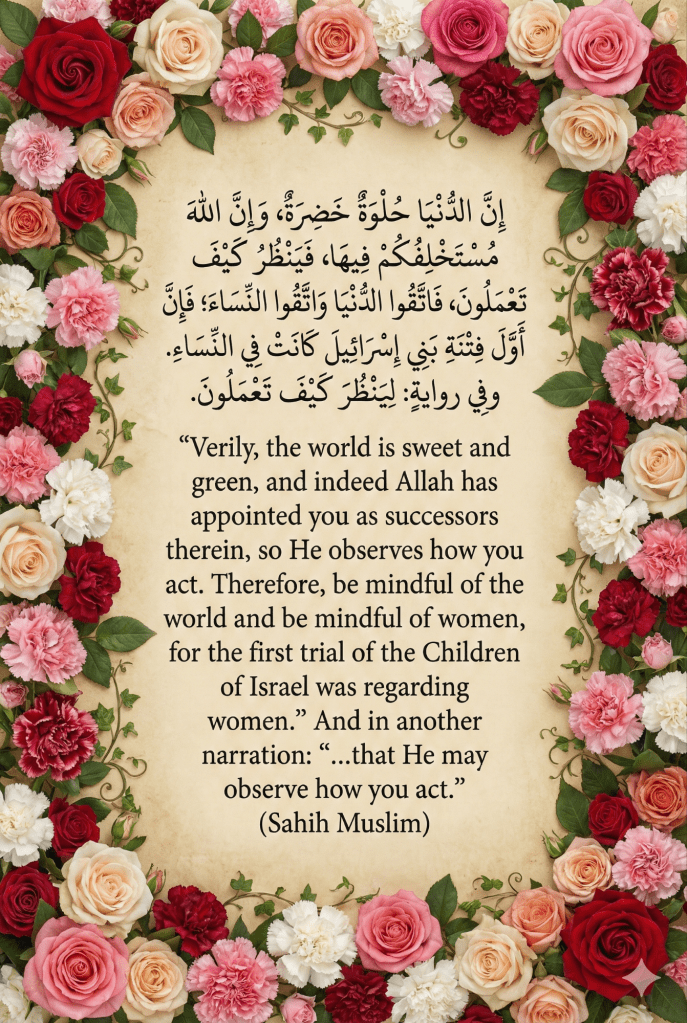
Translation of the Commentary of the Hadith From dorar.net
Allah the Almighty has established the worldly life (ad-Dunya) as an abode of testing and tribulation. The wise individual is he who garners provisions from it for his Hereafter.
The Prophet (peace and blessings of Allah be upon him) counseled the performance of righteous deeds therein, the maintenance of God-consciousness (Taqwa) within it, and wariness of its adornments and temptations.
In this Hadith, the Prophet (peace and blessings of Allah be upon him) states: “Indeed, the world is sweet and green.” It is sweet in taste and lush in appearance. When an object is verdant and sweet, the eye desires it first, followed by the self (an-nafs). This alludes to its allure, which causes souls to yearn for and seek it; consequently, man becomes beguiled by it and engrossed within it.
The Prophet (peace and blessings of Allah be upon him) elucidated that Allah, the Glorious and Exalted, has appointed us as successors (mustakhlifuna) in this worldly life to observe how we act. The meaning of this succession (Istikhlaf) is that Allah (Mighty and Majestic) has made us successors to the generations that have passed before us, or that we succeed one another. This is to observe our conduct regarding what He has made obligatory upon us: do we execute His obedience, or do we disobey Him? For this reason, he said: “So be wary of the world.” That is: Beware lest the enjoyment and adornment of the world deceive you, thereby inducing you to abandon what Allah has commanded and to fall into that which He has forbidden, as the Almighty stated: {So let not the worldly life deceive you and let not the Deceiver deceive you about Allah} [Luqman: 33].
Then, he (peace and blessings of Allah be upon him) commanded caution regarding women, stating: “And be wary of women.” That is, beware of women. The nature of this caution is that a woman, if she is a wife, may at times burden a man with expenditures he cannot bear, thereby distracting him from seeking matters of religion and compelling him to recklessly pursue the world.
Furthermore, their trial (fitnah) may manifest through the allure of men and inclining them away from the truth if they go out and intermix with them, particularly if they are unveiled (safirat) and displaying their beauty (mutabarrijat).
This may lead to falling into Zina (illicit sexual relations) in its various degrees. Thus, it behooves the believer to hold fast to Allah and to turn fervently to Him for salvation from their temptation and safety from their harm. He (peace and blessings of Allah be upon him) informed that the first trial of the Children of Israel concerned women; they were tempted by the trial of women, so they went astray and led others astray.
He (peace and blessings of Allah be upon him) mentioned what befell the nations before us solely for the sake of lessons and admonition, and so that we may be wary of what they fell into and its causes. The Prophet’s (peace and blessings of Allah be upon him) mention of the trial of women after the trial of the world falls under the category of mentioning the specific after the general (dhikr al-khas ba’d al-‘am) to heighten the warning, signaling that the trial caused by them is among the greatest of worldly trials.
The Hadith contains an exhortation to adhere strictly to God-consciousness (Taqwa) and to refrain from being preoccupied with the superficial aspects of the world and its adornments.
(End of the explanation. Translated by Mohammed bin Thajammul Hussain Manna.)


 Saheehus-Seerah