A Balanced Approach to the An-Nawawi Case – Shaykh Dr. Ayman al-Anqari (Professor at Ibn Saud University in Riyadh)

A Balanced Approach to the Nawawi Case – Shaykh Dr. Ayman al-Anqari (Professor at Ibn Saud University in Riyadh) on the ongoing discussion about an-Nawawi:

“As for clarifying the condition of people like an-Nawawi, who is known for his fanaticism towards the Ash’ariyyah – and adh-Dhahabi mentioned in Tarikh al-‘Islam that an-Nawawi was a fanatic Ash’ari who was zealously committed to the Ash’ari methodology¹…

“The point is that it should be clarified that people like an-Nawawi and his like should not be called Imams.

“I remember our Shaykh ‘Abd al-‘Aziz ibn Baz, during one of his gatherings of knowledge, when one of the students said: ‘Al-Imam an-Nawawi said’, the Shaykh alerted him and said: ‘Do not say Imam, but say al-Hafidh. Al-Hafidh an-Nawawi.’ Meaning: he should not be described as Imam.

“The man was a fanatic supporter of the Ash’ariyyah. And whoever reads the explanation of an-Nawawie on Sahih Muslim, will find this clearly and explicitly, when he speaks about the verses and narrations regarding the Attributes of Allah. Here he either follows the path of distortion (at-tahreef) or the path of at-tafweed (not accepting the meaning).

“Also, the man engaged in Sufi practices. For example, he was known for wearing the khirqah (special Sufi cloak) of the Sufiyyah. His condition is known.

“The point here, with regards to these people who ascribe themselves to knowledge, like an-Nawawi, is that no high status should be given to them.

“One can benefit from their books, such as their books on jurisprudence (al-fiqh) and the traditions, but only to a certain extent. They do not reach the level of being Imams.

“The reality is as follows: the current problem is that many Harakiyyeen and Ikhwaani’s who dilute (the disputes with deviants) and call for laxity, have caused a melting away of the differences between Ahl as-Sunnah and Ahl al-Bida’ such as the Asha’irah.

“As a result, the disputes are merely considered as ‘just differences of opinion’ and ‘an-Nawawi can be right and can also make mistakes’ and ‘so-and-so can be right and can also make mistakes’.

“Whilst what we are talking about here is a fundamental principle – there is a dividing line. Whoever is not on the belief of Ahl as-Sunnah should be declared misguided and an innovator. Whoever he may be. But this does not mean that one cannot benefit from him in some matters, as I mentioned with regards to jurisprudence (al-fiqh) or the narrations. […]

“Clarifying such matters and issues, discussing them and clarifying the truth, is an important matter, so that Ahl as-Sunnah are not harmed and so that no individuals are counted among Ahl as-Sunnah who do not belong to it.

“Many people now think that an-Nawawi and his likes belong to Ahl as-Sunnah, while in reality he does not belong to Ahl as-Sunnah. He is a fanatic Ash’ari.”

End of the transcript of the audio by Shaykh Dr. Ayman al-‘Anqari (may Allah preserve him)

[1] There is some doubt about the statement of adh-Dhahabi after the debate between Sh. Muhammad ibn Shams ad-Deen and Hasan al-Husayni, because it appears in some manuscripts in the margin and therefore it is not clear whether it is the statement of adh-Dhahabi himself or of as-Subkie. However, this does not affect the point.

Source: @r_abukhuzaymah (On Twitter)

Link: https://twitter.com/r_abukhuzaymah/status/1685031615368404992?t=ASlgTFA5EqYuSyr5if7xkA&s=19

(Disclaimer: This article has been shared here only to preserve it for reference, authenticseerah.wordpress.com doesn’t own it or agree to everything that is written in it word-for-word.)
Women Were Involved In Politics In The Era Of Nabi ﷺ!? Answering a WhatsApp forward…

السلام عليكم ورحمة الله وبركاته. الحمد لله و الصلاة والسلام على نبينا محمد وعلى آله و اصحابه اجمعين.

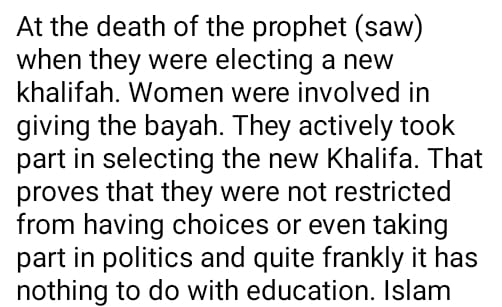
I received this image on WhatsApp by a concerned brother, which asserted a few things about women in the era of the Prophet ﷺ and the Sahabah (companions (رضي الله عنهم)).

The image:

1. The first sentence, ‘At the death of The Prophet ﷺ they were electing a new Khalifah’…

Correction: They were *not* ‘electing’ a new Khalifah similar to how modern day democracies elect their leaders where every person has the right to vote.

Rather some of the leaders from amongst the Ansaar (Companions of Madinah) wanted to chose a leader from amongst themselves and a leader from amongst the Muhajiroon (Companions who migrated from outside into Madinah). It was at this point that Abu Bakr As-Siddeeq (رضي الله عنه) told them that the Ameer (leader) will only be from the tribe of the Quraysh, and he asked them to chose from Umar or Abu Ubaidah (رضي الله عنهما). At this point Umar (رضي الله عنه) gave his hand (pledge of allegiance) to Abu Bakr, and then everyone followed. (See Sahih Al-Bukhari 3667,3668, 3669, 3670, for the detailed narrations.)

So here, in these narrations, you will not see Abu Bakr As-Siddeeq (رضي الله عنه) standing for an election, and woman being asked to vote. As a matter of fact, not even the majority of the companions were consulted in this matter. Only some of the senior most were consulted and the decision was taken. After that everyone pledged allegiance to the new Khalifah (Caliph).

A similar thing occured when Umar ibn Al-Khattab (رضي الله عنه) was nominated for the post of the Khalifah by Abu Bakr. Abu Bakr As-Siddeeq just sought counsel from some of the the senior most companions and placed Umar as his successor.

Umar ibn Al-Khattab, made a panel of 6+1 (seven) companions to chose the next Khalifah from amongst the six, and the panel chose Uthman bin Affan (رضي الله عنه).

So there’s no democratic election going on where everyone had the right to vote.

2. The second sentence, ‘Women were taking part in the Bayah. They actively took part in selecting the Khalifah.’…

Women were taking part in the Bayah (pledge of allegiance), just like the other male companions, who were non-panelists in the consultation committee, were taking part in the Bayah. Regardless of they attending the Bayah session or not, didn’t affect the selection of the Khalifah at all.

3. The paragraph says, ‘That proves that they were not restricted from having choices or even taking part in politics and quite frankly it has nothing to do with education.’

The women had no choices in selecting or electing the Khalifah. Islamically speaking, not every Muslim (male or female) has the right to select or elect the Khalifah, Ameer or King (as in a monarchy). The rulers are selected by a limited elite panel of scholars, commanders and other important stakeholders of the nation, as it happened in the era of The First Four Khalifas, and after them when monarchies (Kingship) began.

Common Muslims (men and women) may give necessary suggestions to their rulers, as was done during the era of The Prophet Muhammad ﷺ and his Companions, and there are various examples of this.

May Allah guide us all to the truth and grant us the proper understanding of The Religion. Aameen.

-Mohammed Manna.

Basic Beneficial Books For A New Student Of Knowledge In The English Language

Bismillah,

My name is A**** M*** from London UK.

Please can you recommend me some books to study in ENGLISH on the following subjects in shaa Allah and to learn the deen. Please provide enough books which if i practice upon I will get jannah in shaa Allah:

Aqeedah and tawheed books

Fiqh covering all acts of worship, amaal, trasacations/dealings, adab, akhlaq and all halal and haram masail that i may encounter in my everyday life.

Tafseer commentary of the meanings of the quran and explaination.

Hadeeth commentary on the meaning of hadiths of the prophet and explaination.

Sunnah all sunnats of the prophet that i can practice upon everyday and books of the sunnah

Stories and biographies of the prophet saw, his sahabah, tabieen and atba e tabieen the first three generations and stories of the pious mujtahideen imams, muhadditheen and real awliya.

Tazkiyah e nafs how to reform my character and nafs from evil traits.

Manhaj & usool (principles)

If you can help me to learn islam that would be amazing in shaa Allah taala. Please recommend as many books as possible in shaa Allah i am an avid reader.

Please do not forward to a book seller instead please kindly provide book titles and name of the authors in shaa Allah

Please do not ignore this message in shaa Allah.

📍📍📍The Answer Below📍📍📍

السلام عليكم ورحمة الله وبركاته Brother.

This is my response to your request that was forwarded to me by a brother. May Allah reward you immensely for having an intention to begin seeking knowledge. May Allah grant you sincerity, dedication and consistency in seeking knowledge.

I will be mentioning only those books that are easy to comprehend and are available in English, In-Sha-Allah.

📍Aqeedah and Tawheed books.

1) Guide To Sound Creed (Shaikh Saleh bin Fawzan Al-Fawzan)
2) The Islamic Creed Series (Shaikh Umar Al-Ashqar, 8 volumes)
3) Qawlul-Mufeed Explanation of Kitabut-Tawheed (Shaikh Muhammad bin Saleh Al-Uthaymeen )

📍Fiqh covering all acts of worship, amaal, trasacations/dealings, adab, akhlaq and all halal and haram masail that i may encounter in my everyday life.

4) The Summary of Islamic Jurisprudence (Shaikh Saleh bin Fawzan Al-Fawzan)
5) The Major Sins (Imam Shams Ad-Din Adh-Dhahabi)

📍Tafseer commentary of the meanings of the quran and explanation.

6) a) (For a summarized Tafseer) Tafseer Al-Muyassar by Tafseer Center for Quranic Studies Riyadh.
6) b) (For a detailed Tafseer) Tafseer Ibn Katheer by Darussalam Riyadh Publishers.

📍Hadeeth commentary on the meaning of hadiths of the prophet and explaination.

7) Riyadhus-Saliheen explained by Shaikh Muhammad bin Saleh Al-Uthaymeen (Darussalam Riyadh Publishers)
8) Al-Adab Al-Mufrad (Only the one published by Dakwah Corner Bookstore)
9) Ash-Shamail Al-Muhammadiyyah (Only the one published by Dar Al-Arqam UK)

📍Sunnah all sunnats of the prophet that i can practice upon everyday and books of the sunnah.

10) All the books mentioned above under Hadith will cover the Sunnahs.
11) (In order to learn Duas of day to day life:) 11a) Hisnul-Muslim (published by Islamworld Bangalore is the best edition In-Sha-Allah)
11b) ‘Authentic Invocations & Supplications Selected from the Works of the Scholar Nasser ad-Din al-Albany’.

📍Stories and biographies of the prophet saw, his sahabah, tabieen and atba e tabieen the first three generations and stories of the pious mujtahideen imams, muhadditheen and real awliya.

12a) (For a summarized biography of the Prophet ﷺ:) ‘When The Moon Split by Shaikh Safi-ur-Rehman Mubarakpuri’.
12b) Famous But Unauthentic Stories From The Seerah Of The Prophet Muhammad ﷺ (by Shaikh Muhammad bin Abdullah Al-Ushan)

12c) I’ve compiled a detailed biography of The Prophet Muhammad ﷺ based only on authentic Ahadith and lessons from the Salafi Ulama titled, ‘The Biography of The Prophet Muhammad ﷺ From Reliable And Credibly Established Narrations (3 Vols.)’.

13) (For a summary of the history of Islam:)
13a) The History of the Four Caliphs,Itmam al-Wafa fi Sirat al-Khulafa, by Shaykh Muhammad Al-Khudari Bak Al-Bajuri.
13b) Lessons In Islamic History by Shaykh Muhammad Al-Khudari Bak Al-Bajuri.

📍Tazkiyah e nafs how to reform my character and nafs from evil traits.

14a) Read the various books authored by Imam Ibn Al-Jawzi and Imam Ibn Al-Qayyim.

14b) Etiquettes of The Student of Knowledge (Shaikh Bakr Abu Zaid)

📍Manhaj & usool (principles).

15) Manhaj Al-Ambiya Fid-Dawah by Shaikh Rabee bin Hadi Al-Madhkali.
16) ‘It is Not from the Manhaj of the Salaf’ by Shaykh Muhammad Bazmool.
17) ‘What is Salafiyyah?’ (Published by QSEP Publications.)
(Additional reading:) The Treatment of Terrorism in Light of the Qur’an and Sunnah by Shaykh Abdur-Rahman as-Sudays.

📍 Additional advice:
*1) Focus on learning Arabic, upto an advanced level from a dedicated teacher.
*2) Do memorize at least one Juzz of The Qur’an per six months, this is the least minimum that you’ve to do. If you’re quicker, do more In-Sha-Allah.

*3) Aim to shift to reading and taking knowledge from Arabic books and lectures directly in the near future In-Sha-Allah.

These my dear brother, are just some basic books, for the beginners in seeking Islamic knowledge, as you progress In-Sha-Allah, you will have to go through more books and lessons.

Note: You ‘must’ be in touch with a good set of students of knowledge and teachers following the path of the pious predecessors,i.e. someone who ascribes himself to the Salafi Ahlul-Hadith Manhaj. It is a must to keep company with them and attend live sessions on various topics, In-Sha-Allah.

-Mohammed (bin) Thajammul Hussain Manna.

The Srebrenica Genocide Of The Bosniak Muslims

The Srebrenica Genocide of the Bosniak Muslims was a tragic event that took place during the Bosnian War in July 1995. It is considered one of the darkest chapters in European history since World War II, more so a tragic tale for the Muslims worldwide.

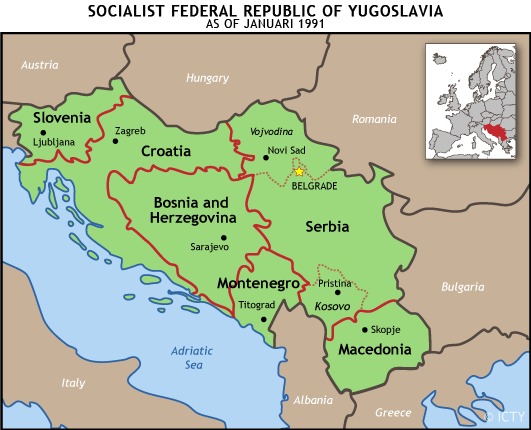
  1. Background: The Bosnian War (1992-1995) was a complex conflict that arose after the breakup of Yugoslavia. The main parties involved were Bosnian Muslims (Bosniaks), Bosnian Croats (Catholics), and Bosnian Serbs (Orthodox Christians).
  2. Srebrenica: Srebrenica was a town located in eastern Bosnia and Herzegovina, near the border with Serbia. Before the war, it had a predominantly Muslim population (around 44%).
  3. UN Safe Area: In April 1993, Srebrenica was declared a “safe area” by the United Nations Security Council. This designation was meant to protect the civilian population from attacks and ensure their safety.
  4. Bosnian Serb Forces: The Bosnian Serb Army, led by General Ratko Mladić, launched an offensive against Srebrenica in July 1995. Their objective was to capture the town and expel or kill its Muslim population.
  5. Massacre: On July 11th, 1995, Bosnian Serb forces overran Srebrenica, despite its status as a UN safe area. Thousands of Bosniak men and boys who had sought refuge in the town were separated from their families and systematically executed.
  6. Ethnic Cleansing: The Srebrenica Genocide was part of a larger campaign of ethnic cleansing carried out by Bosnian Serb forces during the war. The goal was to create ethnically homogeneous territories by forcibly removing or killing non-Serb populations.
  7. Number of Victims: The exact number of victims is still a subject of debate, but it is estimated that between 7,000 and 8,000 Bosniak men and boys were killed in and around Srebrenica. Many women, children, and elderly people were forcibly deported.
  8. [Quoted from https://srebrenica.org.uk/what-happened/sexual-violence-bosnia%5D: ‘It is estimated that somewhere between 20-50,000 (Bosniak Muslim) women were raped during the war in Bosnia. Women were imprisoned in gyms, hotels, abandoned houses, and concentration camps. They were raped with objects, such as guns and truncheons, but also with broken glass bottles to maximise physical damage. The rapes were carried out in fulfilment of official orders as part of the Bosnian Serb strategy of ethnic cleansing of the region. Several victims recalled how Serb soldiers remarked that, “It is better to give birth to Chetniks than to Muslim filth”.’
  9. International Response: The international community was widely criticized for its failure to prevent the Srebrenica Genocide. The United Nations peacekeeping forces stationed in the area were unable to protect the population, leading to calls for accountability and reform.
  10. Response from Muslim nations: During the Bosnian War in the 1990s, Pakistan played a major role in supporting Bosnian Muslims. Pakistani forces provided military aid as part of the UNPROFOR peacekeeping mission and sent medical teams to offer healthcare services. They also supplied relief items like food and clothing to help alleviate the suffering of displaced and affected populations. Their involvement contributed to stabilizing the region and supporting Bosnia’s struggle for independence and protection from ethnic cleansing. The Pakistani Forces, did not leave Bosnia, even after the UN asked them to leave, leading to wide appreciation of their efforts, in the Muslim world. General Javed Nasir’s role was heroic during the events that transpired here.
  11. Michael Dobbs writes: ‘Dismayed by Western inaction in Bosnia, Saudi Arabia (under King Fahad bin Abdul Aziz ) funded a $300 million covert operation to channel weapons to the Muslim-led government over the past three years with the knowledge and tacit cooperation of the United States, according to an official with firsthand knowledge of the operation. The arms shipments, which were in addition to around $500 million in Saudi humanitarian aid, were in direct violation of a United Nations arms embargo on the former Yugoslavia that Washington had pledged to enforce.’ (https://www.washingtonpost.com/archive/politics/1996/02/02/saudis-funded-weapons-for-bosnia-official-says/1a163310-2064-49f6-bd11-84bc67092ce2/)
  12. War Crimes Trials: In the aftermath of the war, the International Criminal Tribunal for the former Yugoslavia (ICTY) was established to prosecute those responsible for war crimes, including the Srebrenica Genocide. Several high-ranking Bosnian Serb officials, including Ratko Mladić and Radovan Karadžić, were eventually convicted for their roles in the massacre.
  13. Commemoration: The Srebrenica Genocide is commemorated annually on July 11th as a day of remembrance for the victims. It serves as a reminder of the atrocities committed during the Bosnian War and the importance of preventing such crimes in the future.

-Notes by Mohammed bin Thajammul Hussain Manna.