Uniform Civil Code, some comments…

The implementation of a Uniform Civil Code (UCC) in India has been a long-standing topic of debate. The UCC aims to replace religion-based personal laws with a uniform set of laws applicable to all citizens. Though this outwardly will seem to affect all religious groups, the main target of such laws will be Muslims and Islamic practices. This, if implemented, will essentially invalidate, according to ‘the law of the land’ all Islamic practices which go against the UCC. The govt aims to implement it by this monsoon session.

What will UCC change?

1. Multiple simultaneous marriages for Muslim men will be disallowed, as it is already not allowed for other communities in general.

2. Talaq and Khula, will not be legally effective according to the UCC. Divorce procedures would’ve to be followed under the Civil court directives. Cancellation of the Iddah period, and allowing the women to go back to her triply divorced husband without going through another marriage will be enacted.

3. Islamic inheritance laws will become disfunctional. UCC laws of inheritance will become effective. according to which a Muslim woman will get an equal share from her father’s property just like her brother. This is against what Allah and His Messenger ﷺ have enshrined in The Shariah.

4. UCC aims to work on population control in order to limit the births of children per couple.

Note:

The issue of referring to non-Islamic law is a matter of great seriousness in the Islamic Shariah. If a person ‘willingly’ chooses to refer to a non-Islamic law thinking that he/she can get more rights using the non-Islamic laws and thus thinks that- *’the non-Islamic laws are better’*, then he/she is considered a disbeliever. This is because he has rejected the authority of Allah and His Messenger ﷺ and has instead chosen to follow the laws made by humans.

Also: If a person is pleased and happy that the Muslim Personal Law will be (or has been) repealed, or he/she is pleased that what was Halal for the Muslims was made prohibited by an oppressor, and he thinks that the development is a positive change for the Muslims. He is no longer a Muslim, he is a disbeliever, because he thinks that something other than the Shariah of Prophet Muhammad ﷺ is good for judging between Muslims.

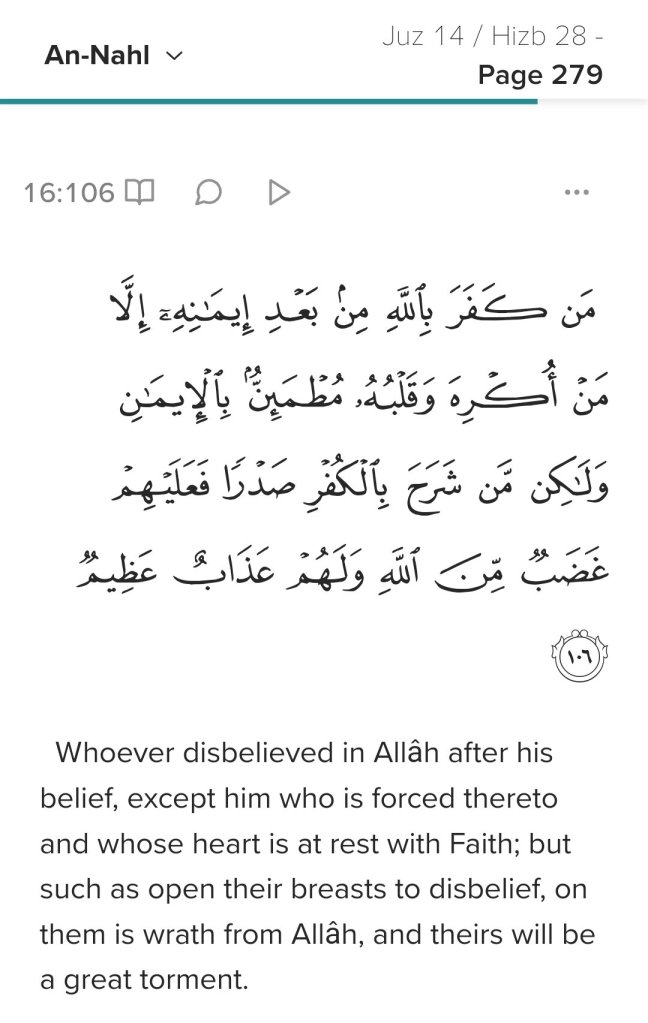
A Muslim can use non-Islamic laws only under coercion, and with the belief that what Allah and His Messenger ﷺ revealed are and forever will be superior.
Great Dhikr After Friday Prayer! A Forgotten Sunnah…

🖊️ There is a Hadith upon which very few act upon today. In fact, I believe this to be an abandoned Sunnah.

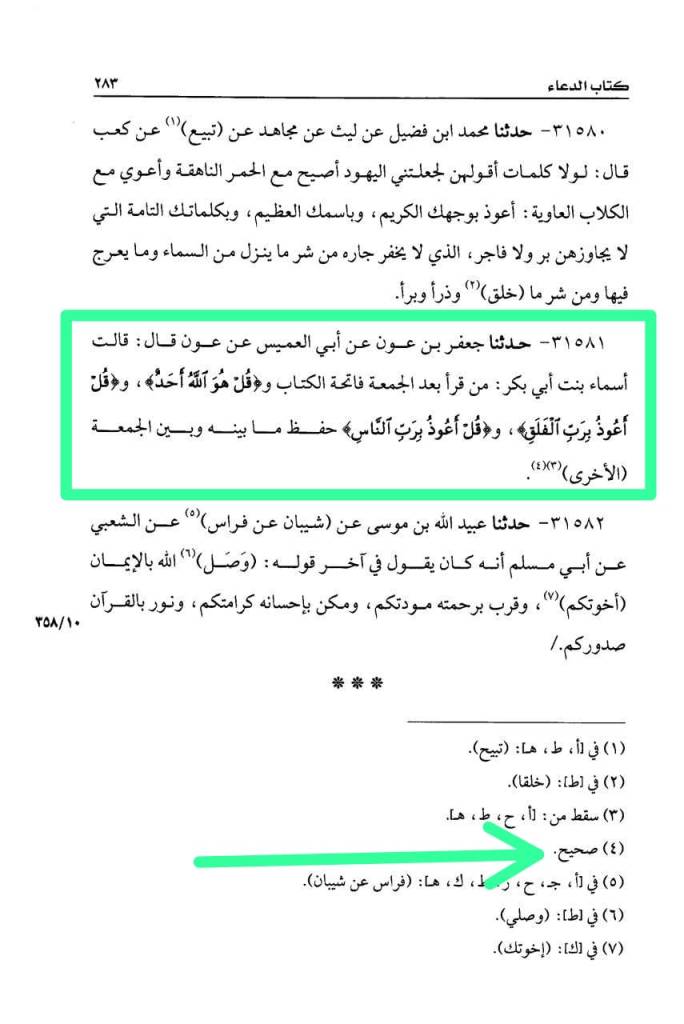
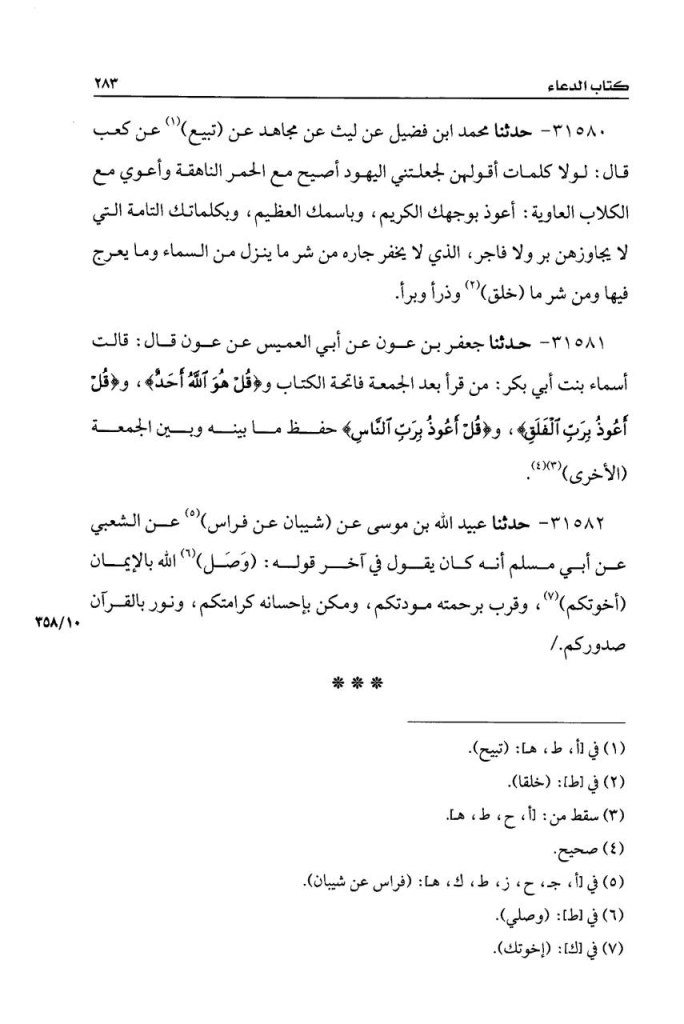
Asma bint Abi Bakr (رضي الله عنها) said:

مَنْ قَرَأَ بَعْدَ الْجُمُعَةِ فَاتِحَةَ الْكِتَابِ، وقُلْ هُوَ اللَّهُ أَحَدٌ، وَقُلْ أَعُوذُ بِرَبِّ الْفَلَقِ، وَقُلْ أَعُوذُ بِرَبِّ النَّاسِ حَفِظَ مَا بَيْنَهُ وَبَيْنَ الْجُمُعَةِ.

Whoever recited Surah Al-Fatihah, Surah Al-Ikhlas, Surah Al-Falaq and Surah An-Nas after the Friday prayer, he will be protected from that Friday to the next Friday.

📚 Narrated by Ibn Abi Shaybah in “Al-Musannaf” (29602), and declared to be Hasan (Acceptable) by our Shaykh Zubair Marjalvi in his work “Surah Al-Fatihah: It’s Virtues, Peculiarites, Academic Benefits and Practical Benefits” (p. 5)

📝 Note: The Hadith is elevated to being Marfu, as Asma couldn’t speak about this affair unless if she learned it from the Prophet ﷺ, as her statement can’t be from Qiyas or Ijtihad.

I asked our Shaykh Zubair Marjalvi حفظه الله regarding this Hadith:

Many women do not attend the Friday prayer, so if they read these four Surahs after the Friday prayer ends, will they be included in the virtue mentioned in this Hadith?

The Shaykh said:

“Yes إن شاء الله, and it’ll be upon their intention. If a woman is menstruating for example; can we say she can’t remember Allah? No! So it is hoped that she will be included among those mentioned in the Hadith.”

(Translated by Ibn Badar As-Salafi, and taken from his Telegram Channel:
https://t.me/ibnbadar99books)

Update: I learnt that Shaikh Sa’ad Ash-Shitri Hafidhahullah has declared the Hadith below to be Sahih. (Thanks to Brother Ibn Badar As-Salafi.)

Lament…

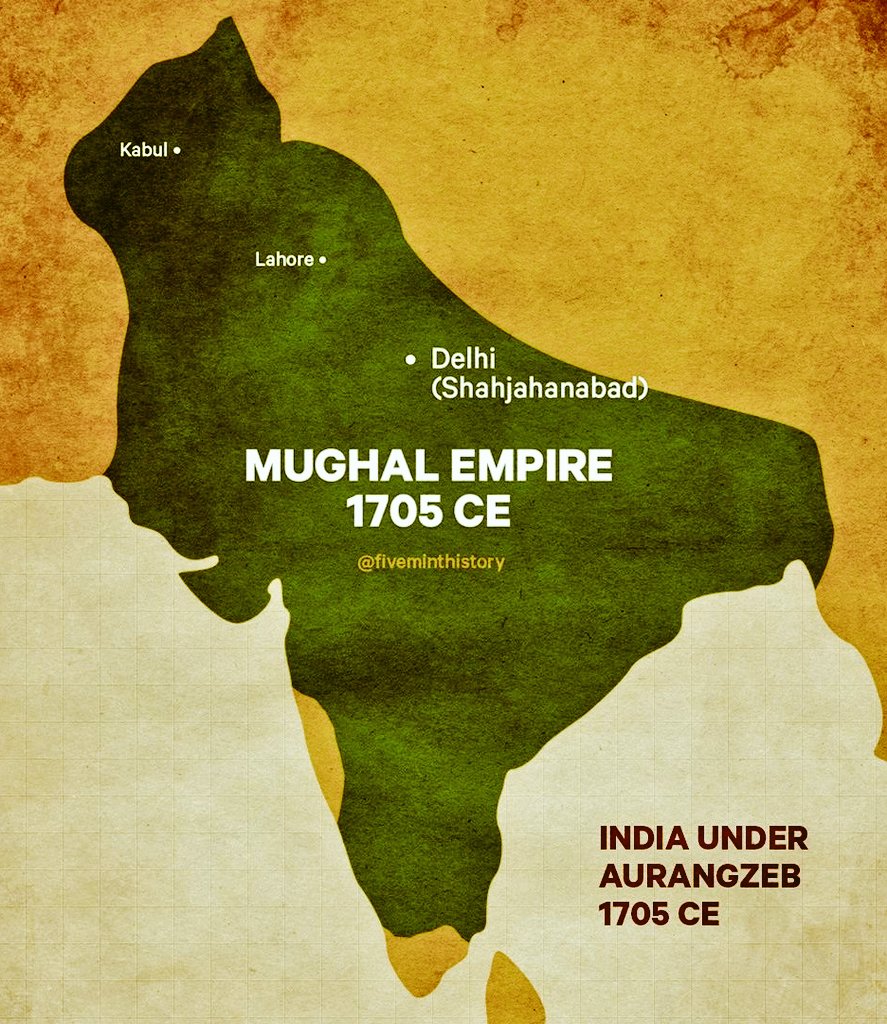
In the land where once they reigned with justice & might,
Muslims’ glory shone in radiant light.
From rulers of a vast & golden land,
To now, at the mercy of their foes’ command.
Straying from Islam, their strength did fade,
A lament for the Indian Muslims, a sorrowful cascade.

A Clarification On An Answer Given By Shaikh Assim Al-Hakeem On Acts Of Kufr Al-Akbar…

السلام عليكم ورحمة الله وبركاته

With due respect to Shaikh @Assimalhakeem (Twitter handle). Shaikh please stop teaching sensitive issues in one-two liner paragraphs. There are acts of Kufr Al-Akbar (Major disbelief) that which if a person does, even without conviction, he will exit Islam.

For example. If someone clearly mocks the religion or its aspects, and does it with or without conviction of Kufr, it is still Kufr Al-Akbar.

Sh. As-Saeedan says in the video below, ‘If someone says that to do Takfeer of the one prostrating to an idol (without compulsion),he needs to do Istihlal (believe it is permissible in his heart),then such a person is a Murji’, because there is no Istihlal required in matters that are Kufr bi-Dhatihi (Kufr in and of themselves).’ (See from 15:00 mins onwards)

Thus, if an action is Kufr Al-Akbar, by itself, even if one does it without conviction, without being compelled or forced (Ijbar), then it is Kufr Al-Akbar itself.

Note: The Murjiyah, were/are a deviant sect who restricted Imaan only to belief in the heart and statement of the tongue, such that if anyone did an act of disobedience externally, they believed that it didn’t harm his inner Imaan.

Read more here:

https://abdurrahman.org/2012/03/11/what-are-the-types-of-murjiah-shaykh-saalih-al-fawzaan/

Also, if an act of Kufr Al-Akbar is ‘done without conviction’ (as you said), you’ve to at least clarify when it would be excusable & when it would be a major sin that needs repentance.

This post in no way means to belittle Shaikh Assim Al-Hakeem, may Allah preserve him and rectify our mistakes and errors.

(Added benefit by @aasif__javid)

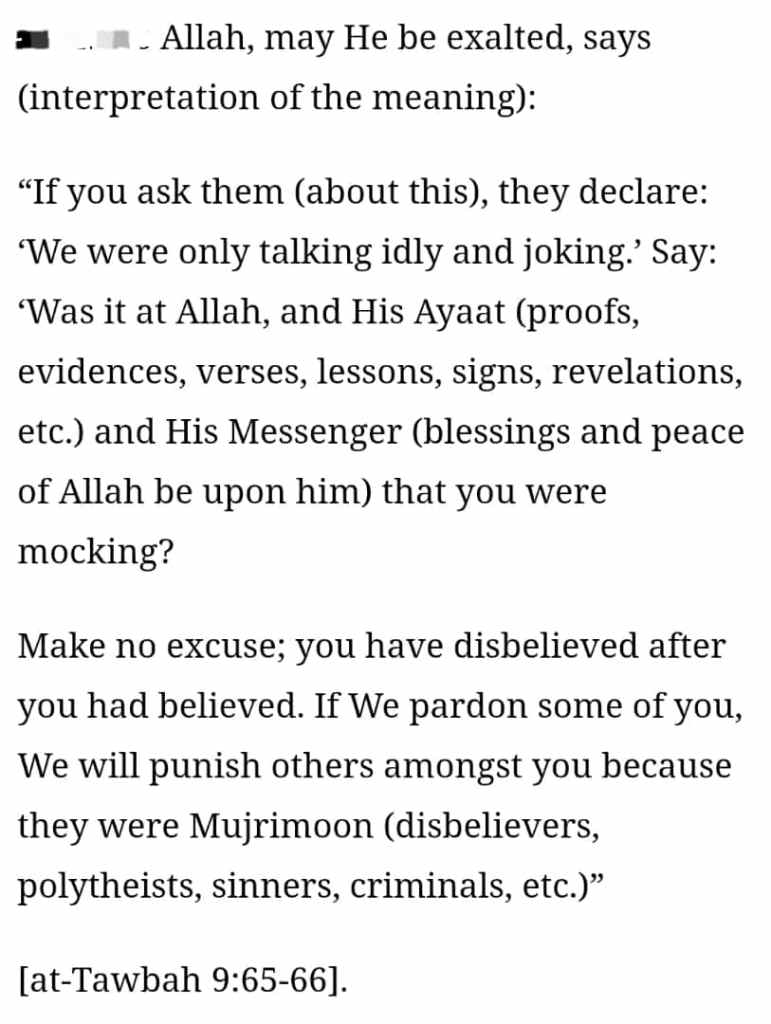
From the benefits Shaikh Fawzaan حفظه الله derived from these two verse (pic) about mocking the deen :
1. The one who commits kufr (disbelief) and claims he did not know it is kufr isn’t excused for that.
Note: This is about المسائل الظاهرة

2. The one who utters a statements of kufr (disbelief) becomes a disbeliever even if he does not believe in his heart what he said (with his tongue).

– الملخص في شرح كتاب التوحيد

-End of note.

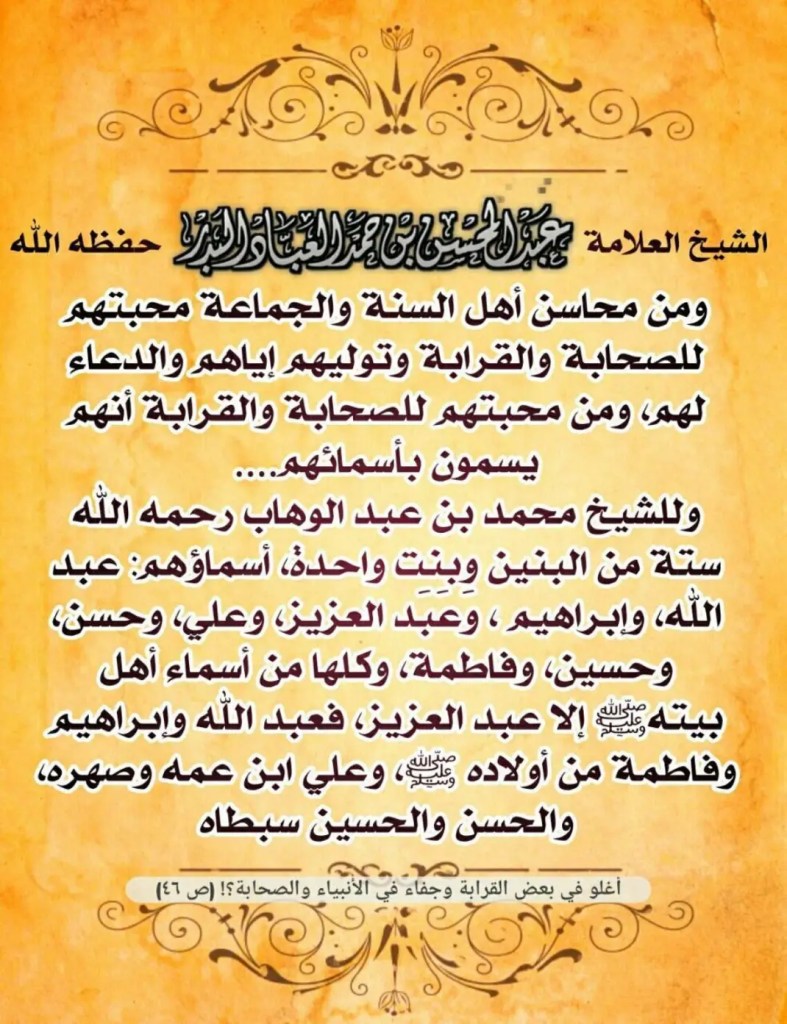
Ahlus-Sunnah name their children by the names of the Sahaba and the Ahlul-Bayt (رضي الله عنهم أجمعين).

Sheikh Abdul Muhsin Al-Abbād, may Allah preserve him, said:

And one of the virtues of the Ahl al-Sunnah wa al-Jama’ah is their love for the companions and their close relatives, their care for them, and their supplication for them. As a sign of their love for the companions and close relatives, they name their children after them.

Sheikh Muhammad Ibn ʿAbdul Wahhāb, may Allah have mercy on him, had six sons and one daughter. Their names were Abdullah, Ibrāhīm, Abdul ʿAzeez, ʿAlī, Hasan, Husain, and Fātimah. All of these names were among the Ahl al-Bayt (the family members of the Prophet ﷺ), except for Abdul ʿAzeez. Abdullah, Ibrāhīm, and Fātimah were his (the Prophet’s) children. ʿAlī was his uncle’s son and the husband of his daughter (Fatimah), and Hasan and Husain were his grandsons.

[Ref: Is it extremism with some of the relatives (of the Prophet ﷺ) and ill-treatment (hatred) towards the prophets and his companions? (Q(46))]