The main aim of our site is to purify The Seerah of Prophet Muhammad ﷺ from weak and fabricated narrations using the works of the scholars of Islam. We may add other beneficial material as well.
Imam Abu Shamah Abdur Rahman Al-Maqdisi Rahimahullah wrote about Sultan Nuruddin Zangi Rahimahullah:
In times of war, he was the first to fight and he used to say, “I fought many battles and wished to be a martyr but I did not obtain my wish.” On hearing him, Imam Qutb Ad-Din An-Naysaburi told him, “I adjure you in the name of Allah not to risk your life, Islam and the Muslims- for you are their backbone. Were you to be killed in a battle. the Muslims would be murdered and their lands would be invaded.”
Nuruddin Zangi Rahimahullah replied, “What is all this about? Who am I to be considered so important? There is The One Who saved Islam and its lands before me; it is the Almighty and there is no god but He .”
(Noble Dynasties, The History of Nuruddin and Salahuddin, English, p.17)
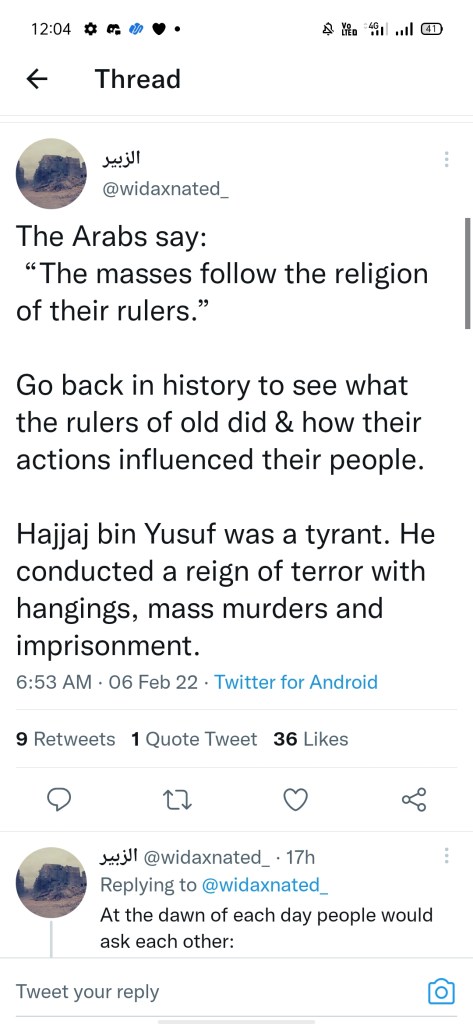
The Arabs say: “The masses follow the religion of their rulers.”
Go back in history to see what the rulers of old did & how their actions influenced their people.
Hajjaj bin Yusuf was a tyrant. He conducted a reign of terror with hangings, mass murders and imprisonment.
At the dawn of each day people would ask each other: “Who was killed yesterday, who was hanged, who was whipped?”
The Umayyad Caliph, Walīd b Abdul-Malik, loved to build beautiful buildings and set up workshops & factories. During his reign, people cultivated the same tastes.
They built buildings, established workshops, dug canals and planted trees.
He was followed by Suleiman bin Abdul-Malik who loved good food and music. In his times people would talk of singers and concubines and matrimonial feasts and festivities.
Then came the blessed reign of ‘Umar bin ‘Abdul-‘Aziz, and radical change. All of a sudden, people would ask each other: How much of the Qur’an did you commit to memory? How many supererogatory prayers did you say the previous night?
How many days did you fast this month? How much of the Qur’an has so-and-so memorized? And when will so-and-so finish reciting the whole of the Qur’an?
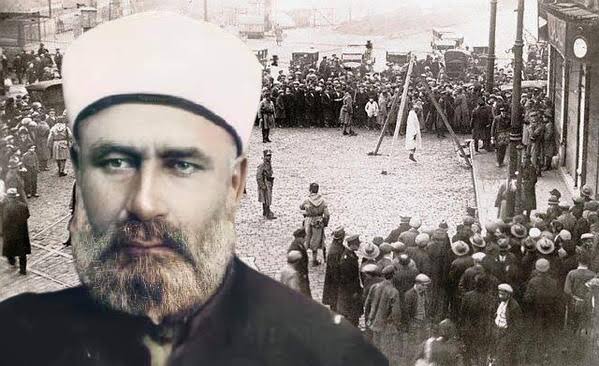
(Shaikh) İskilipli Mehmed Atıf Hoca was an Islamic Scholar. He was born in Çorum, Turkey. He started his early education in his village. In 1893, he came to Istanbul for Madrasa (“school” in Arabic) education. In 1902 he started Darü’l-fünun ilahiyat Fafültesi (Darü’l-fünun Divinity School). He finished his faculty in 1903 and started working as Ders-i Amm ( Ulema, a person who teaches the Madrasa students) in the Fatih Mosque.
He was later arrested and taken to jail several times, but freed. He was the founding member of Cemiyet-i Müderrisin together with Mustafa Sabri.
[He was arrested by the secular government (of Mustafa Kemal Pasha) for continuously preaching Islam and ‘propagating about not imitating the disbelievers’, even after repeated orders warning him not to do so.]
Before the Westernization movement in Turkey, he wrote a book titled Frenk Mukallitliği ve Şapka (literally- Westernization and the (European) Hat) in 1924. In it, he advocated Sharia Law and opposed western influences like “Alcohol, Prostitution, Theater, Dance” and the “western hat”. Because the western hat was a symbol of the Non-Muslims, and wearing a hat would make Muslims to lose their Islamic identity.
After the passing of “The Hat Act”, a law that passed on 25 November 1925 and ordered that no other headwear except the ‘western hat’ was allowed (therefore banning the wearing the Fez, classical Turkish turban worn by Muslims), people rose in revolt in some provinces, which the government suppressed.
[The secular government wanted to remove all the symbols of Islam, so they banned the Turkish Turban (Fez) and the traditional dress of the Turkish Muslim scholars, the Turkish gown (thobe).]
He was arrested and sent to Ankara on 26 December 1925 where he stood trial on 26 January 1926. The attorney general demanded three years of imprisonment, but the court postponed the trial to the next day. The next day, the Shaikh İskilipli declared that he no longer desired to defend himself. He was sentenced to death and martyred by hanging on 4 February 1926.
The Tomb of Atıf Hoca, who was buried in secret from his family, was found 82 years later and buried in the Gülbaba Cemetery in Iskilip district.
Shaikh Mehmed Iskilipli Atif Hoca meets his martyrdom in public view. May Allah accept his martyrdom for His Religion, forgive his shortcomings and grant him Al-Firdaws.
Among the believers, there are men who came true to the covenant they had with Allah. So, some of them have fulfilled their vows (by sacrificing their lives in the way of Allah), and some of them are (still) waiting, and they did not change (their commitment) in the least. (Surah Al-Ahzab,33:23)
All Praises And Thanks be to Allah and peace and salutations be upon His Messenger, Prophet Muhammad ﷺ, his household, his noble companions and all those who follow him, till the Day of Judgement.
Understand this- No matter how much the right wing Non-Muslim groups or governments claim about the Muslims that, ‘Muslims don’t love India’ or that ‘Muslims are against LGBT’ etc.,- that is not their actual issue with us.
And just because they say that, we shouldn’t overdo things to just prove them otherwise.
Indian Muslims think that by wearing a tricolor (Indian Flag) Kurta or Hijab on the national days the right wing Hindus will start loving us or becoming neutral towards us? Has it happened? -No!
We keep bad mouthing Pakistan to prove our nationalism, has it helped anyways? – No! May be 1% or 5% think positively about us, but majority of the Hindus still doubt us and say we’re just acting and pretending!
Similarly, the French Muslims have joined LGBT rights rallies and other such rights’ movements and do sloganeering in support!? Has it even helped them against the evil Emmanuelle Macron (French President)? Not much!?
If the problem with Indian Muslims is that they don’t love India, how did the extremist Hindus who removed the baby from a pregnant Muslim female’s belly (using a sword) during Gujrat riots (2002) and slaughtered the child know that the unborn child doesn’t love India? The child didn’t yet enter the world… So, what was the problem with that child?
Allah informed us the reason for their hate more than 1400 years ago!
They punished them for nothing but that they believed in Allah, the All-Mighty, the Worthy of All Praise. (-Surah Al-Buruj, Ayah 8)
So what do we do now?
Instead of trying to please them, we should try to be firm on our religion, and stop compromising. Then we will either live with dignity or die with honour.
If we keep watering down our religion, we may save our bodies and not our hearts! And we and our subsequent generations will lose our Akhirah and end up as apostates with Arabic and Persian names.
The Jews will never be pleased with you, nor will the Christians, unless you follow their faith. Say: “Guidance of Allah is, indeed, the guidance.” Were you to follow their desires despite the knowledge that has come to you, there shall be no friend for you against Allah, nor a helper. (Surah Al-Baqarah, Ayah 120)
Explanation: Allah addresses and warns His Prophet, telling him that the Jews and the Christians will never be happy with him unless he leaves Islam and follows what they do; and that if he (ﷺ), or one of his followerrs, were to do such a thing, after the clear truth has come to them, they would not find protection or help from Allah. (Explanation of 2:120 from Tafseer Center For Quranic Studies, Riyadh)
So dear Muslims, remember that these trials from the Non-Muslims are coming to us are because we all say La-Ilaaha-Illa-Allah (There is no true god worthy of worship except Allah). The Non-Muslims may claim different reasons, but the main and I must say the only reason is La-Ilaaha-Illa-Allah.
So remember that in this tussle and tug-off war between the Muslims and Non-Muslims, you have two options.
1.Try to be at the mercy of Non-Muslims and compromise your religion, thereby loosing Allah's Help in this Dunya and losing your Akhirah.
(Or)…
2. Be firm on your religion, don’t compromise with the Islamic fundamentals, let them put us in jails and torture us, let them throw us in a pool of fire. Allah has prepared for such believers a Jannah where we will live forever.
Indeed We have tested those who were before them. So Allah will surely know the ones who are truthful, and He will surely know the liars.(Surah Al-Ankabut, Ayah 3)
O you who believe, shall I tell you about a trade that saves you from a painful punishment? That you believe in Allah and His Messenger, and carry out Jihad (struggling) in His way with your riches and your lives. That is much better for you, if you but know.(-Surah As-Saf, Ayah 10,11.)
Remember- Whether you compromise on you religion or be firm, you will live only as much as is written in your fate. No liberal Muslim lived longer than what Allah willed for him and no firm Muslim lived a life shorter than what Allah had prescribed for him!
So please Allah and be firm in whatever is left out of your lives.
وَمَا عَلَيۡنَآ إِلَّا ٱلۡبَلَٰغُ ٱلۡمُبِينُ
Our obligation is no more than to convey the message clearly.” (Surah Ya-Seen, Ayah 17)
Hijrah has several meanings[1]. Amongst them is ‘to leave’ as Al-Fairoozabadi mentioned in ‘Al-Qaamoos Al-Muheet Al-Jaami’ limaa Dhahaba min Kalaam Al-‘Arab Shamaateet’, page 637. And Ar-Raaghib Al-Asfahaanee said in Mufradaat Al-Faadh Al-Qur’an, page 833: “Al-Hajr and Al-Hijraan is the person separating himself from someone else either by the body or by the tongue or by the heart.”
And Ibn Al-Atheer said in An-Nihaayah fi Ghareeb Al-Hadith, volume 5, page 244: “Hijrah originally is the word from Al-Hajr, the act of separating; the opposite of connecting. He separated from him Hajran and Hijraanan. Then it was predominately used for departing from a land to another land and leaving the first for the second. And it is said for it Haajara Muhaajartan.” This (last meaning) is what we are presently concerned with. End quote.[2]
[1] Hijrah, in the Ahadith also means to leave or to abandon sins and evil deeds. As in the Hadith:
Abdullah ibn Amr reported: A man asked, “O Messenger of Allah, which emigration (Hijrah) is best?” The Messenger of Allah ﷺ said, “To emigrate away from that which Allah disapproves. Emigration is of two kinds: The emigration of the resident and the Bedouin (Nomadic Arabs) . As for the emigration of the Bedouin, he responds when he is called and he obeys when he is commanded. As for the emigration of the resident, its trial is more severe and its reward is greater.” Musnad Aḥmad 6774, Sahih according to Ahmad Shakir.
[2] This passage was taken from Page 8 of ‘Irshad Al-Akhyaar’ by Shaikh Abu ‘Amr Abdul Kareem bin Ahmad.
Shaikh Saalih bin Fawzan Al-Fawzaan was asked:
What is the ruling on one who fears the aggression of the Kuffaar and Mushrikeen, and shows approval of some of their evil actions for fear of them, and not because he agrees with or approves of what they do?
He replied: It is not permissible for the Muslim to show approval of the Kuffaar at the expense of his religious commitment, or to agree with their actions and deeds, because their actions may be Kufr, Shirk and major sins, so it is not permissible for the Muslim to agree with what they do or to join them in that of his own accord, rather what he must do is to practice his religion openly.
And it is not permissible for him to live with the Kuffaar and stay in their land unless he is able to practice his religion openly, such as enjoining what is good and forbidding what is evil, and calling to the way of Allah, and that is what is meant by practicing Islam openly. If he cannot do that, then he must migrate to the Muslim lands from the Kafir land, and not stay there at the expense of his religious commitment and belief.
End quote from Al-Muntaqa (1/254).
Is It Permissible To Migrate To Another Land Of The Non-Muslims Where We Are Relatively Safer Than Our Own Non-Muslim Homeland?
In a Fatwa issued by the Standing Committee (of Saudi Arabia) (12/50) they stated: One may also migrate from a Mushrik land to another Mushrik land that is less evil and where there is less danger to the Muslim, as some of the Muslims migrated from Makkah at the Prophet’s command to Abyssinia. End Quote.
Was Hijrah Abrogated After The Conquest of Makkah?
-An Important Doubt
Narrated ‘Ata bin Abi Rabah: `Ubaid bin `Umar Al-Laithi and I visited Aisha and asked her about the Hijrah (i.e., migration), and she said, “Today there is no (Hijrah) emigration. A believer used to run away with his religion to Allah and His Messenger lest he should be put to trial because of his religion. Today Allah has made Islam triumphant, and today a believer can worship his Lord wherever he likes. But the deeds that are still rewardable (in place of emigration) are Jihad and good intentions.”[1]
In this regards we may quote from Imam An-Nawawi and Imam Ibn Hajar Al-Asqalani[2]:
Al-Imam An-Nawawi said in the explanation of Sahih Muslim, volume 9, pages 127-128, “The Scholars have said making Hijrah from the land of war to the land of Islam remains until the Day of Resurrection, and there are two positions concerning the explanation of this Hadith:
One is that there is no Hijrah after the conquest from Makkah because it became a land of Islam and Hijrah is only from the land of war. And this contains a miracle for the Messenger of Allah ﷺ in that it will remain a land of Islam from which making Hijrah is not imaginable.
The second is that it means there is no Hijrah after the conquest, its excellence being like the excellence before the conquest as Allah said:
“Not equal among you are those who spent before the conquest and fought (and those who did so after it.) Those are greater in degree than those who spent afterwards and fought. But to all Allah has promised the best (reward). And Allah knows what you do.” (Surah Al-Hadeed: 10)
Al-Hafidh Ibn Hajar said in Fathul-Baari, volume 4, page 47, “The meaning is that the obligation of making Hijrah from Makkah ceased with its conquest because it became a land of Islam…” End quote.
The Prophet ﷺ clarified in many Ahadith that Hijrah from the land of disbelievers to the land of Islam will not cease till the Day of Judgement:
‘Abdullah bin Waqdan As-Sa’di narrated:
“We came in a delegation to the messenger of Allah, each of us with a question to ask him. I was the last of them to come in to the Messenger of Allah, and I said: ‘O Messenger of Allah, I have left people behind me, and they are saying that emigration (Hijrah) has ceased.’ He said: ‘Emigration will not cease so long as the disbelievers are being fought.”‘[3]
Narrated Mu’awiya bin Abi Sufyan :
I heard the Messenger of Allah ﷺ say: “Migration will not end until repentance ends, and repentance will not end until the sun rises from the west”.[4]
Shaikh Saalih Al-Fawzan said: “…what is meant by «there is no migrating after the conquest» is (no migrating) from Makkah, since through the conquest, it became an abode of Islam. The people thought that migrating remained from Makkah after the conquest so they wished to attain the reward of migrating. As for migrating from the land of disbelief, then it remains until the Hour is established.” End quote.[5]
Shaikh Muhammad bin ‘Abdul Wahhab said: “Hijrah, from the land of shirk to the land of Islam, is an obligation upon this nation (Ummah) and it continues until the Hour is established”.[6]
[1] Sahih Al-Bukhari, 3900. Also see similar Ahadith in Sahih Muslim, 1353 a, 1864 and Sahih Al-Bukhari, 2783.
[2] This passage was taken from Page 34 of ‘Irshad Al-Akhyaar’ by Shaikh Abu ‘Amr Abdul Kareem bin Ahmad.
[3] Sunan An-Nasai, 4172. Shaikh Al-Albani graded this narration to be Sahih. Shaikh Shuaib Al-Arnauut said that the chain of this narration is Sahih according to the conditions of Imam Al-Bukhari, see Takhreej Mushkil Al-Athaar, 2632.
[4] Sunan Abu Dawud, 2479. Shaikh Shuaib Al-Arnauut said that the chain of this narration is Hassan Li Ghairihi in Musnad Ahmad, 16906. Shaikh Al-Albani declared it Sahih.
[5] Sharh-ul-Usool-ith-Thalaathah. Explanation of the Three Fundamental Principles of Imam Muhammad ibn ‘Abdil-Wahhab by Shaykh Saalih ibn Fawzan Al-Fawzan. Translated by Daawood Burbank. (Abdurrahman.org)
1. The Obligation To Migrate -For The One Who Is Not Safe To Practice His Religion And Protect His Life And Honour- In The Land of The Disbelievers
Allah says: “Verily, as for those whom the angels take (in death) while they are wronging themselves, they say, “In what condition were you?” They reply, “We were weak and oppressed on earth.” They say, “Was not the earth of Allah spacious enough for you to emigrate therein?” Those will find their abode in Hell, and what an evil destination;[1] except the weak ones among men, women and children who cannot devise a plan, nor are they able to direct their way. For these there is hope that Allah will forgive them, and Allah is Ever Oft-Pardoning, Oft-Forgiving.
2. The Promise of Allah To The The Ones Who Wish To Migrate
Allah says: “And whoever emigrates for the cause of Allah he will find on earth many dwelling places and plenty of provision”.
3. The Case of A Muslim Who Dies During Migration
Allah says: “And whoever leaves his home emigrating to Allah and His Messenger and then death overtakes him, his reward has become incumbent upon Allah, and Allah is Oft Forgiving Most Merciful”.[2]
4. Hijrah Is A Reason For Forgiveness of Major Sins Committed Prior To The Hijrah
The Prophet ﷺ said to ‘Amr ibn Al-‘Aas when he came to accept Islam- “Did you not know that Islam wipes out what was before it and that Hijrah wipes out what was before it and that Hajj wipes out what was before it?”…[3]
5. Hijrah Is A Reason For Forgiveness of Major Sins Committed After The Hijrah
It is narrated on the authority of Jabir that Tufail ibn ‘Amr Ad-Dausi came to the Prophet (ﷺ) and said: Do you need strong, fortified protection? The tribe of Daus had a fort in the pre-Islamic days. The Prophet (ﷺ) declined this offer, since it (the privilege of protecting the Holy Prophet) had already been reserved for the Ansar. When the Prophet (ﷺ) migrated to Madinah, Tufail ibn ‘Amr also migrated to that place, and there also migrated along with him a man of his tribe. But the climate of Madinah did not suit him, and he fell sick. He felt very uneasy. So he took hold of an iron head of an arrow and cut his finger-joints. The blood streamed forth from his hands, till he died. Tufail ibn ‘Amr saw him in a dream. His state was good and he saw him with his hands wrapped. He (Tufail) said to him: What treatment did your Lord accord to you? He replied. Allah granted me pardon for my migration to the Prophet. He (Tufail) again said: What is this that I see you wrapping up your hands? He replied: I was told (by Allah): We would not set right anything of yours which you damaged yourself. Tufail narrated this (dream) to the Messenger of Allah (ﷺ). Upon this he prayed: O Allah! Grant pardon even to his hands.[4]
6. It Is A Greatly Rewarding Act
It was narrated from Kathir bin Murrah that Abu Fatimah told him that he said: “O Messenger of Allah, tell me of an action that I may do and persist in it.” The Messenger of Allah said to him: “You should emigrate, for there is nothing like it.”[5]
Abu Fatimah Al-Iyadi narrated that the Messenger of Allah ﷺ said: “Upon you is to emigrate, for there is nothing like it, upon you is fasting, for there is nothing like it, upon you is to prostrate (increase in prostrations), for you will not prostrate to Allah but He will raise you in status one degree thereby and erase from you one sin.”[6]
7. It Is The Right of The Muhajir Upon Allah That He Shall Be Admitted Into Paradise
It was narrated that Sabrah bin Abi Fakih said:“I heard the Messenger of Allah ﷺ say: ‘The Shaitan sits in the paths of the son of Adam. He sits waiting for him, in the path to Islam, and he says: Will you accept Islam, and leave your religion, and the religion of your forefathers? But he disobeys him and accepts Islam.
Then he sits waiting for him, on the path to Hijrah (emigration), and he says: Will you emigrate and leave behind your land and sky? The one who emigrates is like a horse tethered to a peg. But he disobeys him and emigrates.
Then he sits, waiting for him, on the path to Jihad, and he says: Will you fight in Jihad when it will cost you your life and your wealth? You will fight and be killed, and your wife will remarry, and your wealth will be divided. But he disobeys him and fights in Jihad.’
The Messenger of Allah (ﷺ) said: ‘Whoever does that, then he had a right from Allah, the Mighty and Sublime, that He will admit him to paradise. Whoever is killed, he has a right from Allah, the Mighty and Sublime, that He will admit him to Paradise. If he is drowned, he has a right from Allah that He will admit him to paradise, or whoever is thrown by his mount and his neck is broken, he had a right from Allah that he will admit him to Paradise.'”[7]
8. The Muhajir (Emigrant) Is More Entitled To Be An Imam (Lead The Prayer)
Abu Mas’ud Al-Ansari reported- The Messenger of Allah (ﷺ) said to us: The one who is well grounded in Allah’s Book and is distinguished among them in recitation should act as- Imam for the people. And if they are equally versed in reciting it, then the one who has most knowledge regarding Sunnah; if they are equal regarding the Sunnah, then the earliest one to emigrate (do Hijrah); If they emigrated at the same time, then the oldest one in age. No man must lead another in prayer in latter’s house or where (the latter) has authority, or sit in his place of honour in his house, except that he gives you permission or with his permission.[8]
9. Dying Somewhere Which Isn’t Your Birthplace
ʾAbdullah ibn ʾAmr said: “A man passed away in Madinah and he was someone who was [actually] born there. The Prophet ﷺ performed the funeral prayer over him and then said, ‘Would that he had died somewhere else apart from his birthplace.’ So a man said, ‘Why, O Messenger of Allah?’ He replied, ‘When a person dies somewhere which isn’t his birthplace, a space is measured for him in Paradise [equal to the distance] from his birthplace to the place where he died.’” (Sahih Ibn Majah 1309, Hasan (Al-Albani).)
10. If You Leave A Land For The Sake Of Allah, Allah Will Replace It With Something Better:
Abu Qatadah reported: The Prophet, peace and blessings be upon him, said, “Verily, you will never leave anything for the sake of Allah Almighty but that Allah will replace it with something better for you.” (Musnad Aḥmad 23074, Sahih (Al-Arnauut))
11. Migration As An Act of Worship Will Not End Till The Day of Judgement
Narrated Mu’awiya bin Abi Sufyan : I heard the Messenger of Allah ﷺ say: “Migration will not end until repentance ends, and repentance will not end until the sun rises from the west”.[9]
[1] The Ayah is a stern warning to the Muslim who is able to do Hijrah and it is not possible for him to openly perform his religion by living under oppressive disbelievers and/or it is not possible for him to perform the obligatory aspects of his religion while residing amongst them. Let us be clear here that abandoning Hijrah is a ‘major sin’ and not something which makes a Muslim a disbeliever.
[9] Sunan Abu Dawud, 2479. Shaikh Shuaib Al-Arnauut said that the chain of this narration is Hassan Li Ghairihi in Musnad Ahmad, 16906. Shaikh Al-Albani declared it Sahih.
Summarized from the book : The Biography of Prophet Muhammad From Reliable and Credibly Established Narrations: Vol. 1/3 The Life of Prophet Muhammad in Makkah, by Mohammed bin Thajammul Hussain Manna.



 Saheehus-Seerah