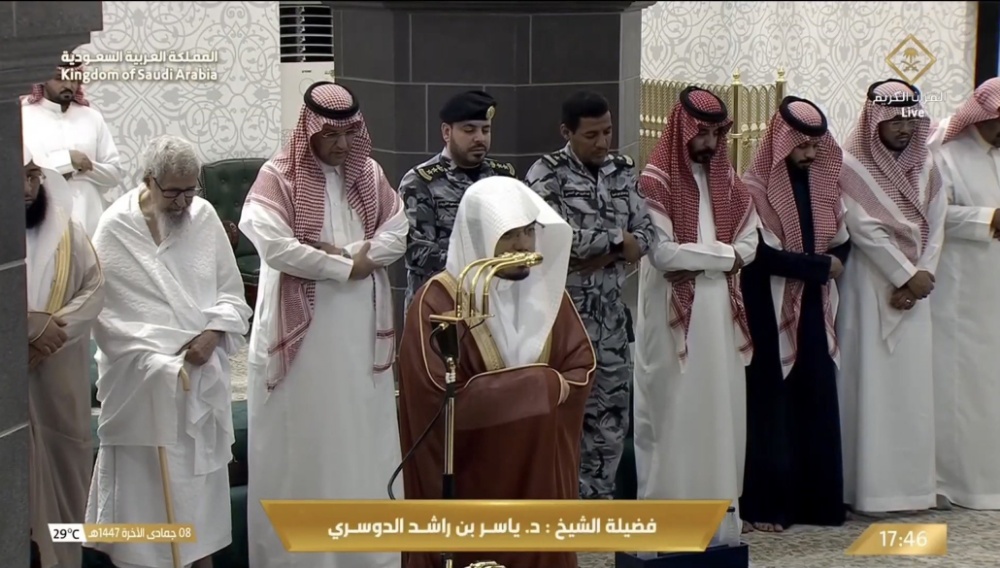
Is Ruqya restricted to what is narrated in The Quran and The Sunnah Only |Shaykh Saleh Al-Fawzan

🔉The questioner asks: Is Ruqyah (Islamic exorcism/incantation) Tawqeefi (restricted to prescribed texts), or is Tajurbah (working based on experience) permissible, given that it is for treatment and not for worship, and may Allah reward you?

Shaykh Saleh Al-Fawzan: What is Ruqyah…. (pardon)…?

Questioner: Restricted to prescribed texts?

Shaykh Saleh Al-Fawzan: How is it restricted? Ruqyah is by the Quran and by supplications, and by supplications that conform to the Book and the Sunnah. Even if its exact wording is not explicitly mentioned, as long as it conforms, even if its exact wording is not explicitly mentioned, there is no harm in that. So it is not restricted to prescribed texts. Yes. Allah Almighty knows best, and may Allah’s peace and blessings be upon our Prophet Muhammad. End of the answer.

(Translated by Mohammed bin Thajammul Hussain Manna.)

Imam Yahya ibn Ma’in and Ayat al-Kursi, Some Benefits Regarding Ruqya Shariyah

From Abbas al-Duri, who said: “I heard Ibn Ma’in say: ‘When I would enter my home at night, I would recite Ayat al-Kursi over my home and my family five times.”

“While I was reciting, something spoke to me, saying: ‘How much do you recite this? As if there is no one else who can recite well besides you!'”

“So I said: ‘I see this displeases you! By Allah, I shall increase it for you!'”

“Thereafter, I began to recite it fifty or sixty times a night.”

[Siyar A’lam al-Nubala’, 11/87]

The following benefits can be derived from this report:

1- Jinn may inhabit some homes and attempt to harm the household members, either through sounds or movements within the house, such as extinguishing lights and similar actions.

2- Frequent recitation of the Qur’an harms the jinn and expels them from the home, especially Ayat al-Kursi, which has a significant effect in weakening the shayatin (plural of shaytan).

3-Some jinn may speak to humans with a discernible voice, but without humans being able to see them.

-by Shaikh Sultan bin Abdullah Al-‘Amri

Source

(Translated by Mohammed bin Thajammul Hussain Manna from the Arabic website.)

Additional Points To Understand (by the translator):

1- Ayat al-Kursi has many virtues generally mentioned in the Ahadith.

2- In the above narration Imam Yahya ibn Ma’in recites Ayat al-Kursi more than once, in a manner not exactly mentioned in the Ahadith.

3- This shows that for Ruqya, what is necessary is that the Ruqya is free of Shirk and anything that is impermissible.

4- Ruqya is not Tawqeefiyah (strictly based on a narrated text from The Quran and The Sunnah), but is based on Tajurbah (previous experience).

5- From Shaykh Saleh bin Fawzan Al-Fawzan.

🔉The questioner asks: Is Ruqyah (Islamic exorcism/incantation) Tawqeefi (restricted to prescribed texts), or is Tajurbah (working based on experience) permissible, given that it is for treatment and not for worship, and may Allah reward you?

Shaykh Saleh Al-Fawzan: What is Ruqyah…. (pardon)…?

Questioner: Restricted to prescribed texts?

Shaykh Saleh Al-Fawzan: How is it restricted? Ruqyah is by the Quran and by supplications, and by supplications that conform to the Book and the Sunnah. Even if its exact wording is not explicitly mentioned, as long as it conforms, even if its exact wording is not explicitly mentioned, there is no harm in that. So it is not restricted to prescribed texts. Yes. Allah Almighty knows best, and may Allah’s peace and blessings be upon our Prophet Muhammad. End of the answer.

Source

6- This is based on the Hadith-
‘Auf b. Malik Al-Ashja’i reported, ‘We practised Ruqya in the pre-Islamic days and we said: Allah’s Messenger, what is your opinion about it? He said: “Let me know your Ruqya and said: There is no harm in the Ruqya as long as there is no Shirk in it.” (Sahih Muslim 2200)

The Issue of Having Two Friday Prayers One After The Other In The Same Masjid Because of Overcrowding- Dr.Muhammad Salah (Huda TV)

(The Fatwa of Shaykh Dr. Muhammad Salah transcribed:)

“This (question) is concerning holding two Jumu’ah (two Friday Prayers in the same Mosque). And why don’t we just all say that two jama’ah (two congregations)?

The Prophet (Peace Be Upon Him) forbade holding two jama’ah in the same masjid. In order to block the means of creating a split and disputes in the community. Oh, no, no, no- The case is different (here). It’s simply one batch finished, and another batch walked in, and they offered another Jama’ah. Is it permissible? That is permissible.

Now we get to speak about the Jumu’ah, on Friday prayer. So under regular circumstances, there is only one Jumu’ah. When you come and you attend, or you come late, and you managed to join the Imam in the first rak’ah, with the Imam and you made ruku with the Imam, masha’Allah this is Jumu’ah. And it counts as Jumu’ah.

But when some people, in some communities, the Muslim community is outgrowing the building, and according to the city regulations (which state) that you cannot pray outside (the Masjid). And the fire department says that the capacity is 2000 maximum at a time. So these scholars made Ijtihad (deduction based on The Quran and The Sunnah). We have a big masjid that can take 3000 at a time, but the Muslim community is about 10,000. So they made two Jumu’ahs and three Jumu’ahs for this reason, and they sign up. I’m going to attend the first or the second or the third, in order to regulate this process, to maintain the capacity and the city regulations. Is this permissible? It is permissible.

And the person who led the first Jumu’ah may give the Khutbah of the second, but somebody else who did not pray the Jumah can lead another Jumu’ah, another Imam. Another Imam can come and hold another Khutbah and another Salat al-Jumu’ah, because of the need. Or otherwise, those people would not get to pray.

Masha’Allah, across Europe and North America, the Muslim community is expanding, and it is growing, and it is outgrowing all the masajid. All the masajid. I remember 20 years ago when we started discussing this matter and it was in Texas. The masjid used to take 3000, 4000, and 5000, but not anymore. The Muslim community is getting bigger and bigger. So masha’Allah, we’re building more masajid, but again, the people are growing. Alhamdulillah. So can we hold multiple Jumahs for this reason? The answer is yes. Barakallahu feek.

(Transcribed by Mohammed bin Thajammul Hussain Manna, from the YouTube @HudaTvChannel, from Shaykh Dr. Muhammad Salah’s Question and Answers in English.)

The Issues of Holding Multiple Friday Prayers In The Same Locality – Shaykh Uthman Al-Khamees

Shaykh Uthman Al-Khamees stated in a video while explaining Daleel At-Talib (the chapter on Jumu’ah):


“Yes. He (Ash-Shaykh Mar’i bin Yusuf Al-Karmi Al-Hanbali, may Allah have mercy on him) said: “It is forbidden to establish the Friday prayer (Jumu‘ah) and the Eid prayer in more than one location within a town, except out of necessity, such as overcrowding, distance, or fear of fitnah (discord). If they multiply (i.e increase the places where the Jumu’ah is conducted) for reasons other than these, then the one that precedes in assuming iḥrām (starting the Jumu’ah prayer with Takbeeratul-Ihram) is the correct one.”

This is a real problem we are currently facing in our countries: the establishment of multiple Friday prayers in multiple mosques. The fundamental principle is that Jumu‘ah should gather people (bring people together). For example, in a neighborhood, an area, or a block, if there are four mosques, only one should hold Jumu‘ah. Now, almost all mosques hold Jumu‘ah. And no mosque is full. Each mosque has half its capacity or less, and this is wrong. It is not permissible. It is not permissible to hold a second Jumu‘ah until the first Jumu‘ah is completely full, such that there is no space for people—meaning, there is a reason. There must be a reason for establishing a second Jumu‘ah, such as lack of space, distance, or fear of fitnah (discord). If there are no such reasons, the default is that (the locations of conducting) Jumu‘ah prayers should not be multiplied. What is happening now in our countries, unfortunately, is a very grave error, which is the multiplication of Jumu‘ah prayers.

Look, between one mosque and another, just two streets away, there is a Jumu‘ah. And behind this mosque, there is a Jumu‘ah; in front of it, a Jumu‘ah; to its left, a Jumu‘ah. Everywhere, there is a Jumu‘ah. Almost all mosques now hold Jumu‘ah, except for a few, and this is wrong. The principle is that all the people of an area should gather for one Jumu‘ah.

If the mosque is not enough for them, another mosque should be opened. If that’s still not enough, they should… (unclear), and so on. But for everyone to say, “By Allah, we want Jumu‘ah at our mosque. We have a good preacher, and so we want Jumu‘ah here,” and another says, “We want Jumu‘ah here,” and another says, “We want Jumu‘ah here”—this is wrong. This is truly a bad leniency. Establishing multiple Jumu‘ah prayers without necessity. The principle is that the Jumu‘ah prayer gathers people. The people in multiple mosques should all gather in one mosque.

And the Eid prayer is likewise, even more so. Because Eid gathers more people than Jumu‘ah, as it is prayed outside mosques. So, more people gather there.

The point is that it is not valid to hold more than one Jumu‘ah at the same time, and the madhhab (school of thought, here he is referring to the Hanbali Madhhab) is strict on this issue.

If more than one Jumu‘ah is held without necessity, the second Jumu‘ah is invalid. If more than one Jumu‘ah is held without necessity, the second Jumu‘ah is invalid.

Shaykh asks a question to the audience: Is there a mosque where Jumu‘ah is held? (Another voice): Shaykh, we have mosques where Jumu‘ah is held, except for one mosque. (The Shaykh): Allah’s help is sought. I mean, look now, what is the distance between this mosque and the mosque in front of it? (Another voice): 100 meters. (The Shaykh): Huh? (Another voice): 100 meters. (The Shaykh): No, no, say approximately 400 meters. Okay. Jumu‘ah there and Jumu‘ah here. Is this one full? (Another voice): No. (The Shaykh): It’s not full. I think there’s a mosque behind it too. (Another voice): All (hold) Jumu‘ah. This one says here, and that one says there. (The Shaykh): And some mosques are small. And all of them hold Jumu‘ah.

According to Aḥmad’s madhhab, the one that starts first is the correct one, and all the rest of the Jumu‘ah prayers are invalid. To that extent (there is strictness in this issue). Therefore, it is truly necessary to send this message to the ministry that it is not permissible to open all mosques for Jumu‘ah. The principle of Jumu‘ah is to gather people. The principle is that the people of the mosques should gather in one mosque. This is the principle. But if every mosque holds Jumu‘ah, we gain nothing. Yes.

He said: “And it is forbidden to establish Jumu‘ah and Eid prayers in more than one location within a town, except out of necessity, such as overcrowding, distance, or fear of fitnah. If they multiply”—meaning the Jumu‘ah prayers—”for reasons other than that, then the one that precedes in assuming (Takbeeratul-) iḥrām is the correct one.” This means that the ones that come after it are incorrect. Yes.” (End of the Shaykh’s words.)

(Translated by Mohammed bin Thajammul Hussain Manna.)

‘Lambert The Sheepish Lion’? Lessons In Tarbiyyah For The Ummah

In the vast realm of modern entertainment, particularly from Western sources like Disney, one often finds narratives that, while visually appealing, frequently lack profound moral guidance or serve what some might consider aimless escapism. Yet, even from such unexpected quarters, lessons can emerge for those with discerning hearts.

Just as our beloved Prophet Muhammad (peace be upon him) commented on the incident of Shaitan (Satan) teaching Abu Hurayrah the virtue of Ayatul Kursi, remarking, “He told you the truth, although he is a liar.”, so too can wisdom be extracted from seemingly unlikely sources.

One such instance is the Disney cartoon, “Lambert the Sheepish Lion (1952).” The video captures a pivotal moment: Lambert, the lion raised by sheep since his birth, is seen sleeping uneasily amidst his flock under a moonlit sky with his sheep-mother. Lambert grows into a huge lion, but of course with the heart and characteristics of a sheep. One day a menacing wild wolf appears, its howl chilling the night and greatly terrifying Lambert and the other sheep. When this predator directly threatens and attacks his adoptive mother, a surge of innate lion courage suddenly awakens within Lambert. Despite his sheepish upbringing, he roars like a lion that he is, he charges forward, and with a brave and powerful ‘headbutt’—an action more akin to a sheep’s defense than a lion’s maul—he sends the wolf tumbling off the cliff, saving his beloved mother and earning the admiration of the entire flock.

This enduring tale offers a potent lesson on the profound impact of upbringing and the awakening of inherent nature. A lion cub, by divine fitra (innate nature) is a creature of strength, yet raised among sheep, adopts their timid ways. Only when confronted by a dire threat does his inherent nature stir, manifesting courage, albeit through a sheep’s familiar headbutt.

This parable holds deep wisdom for the Muslim Ummah, reminding us that true Islamic identity and strength, though ingrained in our children by Allah, can be obscured (hidden and concealed) without proper Tarbiyyah (Islamic nurturing and education). Historically, the Ummah possessed the heart of a lion, embodying Izzah (honour) and justice. However, without vigilant Tarbiyyah, successive generations risk becoming “sheepish,” adopting cautious, compliant habits in the face of challenges.

To cultivate a brave and resilient Ummah, one that truly embodies Islam’s Izzah, the Tarbiyyah of Muslim children is paramount. It is through dedicated Islamic parenting, instilling the stories of the Prophet (peace be upon him) and his Companions, a deep understanding of the Qur’an and Sunnah, and cultural values rooted in our faith, that children learn to apply their inherent strength.

It is not enough for a child to be born a Muslim; they must be raised as one, nurtured to fully embrace that leonine spirit, ensuring courage becomes a foundational way of life, guided by Sharia and striving for Allah’s sovereignty on Earth.

May Allah guide us to nurture our children with the best Islamic upbringing possible from our end.

Clip from ‘Lambert The Sheepish Lion 1952 (Disney)’

(Reflections by Mohammed bin Thajammul Hussain Manna. Author-compiler of the first Biography of the Prophet Muhammad (Salallahu Alaihi Wa Sallam) in English that only uses authentic narrations for the story line. B.E (Aeronautical Engineering), and other books, B.A (Islamic Studies), Advanced Diploma (Islamic Studies), student of Masters in Social Work.)