The main aim of our site is to purify The Seerah of Prophet Muhammad ﷺ from weak and fabricated narrations using the works of the scholars of Islam. We may add other beneficial material as well.
Chapter: Is the ‘Aqiqah Legislated with [Animals] Other Than Sheep, Such as Camels and Cows?
On the authority of Ibn Abi Mulaykah, who said: A boy was born to ‘Abdur-Rahman bin Abi Bakr. It was said to ‘A’ishah: “O Mother of the Believers, sacrifice a camel (jazur) as an ‘Aqiqah for him.” She replied: “Maadh Allah (God forbid)! Rather, [we do] what the Messenger of Allah (Salallahu Alaihi Wa Sallam) said: ‘Two comparable sheep (shatan mukafa’atan).'” Hasan: Recorded by At-Tahawi in Sharh al-Mushkil (1042) and Al-Bayhaqi (9/301) through the route of ‘Abdul-Jabbar bin Ward al-Makki, who said: I heard Ibn Abi Mulaykah say… and he mentioned it.
Its chain of narration (isnad) is Hasan because of ‘Abdul-Jabbar bin al-Ward, as he is truthful (saduq) and has good narrations (hasan al-hadith).
‘Abdur-Razzaq recorded in his Musannaf (7956) on the authority of Ibn Jurayj, who said: Yusuf bin Mahak informed us, saying: Ibn Mulaykah and I entered upon Hafsah bint ‘Abdur-Rahman bin Abi Bakr. She had given birth to a boy for Al-Mundhir bin Az-Zubayr. I said: “Why do you not sacrifice a camel as an ‘Aqiqah for your son?” She replied: “Maadh Allah (God forbid)! My aunt ‘A’ishah used to say: ‘For a boy, two sheep, and for a girl, one sheep.'” Its chain of narration is Sahih.
Ibn al-Qayyim said in Tuhfat al-Mawdud (pp. 136-137): The jurists (fuqaha’) have differed regarding whether [animals] other than sheep can take their place in the ‘Aqiqah.
Ibn al-Mundhir said: They differed concerning the ‘Aqiqah with other than sheep. We have been narrated from Anas bin Malik that he used to sacrifice a camel as an ‘Aqiqah for his child.
And from Abu Bakrah, that he slaughtered a camel for his son ‘Abd al-Rahman, and fed the people of Basra. Then he relayed from Al-Hasan, who said: Anas bin Malik used to sacrifice a camel as an ‘Aqiqah for his child. Then he mentioned from the hadith of Yahya bin Yahya: Hushaym informed us, on the authority of ‘Uyaynah bin ‘Abd al-Rahman, from his father: that Abu Bakrah had a son born to him [named] ‘Abd al-Rahman, and he was the first newborn in Basra. So, he slaughtered a camel as an ‘Aqiqah for him and fed the people of Basra.
However, some of them rejected that, saying: The Messenger of Allah (Salallahu Alaihi Wa Sallam) ordered two sheep for a boy, and one sheep for a girl. It is not permissible to perform the ‘Aqiqah with anything else…
Ibn al-Mundhir said: Perhaps the evidence (hujjah) for those who consider the ‘Aqiqah to be fulfilled with camels and cows is the statement of the Prophet (Salallahu Alaihi Wa Sallam): “With the boy is his ‘Aqiqah, so spill blood on his behalf.” He did not specify one [type of] blood over another; therefore, whatever is slaughtered for the newborn, based on the apparent meaning of this report, suffices.
He [Ibn al-Mundhir] said: And it is permissible for one to say: “This is general (mujmal), whereas the statement of the Prophet (Salallahu Alaihi Wa Sallam) : ‘For the boy are two sheep and for the girl is one sheep’ is explicit (mufassar), and the explicit takes precedence over the general.”
Malik said: Sheep for the ‘Aqiqah are more beloved to me than cows, and sheep/goats are more beloved to me than camels; however, cows and camels for the Hady (pilgrimage sacrifice) are more beloved to me than sheep/goats, and camels for the Hady are more beloved to me than cows.
I say (Shaykh Dr.Diya-ur-Rahman, as a conclusion): There is another observation regarding preferring sheep over camels and vice versa, which is the benefit of those being fed. If they are many, then a camel is better; and if they are few, then a sheep is better, taking into consideration their preference for the type of meat.
End of the chapter.
[6/680, 37-Kitab Al-‘Aqeeqah, 5-Is the ‘Aqiqah Legislated with [Animals] Other Than Sheep, Such as Camels and Cows? (From Al-Jami Al-Kamil Fee Ahadith As-Sahih Ash-Shamil of Shaykh Dr.Diya-ur-Rehman Al- Azami Rahimahullah)]
(Translated by Mohammed bin Thajammul Hussain Manna.)
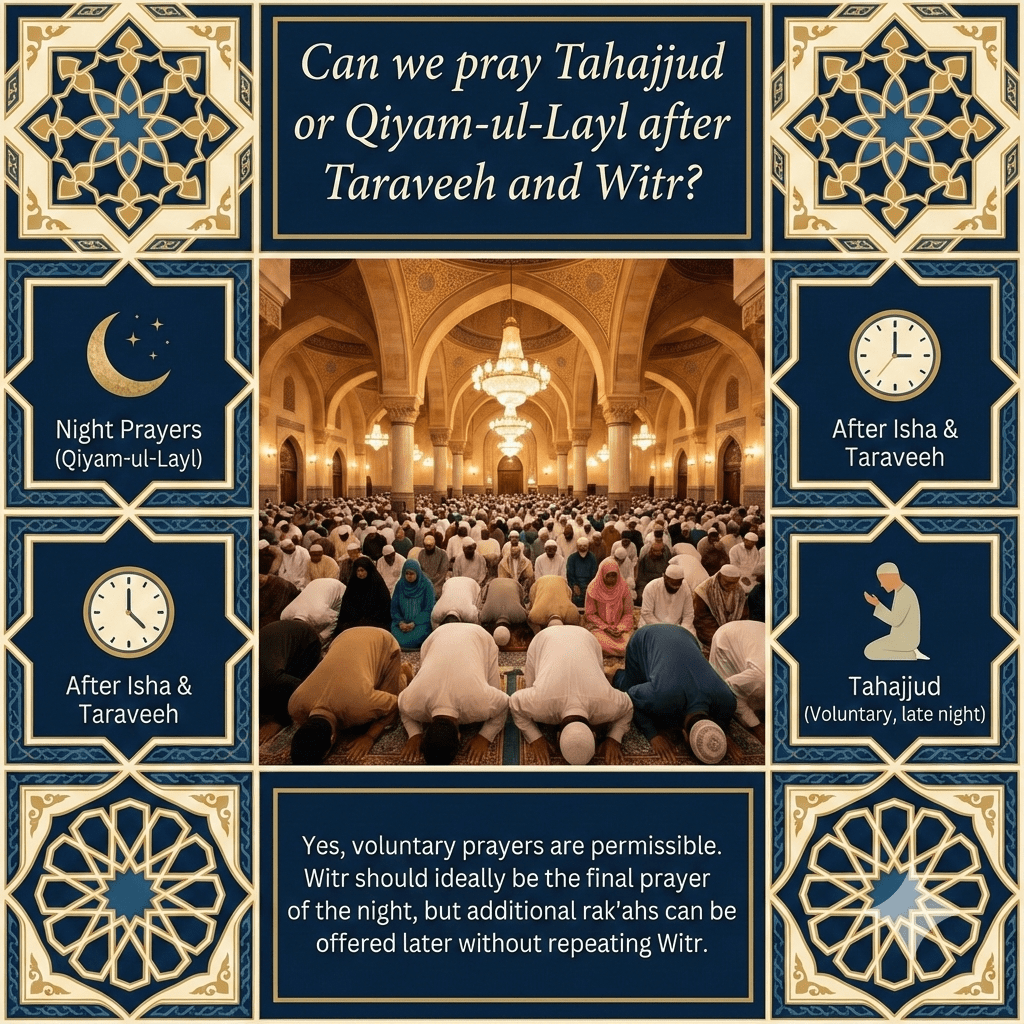
Whenever the question arises, ‘Can we pray Tahajjud or Qiyam-ul-Layl even after praying Taraweeh and Witr?’, many people reply:
“There is no need to pray because there is a hadith of the Prophet ﷺ which says that whoever offers the complete prayer with the Imam gets the reward equivalent to offering the prayer the entire night (Sunan An-Nasa’i, Saheeh [Al-Albani]).”
However, this answer is wrong from many angles.
First of all, is it permissible to offer any prayer after 11 rakats, which also includes Witr?
Yes. The Ahadith which says that Witr should be the last prayer, it does not mean that praying any Nafl salah (voluntary prayer) after Witr is completely Haram (forbidden). It means that Witr should generally be the last prayer. But if someone prays any Nafl or Sunnah of Isha after Witr, then there is no harm in it. For example, praying Tahajjud after Witr is proven from the Prophet ﷺ (and from the Sahaba, as will be seen soon InshaAllah).
Praying 2 Rakats after Witr by Prophet (Salallahu Alaihi Wa Sallam):
Abu Salamah narrates, “I asked Aisha (Radi Allahu Anha) about Prophet’s prayer.” She said: “He (Salallahu Alaihi Wa Sallam) used to pray thirteen (13) rakats. He (Salallahu Alaihi Wa Sallam) used to pray eight (8) rakats, then He prayed Witr. After that, he used to sit and pray two (2) rakats. Then, when He wanted to perform ruku, He would stand up and perform ruku. And alongside, He used to pray two (2) rakats between the Adhan and Iqamat of Fajr.” (Sahih Muslim)
Secondly- Is it correct to say that if you complete the entire taraweeh with the imam then you have earned the reward of praying the whole night and there is no need to pray any more?
This is a misunderstanding of the Prophet’s hadith. The meaning of this hadith is not to say, “Don’t pray extra prayers,” as neither the Prophet nor the companions understood it that way. The hadith describes the virtue of completing the taraweeh with the Imam. If there were no need to pray more than that because “it’s equivalent to praying all night,” then simply praying Isha and Fajr would be sufficient. Because the one who prays Isha and Fajr in congregation would not require to pray the Sunnah prayers at all as the person who prayed both the prayers would get the reward of praying the whole night according to the following hadith –
Uthman bin Affan (Radi Allahu Anhu) narrates that Messenger of Allah (Salallahu Alaihi Wa Sallam) said: “The person who offers Isha prayer in congregation gets the reward of spending half the night in Qiyam. And the person who offers both Isha and Fajr prayers in congregation gets the reward of spending the entire night in Qiyam.” [Jami At-Tirmidhi, 221, Sahih (Zubair Ali Zai)]
Thirdly- Did the companions pray in another jamaat (congregation) after one Taraweeh jamaat?
In the narration from Sunan Abi Dawood (1439), the companion Talq bin Ali (Radi Allahu Anhu) returns home and leads his family in prayer, including the Witr prayer. Afterwards, he goes to the masjid, leads the prayer, but does not pray the Witr prayer again. This suggests that one can pray after the Witr, but that the Witr prayer should not be repeated again, and one can also participate in two night-prayer congregations.
Qays ibn Talq narrates: Talq ibn Ali visited us on a day of Ramadan. He stayed with us till evening and broke the fast with us. Then he got up and lead the Witr prayer for us. After this he went to his masjid and offered the prayer there (for the people). Then when Witr prayer was left to be offered, he called forward another person and said: “Offer the Witr prayer for your people, because I heard the Messenger of Allah (Salallahu Alaihi Wa Sallam) saying, “There are no two Witrs in one night.”” (Abi Dawood, 1439, Sahih [Al-Albani], Hasan [Al-Arnaut])
Shaykh Saleh Al-Fawzan (May Allah preserve him) said:
“If a person prayed Taraweeh and prayed witr with the Imam, then stood in the night for tahajjud, then there is no preventative for that. And he does not repeat the witr, rather the witr he prayed with the Imam suffices him. He prays tahajjud in the night with what Allah makes easy for him and if he delays witr until the end of the night, then there is no harm. However, he will miss following the Imam and it is better to follow the Imam by praying witr with him due to the statement of the Prophet (Salallahu Alaihi Wa Sallam):
Indeed, whoever stands (praying) with the Imam until he finished, then it is recorded for him that he prayed the whole night. [Reported by Abu Dawood (2/51), Tirmidhi (3/147-148), Nasaai (3/83-84), Ibn Majah (1/420-421)]
So he follows the Imam and prays witr with him. This does not prevent him from standing at the end of the night and praying tahjjud with what is easy for him”. End.
[al-Muntaqaa min Fatawa Fawzan (no. 116), translation of Shaykh Saleh Al-Fawzan’s Fatwa was taken from torontodawah.com/the-ruling-on-praying-tahajjud-after-taraweeh/]
(Compiled by Mohammed bin Thajammul Hussain Manna, translated from Roman Urdu to English by Adeeb Sheriff.)
Ruling on Eating Meat Sold in Markets of Non-Muslim Countries- Shaykh Ibn Baaz
Question: What is the ruling on eating meat sold in the markets of non-Muslim countries? Is it permissible (halal) or forbidden (haram)?
Answer: The scholars of Islam are unanimously agreed upon the prohibition of the slaughtered meat of the polytheists, idol worshipers, atheists, and all similar categories of disbelievers, except for the Jews, Christians, and Zoroastrians (Majus). They are also unanimously agreed upon the permissibility of the slaughtered meat of the People of the Book (Jews and Christians).
They differed, however, regarding the slaughtered meat of the Zoroastrians (Majus) – the fire worshipers. The four Imams and the majority of scholars hold that it is prohibited, likening the Zoroastrians to idol worshipers and all other categories of disbelievers who are not from the People of the Book. Some scholars held that their slaughtered meat is permissible, likening them to the People of the Book.
This latter view is very weak, rather it is false. The correct view is that of the majority of scholars: the prohibition of the slaughtered meat of the Zoroastrians, like the slaughtered meat of all other polytheists, because they are of their kind, except concerning the Jizyah (poll tax). The Zoroastrians only resemble the People of the Book in that the jizyah is accepted from them.
The evidence for this is the saying of Allah the Exalted in His Noble Book, in Surat Al-Ma’idah (5:5): “This day [all] good foods have been made lawful, and the food of those who were given the Scripture (Jews and Christians) is lawful for you and your food is lawful for them.”
He the Exalted explicitly states that the food of the People of the Book is lawful for us. Their “food” refers to their slaughtered meat, as stated by Ibn ‘Abbas and other scholars.
The implication of the verse is that the food of those disbelievers who are not from the People of the Book is forbidden to us. This is the view held by all scholars, except for the aforementioned aberrant and weak difference of opinion regarding the slaughtered meat of the Zoroastrians.
Now that this is established, the meat sold in the markets of non-Muslim countries: If it is known that it comes from the slaughtered meat of the People of the Book, then it is permissible for Muslims, as long as it is not known that it was slaughtered in a manner contrary to Islamic law. The principle is its permissibility based on the Qur’anic text, and one should not deviate from this except for a verified matter that necessitates its prohibition.
However, if the meat comes from the slaughtered meat of the rest of the disbelievers, then it is forbidden to Muslims, and it is not permissible for them to eat it, based on the textual evidence and consensus. Mentioning Allah’s name over it during washing or during eating is not sufficient.
As for the argument some might raise based on the Hadith, that narration pertains to a group of Muslims who were new to faith. Some Companions, may Allah be pleased with them, asked the Prophet (Salallahu Alaihi Wa Sallam) about this, saying: “O Messenger of Allah, people who are new to faith bring us meat, and we do not know whether they mentioned the name of Allah over it or not.” This was narrated by Al-Bukhari in the Hadith of ‘A’ishah, may Allah be pleased with her. This Hadith cannot be used as a pretext by those who permit eating meat brought to markets from the slaughter of disbelievers other than the People of the Book by merely mentioning Allah’s name over it. This is because the aforementioned Hadith of ‘A’ishah pertains to Muslims, not to disbelievers; thus the ambiguity is removed. The affairs of a Muslim are assumed to be correct and upright as long as the contrary is not known. Perhaps the Prophet (Salallahu Alaihi Wa Sallam) commanded those who asked him to mention Allah’s name when eating, as a precaution and to nullify the whisperings of Satan, not because that permits what was forbidden from their slaughtered meat. And Allah the Exalted knows best.
Regarding a Muslim in those non-Muslim countries finding it difficult to obtain meat slaughtered according to Islamic law, or becoming weary of eating chicken meat and the like, this and similar reasons do not make it permissible for him to eat forbidden meat, nor does it place him in the category of one under duress, by consensus of the Muslims.
It is essential to pay attention to this matter and beware of unjustified leniency.
This is what has become apparent to me concerning this issue, which has become widespread. I ask Allah to grant success to the Muslims in what is beneficial for their religion and their worldly affairs, to fill their hearts with fear of Him and reverence for His sanctities, and to beware of what contradicts His Law.
—
[1] Narrated by Al-Bukhari, no. 5083 (Book of Slaughtering and Hunting), Chapter on the Slaughtered Meat of Bedouins and the Like. [2] Published in the Journal of the Islamic University in Madinah. (Collection of Fatawa and Articles of Shaykh Ibn Baz 23/13).
Ruling on Eating from the Slaughtered Meat of the People of the Book
Question: This question is sent by the listener Al-ʿUmari Muhammad, a Moroccan national residing in France. He has two questions, the first of which is: He says, “You know that the custom of those who were given the Scripture differs from the custom of the Arabs in slaughtering animals. However, we eat from their beef, mutton, and goat meat. Is there any sin upon us for that or not?”
Answer: Allah the Exalted has permitted for us the food of the People of the Book. He said (interpretation of the meaning): “This day [all] good foods have been made lawful, and the food of those who were given the Scripture is lawful for you and your food is lawful for them.” [Al-Mā’idah: 5]. The People of the Book are the Jews and Christians. They had altered and substituted [scripture] before the mission of the Prophet (Salallahu Alaihi Wa Sallam), and they have distorted [it]. Despite that, Allah permitted for us their food and the chaste women from among them.
This indicates that there is no harm for us in eating their food. Their food means their slaughtered meat. As for fruits and similar items, these may be eaten from all categories of people, even from those not among the People of the Book. Even the polytheists of various kinds, there is no harm in eating their fruits, grains, and produce—no problem. What is prohibited is the slaughtered meat. Slaughtered meat from those other than the People of the Book, such as polytheists, Zoroastrians, and those with no religion, is forbidden. The slaughtered meat of these individuals is not permissible for Muslims at all. Rather, what is permitted for us is specifically the slaughtered meat of the People of the Book: the Jews and Christians.
If you do not know how they slaughtered [the animal], then eat, and praise be to Allah. Do not ask, as long as you know that this is from the slaughtered meat of the People of the Book, the Jews or Christians, for it is lawful for you.
However, if you come to know that they (the Jews and the Christians) slaughtered it in an un-Islamic manner—for example, if they strangled it to death, then do not eat it. For they are not better than the Muslims. If a Muslim were to strangle an animal, it would be forbidden; if he struck its head until it died, it would be forbidden; if he struck its belly until it died, it would be forbidden, and he is a Muslim. So how about a Jew or Christian? The Jew or Christian is less than a Muslim. So if they are negligent in slaughter, and you know that—that he slaughtered it in an un-Islamic way, such as strangling it or beating it until it died—then it is not permissible.
Host: Or by electrical means, for example.
Shaykh: Or by electrical means, extracting its blood, draining the blood from its veins until it died, or striking its head until its skull was crushed—then it is not permissible.
Likewise, if he engaged in some other method besides these known methods, other than proper slaughter, or if he slaughtered it for other than Allah, dedicating it to the Messiah, or to Ezra, or to other idols, then it is not permissible. Because Allah has forbidden that which is dedicated to other than Allah.
As for when you do not know, then you may eat. Or if you know that they slaughtered it according to Islamic slaughter—[cutting] the throat (ḥalqūm), the esophagus (marī’), and the two jugular veins (wadajayn). Islamic slaughter is like this: cutting the throat, esophagus, and the two jugular veins. This is complete slaughter. If he cuts the throat and esophagus, it suffices. If he cuts along with them one of the two jugular veins, that is good. However, perfection in slaughter is to cut the throat, the esophagus, and both jugular veins altogether. These are the two veins surrounding the neck. If the slaughterer cuts these four things, it is most complete. If he suffices with the throat and esophagus, it is permissible according to the correct view. If he cuts along with them one of the two jugular veins, it is likewise permissible. If he cuts them—cuts all four—this is the most complete form of slaughter.
The Sunnah is that he should say the tasmiyah: “Bismillah.” Rather, this is obligatory at the time of slaughter, to mention the name of Allah. If he forgets it or is unaware of the ruling, there is no harm if he slaughtered and did not say the tasmiyah out of ignorance or forgetfulness, whether he is Muslim or a disbeliever. There is no harm. Yes.
Jab bhi sawal ata hai ki ‘kya Taraveeh aur Witr ke baad bhi Tahajjud ya Qiyam-ul-Layl padh sakte hain?’, tho kayi hazraat jawab mein keh dete hain ki
‘Padne ki zarurat hi nahi hai kyunki Nabi Salallahu Alaihi Wa Sallam ki Hadis hai ki Jisne Imam ke sath puri namaz ada ki, wo saari raat namaz ada karne ke barabar hai. (Sunan An-Nasai, Saheeh (Al-Albanil).
Lekin ye jawab ghalat hai kayi noiyat (angles) se.
#1) Sabse pehli baat ye, ke kya 11 Rakat, jismein witr bhi shamil hai, uske baad koi bhi namaz padna jayaz hai?
Jee haan, jayaz hai. Jin ahadith mein hai ki witr ko aakhri namaz banawo, uska matlab ye nahi ke witr ke baad namaz padna bilkul HARAM hai. Uska matlab hai ki witr ko aam tour par akhri namaz banani chahiye. Lekin agar koi witr ke baad raat ki koi Nafil ya sunnat padh le tho ismein koi harj naji hai. Jaise ke Nabi e Kareem Salallahu Alaihi Wa Sallam se witr ke baad Tahajjud padhna sabit hai (aur Sahabah se bhi).
Witr ke baad Nabi Salallahu Alaihi Wa Sallam ka 2 Rakat Padhna:
Abu Salamah bayan karte hain, “Main ne Hazrat Aisha se Nabi (Salallahu Alaihi Wa Sallam) ki namaz ke baare mein poocha.” Unhon ne farmaya: “Aap (raat mein) terah (13) rakat parha karte thay. Aap aath (8) rakat parhte, phir Witr parhte. Iske baad aap ﷺ baith kar do (2) rakat parhte thay. Phir jab ruku karne ka irada hota, toh kharay ho kar ruku farmate. Aur iske sath sath, aap Fajr ki Azan aur Iqamat ke darmiyan do (2) rakat parhte thay.” (Sahih Muslim)
#2) Kya ye kehna sahih hai ki Imam ke sath puri Taraveeh mukammal kar li tho sari raat namaz ka sawab mil gaya, abhi aur padhne ki zarurat nahi hai?
Ye Nabi Salallahu Alaihi Wa Sallam ki hadis ki ghalat samajh hai. Us hadis ka matlab ye nahi ke aur namaz mat padho, na Allah ke nabi ne aisa samjha na sahaba ne. Wo hadis fazail bayan kar rahi hai imam ke sath taraveeh mukammal karne ki. Agar ‘saari raat namaz ada karne ke barabar hone se’ aur zyada namaz padhne ki zarurat nahi hoti, tho sirf Isha aur Fajr ki Farz padna hi kaafi ho jata. Kyunki jo Isha aur Fajr jamaat se padhe use waise bhi saari raat qiyaam (namaz mein khade hone) ka sawab mil jata hai. (Lekin aisa tho bilkul nahi hai.)
Uthman bin Affan riwayat karte hain ke: Allah ke Rasool (Salallahu Alaihi Wa Sallam) ne farmaya: “Jo shakhs Isha ki namaz jamaat ke sath aada karta hai, toh usey aadhi raat qiyaam karne ka sawab milta hai. Aur jo shakhs Isha aur Fajr dono namazein jamaat ke sath parhta hai, toh usey poori raat qiyaam mein guzarne ka sawab milta hai.” [Jami At-Tirmidhi, 221, Sahih (Zubair Ali Zai)]
#3) Kya Sahaba ek Taraveeh ki jamaat ke baad aur ek Jamaat mein padhte thay?
Sunan Abi Dawood 1439 ki riwayat mein Sahabi Talq bin Ali (Radi Allahu Anhu) apne ghar aate hain aur ghar walon ko namaz padhate hain witr ke sath. Uske baad Masjid jakar dubara Imamat karwate hain, lekin dubara Witr nahi padhte. Isse pata chalta hai ki witr ke baad bhi namaz (Taraveeh/Tahajjud) padh sakte hain, lekin witr repeat nahi honi chahiye, aur do (2) jamat mein participate bhi kar sakte hain.
Qays ibn Talq bayan karte hain ke: Hazrat Talq ibn Ali Ramadan ke kisi din hamare paas tashreef laye. Wo shaam tak hamare sath rahay aur hamare sath roza iftar kiya. Phir unhon ne kharay ho kar humein Witr ki namaz parhai. Iske baad wo apni masjid mein gaye aur wahan (logon ko) namaz parhai. Phir jab Witr baqi reh gaye, toh unhon ne ek aur shakhs ko aage kiya aur farmaya: “Apne sathiyon ko Witr ki namaz parhao, kyunki main ne Allah ke Rasool ﷺ ko farmate hue suna hai: ‘Ek raat mein do (2) Witr nahi hote.'” (Abi Dawood, 1439, Sahih (Al-Albanil), Hasan (Al-Arnaut))
Shaikh Saleh Al-Fawzan (Mufti e Azam Saudi Arab, Hafidhahullah) farmate hain:
“Agar koi shakhs Imam ke sath Taraweeh aur Witr parh le, aur phir raat mein Tahajjud ke liye khara ho, toh is mein koi manai (rukawat) nahi hai. Aur wo Witr ko dobara nahi parhega, balkay jo Witr usne Imam ke sath parh liye hain, wahi uske liye kafi hain.
Wo raat mein Tahajjud utni parh le jitni Allah uske liye asaan kare, aur agar wo Witr ko raat ke aakhri hissay tak muakhar (delay) karta hai, toh is mein bhi koi harj nahi hai.
Lekin, is tarah wo Imam ki iqtida (sath parhne k sawab) se mehroom reh jayega, aur behtar yahi hai ke Imam ki pairwi karte hue uske sath hi Witr parhe, kyunki Nabi ﷺ ka farman hai:’ Beshak jo shakhs Imam ke farigh hone tak uske sath (namaz mein) khara rehta hai, toh uske liye poori raat ki ibadat likh di jati hai.’ [Sunan Abu Dawood (2/51), Jami At-Tirmidhi (3/147-148), Sunan An-Nasaai (3/83-84), Sunan Ibn Majah (1/420-421)]
Lihaza, wo Imam ki pairwi kare aur uske sath Witr parhe. Yeh cheez usey raat ke aakhir mein kharay hone aur jitna asaan ho utni Tahajjud parhne se nahi rokti.” [Al-Muntaqa min Fatawa Fawzan (No. 116)]
In the name of Allah, the Most Gracious, the Most Merciful. Peace and blessings be upon our beloved Prophet Muhammad, his pure family, and his noble Companions.
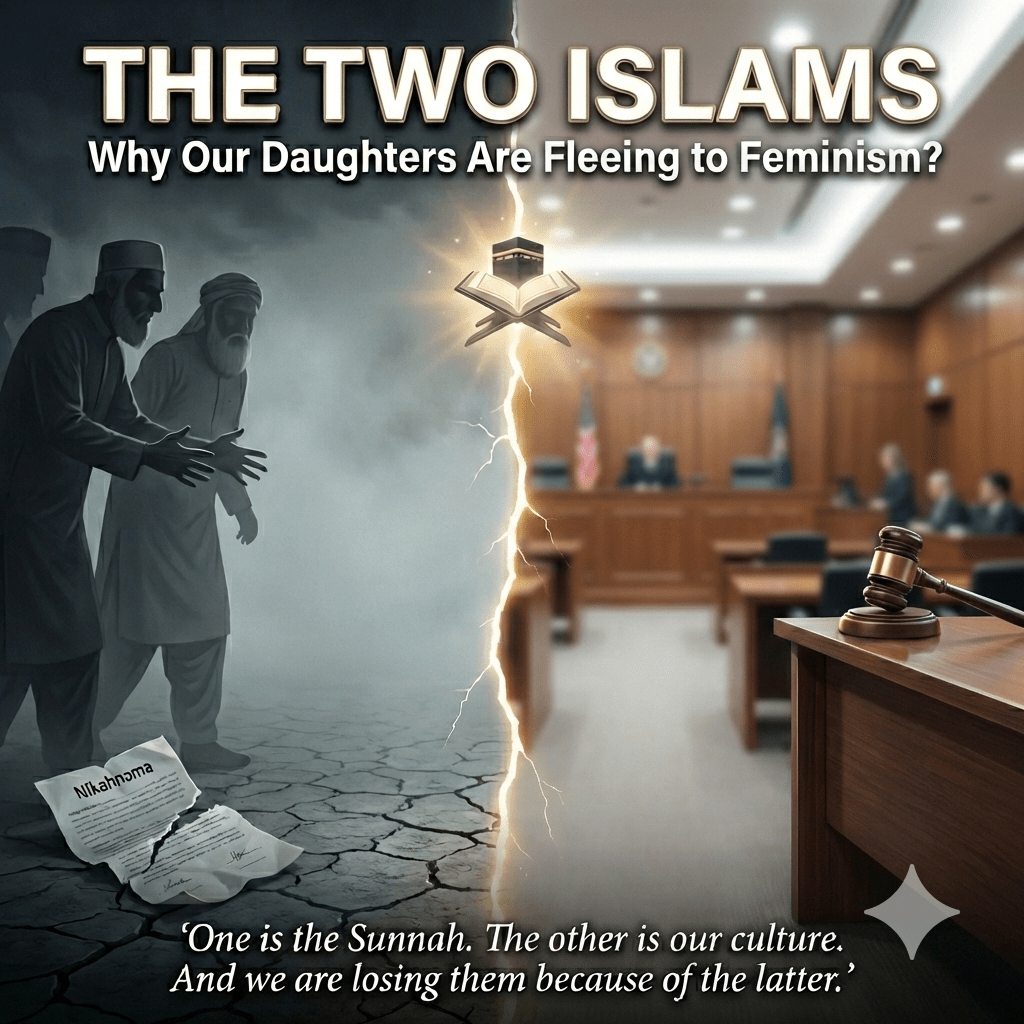
There is a cancer growing in our Ummah. Muslim women—our mothers, sisters, and daughters—are increasingly embracing secular feminism. As an orthodox Muslim, I (and generally all of us) hold that feminism is a poisonous Western ideology that opposes our Fitrah (innate nature), destroys the family unit, and places the creation’s desires above the Creator’s commands.
But let us pause. Let us engage in serious self-reflection.
If Islam truly grants women God-given rights—the right to choose a spouse, the right to education, the right to financial maintenance, the right to inheritance, the right to seek divorce from oppression—then why are our women walking away? Why do they see feminism as their only refuge?
The painful answer is this: We have presented them with two Islams. There is the pure, just, and balanced Islam of Prophet Muhammad (Salallahu Alaihi Wa Sallam). And then there is the twisted, patriarchal, culture-ridden “Islam of the subcontinent”—Desi Islam. And tragically, it is this second Islam that our women experience in their homes, their marriages, and their communities.
The Great Hypocrisy: Talking Rights, Denying Reality
We Desi Muslims love to deliver sermons on women’s rights in Islam. We proudly declare that Islam gave women their rights 1400 years ago. But when our own daughter sits before us, we force her into a marriage with a man she does not want. When our sister’s husband abuses her, we tell her to be patient. When our niece asks for her inheritance, we call her greedy and manipulative. This is the norm in most Desi families.
We have become masters of hypocrisy. We speak the language of the Quran, but we practice the language of our forefathers’ customs.
The Marriage Trap: Blackmail in the Name of Parental Honour and Love
Narrated Abu Huraira: The Prophet (Salallahu Alaihi Wa Sallam) said, “A matron should not be given in marriage except after consulting her; and a virgin should not be given in marriage except after her permission.” The people asked, “O Allah’s Messenger! How can we know her permission?” He said, “Her silence (indicates her permission). (Sahih al-Bukhari 5136.)
Aisha reported: A young woman entered her home and she said, “My father married me off to his brother’s son to raise his status, but I was unwilling.” Aisha said, “Sit here until the Prophet, peace and blessings be upon him, comes.” The Messenger of Allah came and she told him about it, so he sent for her father, who gave her the decision. She said, “O Messenger of Allah, I have allowed what my father did, but I rejected it so I could know if women have any say in the matter.” (Sunan an-Nasā’ī 3269, Sahih (authentic) according to Al-Arna’ut. Hadith translation from abuaminaelias.com)
Shaykh al-Islam Ibn Taymiyyah said, “As for marrying her off despite her unwillingness, this contradicts fundamental principles and sound reasoning. Allah did not allow her guardian to force her into buying or renting unless she consents, nor to eat, drink, or wear something she does not want. How can he force her to be intimate and interact with a man she does not want to be intimate with? Or to live with a man she does not want to live with? Allah has placed love and mercy between spouses. If a marriage cannot be contracted unless she hates him and he is repulsive to her, then where is the love and mercy in that?” (Majmū’ al-Fatāwá 32/25, abuaminaelias.com)
Yet in our Desi culture, a girl’s consent is trampled upon using the weapon of parental blackmail. When a daughter expresses her choice—perhaps she wishes to marry a pious young man, or she refuses a proposal due to genuine incompatibility—the parents unleash emotional terrorism. “We raised you for twenty-five years, and this is how you repay us?” “We will never show our face in society if you refuse this proposal.” “Your younger siblings’ marriages will be ruined if you say no.” “If you don’t marry this person, we will cut off all ties with you.”
We use the “rights of parents” card not as the Prophet (Salallahu Alaihi Wa Sallam) taught—with mercy and wisdom—but as a weapon to crush our daughters’ wills. We disregard the Hadith of choice completely. We ignore that the Prophet permitted a woman who was given in marriage without her consent to nullify the marriage entirely. We behave as if our daughters are property to be transferred, not souls entrusted to us by Allah.
At times, we throw away the principle of Kufu (compatibility) entirely. We marry our less religious daughters to extremely practicing men, thinking this will “fix” them. We marry our hijabi, Quran-memorizing daughters to modern, liberal men who drink and neglect prayers, thinking “he will provide well.” When the marriage inevitably collapses due to fundamental incompatibility, we blame the girl. We blame fate. We blame everyone except our own willful ignorance of the Prophet’s teachings and our own emotional blackmail that forced her into that situation.
The Prison of Nikah: Talaq, Khula, and the Forgotten Door of Faskh
Let us understand the Islamic framework for separation:
Talaq: The right given by Allah to the husband to pronounce divorce. It is not a toy to be played with.
Khula: The right of the woman to seek separation by offering compensation to the husband, usually returning the Mahr. Allah says: “If you fear that they will not maintain the limits of Allah, then there is no blame upon either of them concerning that by which she ransoms herself.” (Surah Al-Baqarah, 2:229).
Faskh-e-Nikah (Al-Faskh, Annulment): This is a unilateral divorce granted by an Islamic authority. When a husband refuses to give Talaq and rejects Khula, despite the woman suffering cruelty, abuse, neglect, or harm, a qualified Mufti or Qadhi can dissolve the marriage. This is her Islamic right.
However, here lies the tragedy of the Muslims in the subcontinent, since the vast majority of them are Hanafis. Due to the absence of an Islamic state and an over-cautious approach in later juristic tradition, the Hanafi Madaris and their Ulama stopped authorizing their Muftis to perform Faskh. Effectively locking the door of escape.
So a woman trapped in an abusive marriage goes to her local Mufti. He tells her, “Khula is only possible if your husband agrees.” She goes to her husband; he laughs and refuses or completely absconds. She returns to the Mufti. He says, “Be patient, pray more, perhaps Allah will change his heart.” She suffers for years, bearing beatings, verbal abuse, and psychological torture, all in the name of “preserving the marriage.”
The great scholar Maulana Ashraf Ali Thanvi (Rahimahullah) recognized this crisis. He explicitly permitted, within the Hanafi madhhab, the adoption of the Maliki position to authorize select Muftis to perform Faskh for women in dire situations. Alhamdulillah, some organizations are now doing this, but the progress is agonizingly slow. Most women don’t even know this option exists.
After years of running in circles, of being failed by the very people who should represent the Shariah, she finally walks into a secular court. The judge grants her a divorce in months. And then the Muslim community blames ‘her’ for going to the secular system! Who pushed her? We did. We failed to provide the Islamic solution, so she took whatever solution was available.
The Evil of Pre-Planned Halala: Playing with Allah’s Boundaries
Among the most disgusting practices that has crept into our society is that of pre-planned Halala.
When a man pronounces three divorces upon his wife in a single sitting—whether in anger, under the influence, or even in jest—according to the Hanafi madhhab, the divorce is binding and irrevocable. The woman becomes completely forbidden to him. She cannot return to him unless she marries another man in a ‘genuine’ marriage, the marriage is consummated, and then that second marriage ends naturally through death or divorce.
But what do we see in our society? A couple fights. The husband screams “Talaq, Talaq, Talaq!” in one breath. The next day, they regret it. But instead of accepting the consequence of their sin and ignorance, they look for shortcuts.
They find an “arranger” who brings a man to perform a temporary, fake marriage. They agree beforehand: “Marry her for one night, consummate it, divorce her in the morning, and we will pay you.” This man marries her, spends the night with her, and then divorces her. She then becomes halal for her first husband.
This is pre-planned Halala. This is a mockery of the Deen of Allah.
The Prophet (Salallahu Alaihi Wa Sallam) cursed the one who does Halala and the one for whom Halala is done. (Sunan Abi Dawud, Sunan al-Tirmidhi, Ibn Majah). In some narrations, he referred to such people as “adulterers.”
Think about this, brothers. We subject a Muslim woman—our sister—to the indignity of being passed between men like a commodity. We reduce marriage, which the Quran calls a ‘mithaqan ghaleezan’ (a solemn covenant), to a legal loophole. We destroy her honor, her self-respect, and her connection to the Deen. And then we wonder why she becomes bitter? Why she questions whether Islam truly respects her?
The fault lies in the ignorance of men who throw three divorces without knowledge. If they had learned the Fiqh of marriage before entering it, they would know that divorce is a process, not a game. They would know that even a single pronouncement of Talaq is enough as a separation, that still gives a chance for reconciliation. But we don’t learn. We don’t study. And our women pay the price.
The Abandoned Children: Deadbeat Fathers in Our Midst
Another silent crime is the abandonment of children after divorce. Islam places the financial responsibility of children squarely on the father.
Allah says: “But the father of the child shall bear the cost of the mother’s food and clothing on a reasonable basis.” (Surah Al-Baqarah, 2:233). This obligation continues until the children reach puberty and can support themselves, and it continues for daughters until they are married.
Yet how many men in our society, after divorcing their wives, simply stop spending on their own children? The mother is left struggling, working, begging, or relying on her own family, while the father moves on to a new marriage as if his previous children never existed.
And what does our community do? Nothing. We don’t boycott such men. We don’t shame them. We don’t hold them accountable. We still invite them to our gatherings, marry our daughters to their sons, and treat them as respectable members of society. We have removed the social punishment that should accompany such open disobedience to Allah’s command.
Inheritance: Robbing Women in the Name of Love
Allah has clearly specified the shares of inheritance in Surah An-Nisa. The daughter, the sister, the mother, the wife—all have fixed, God-given rights to property. Yet in our culture, we systematically deprive women of these rights.
We use emotional blackmail: “We spent so much on your wedding.” “Your brother has a large family to support, he needs it more.” “Your uncle is poor, be generous and give it up.” “If you take your share, your brothers will be angry and won’t look after you.”
We manipulate our mothers, sisters, and daughters into surrendering what Allah has decreed for them. We steal from them with words of love. And then we wonder why they grow resentful? Why they look at secular laws that enforce inheritance and think, “At least the court gives me justice”?
The Triple Talaq Epidemic
Perhaps nothing has damaged the image of Islam among women more than the casual, ignorant use of triple Talaq. Men who have never studied a single book or chapter on marriage, are entering this sacred union with the assumption that they will learn it naturally!?
The Prophet (ﷺ) said: “Seeking knowledge is an obligation upon every Muslim.” (Ibn Majah). Yet we enter the most serious contract of our lives—marriage—without any knowledge of its rules, its responsibilities, or its proper dissolution.
A man gets angry. He shouts three divorces. The next day, he regrets it. But according to the Hanafi madhhab, which we follow, the divorce is complete and irrevocable. His wife is now a stranger to him. His children are now from a broken home. All because he never learned that divorce should be given one at a time, during a period of purity, with a waiting period.
And in this ignorance, the woman suffers most.
The Moment of Realization
Brothers, let us stand back and look at the picture we have painted.
A young girl grows up watching her mother’s choices ignored in marriage decisions through emotional blackmail. She sees her aunt trapped in an abusive marriage with no way out, the Mufti offering only empty platitudes. She hears of a cousin subjected to the humiliation of Halala. She watches another relative struggle alone with children while the father lives freely without consequence. She herself is pressured to give up her inheritance for the sake of “family harmony.”
Then she goes online. She reads about feminism. Feminism tells her: “You are strong. You are independent. You don’t need a man. The patriarchal system is oppressing you. Break free.”
And she thinks, “They’re right. My religion didn’t protect me. My community didn’t protect me. My own family didn’t protect me. So why should I stay?”
She doesn’t realize that she was never shown real Islam. She was shown Desi culture wearing an Islamic mask. She rejected the mask, and in doing so, she also turned away from the beautiful face of the Deen beneath it.
The Path Forward: Advice to the Ummah
1. To the Men: Fear Allah Regarding Your Women. The Prophet (ﷺ) said in his Farewell Sermon: “Fear Allah concerning women. Verily, you have taken them as a trust from Allah, and their intimacy has been made lawful to you by the word of Allah.” (Sahih Muslim). You are shepherds responsible for their welfare. Justice is not optional, it’s obligatory.
2. Learn Before You Act. Study the Fiqh of marriage before you marry. Study the rules of divorce before you utter a single word. Knowledge precedes action in Islam. If you don’t know, ask. If you’re angry, stay silent. One moment of ignorance can destroy lives.
3. Implement Faskh-e-Nikah Fully. Our Ulama and Muftis must rise to the occasion. We must establish systems where women in genuine distress can obtain Islamic divorces without waiting years. We must follow the permission granted by our own scholars to use other madhahib when necessary for genuine need. Let us open the doors of the Shariah before our sisters run to the doors of the secular courts.
4. Boycott the Oppressors. If a man abandons his children, refuses maintenance, or deprives his sister of inheritance, he should face social consequences. Do not marry into such families. Do not do business with such men. Do not honor them in gatherings. Let them feel the weight of community disapproval until they repent and fulfill their obligations.
5. Stop the Halala Evil. Pre-planned Halala is a curse upon our Ummah. We must educate our communities regarding the proper way of separation in Islam. We’ve to close the doors that lead to the preplanned Halala market.
6. Return to the Sunnah in All Things. Let us consciously examine every practice in our families. Ask: Is this from the Quran and Sunnah, or is it from Desi culture? If it is from culture and contradicts the Shariah, abandon it immediately, no matter how “normal” it seems.
Conclusion
We do not need “Islamic feminism.” We do not need to import Western ideologies to reform our communities. What we need is to return to the authentic, balanced, and just Islam of Prophet Muhammad (Salallahu Alaihi Wa Sallam). We need to strip away the layers of ignorant cultural patriarchy that has suffocated the Deen.
When we implement the Shariah in its fullness—not just the parts convenient for us—our women will see that Islam is their greatest protector, not their oppressor. They will see that the Prophet (Salallahu Alaihi Wa Sallam) honored women, consulted them, and defended their rights in ways the world had never seen.
Let us fix ourselves. Let us hold ourselves accountable. Let us be the men that Allah described as Qawwamun— not tyrants, but protectors, maintainers, and caretakers. Let us be the ones who implement justice, so that our mothers, sisters, and daughters never feel the need to seek justice elsewhere.
A lot more needs to be written, but this much will suffice for now, InshaAllah.

 Saheehus-Seerah