In Search of Real Islam, my path towards Salafiyyah…
الحمد لله نحمده و نصلي على رسوله الكريم.
Assalamualaikum wa rahmatullahi wa barakatuhu….
This is my story of how I accepted the Madhab of Salafiyyah and Ahlul-Hadeeth.
I was born Alhamdulillah, in a Muslim family. My paternal relatives were Muqallideen of Imam Ash-Shafii,who are working with Jamat-e-Islami and my mother was from a staunch Deobandi Hanafi background who were also influenced by Jamaat-e-Islaami.
My mother was the one who hardened my foundations in my faith, Alhamdulillah, and she taught me how to be a fundamentalist Muslim. Even before I joined school she started teaching me how to speak English and forced me to have a command over it, she also coaxed me to learn Urdu and always insisted on me to learn the Urdu language.
My mother used to narrate to me inspirational stories of Mohammed ﷺ ,Umar ibn al-Khattab (رضي الله عنه) ,Hussain (رضي الله عنه) (the story of his martyrdom at Karbala), Salahuddin Al-Ayyubi, Aurangzeb, Tippu Sultan, etc (رحمةالله عليهم).
Though I still had a very meagre knowledge of Islam,I almost always held the belief that there can be no religion superior to Islam. Except for my teenage years in school, where I had a lot of doubts about my faith and had come to a conclusion that ‘all religions were from God and had various goodnesses in them’. This was a really perplexed state I was in, and if it wasn’t for Allah Who guided me, I would have apostatized, and we seek Allah’s protection from that.
In my house there were two types of literature, as I said,Deobandi as well as Ikwani (related to Jamat-e-Islami). I only remember reading Khutbaat of Sheikh Maudodi (May Allah forgive him) and quite a bit of Tafheem-Al-Quraan. I also read some of his other books. I still hold the memories of the books of Ashraf Ali Thanvi (The Deobandi, May Allah forgive him) my mother read out to me.
I however did not participate in the Tableeghi Jamat or Jamaat-e-Islami actively, because I was put up in Kuwait from LKG till the 10th standard. Neither did I hear the terms Ahlul Hadith or Salafiyyah till then.
The place I heard the word ‘Wahhabi’ is still strong in my memory. In my eighth standard Social Science text book, it said that the people of a Muslim sect ‘Wahhabis’ were the ones who started the freedom struggle. I however did not feel proud of it, because I thought, ‘What was the use of fighting against the British when you (The Wahhabis) will anyway go to the Hell Fire (by being a deviant sect)?’ Since I had never heard of ‘Wahhabis’, I thought they might be some sect like The Shia or The Bohris, so without proper beliefs any other action won’t be accepted, and that too must be the case with the Wahhabis.
Meanwhile, I did have a faint picture of Brother Zakir Naik (May Allah rectify his affairs and guide him to Salafiyyah). Once when I saw him on QTV (a TV channel of the grave worshippers who later stopped airing Zakir Naik’s lectures) with a coat and tie, and brother Zakir was saying that it was Halal to wear it. I switched off the TV, thinking of him to be a modernist and deviant trying to defend modernism in Islam, as I was taught that the tie was a Christian symbol.
•••
For 11th, I came to India and stayed in my grandmother’s place. In my grandma’s place, they would often ask me to lead the prayers, as they assumed that I have good knowledge of Islam (which wasn’t true at all that time). However, they would, remind me to pray in the Shafii way, but I would insist and pray in the Hanafi way, because I believed that all the four Imams were absolutely right in every issue that they had mentioned رحمة الله عليم.
Once in the Fajr prayer, I remember, that after the 2nd Rak’ah, I was about to go into Sujud without reciting the Dua Al-Qunut! On that my uncle, standing beside me, pulled my hand forcibly, and so I raised again, and recited the Qunut!
I remember, as a teenager, that once when I went to our family Mosque, which was lead by a Hanafi Imam (and he too was forced to pray the Shafi way by the public) to ask him about an issue, he would give us answers based on The Madhhabs but not upon The Sunnah. So I asked him, one day, as to what was the ruling if I missed such and such part of the Salah. He replied by telling me that it depended on which Madhhab I belonged to. I was a little bit confused, displayed silence and came back. This year, was when, I actually had an insight into Jamat-e-Islami’s activities in my area.
I understood some basic things about Jamat-e-Islami. They vehemently supported Iran as they always do and is evident from them openly, and they heftily abused the government of Saudi Arabia and all the Arab rulers in particular. This feature of theirs did alarm me later on.
Some two sessions of Quran classes in the weekly SIO (Students’ Islamic Organization, the students’ wing of Jamat-e-Islami) meet, and singing some Anasheed in Jamat-e-Islami programs was what I contributed to them (and I ask Allah to forgive me for cooperating with them). However, I really liked the way they grouped people irrespective of their differences (I realized later on that this was because in their organizational structure, that as long as you were their member, it didn’t matter if you were a Hadith-rejector or from Ahlus-Sunnah).
One thing of theirs, which I hated was, their leniency towards sporting the beard, wearing the skull cap and having the pants above the ankles. They considered these to be mere Sunnahs which could be comfortably neglected!
•••
When I was in 12th my mother came to India,and I started living with her, far from all Jamaat-e-Islami activities this while. There was Peace Tv English in our cable channel, which I rarely saw, and when I did, it generally had only comparative religion Dawah which was really impressive to me. I picked up many things like stats and verses etc., even though I watched it for less than 3 hours a week. I was interested in doing Dawah now, being still a Deobandi Hanafi within!
•••
There was a Barelvi mosque near our house, not exactly my house but close to my tutorial classes , which I liked going to, for the Friday Khutbah. I thought that the Naats and Salaams they sung, were the best way of showing love to the Prophet ﷺ . I also loved their show of love for the Prophet ﷺ . But on one Friday Khutbah the Imam of that Mosque spoke badly of the Mughal Emperor Aurangzeb because he supposedly dug out the grave of some Auliya-Allah (a pious Muslim, here – a pious revered saint) as a way of reprimanding those who say that the Auliya speak from their graves! Even before praying the Friday prayer in that Mosque, I left the Mosque and went out in disgust.
The reason I left that mosque, was not because of Tawheed, but because they cursed Aurangzeb and my mother has taught me how kind, pious and fore-bearing he was as a ruler !!!
With all these confusions in mind, I finished my 2nd PUC. I wanted to do medicine, but my circumstances forced me to select Engineering. With utter disgust I decided to opt for engineering, but I settled for a course which would be available only in Bangalore! Because I wanted to stay away from my strict mother who never allowed me to enjoy student life and meet my friends outside college. The course was Aeronautical Engineering.
All my decisions, which I made to escape from the clutches of a restricted life with my parents, made me happier by the day. Because I was soon going to enjoy life in Bangalore!
●●●
In Bangalore, my college’s Muslim friends’ circle was Tableeghi. (The Tableeghis are The Dawah wing of The Madrasa of Deoband.) I was happy finally, as I got my roots back, they said they were Deobandi Hanafis! Six months I was with them, sitting in the Fazail-e-Amaal ‘gashts’ (gatherings discussing the book) and speaking on Imaan (belief) was the norm.
There were two ‘Fitnah maker’ Ahle-Hadis (that’s what Salafis/Ahlul-Hadith are called in India- ‘Ahle Hadis’) guys in our group. The Deobandis would called the Salafis as ‘Fitnah Makers’, i.e. those who would deviate people by their deviant ideology. When these guys would tell about The Qur’an and The Sunnah to me, they would talk sense, but then I would give lame arguments to prove that the 4 Imams’ Madhhabs can exist in co-existence (with clear cut contradictions between them and the authentic Ahadith)!
But the Tableeghis soon realized the scene and started making me listen Anti-Ahlehadis (Anti-Salafi) speeches by a Deobani Scholar Shaikh Anzar Shah Qasmy from Bangalore. I heard quite many of his speeches, mostly on topics like-‘Ham Hanafi kyu hain? (Why are we Hanafis?)’, ‘Ghair Muqallid ka operation (Refutation of Non-Madhhabists)’,etc. This was the time I started sporting a beard, i.e, a trimmed and patchy one, not a ‘Salafi beard.
Whenever I would argue with these 2 Salafi guys, I knew my argument was lame, yet i would continue adamantly defending the Hanafi Madhhab. Finally all what I could understand about the Salafis from Anzar Shah Qasmy was that they, “Only accept authentic Ahadith”, “Reject or throw away statements which contradict the authentic Hadith”, “That they rob issues from the houses (bookd) of the 4 Imams”, “They hate blind Taqleed (blindly following a Madhhab without asking for a proof)” and “They don’t do any Shirk (act of polytheism) or Bid’ah (innovations in the religion of Islam)”!!!
As I was still trying to make sense of what being an ‘Ahle-Hadis/Salafi’ actually was, there was some Ramadan Students Event in the Mosque near our college in Bangalore. Brother Mehtab Amjad, from CIS (Cetre of Islamic Studies) had come there to give a speech on ‘The Importance of Seeking Knowledge’ (Or something similar).
What I had always heard of Ahle-Hadis/Salafis was that they always had ‘Beynoor'(Urdu for ‘darkened’) faces! But when I saw brother Mehtab Amjad, even though I had never seen many Salafis, I felt that, this brother is most probably an Ahle-Hadis (I wasn’t sure though and did not ask him about it). And in the Q&A session, he classified a very famous hadith as ‘fabricated’ . I was really impressed by this- i.e. that we as Muslims are supposed to look out for authenticity of Hadiths (Ahadith). I never knew Hadith too were classified as authentic or unauthentic. We were previously made to believe in everything that we were told to be was a Hadith….!!!
[The Hadith that Brother Mehtab Amjad spoke about was- “Seek knowledge even if you have to go as far as China, for seeking knowledge is a duty on every Muslim,” Shaykh Al-Albani said in Da’eef Al-Jaami’: “(It is) fabricated.” (no. 906). ]
Just after the event, I went in to congratulate him and ask questions like how to do Da’wah and similar stuff! But even without me asking him anything more, this brother started explaining me about the topic- ‘Where Is Allah?’ He asked me, ‘Where is Allah?’, for a moment I couldn’t make sense of what he was saying, I just couldn’t answer, though I wanted to say ‘Everywhere’. He explained to me that studying the religion from The Qur’an and Sunnah was important before we moved to conveying the religion to other people. He mentioned some proofs about ‘Allah being on His Arsh (Throne)’ and that His Knowedge encompassed everythind’, at the very place I could make sense of the belief that Allah was on His Throne (Ahamdulillah!). (The common Deobandi Aqeedah and Jamaat-e-Islami’s founder Moulana Moudodi’s Aqeedah was that Allah is everywhere-this is a serious mistake in Aqeedah.) Brother Mehtab Amjad directed me to the CIS bookstore and asked me to come there to buy some ‘authentic’ books to learn about Islam.
This was the real beginning of loving the methodology of the Ahlul-Hadith and a journey towards a rugged terrain.
One of those 2 Fitnah-makers, who actually did not sport a beard, asked me how was this speaker (Mahtab Amjad)! I replied positively, to this he said that the brother was also an Ahle-Hadis. This was a slight shocker to me as the brother Mahtab Amjad looked very gracious and handsome though he was tall, dark and slightly heavier on the scales. (Remember- The Deobandis would say that the Ahle-Hadis have darkened faces because of rejecting the blind following of Madhhabs!)
Then we had our college vacations and I went back home with the beard!
•••
When I reached my hometown, Udupi, my relatives asked me if I had become a ‘Salafi’. I never heard the word ‘Salafi’ yet, I just knew Ahle-Hadis! I asked in amazement- who are they? They told me all vices about them just like I heard from Anzar Shah Qasmy’s talks- that they criticize other groups a lot, they think only they go to Jannah, that they support Israel etc. I in innocence, made a sort of promise with one of my Jamat-e-islami uncles that I would never become ‘this thing that is called a Salafi!’
•••
Soon this incident happened in my grand mother’s place.(Allah opens up the hearts of the people in the way He has planned, Walhamdulillah.)
My younger uncle XYZLMN came from one of the Arabian Gulf States. He wanted to buy a gift to his Christian boss because he had done many favors on him. I went with my Uncle to the Bazaar. Soon my uncle entered a shop which had sandal wood idols of Hindu gods! My uncle then brought a sandal-wood elephant model for rupees 3500, I told my uncle that it is haram to buy an idol from an idol worshipper as it would be supporting him in his evil. He had lame arguments saying that the Christian boss won’t worship this. I still insisted that buying from a shop specifically selling them was Haraam. But my uncle brought it and we went home.
From my grandmothers place, I went back to my house, approx 5 kms from there, but I was really disturbed! The next day I went to my grandmother’s place, with an intention to advice my uncle to return back the idol.
My uncle refused and scolded me. I had a very meagre knowledge of Islam, and that too not Islam as taught by the Salafi scholars, but still I told my uncle-“You have become Mushrik by buying the idol.” (This was wrong of me to label him like that, it was my recent awakening of Islam that led me to be angry about ‘buying from a shop of idols’.)
My uncle said-“You have become a Salafi who nags on the smallest of things.”
Me-“What Salafi, I m not a Salafi?”
Uncle-“you will now keep beards like the Jews”.
Me- “Uncle! Can you see I have trimmed my beard, but uncle don’t slander the Salafis, they have got Hadiths (Ahadith) to support their opinion of having a long beard,as the prophet never trimmed his beard.” (I got this knowledge from my arguments with the 2 Salafi brothers I had mentioned above.)
Uncle- “Oh wow! And then you will keep the hands on your chest like this (showing me the way Salafis place their hands on the chest in a mocking way)”…..
Me- “Uncle, don’t joke about them like this, there is a hadith in Abu Dawud which supports their action.”
Uncle- “Do you shake your index finger in Namaz (Salah)?”
Me- “No!”
Uncle- “But the Salafis do it! And they distract people in prayer!”
Me- “They may have some hadith for that, we should ask them (instead of blaming them)!”
Uncle- “Oh ok! So, the Salafis have only got all the Hadiths in the world! Do you know the Barelvis also have Hadith to go to the Dargahs (The Barelvis commit acts of extreme veneration, innovations and Shirk on the tombs (Dargah) of the pious saints) ! ”
I was immensely angry at this. I shouted aloud, forgetting that he is a fatherly figure to me. . .
I said- “Barelvis have got hadith!!! Shut your mouth and move on, if you don’t know something don’t speak about it! ”
My uncle-“Ya Allah! My child said this to me”(he was almost about to cry).
My mom-“Son you shouldn’t have spoken this way!”
Me- ” Ammi! He is supporting the Mushriks! Mocking the hadith! Mocking the acts of the prophet! Should I stay silent. . ?”
My mom and I left the place soon, I was hurt, I felt why did I support the Salafis. It has already started division, just like I heard about them..! (I had heard that they split people from their families by making them follow Ahadith.)
(Tears were rolling down my eyes when I wrote this. Perhaps Allah loved my arguments defending his Deen, even with the gross ignorance of mine at the time. And Allah pushed me towards the Haq (The Truth).)
•••
Next day, a Salafi boy, Muzammil (a classmate of my younger brother) ,who had become Salafi from being a Barelvi long before me, came to our house.
After we finished the zuhr prayer,he asked me.
Muzzammil-“Why are your hands below the navel?”
Me-“See there is no authentic Hadith for any placement of the hands.”
Muzmammil immediately opened my desktop and showed me a video of Zakir Naik from his pen-drive, supporting placement of hands on chest, saying that the hadith of placement of hands on chest was stronger that the other two hadith on the same issue! (As I had never considered brother Zakir to be an authentic guy I felt that Dr.Zakir’s authority in Islaam is nil!!)
Me- “See brother, when there are 3 weak hadith, we can follow anyone. I’ll enquire it elsewhere and see.”
Muzzammil did not have enough material to convince me and my heart deep inside did not want to agree to this guy who was 4 years younger to me; though I strongly felt that what he said was true.
•••
With great pain within, I returned to Bangalore. I felt that there must be something very wrong with these Salafis, or else why would people resort to mocking someone with so many evidences. I remembered ‘CIS’ and the meeting with brother Mehtab. Just some days after I reached Bangalore, I went there and bought the book-“The Prayer of The Prophet by sheikh Al-Albani.”
Brother Mehtab asked me if I wanted to see the video series on ‘The Postmortem of Fazail-e-Amaal by Shaikh Meraj Rabbani’ ! I was perplexed as I was hearing something new, I asked again-“What?” He replied ‘Fazail-e-amaal’ Ka Postmortem’! It was a video series by an Ahle-Hadis scholar Shaikh Meraj Rabbani on the grave mistakes present in the famous Tableeghi book ‘Fazaail-e-Amaal’.
I brought that too and by the next week I finished reading almost 15 pages of the book from the front ,and 15 pages from the back! The way Shaikh Al-Albani refuted Taqleed (blind following an Imam without considering proofs) in the beginning and the way with which he described some Hadiths as being ‘weak and fabricated, in the end was superb (Rahimahullah) ! The videos of Shaikh Meraj Rabbani blasted out to me the wrong Aqeedah of the Deobandi and Tableeghi elders! My heart was Salafi withing but I had not yet proclaimed it.
•••
For the remaining queries, I went to Shaikh Ijaz Nadwi of the famous Charminar Mosque in Bangalore, he was the Imam and Khateeb there. He with his handsome Salafi face and politeness cleared all the doubts I had (May Allah reward him immensely).
The news of my arguments with my uncle reached all the corners of my family. Even after becoming a Salafi by heart, when my uncle XYZLMN asked me on phone, if I was a Salafi now- I said- “Please don’t allege things, I m not a Salafi?” I kept telling that to many of my uncles who called me to enquire about my new tendencies.
I was irritated by all of this sudden pressure, this was getting on my nerves. Besides that, the Tableeghis near my house were arguing with me as to why I was doing Rafa-ul-Yadain (raising my hands in Salah before and after the Ruku) etc.
One day, after watching ‘The Seerah of Umar ibn Al-Khattab-by Shaikh Meraj Rabbani’, when I heard how Umar (Radi Allahu Anhu) proclaimed his Islam, I thought to myself why am I not proclaiming that I am following the best group, that I’m following the Salafi Methodology! Thus, I went to the internet center, opened my social networking account, (Orkut at that time) which had many of my relatives, and I changed my name from ‘Mohammed Thajammul Hussain Manna’. . . to ‘MANNA MOHAMMED SALAFI’!
And whenever my uncles called to verify the change (in the utter state of shock they were in), I said-
“You all were forcing me to become a Salafi? Yes I’m a Salafi now!” When one of my uncles asked-“You had promised me that you would never become a Salafi”.
Me: “This is only the correct path! And I m a Salafi now!”
After this incident all my relatives from my fathers side broke their ties with me. My mom and younger brother also accepted this methodology very soon.
This was how I became Salafi. And I never removed the word Salafi from my name, even now, till date after 3 years because I never wanted to hide the truth. And I never had the misconception of naming oneself as an adherent to Ahlus-Sunnah or Ahlul-Hadith or Salafi because descriptive names like Ahlus-Sunnah, Ashabul-Hadith and Ahlul-Hadith were used by the people from the early generations.
May Allah reward the brothers Mohammed Naqeeb and Zameer Pasha for calline me to the right path, may Allah guide Sahikh Anzar Shah Qasmy ,who curses the Salafis in his speeches, to accept the truthfulness of the Salafi Methodology , it is because of him that I felt the need to research on Islam. May Allah raise the status of Shaikh Nasir-ud-Deen Al-Albani (Rahimahullah) for his works. May Allah preserve Shaikh Meraj Rabbani and give him a long and healthy life and take more service from him for His Deen. May Allah preserve Shaikh Aijaz Nadwi for clearing my misconceptions about Salafiyyah. Aameen.
Finally all praises are for Allah, who guides whomsoever He wills….
Reason for revelation: Surah Al-Kafiroon
Sule Yuksel Senler- The Hijab Activist of Turkey
Sule Yuksel Senler (Rahmatullahi ‘Alaiha) was born on the 29th of May 1938 in Turkey.
The times when she was born were turbulent times for the Muslim world and especially Turkey. The enemies of Islam, worked hard to absolve Turkey of its Islamic heritage and culture. Irreligious secularization of the masses and abhorrent Turkish nationalism was being spread under the auspices of Mustefa Kemal Ata-Turk, who was leading the government which succeeded the Ottoman Empire.
Mustefa Kemal and his allies, forcefully banned the Hijab, adopted the Latin script for the Turkish language instead of the erstwhile Arabic-Persian script, banned polygamy and many other signs of Islam.
Mustefa Kemal Ata-Turk (1881 – 10 November 1938) worked his way from the Turkish military towards the Presidency and found the Republic of Turkey, and served as its president from 1923 until his death in 1938.
Atatürk and his colleagues wanted to Turkify Islam. They ordered the Muslims to use the Turkish word “Tanri” instead of Allah for God and use the Turkish language in the Salah (the Muslim daily prayers) and Adhaan (the call to prayers). He worked tirelessly to eliminate Islam from the lives of the Turkish Muslims.
He was succeeded by Ismet Inonu.
Sule Yuksel Senler was born in central Turkey’s Kayseri to a relatively secular family, who later settled in Istanbul. She was the eldest
daughter to a family of six children. Sule Yuksel Senler dropped out of school and had to work when her family went bankrupt and her mother ailed. She worked as an assistant to an Armenian tailor after leaving middle school.
Even though her family adopted a secular lifestyle. Her brother, Özer (Uzair), was a follower of Shaikh Saeed Nursi, a Muslim theologian who played a vital role in the revival of Islam in Turkey. He introduced her to the Islamic magazine Risale during her 20s (Risalah in Arabic) which had a positive influence on her.
She started writing about her life with a story that was published in (the magazine) Yelpaze Review (1958-60) by Safa Onal.
Her first writing works were published in the weekly newspaper Kadin (1961-63) under the title of of
Duycoar-Gorioer (Sense-Opinion).
In the very years, her articles, poems and stories were published in Medeniyet Daily (Ankara) and Hor-Seizler Daily (published by Ahmet Polat, Erzurum).
During her 20s she started attending the Tafseer classes of Shaikh Saeed Nursi [1877-1960] (Rahimahullah), and she attended them without the headscarf.
Once when someone retorted to her and asked her to wear the Hijab during the Tafseer classes she assertedly said : “If you don’t accept me like this, I won’t come again.”
She soon turned towards a religious lifestyle Alhamdulillah. Since
1965, aged 27, she started praying and wearing the Hijab.
At that time she was the first and only veiled journalist in Turkey. Her works had been published in Yeni Istiklal, Babalide Sabah (she edited pages
for a womens paper) and Bugon (daily anecdote, 1967).
She head-wrote works and she prepared Islamic content based pages
for girls where she now began preaching about the Hijab to them, for Seher Vakti that she published – with her brother.
She gave lectures on topics like- ‘The Position of Women in Islam and Obligations upon them’, ‘Spiritual Crisis in Turkey’ and ‘Yesterday, Today and Tomorrow’ around various cities in Turkey.
She was successful in inspiring many women to wear the Hijab. The enemies of Islam, hypocrites- who bore Muslim names, started filing lawsuits against her for her Dawah efforts (Islamic call).
In 1967 the Turkish Women’s Union filed a lawsuit against her for an article in which she wrote:
“It’s a must that Muslim women put on their headscarves.”
During the 60s and 70s she travelled around Turkey giving lectures and many of her followers began to wear the headscarf, but her actions didn’t go unnoticed by the powers of the time.
She asked the Turkish people, especially the women to turn to Islam. Nevertheless, her harsh criticisms against western values received backlash from secularist female activist groups such as the Turkish Women’s Union, and she was judged in court against allegations of speaking out against Turkish laicism.
One conference in particular, in Ankara’s Faculty of Language, History and Geography, in 1971, caught the attention of then-president Cevdet Sunay, who said:
“Those behind [the increasing number of] covered women on the streets will be punished…”
Sule Yuksel Senler wrote in an article that the President should seek forgiveness from Allah and the entire nation for his insulting comments on Hijab clad women.
Şenler responded in a letter to Sunay saying that he “should apologize to Allah and the nation.”
A warrant was put out for her arrest, and when she was hospitalised, the police were called, but doctors helped her escape.
She lived on the run until she was taken ill again with tuberculosis. Now unable to run, she handed herself into the police and was thrown into Bursa jail for a 9-month sentence. After public outcry, Sunay pardoned her two months in, but she refused amnesty and carried out her whole sentence, despite her ill health.
“Mother Sule was a woman with a cause, having a stance of life with strength, courage and an uncompromising attitude,” said Muzeyyen Tasci, a conservative Turkish author, who was mentored under Senler’s tutelage for nearly 30 years.
The autocratic response to Senler’s headscarf made her famous among conservative women and men.
“People who wanted to silence my aunt’s voice, indeed, somewhat promoted her in a better way. If they did not indict my aunt, imprisoning her and bringing more bans, newspapers would not talk about her and neither Sule Yuksel Senler nor Sulebas could have been known [by the larger public],” her niece Aysenur Alev Yilmaz said.
After her release, she defiantly continued delivering lectures, writing articles, and authoring books for several years as a journalist. She defended and propagated the message of Islam, all whilst battling advanced age and illness. She authored many articles and books on Islam and related topics.
On the 27th of Dhul Hijjah 1440 (28th August 2019), Şule Yüksel Şenler, aged 81, took her last breath and passed on to meet her Lord.
Innā lillāhi wa innā ilayhi rājiʿūn. Indeed, to Allāh we belong, and to Him we return.
We ask Allah to accept her Jihad for the sake of her attempts to revive Islam in Turkey. We beseech Allāh (subḥānahu wa taʿālā) to expand her grave, shower His infinite mercy upon her, forgive her sins, and grant her family patience. We also ask Allāh (subḥānahu wa taʿālā) to make this difficult time an expiation of sins and the raising of rank in the sight of our Lord.
Allah says in The Quran:
Among the believers are men who have been true to their covenant with Allah [i.e. they have gone out for Jihad (holy fighting), and showed not their backs to the disbelievers], of them some have fulfilled their obligations (i.e. have been martyred), and some of them are still waiting, but they have never changed [i.e.they never proved treacherous to their covenant which they concluded with Allah] in the least. (Quran 33:23)
-Abu Muaaz Mohammed Manna
11th Rabi Al-Akhir 1441.
____________________
Compiled from:
https://www.dailysabah.com/turkey/2019/08/29/sule-yuksel-senler-icon-for-muslim-women-passes-away
https://en.m.wikipedia.org/wiki/Mustafa_Kemal_Atatürk%27s_personal_life
________________________________
Note: This article doesn’t encourage seeking Islamic knowledge from any of the links or personalities mentioned above. Sule Yuksel Senler or Shaikh Saeed Nursi (May Allah have mercy on both of them) were mentioned only to remind the Ummah about their efforts to revive Islam in the turbulent era of secularism in Turkey. We do not agree to everything that they have or may have propagated. We ask Allah to accept their good deeds and forgive their mistakes. Aameen.
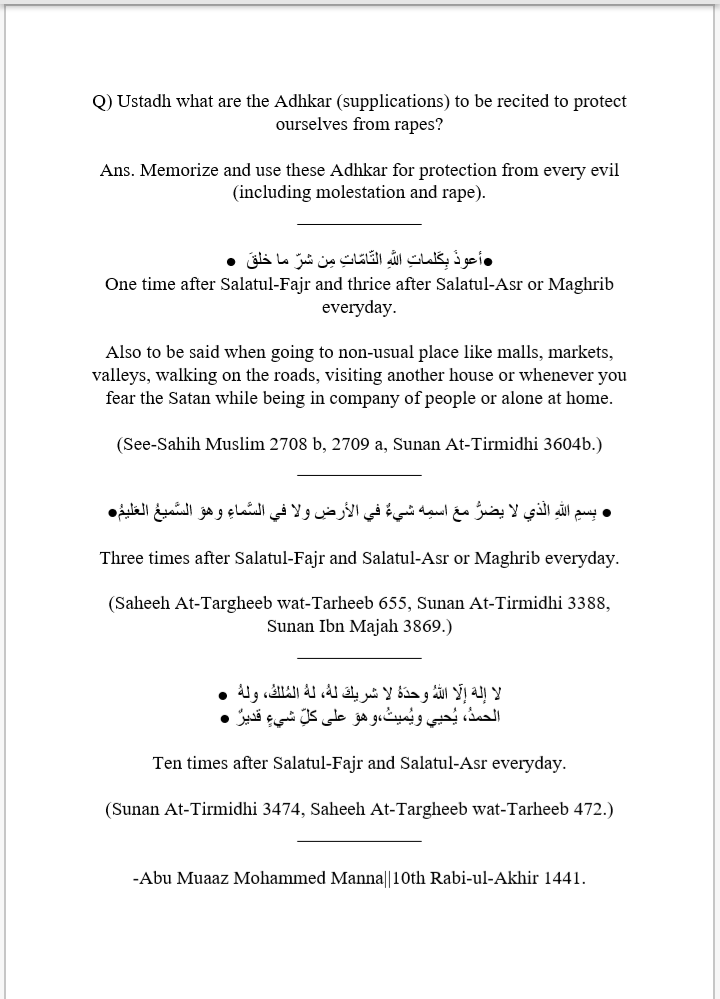
Adhkar for protection against evils ( including Rapes)
 Saheehus-Seerah