What I felt whilst reading the last portion of the Seerah of The Prophet Muhammad ﷺ!

*What I felt whilst reading the last portion of the Seerah of The Prophet Muhammad ﷺ!*

Reading the last portions of the Seerah of The Prophet ﷺ when he falls ill and ultimately dies in the arms of Aisha (رضي الله عنها) in front of the Sahaba, brings tears to the eyes. Wallahi nothing is more of a greater a calamity than that.

Imagine Aisha remembering the days she spent with her husband ﷺ, the love, the jealousy, the running race in which they beat each other, the descending of Ayaat in her house…

And what about the Sahaba who saw his blessed lifeless body…

Talha bin Ubaidullah would remeber his best day , when he was the human shield of the Prophet in Uhud, defending him against the rain of arrows…

Ali ibn Abi Talib may have cried with reminiscences of his childhood with his lovely cousin ﷺ and caring father in law…

Abu Bakr would have seen those youthful days with his non-sibling twin just before his eyes, the day he stopped the polytheists of Makkah from choking his bosom friend ﷺ, the three days in the Cave of Thawr, being his assistant in every battle…

Umar ibn Al-Khattab couldn’t believe his ears and lost his mind, he couldn’t imagine that his love ﷺ was never to return and that Jibreel would cease revelation…

Alas, the Prophet ﷺ has gone, and nothing is greater a calamity than that…

The Prophet said that “If any one of you is touched by a calamity, let him remember the calamity that befell him concerning me (death) because it is of the greatest calamities*.”

We will always miss you Messenger of Allah, you and your blessed teachings will always live in our hearts, we wish to meet you in Paradise and live in your neighbourhood. We will! Surely we will!

الصلاة والسلام عليك يا رسول الله و على آله و صحبه أجمعين.

*[Ref: Tabraani Mu`jam al- Kabeer 6718 and Saheeh by Albaanee in Silsilatul Ahadith As-Saheeha 1106]

-Abu Muaaz Mohammed Manna

[Reflections from the Seerah]

2nd November, 2019.

30 Benefits from The Hadith on ‘spend on yourself and your family’.

بسم الله الرحمن الرحيم

الحمد لله و الصلاة والسلام على رسول الله و على آله و صحبه أجمعين ، أما بعد-

Jabir reported:

A person from the Banu ‘Udhra set a slave free after his death. This news reached the Messenger of Allah (ﷺ).

Upon this he said: Have you any property besides it? He said: No. Upon this he said: Who would buy (this slave) from me? Nulaim b. Abdullah bought it for eight hundred dirhams and (this amount was) brought to the Messenger of Allah (ﷺ) who returned it to him (the owner),

and then said: Start with your own self and spend it on yourself, and if anything is left, it should be spent on your family, and if anything is left (after meeting the needs of the family) it should be spent on relatives, and if anything is left from the family, it should be spent like this, like this.

And he was saying: In front of you, on your right and on your left.

(Sahih Muslim 997a)

Some benefits from this Hadith are:

1. That a person from Banu ‘Udhra decided something, and made a will, and this news reached the Prophet, this shows that the Prophet ﷺ was usually informed of the important events and deaths in and around Madinah.

2. The man from Banu ‘Udhra had a slave in his lifetime. This shows that it was permissible to own slaves during the days of the Prophet ﷺ.

3. If human beings can be enslaved, under certain strict conditions, it is all the more permissible to cage animals and birds, subjected that they’re maintained and fed well without being harmed or abused.

4. So this man, decided to set his slave free after his death. This shows that this man wanted to do a very rewarding act which is encouraged in Islam. Setting a bonded slave free is Mustahab (highly recommended).

5. The Prophet ﷺ enquired about what property he left behind, this is from the concern of the Prophet ﷺ for the man’s family. This shows us the nature that has to be imbibed by the leader of a nation.

6. The man replied that he had no other property except for this slave. This shows the greatness of the sincerity of that man, who was about to give away all of his wealth in the path of Allah even though he had nothing else.

7. The Prophet ﷺ questioned him about his property. This shows that it is permissible to save and accumulate wealth for the future.

8. There were many Sahaba who donated everything they had in the cause of Allah and His Messenger ﷺ. This Sahabi wanted to be one of them.

9. The Prophet decided to sell the slave. This shows that the Prophet ﷺ used to buy and sell slaves. Thus there is nothing Islamically wrong in that.

10. The Sahabi, who actually owned the slave, allowed the Prophet ﷺ to deal with his affair. This shows that even though he wasn’t obliged to obey the Prophet ﷺ in with regards to his property, he allowed the Prophet to decide.

11. We must be reminded that it is not obligatory to accept every suggestion of the Prophet ﷺ. But obeying the suggestions of the Prophet ﷺ when it is not obligatory,is more rewarding than not giving in to them.

12. The slave was brought by Nu’aim bin Abdullah. Nu’aim is a beautiful name which means ‘soft and smooth’ and ‘affluence’. There were atleast 20 Sahaba with the name Nu’aim according to the book ‘Usud Al-Ghabah Fee-Ma’rifatis Sahaba’ by Shaikh Izzuddin ibn Al-Atheer (d.630 AH).

13. Nu’aim bin Abdullah immediately bought the slave for 800 Dirhams. This shows how valuable a good slave was in those days. [1 Dirham in those days was a silver coin made of 2.975 grams of silver and 1 Dinar was made of 4.25 grams of pure gold.]

14. This also shows that different slaves have different prices fixed to them based on their beneficial qualities. Not all slaves are equal in their market value.

15. Some intended good deeds can be ‘undone’ if a better good deed is directed to.

16. The leader of the Muslims, may guide, advise or order the masses or individuals to do things, based on particular contexts. The leader of the Muslims may allow or disallow slavery according to what is beneficial to the situation.

17. Nu’aim bin Abdullah didn’t bargain with the seller (the Prophet ﷺ), this shows that if the seller is trustworthy you need not bargain with him for the price of his goods. And who is more trustworthy than the Prophet ﷺ himself!

18. The only reason the Prophet ﷺ stopped the Sahabi from doing the great good deed of setting the slave free was to direct him to what is better, more beneficial and rewarding than freeing a slave, i.e. not leaving behind your children and dependants poor.

19. A caller to Allah, may stop someone from a great good deed, to direct him to a more virtuous, greater good deed. This is also from the ways of calling to Khair and Ma’roof (goodness and piety).

20. This Hadith shows that good deed are also categorized based on their rewards and benefits. Not all good deeds are equal.

21. It is Mustahab (recommended) to accumulate wealth intending not to make your dependants poor or needy. The upper hand (which gives) is better than the lower hand(which takes) [Hadith].

22. The Prophet ﷺ advised him on the manner to spend his wealth. This is a proof of his Prophethood, that he ﷺ did not leave his Ummah without guidance in the important affairs of life.

23. The Prophet ﷺ did not begin by asking it for himself, unlike the false claimants of prophethood, charlatans and god-men who always ask people to begin charity from them.

24. This is the right methodology of asking people to do charitable acts. Unlike the modern callers to Islam, who seldom apply this Hadith and always compete for the largest piece in the cake. Many a times people neglect their own near relatives and contribute to ‘Dawah Organisations’, even though the later are more needy and giving them is more rewarding.

25. Whenever someone comes to us with an intent to contribute some wealth in charity, we must advise him using this Hadith and encourage him to spend on his closest relatives and likewise. This is thus a Sunnah.

26. So the order of spending is, first on yourself, then your immediate family (parents, wives and children), if something remains,then the near relatives, so on and so forth (we may consider neighbours and close companions after this).

27. There is no mention in this Hadith or any other Hadith that the Prophet ﷺ discouraged ‘slave trade’ or ‘slavery’.

28. Thus whosoever says that ‘Islam came to abolish slavery’ is an apologetic who is either speaking out of ignorance or is wilfully lying to the non-Muslims in order defend Islam from allegations that it supports slavery. Islam is not in need of falsehood to defend itself. Islam has put many restrictions and conditions on ‘the system of slavery’ and it is the best system since it is sent by Allah upon His Messenger Muhammad ﷺ.

29. This Hadith is a proof for choosing better of the two good things. Freedom from slavery would benefit only 1 human being, but selling him for a price would benefit a handful of Muslims, thus the greater benefit is opted for.

30. This Hadith is a proof for the principle ‘Choosing the lesser of the two harms’. Islamic slavery in the context of this Hadith is not a harm, yet, a human being generally dislikes for himself to be a slave, so he considers this a ‘harm’ upon himself. The other harm is that the companion’s family is made needy and poor, this is a greater harm.

So if one man’s freedom (small harm) is curtailed to benefit a group of people and keep them away from poverty (a greater harm), the latter is avoided and the former is chosen.

And Allah knows the best…

17th September 2019, 17th Muharram 1441.

Did the Prophet ﷺ call out to the Jews ‘O brothers of monkeys and pigs!’?

ناداهم بذلك وهي: قام النبي صلى الله عليه وسلم يوم قريظة تحت حصونهم، فقال: «يا إخوان القردة والخنازير، ويا عبدة الطاغوت» فهي ضعيفة فقد أخرجها الطبري (1/484) بإسناد معضل.

https://www.alalbany.org/fatwa-47

(It is reported that) The Prophet ﷺ called them and that was (when): He ﷺ stood on the day of the Battle of Bani Quraizah under their forts and called out to the Jews, ” O brothers of the monkeys and pigs, and O worshippers of the Taghut (false god(s))”.

(Shaikh Al-Albani continued and said) In this narration there is weakness and it was narrated by At-Tabari (1/484) by a Mudal chain.

Two Sahaba who took Qisas(retaliation) from The Prophet ﷺ for poking them!

1) Usayd bin Hudayr (رضي الله عنه):

Narrated Usayd ibn Hudayr,:

Abdur Rahman ibn Abu Layla,

quoting Usayd ibn Hudayr, a man of the Ansar, said that while he was given to jesting and was talking to the people and making them laugh,

the Prophet (ﷺ) poked him under the ribs with a stick.

He said: Let me take retaliation.

He(ﷺ) said: Take retaliation.

He said: You are wearing a shirt but I am not.

The Prophet (ﷺ) then raised his shirt and the man (Usayd bin Hudayr) embraced him and began to kiss his side.

Then he said: This is what I wanted, Messenger of Allah!

(Sunan Abu Dawud,5224, Sahih Al-Albani)

2)Sawwad bin Ghaziyyah (رضي الله عنه):

Ibn Ishaq stated,

“Habban bin Wasi’ bin Habban related to me, from the sheikhs of his tribe, that when the Messenger of Allah ﷺ lined up his forces at the Battle of Badr, he ﷺ held an arrow which he used to indicate how they should adjust their position (and correct their formation).

He ﷺ passed by Sawwad bin Ghaziyyah, an ally of the Banu ‘Adi bin An-Najjar, and who was a little ahead of the line.

He ﷺ poked him in the belly with the arrow,saying,

‘Straighten up, Sawwad!!

“He replied, ‘O Messenger of Allah, I swear by Him who sent you with the truth and justice that you hurt me! So let me retaliate!’

“The Messenger of Allah ﷺ promptly uncovered his stomach and said,
‘Retaliate then!’

Sawwad hugged him and then kissed his stomach.

The Messenger of God ﷺ, asked, ‘Why did you do that, Sawwad?’

He replied,’O Messenger of Allah! You can see what is about to happen (i.e. the battle of Badr); I wanted my last
contact with you to be my skin touching yours.’

The Messenger of Allah ﷺ then supplicated for him.”

Shaikh Al-Albani said that this narration is Hasan in Silsilatul Ahadith As-Saheeha 6/707 and Saheeh Mursal in 2835.

What is wrong with ISIS (The Islamic State of Iraq and Syria)?

السلام عليكم و رحمة الله و بركاته

الحمد لله و الصلاة و السلام على رسول الله و آله وصحبه أجمعين.

After praising Allah and sending salutations upon His Messenger ﷺ I ask Allah to guide me and the readers to the correct methodology of Islam and to protect us from false and deviant ideologies.

What is ISIS (also called Daish- Dawlatul Islam fil-Iraq was-Sham)?

Isis is a self proclaimed Caliphate established under the present ‘Caliph’ Abu Bakr Al-Baghdadi in Iraq and Syria. It was active since 1999, had gone through many developments, claimed the Caliphate in 2014, and by 23rd March 2019 lost almost all of its territories.

What is the methodology of refutation we’ll be doing?

Before refuting ISIS, which In sha Allah we’ll prove to be a modern Khawarij movement, I would like to clarify that this and the coming posts will be from the Salafi point of view.

The Salafi methodology believes in interpreting The Quran and The Sunnah according to The Manhaj (Methodology) of The Sahaba (The Companions of The Prophet ﷺ).

Does this mean that as a Salafi this author doesn’t like Jihad?

That is not true. Not joining terrorist groups like Isis or Al-Qaeda etc. doesn’t mean that we do not love Jihad. But our Jihad is based purely upon The Sunnah and devoid of any un-Islamic extremism. Jihad is fighting all forms oppression and injustice on earth, and no two people dispute that such a fighting is allowed and recommended.

How did this author learn about what ISIS believe?

Though I heard about them from the Ulama, I wanted to know about them from their written sources. For this reason I downloaded their periodical ‘Dabiq’ and read about them.

Dabiq has had almost 15 issues and I thought that finding their Aqeedah inside them would be a tough job since they’re a very deceptive people.

But what was very evident was that unlike their online callers (Duaat) who hid their extremist Takfeeri (act of calling Muslims as disbelievers) attitude from the gullible youth, Dabiq was a very vocal extreme Takfeeri magazine. For me, their first issue had enough of injustice to label them Khawarij.

What does it take to become Khawarij (Khariji)?

The Khawarij were an extreme sect whose coming was prophesied by the Prophet Muhammad ﷺ . There were many (Ahlus Sunnah)scholars who have written volmes on them. One may read ‘Talbees Iblis’ by Imam ibn Al-Jawzi Rahimahullah to know more about them and their offshoots.

In brief- if a Muslim believes that a major sin, except for Shirk Al-Akbar (Major acts of polytheism) and Kufr Al-Akbar (Major acts of disbelief) makes a person a disbeliever, then this makes the one with such a belief a Khawarij.

If a Muslim says that an alcoholic Muslim (a sinner) is a Kafir, then this claimant is from the Khawarij.

It is not necessary that a Muslim has all the beliefs and symbols of the Khawarij of the times of Ali ibn Abi Talib (رضي الله عنه), if he has their hall mark belief in some aspects of Islam, then he is a Khawarij.

Read Kitab-ut-Tawheed by Shaikh Saleh ibn Fouzan Al-Fouzan to learn more about Kufr, Shirk, Bidah etc. and their types and examples.

Why is this refutation from me needed when so many people have refuted them?

Most of the refutations of Isis are from the callers to Islam who do not have a firm hold on issues of Aqeedah and Imaan. Their refutation of ISIS is an emotional one riding along the line that ‘they kill innocent people’. Whilst it is true that they kill innocent people, that is not the very reason that they were labelled as Khawarij.

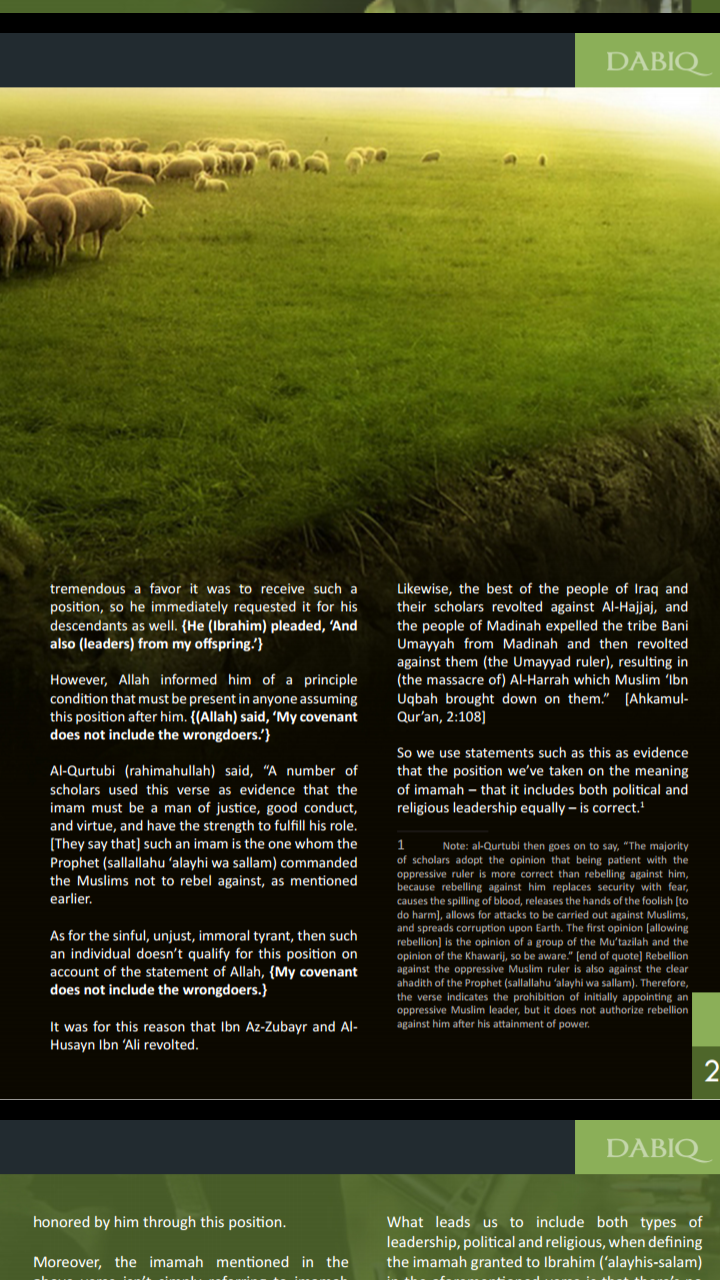
A Clear Display of Khawarij ideology in their magazine Dabiq, Vol.1, page 22.

(See link)

https://authenticseerah.com/wp-content/uploads/2019/08/screenshot_20190317-213548.png

Quoted from the main text under the heading: ‘Examples Of Narrations Reported Interpreting Imamah To Mean Political Imamah

“Al-Qurtubi (rahimahullah) said, “A number of scholars used this verse as evidence that the imam must be a man of justice, good conduct, and virtue, and have the strength to fulfill his role. [They say that] such an imam is the one whom the Prophet (sallallahu ‘alayhi wa sallam) commanded the Muslims not to rebel against, as mentioned earlier.
As for the sinful, unjust, immoral tyrant, then such an individual doesn’t qualify for this position on
account of the statement of Allah, {My covenant does not include the wrongdoers.}

It was for this reason that Ibn Az-Zubayr and Al-Husayn Ibn ‘Ali revolted.

Likewise, the best of the people of Iraq and their scholars revolted against Al-Hajjaj, and the people of Madinah expelled the tribe Bani Umayyah from Madinah and then revolted against them (the Umayyad ruler), resulting in (the massacre of) Al-Harrah which Muslim ‘Ibn Uqbah brought down on them.” [Ahkamul-Qur’an, 2:108]

So we use statements such as this as evidence that the position we’ve taken on the meaning of imamah – that it includes both political and religious leadership equally – is correct.*1

End Quote from the main text.

But what is strange is that after proving that they are a group who are rebelling against the oppressive Muslim ruler and making this a part of their invitation to Isis (their Dawah), a strange foot note on the vey same page gives away the actual position of Imam Al-Qurtubi on ‘rebelling against oppressive rulers’.

The footnote for *1 says:

“Note: al-Qurtubi then goes on to say,

“The majority of scholars adopt the opinion that being patient with the
oppressive ruler is more correct than rebelling against him, because

•rebelling against him replaces security with fear,

•causes the spilling of blood,

•releases the hands of the foolish [to do harm],

•allows for attacks to be carried out against Muslims,

•and spreads corruption upon Earth.

The first opinion [allowing
rebellion] is the opinion of a group of the Mu’tazilah and the opinion of the Khawarij, so be aware.”[end of Imam Al-Qurtubi’s quote]

Rebellion against the oppressive Muslim ruler is also against the clear
ahadith of the Prophet (sallallahu ‘alayhi wa sallam). Therefore,
the verse indicates the prohibition of initially appointing an oppressive Muslim leader, but it does not authorize rebellion against him after his attainment of power.”

End quote from the footnote (Spacing and bullets were added by me).

So what we get to conclude here is that ‘by mistake’, the editors for Dabiq have clarified for us the harms of rebellion against the Muslim ruler and that the opinion quoted in the main text is actually an opinion held by the Mutazilah and Khawarij.

So the ISIS have the very apparent and famous Aqeedah of the Khawarij with regards to rebellion.

Prophetic Guidance With Regards to Oppressive Rulers:

It his been narrated through a different chain of transmitters, on the authority of Hudhaifa b. al-Yaman who said:

Messenger of Allah, no doubt, we had an evil time (i. e. the days of Jahiliyya or ignorance) and God brought us a good time (i. e. Islamic period) through which we are now living Will there be a bad time after this good time? He (the Holy Prophet) said: Yes. I said: Will there be a good time after this bad time? He said: Yes. I said: Will there be a bad time after good time? He said: Yes. I said: How?

Whereupon he said: There will be leaders who will not be led by my guidance and who will not adopt my ways? There will be among them men who will have the hearts of devils in the bodies of human beings. I said: What should I do. Messenger of Allah, if I (happen) to live in that time?

He replied: You will listen to the Amir and carry out his orders; even if your back is flogged and your wealth is snatched, you should listen and obey.

Sahih Muslim 1847b.

•The Prophetic guidance here is to obey the rulers in permissible matters and not to revolt against him even if he is oppressive.

(To be continued In sha Allah)

-Abu Muaaz Mohammed Manna

14th Dhul Hijjah 1440, 15th Aug 2019.