(‘Heroes of Islam Series’- Aurangzeb Alamgir … The Righteous Emperor, Written by / Islam Story Articles
2016/05/03, Originally in Arabic.) Source
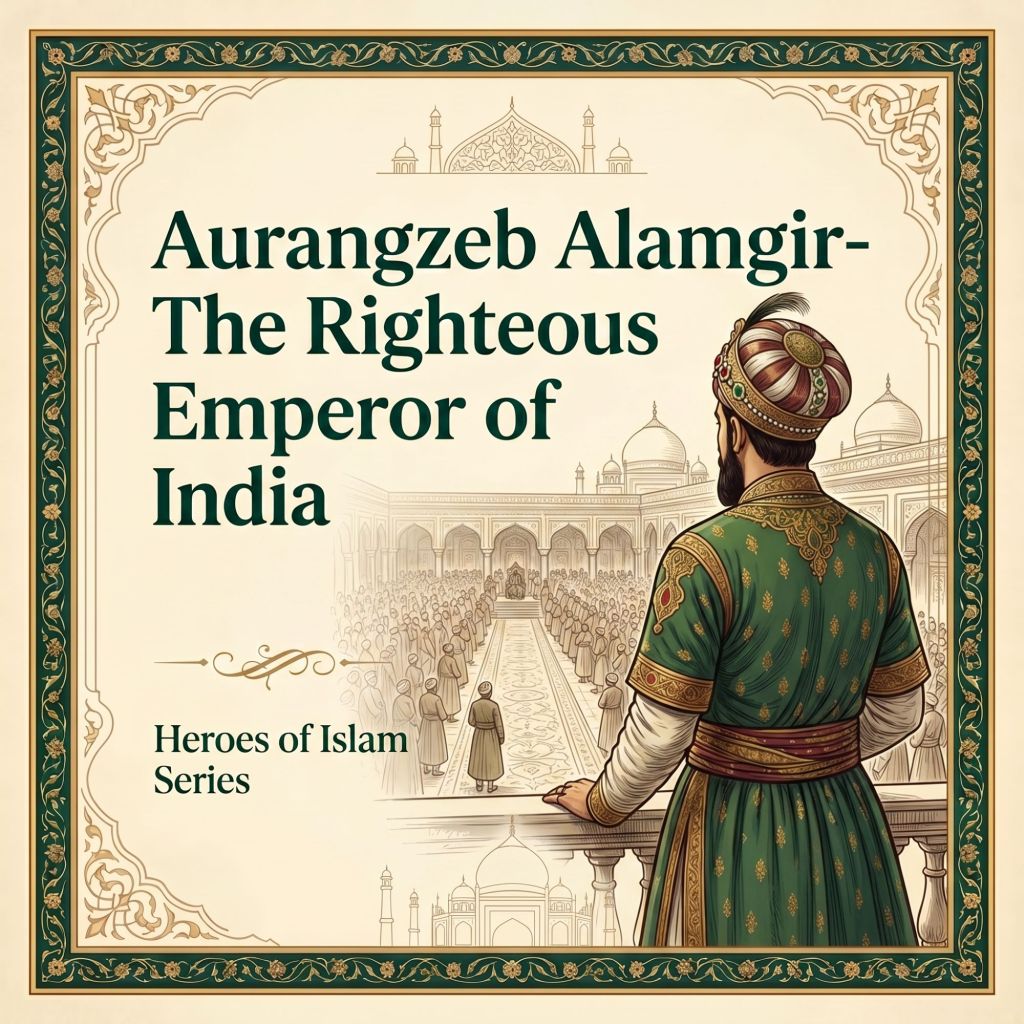
[Translator’s disclaimer: This work is a translation of a historical text and is provided for research, reference, and informational purposes only. The inclusion of statements praising or justifying the destruction of temples or other acts of religious intolerance does not constitute endorsement by the translator. All such opinions are attributable solely to the original author/source.]
We are now in India, in the continent (The Indian Subcontinent) that we ruled for a thousand years, in the world that once belonged to us alone, and whose masters we were. And though we once had in Spain an Andalus containing twenty million, here we had a greater Andalus, in which there are today four hundred million.[1] And though we left in Andalusia the remains of our martyrs and the blood of our heroes, and though we left there the Mosque of Cordoba and Al-Hamra, in every span of this continent there is pure blood that we shed, a noble civilization whose flanks we adorned, and whose margins we embroidered with knowledge, justice, noble deeds, and acts of heroism. And here there are monuments whose beauty and majesty surpass Al-Hamra itself; let the Taj Mahal suffice you as the most beautiful structure that has appeared upon the face of the earth.[2]
So let us journey together into a not-so-distant past, to the Mughal Empire of the Muslims in India, that we may live with a great man who gathered the glories of the great and their noble achievements. He was an ascetic scholar, a just ruler, a sincere mujahid, a man of letters and a poet, a devout jurist, and a victorious commander, just as he was also an artist and a calligrapher. He was one of the geniuses of Islam across the ages, and the crowning jewel of the Muslim rulers of India, which he governed for nearly fifty years. He established justice therein, spread security, subdued tyrannical oppressors, and left traces upon the earth, traces in government, and traces in minds. He filled India with mosques, hospitals, bimaristans (asylums for the sick), refuges for the disabled, and schools for learners. He set forth beneficent precedents in the arts of governance, organized the judiciary, reformed the tax laws, and left to the scholars a book that ranks among the greatest books of Islamic jurisprudence.
He is the great sultan and mighty emperor, Alamgir,[3] Aurangzeb,[4] son of Shah Jahan, son of Jahangir, son of the emperor Akbar, grandson of Timur Lang (Tamerlane).
His Lineage and Birth:
He was the great mujahid imam, the victorious commander, the triumphant ghazi, the emperor, Abul-Muzaffar Muhyiud-Din Muhammad Aurangzeb Alamgir ibn Shah Jahan ibn Jahangir ibn Shah Akbar ibn Abin-Nasr Muhammad Humayun, the grandson of the great tyrant of India, Timur Lang. His mother was Arjumand Banu, daughter of Asaf Jah, known by the name Mumtaz Mahal, the lady of the Taj Mahal mausoleum.
He was born on the night of Sunday, 15 Dhu al-Qa’dah 1028 AH / 24 October 1619 CE, in the village of Dahod in Gujarat, India, during the reign of his grandfather Jahangir (meaning: the one who seizes the world or owns it; he ruled from 1014 AH – 1037 AH / 1605 CE – 1627 CE).[5]
In His Father’s House:
Aurangzeb Alamgir was raised in the cradle of glory and power, and he attained refinement in the days of his grandfather and father. His father was the Sultan of India, Shah Jahan—meaning “King of the World” (he ruled from 1037 AH – 1061 AH / 1627 CE – 1657 CE)—one of the greatest sultans of the Mughal Muslim state in India, and among those who ordered the demolition of many Hindu temples. Yet throughout the whole world he became famous because he was the one who ordered the construction of one of the most beautiful buildings in the world, namely the Taj Mahal, in commemoration of his wife, Mumtaz Mahal, who possessed his heart and his life, until she died in 1631 CE. He elegized her through this immortal structure, which is counted among the Seven Wonders of the World. Twenty-two thousand laborers remained conscripted in the building of the Taj for twenty-two years, and although the marble came to “Shah Jahan” as a gift from the “Maharaja of Jaipur,” the building and its surroundings cost what would today equal two hundred and thirty million American dollars, which in that age was an immense sum of money.[6] Indeed, one cannot but regret this vast quantity of wealth spent on building a single tomb for a woman, however great the love may have been! Sultan Shah Jahan spent the last days of his life recalling his memories with his beloved!
In the Arena of Knowledge and Jurisprudence:
Aurangzeb was raised in a learned, devout Islamic upbringing. He was the scion of a household of knowledge, literature, religion, and beauty. The foremost scholars of his age undertook his education and care, among them Shaykh Muhammad Ma’sum ibn Shaykh Ahmad as-Sirhindi. Aurangzeb was not the eldest of his brothers, nor was he the heir apparent, and it was not hoped that he would inherit the throne. Yet the shaykh exerted himself in his upbringing and lavished his care upon him, so he was reared as a student in a residential religious school among shaykhs and teachers. He read and perfected the Qur’an, excelled in Hanafi jurisprudence, mastered calligraphy, became acquainted with the sciences of his age, and, along with all this, was trained in horsemanship and the paths of combat. When Jahangir died and his son Shah Jahan succeeded him, he appointed each of his four sons to govern a region among the regions of India, and Aurangzeb’s share was the province of the Deccan, which he administered in the finest manner.
Aurangzeb studied under Mawlana ‘Abdul-Latif as-Sultanpuri, Mawlana Muhammad Hashim al-Kaylani, Shaykh Muhiyud-Din ibn ‘Abd Allah al-Bihari, and others among the scholars of India. He learned the Naskh script from al-Hajj al-Qasim, and from as-Sayyid ‘Ali ibn Muhammad Muqim, one of the masters of calligraphy, until he wrote the celebrated proportional script and became proverbial for the excellence of his handwriting. He distinguished himself in many sciences and arts.[7]
The signs of brilliance, strength, horsemanship, and courage also appeared in him from the softness of his nails, that is, from earliest childhood. In Nuzhat al-Khawatir it is related that his father Shah Jahan was one day watching from the tower overlooking the Jumna River a bout of elephant fighting that was taking place in the fortress arena between the fort and the river. The regiments were drawn up behind it, and a great multitude were watching in that arena. Alamgir too was in that crowd, and at that time he was in his fourteenth year, mounted upon his horse. Suddenly an elephant became enraged and charged toward the ranks. All the people fled before it except Alamgir, who stood firm in his place. The elephant turned toward him and wrapped his horse with its trunk, so Alamgir was thrown down by the force of the horse’s fall. Then he rose and drew his sword against it, after which the people came and drove it back by beating, stabbing, kindling fire, and other means. This was a great distinction in steadfastness and resolve, the like of which is not found in other princes at that age.[8] Thus, while still a small child, he gathered what the greatest kings and foremost caliphs gather only at an early but more advanced age.
Aurangzeb and the Struggle for Power:
Sultan Shah Jahan remained captivated by his deceased beloved, and his obsession with the Taj Mahal, where her remains lay, became madness. He spent long years and enormous sums of money building her luxurious mausoleum, and because of this he neglected the management of the affairs of his great kingdom, so the conditions of the land and the people were thrown into disorder.
Aurangzeb Alamgir was the fourth brother among his siblings, who were Dara Shukoh, Shuja’, and Murad Bakhsh (Murad Allah). Shuja’ had been appointed governor of Bengal, Murad Bakhsh was appointed governor of Gujarat, and Aurangzeb was appointed governor of the Deccan.
Shah Jahan had resolved to build a palace facing the Taj Mahal, to serve as his own personal mausoleum opposite the tomb of his wife, though with a difference between them: the mausoleum of the Taj Mahal was of white marble, whereas his own was to be black, with a great bridge connecting them. But the winds blow not as ships desire, and this dream was not realized because of the uprising of the eldest son, Dara Shukoh, against him and his seizure of him in 1067 AH / 1657 CE, whereupon he extended his control over the land and became the sole authority and ruler.
His brothers, however, were not pleased with this, and each rose from his own province against their brother Dara Shukoh: Shuja’ from Bengal, Murad Bakhsh from Gujarat, and Aurangzeb from the Deccan. Fierce battles took place among them, ending in Aurangzeb’s victory over his brothers. He then killed them—despite himself, because of his abhorrence of bloodshed and his preference for reconciliation among his brothers—on account of actions that had proceeded from them, and the scholars issued legal opinions that they had incurred the penalty of death. He imprisoned his father in the fort of Akbarabad, prepared for him whatever food and drink he desired, and provided him with servants from among the slave-girls and servant boys. He remained in confinement for eight years, until his death in 1076 AH / 1666 CE. Shah Jahan found solace in standing before a mirror that one of the engineers had placed for him in one of the pillars, which reflected the image of the mausoleum several miles away from his prison, so that he saw the mausoleum as though it were before him.
Thus Aurangzeb mounted the throne of kingship in 1068 AH / 1657 CE, when he was forty years of age.[9] The atmosphere thereby cleared for Aurangzeb, and it was as though divine providence had driven him forward so that he might become an exceptional ruler and, throughout history, a worthy example of the Muslim ruler in whom Muslims take pride because of his righteous life and conduct, despite the bloodshed that accompanied his accession to the throne.[10]
Aurangzeb, the Greatest of the Mughal Kings:
Historians are almost unanimous that Aurangzeb was the greatest of the Mughal Muslim kings without exception. The Islamic state reached, under his reign, a zenith that it attained neither before him nor after him. Aurangzeb ruled for nearly fifty years, years not devoid of hardship and war; rather, they formed an unbroken chain of wars here and there. Very often Aurangzeb himself stood at the head of his army, personally disciplining his enemies and adding new territories to the expanse of his kingdom, to the point that he scarcely knew the taste of rest or peaceful residence in the capital of his dominion.
Abul-Fadl al-Muradi al-Husayni, the author of Silk ad-Durar, said in describing the state of the mujahid sultan Aurangzeb: “The Sultan of India in our age, the Commander of the Believers and their imam, the pillar of the Muslims and the one who orders them, the mujahid in the path of Allah, the learned scholar, the Sufi knower of Allah, the king who stood in support of the religion, who annihilated the unbelievers in his land, subdued them, destroyed their temples, weakened their polytheism, strengthened Islam, raised its banner high in India, and made the word of Allah supreme.”
The Mughal Islamic Empire in India witnessed, during the reign of Aurangzeb, its furthest territorial expansion, thanks to the military efforts exerted by Sultan Aurangzeb—may Allah have mercy on him—for there remained no province among the provinces of India that did not come under his control. Indeed, his authority extended to include India, Assam, Arakan in Burma, as well as Afghanistan. That was the peak to which Mughal rule attained. Thus, under his reign, the dominion of India stretched from the foothills of the Himalayas in the north to the sea coasts in the south.
Yet during his reign a group of rebellions and wars broke out, such as the Rajput rebellion, in which they broke their covenant and refused to pay the jizyah. King Aurangzeb sent against them his son Muhammad Akbar, who put down their rebellion in 1090 AH. The Marathas also rebelled against Aurangzeb. They were a group from the lower strata of Indian society with their own customs and traditions, living to the north and south of Bombay. Their leader was “Sivaji,” or “Hsuwaji,” or “Siwaji,” (Shivaji) as it is sometimes pronounced. He used to seize opportunities arising from the weakness of the Mughal state or its preoccupation with wars against other states or rebellions in order to declare insurrection against the state. He struck coins in his own name and even attacked the caravans of pilgrims in the city of Surat, from which pilgrims used to sail to the Hijaz before the port of Bombay. He remained a rebel and combatant against the Mughals until he asked for pardon and forgiveness, whereupon Muhammad Akbar pardoned him and granted him some lands in Berar. Aurangzeb remained occupied with the Marathas until he brought their affair to a complete end in 1116 AH / 1705 CE.
As for the Safavid Shi’ites, Aurangzeb—may Allah have mercy on him—was able to seize their kingdom in Golconda, especially after they had cooperated with those rebelling against him by money and arms, and had failed to honor their commitments to pay the jizyah and to refrain from insulting the Companions—may Allah be pleased with them. That was in 1098 AH / 1687 CE.
Thus we see how this emperor spent his life as a warrior, taking the battlefields as his permanent abode, as though he had been created for the life of struggle rather than the life of palaces and their enjoyments. His advanced age, which reached ninety, did not prevent him from doing so, and he died in the fields of battle far from the capital of his kingdom, Delhi. He was a wonder among the wonders of time in all his aspects.[11]
Aurangzeb’s Policy in His Kingdom:
When Aurangzeb ascended the throne of kingship and sultanate, he began to proceed according to the method of Prophethood and the practice of the Rightly Guided Caliphs. He raised the banner of jihad against the Hindus and the Safavids, abolished their rites, and elevated the rites of Islam.
He used to look into the affairs of his subjects from the nearest reaches of his lands to the farthest with the eye of an eagle, and he struck against corrupters with the paw of a lion. He stilled every whisper of corruption and put an end to every sign of unrest. Then he undertook reform and removed what remained of the heresy introduced by Jalalud-Din Akbar, his grandfather’s father. Oppressive taxes had burdened the people, while the fire of their harm did not touch the princes of the Magians (translator’s note: meaning the non-Muslim rulers, like Hindus, were not harmed). He abolished eighty kinds of them (unjust taxes), instituted a just tax system, and imposed it upon the masses, and he was the first to collect it from those princes. He repaired the old roads and opened new ones. To know the length of the roads in India, it is enough to know that one single road, which Sher Shah as-Suri had opened, took the traveler three months to traverse, and along its entire length it was lined with trees on both sides, with mosques and khankhas (Sufi lodges or resting places) recurring along it.
He built mosques in the regions of India, appointed imams and teachers for them, and established homes for the elderly, bimaristans (assylums) for the insane, and hospitals for the sick.
He established justice for all people, so that no one was too great for the judgment of the courts to be enforced upon him. He was the first to give the judiciary a formal code, and he himself judged in legal matters, not by arbitrary rule but according to the Hanafi school, with reasoning and proof. He had certain privileges, but he abolished them and made himself subject to the ordinary courts. Whoever had a claim against him could litigate against him before the qadi alongside the commoners and the masses of the people.[12]
In 1082 AH / 1672 CE, Aurangzeb imposed the jizyah upon the Hindus, in implementation of the teachings of Islam, after his forefathers had abolished it for more than a full hundred years. In return, Aurangzeb abolished some taxes that the Shari’ah had not imposed, and exempted the Hindus and others from them. His aim in this was not to humiliate some of his subjects, nor fanaticism, nor merely to seize money. Rather, the purpose was to give his state an Islamic character that respects the rights of others and their freedoms within the bounds of the law. When it was suggested to him that officials who did not adhere to the religion of the state should be dismissed from public office, he wrote, saying: “Religion has nothing to do with secular matters, and in the matters with which we are presently concerned there is no room for fanaticism.”[13]
Muslims have continued to regard Aurangzeb as they regard the righteous friends of Allah, and this notion did not become established in the minds of Muslims over the centuries in vain. What is known of his religiosity, scrupulousness, asceticism, and adherence to the teachings of the Shari’ah unquestionably raises him to that station.
Aurangzeb: His Achievements and Virtues:
‘Abdul-Hayy ibn Fakhrud-Din ibn ‘Abdul-‘Ali al-Husayni at-Talibi, the author of Nuzhat al-Khawatir, mentioned a number of the achievements of Aurangzeb Alamgir, such as are rarely found except among the righteous kings and great caliphs. Among them, in summary, are the following:
- Alamgir was a learned, devout, pious, scrupulous man, firm in his school of law, adhering to the Hanafi madhhab and never departing from it in word or deed.
- He acted according to the path of strict resolve. He performed the obligatory prayers at their earliest times in congregation in the mosque whenever possible, observed all the sunnahs and supererogatory prayers, and performed the Friday prayer in the congregational mosque. Even if he was absent from the town on account of some matter, he would come to it on Thursday, perform the Friday prayer, and then go wherever he wished.
- He used to fast in Ramadan in the intense heat, spend the night in Tarawih prayers, and observe i’tikaf in the last ten days of Ramadan in the mosque. He also fasted on Monday, Thursday, and Friday of every week of the year, and he fasted on the days concerning which it is reported that the Prophet—may Allah bless him and grant him peace—used to fast.
- He used to give zakat from his wealth before and after he ascended the throne, from what had been set aside for him from several villages and some salt mines, for private expenditures down to the smallest amount.
- In the days of his father, he wished to travel to the Two Noble Sanctuaries for Hajj and visitation, but his father would not accept separation from him. After that, royal affairs no longer allowed him the opportunity. Yet he used to send people to the Two Noble Sanctuaries for Hajj and visitation, lavish generous gifts upon them, and dispatch enormous sums there for those in need during the Hajj season every year or every two years.
- He employed men and women engaged in remembrance of Allah and assigned them ample stipends. He maintained ritual purity through ablution, preserved the Dua formulas and supplications transmitted from the Prophet—may Allah bless him and grant him peace—during most of his times, and enlivened the blessed nights with prayer, charity, and the company of scholars and shaykhs in the mosque.
- From the softness of his nails, he guarded himself against every evil and reprehensible thing. He never drank wine, never approached a woman unlawful to him, never wore unlawful garments, and never ate from vessels of gold and silver. He ordered that precious jewels be set in jade in place of gold.
- He forbade the princes to wear what was unlawful, and prevented them from speaking in his presence with lies, backbiting, and false testimony. He ordered them, if necessity compelled them to mention unpleasant matters, to do so through euphemism and metaphor.
- He distributed his time carefully: a time for worship, a time for study and discussion, a time for military affairs, a time for complaints brought before him, and a time for reading the books and reports that came to him every day and night from his kingdom; he did not mix one thing with another.
- He would sit three days each week for study and discussion of religious books such as al-Ihya’, al-Kimiya’, al-Fatawa al-Hindiyyah, and others, with as-Sayyid Muhammad al-Husayni al-Qannuji, the scholar Muhammad Shafi’ az-Zaydi, Nizamud-Din al-Burhanburi, and other scholars.
- Among his beautiful achievements is that he memorized the Noble Qur’an after ascending the throne. Some scholars dated the beginning of his memorization from His Exalted saying, “We shall make you recite, so you will not forget,” [al-A’la: 6] and its completion from His saying, “in a Preserved Tablet.” [al-Buruj: 22]
- Another of his achievements is that he had knowledge of Hadith. He compiled a work of forty hadiths, gathering in it forty sayings of the Prophet—may Allah bless him and grant him peace—before he assumed the kingdom. He also compiled another book containing forty hadiths after taking power, translated both into Persian, and appended to them valuable notes.
- Another of his virtues is that he was skilled in calligraphy, writing Naskh, Nasta’liq, and Shikastah with the utmost excellence and elegance. Before ascending the throne, he wrote out a mushaf with his own hand and sent it to Makkah al-Mukarramah; after ascending the throne, he wrote another mushaf and spent seven thousand rupees on its gilding and binding, then sent it to al-Madinah al-Munawwarah.
- Another of his qualities is that he was proficient in rhythm and melody, but he abstained from listening to singing out of scrupulousness. As for poetry, he was capable in it, yet he did not concern himself with it and forbade people from wasting their time on poetry, in accordance with His Exalted saying: “And the poets—the erring follow them. Do you not see that they wander in every valley?” [ash-Shu’ara’: 224-225]
- Another of his deeds is that he spent enormous sums in building mosques. He built many mosques in the land of India and restored its old ones. He assigned stipends to the imams and muezzins, and salaries for the mosques for carpets, lamps, and the like. Among these mosques is the “Badshahi” Mosque in Lahore, now in Pakistan.
- Another of his deeds is that he used to send beautiful gifts to the people of the Two Noble Sanctuaries—may Allah increase them in honor—every year or two. He stipulated that these should be given to those in need rather than to the wealthy, and for that reason people used to attribute miserliness to him—far be he from that.
- Another of his deeds is that he employed many scholars and shaykhs who occupied themselves with knowledge and worship, their hearts emptied of every worldly concern. In this he made no distinction between the people of Islam and the unbelievers of India. His decrees are still found among the Brahmins of Benares and elsewhere to this day.
- Among his achievements is that he was naturally disposed toward justice and beneficence, and that he adjudicated in accordance with the purified Shari’ah. For that reason he ordered the scholars to codify the legal questions and rulings from every chapter of jurisprudence. They codified them and compiled al-Fatawa al-‘Alamgiriyyah in six large volumes, after which he ordered the judges to rule according to them.[14]
- May Allah have mercy on him, he did not listen to singing with instruments after he ascended the throne, though he had been skilled in rhythm and melody. He dismissed the musicians and singers from his palace. It is related that one day he was outside his palace and saw musicians and singing girls dressed in black, weeping and carrying a bier. He asked, “What is this?” They replied, “This is singing and musical instruments; we are going to bury them.” He said, “Then bury them well, lest they rise again.”
- Allah granted Aurangzeb Alamgir—may Allah have mercy on him—success in two matters in which none of the Muslim kings had preceded him:
First: he would not give a scholar a gift or stipend unless he required from him some work—either authorship or teaching—lest he take the money and become lazy, thereby combining two evils: taking money without right and concealing knowledge.
Second: he was the first to undertake the codification of legal rulings in a single book to serve as a law. Thus, by his command, under his supervision, and before his eyes, the book al-Fatawa al-Hindiyyah / al-‘Alamgiriyyah was prepared according to the Hanafi school.[15]
Al-Fatawa al-‘Alamgiriyyah:
The Mughal emperor Aurangzeb possessed complete mastery of jurisprudence and was proverbial for his command of detailed legal issues. By his order, the scholars compiled al-Fatawa al-Hindiyyah, or al-Fatawa al-‘Alamgiriyyah. Although Alamgir was a king and not a scholar in the formal sense, he was able, through the strength of his faith and his profound understanding of his religion, to renew the Islamic religion and reform the condition of the Muslims and their state in India. Indeed, his powerful zeal for Islam led him to gather a large number of Hanafi Muslim scholars and jurists, asking them to compose a book in Hanafi jurisprudence containing all juridical matters and serving as a kind of constitution to which the state and the judiciary of the Mughal Muslims would refer. The scholars answered the call and formed from among themselves a team to author the work, headed by the eminent scholar Shaykh Nizamud-Din al-Burhanburi. They compiled an encyclopedic work in Hanafi jurisprudence, called al-Fatawa al-‘Alamgiriyyah or al-Fatawa al-Hindiyyah, in six large volumes. It became famous throughout the Islamic lands, its benefit spread widely, and it came to serve as a reference for muftis. Two hundred thousand coins were spent on its compilation.
These fatawa are considered among the greatest civilizational achievements of Sultan Aurangzeb. He was one of the few Muslim leaders who established comprehensive juridical reference works by which the course of the state and its laws might be regulated. Thus Aurangzeb was among the few Muslim kings who gave attention to Islamic legislation and laid down laws for the state.[16]
Aurangzeb and the English:
During the tenth Hijri / sixteenth Christian century, competition among the Western states had reached a frenzied level in their effort to destroy the State of Islam, as well as to seize new lands and abundant spoils beyond their own lands. They thus turned toward the lands of the Islamic East. The English adopted trade as a veil behind which they concealed their odious colonial aims. A decree was issued establishing the first English company in 1009 AH / 1600 CE. The English relied on trickery and ingratiation with the Muslim rulers of India, presenting them with various gifts. In the eyes of the rulers of India they were nothing more than mercenary merchants; therefore the rulers paid them no great attention, and this had been the case since the time of Jalalud-Din Akbar and Shah Jahan.
The English exploited Aurangzeb’s leniency, extending their influence to Bombay on the western coast and undertaking hostile acts against the state. Their company came to have branches in nearly every region of India, and they began to entertain ambitions of imposing their authority over some of his possessions in Bengal. This prompted Aurangzeb to strike them a crushing blow and seize their centers and their wealth, compelling them to seek peace and pay a large fine, and that was in 1101 AH / 1689 CE. However, may Allah have mercy on him, he withdrew from severity toward them and in the following year allowed them to establish and fortify a center in Calcutta called “Fort William.” The English then began to unify their commercial efforts on the coast of India into a single company, the East India Company. Yet it was unable to impose its influence over any part of the Indian territories that were under the rule of the powerful emperor Aurangzeb. The sultan did not realize that, by the leniency and tolerance he had shown toward the English, he was paving the way for them to seize India altogether—those very people who did not scruple to employ the lowest and vilest means in order to seize this land and fulfill their ambitions.
But after the death of Aurangzeb in 1118 AH / 1707 CE, the strong state began to weaken and disintegrate. Independent governments began to emerge in various regions, and conflicts and wars arose among them. This proved a stroke of good fortune for the crusading colonizers among the English, Portuguese, Dutch, and French. They began their real process of domination, winning time and territory to their side. The hungry eagles descended upon the diseased body, tearing at it and increasing its weakness from every direction, until the English alone succeeded in colonizing the Indian lands, thereby inaugurating a new phase of history in which the Muslims of India would inscribe honorable models of revolution and jihad.[17]
The Death of Sultan Aurangzeb Alamgir:
After a long life of reform and jihad, the victorious sultan and righteous emperor Aurangzeb Alamgir died at Ahmadnagar in the south, one thousand five hundred kilometers away from his capital, on 28 Dhu al-Qa’dah 1118 AH / 20 February 1707 CE, after having ruled for fifty years and lived about ninety years. He was buried in Aurangabad, and his grave remains there to this day.[18]
With the death of Sultan Aurangzeb Alamgir, the greatness of the Muslim state in India came to an end. After him came weak rulers, whose appointment and dismissal the English controlled. Matters remained so until they ended completely with the fall of the last Muslim sultan in India, “Bahadur Shah II,” in 1274 AH / 1857 CE. Then the English committed deeds that no mind can imagine and no conscience can bear, until even the wise among the English disavowed the savage deeds of their own people. They slaughtered Bahadur Shah’s three sons before his eyes, prepared meals for him from their flesh, and forced him to eat from it.
After that, Islam had no standing in those vast lands from that time onward. There is no might and no power except through Allah, the Exalted, the Magnificent.[19]
This, then, is the biography of Aurangzeb Alamgir, the emperor whom neither his world nor his successive wars distracted from his religion and his Hereafter. Thus he was a ruler the like of whom India had never witnessed in the breadth of his dominion, the righteousness of his character, and the excellence of his outward conduct and inward state.
He truly was a remnant of the Rightly Guided Caliphs.
[1] This was the number of Muslims in the age of Aurangzeb in the eleventh Hijri / seventeenth Christian century. As for now, the number of Muslims in India is about 180 million people, i.e. approximately 14.5% of a population exceeding one billion. See: Asharq al-Awsat newspaper.
[2] ‘Ali at-Tantawi, Rijal min at-Tarikh, Dar al-Bashir – Dar al-Manarah – Jeddah, 1st ed., Egypt, 1418 AH / 1998 CE, vol. 2, p. 16.
[3] Alamgir or ‘Alamjir: its meaning is “the one who gathers the reins of the world,” or “the one who seizes the world and is master of it.”
[4] Aurangzeb or Awrangzib: its meaning is “Adornment of the Throne”; for Aurang means “throne,” and zeb means “adornment.”
[5] Muhammad Khalil al-Muradi al-Husayni, Silk ad-Durar fi A’yan al-Qarn ath-Thani ‘Ashar, publisher: Dar al-Basha’ir al-Islamiyyah, Dar Ibn Hazm, 3rd ed., 1408 AH / 1988 CE, vol. 4, p. 113. ‘Abd al-Hayy ibn Fakhr ad-Din ibn ‘Abd al-‘Ali al-Husayn at-Talibi, al-I’lam bi-man fi Tarikh al-Hind min al-A’lam, entitled Nuzhat al-Khawatir wa Bahjat al-Masami’ wa an-Nawazir, publisher: Dar Ibn Hazm, Beirut, Lebanon, 1st ed., 1420 AH / 1999 CE, vol. 6, pp. 737-738.
[6] Will Durant, The Story of Civilization, translated by Dr. Zaki Najib Mahmud and others, publisher: Dar al-Jil, Beirut, Lebanon; Arab Organization for Education, Culture, and Science, Tunis, publication year 1408 AH / 1988 CE, vol. 3, p. 394.
[7] ‘Abd al-Hayy ibn Fakhr ad-Din ibn ‘Abd al-‘Ali al-Husayn at-Talibi, al-I’lam bi-man fi Tarikh al-Hind min al-A’lam, vol. 6, p. 738. ‘Ali at-Tantawi, Rijal min at-Tarikh, vol. 2, p. 21.
[8] ‘Abd al-Hayy ibn Fakhr ad-Din ibn ‘Abd al-‘Ali al-Husayn at-Talibi, al-I’lam bi-man fi Tarikh al-Hind min al-A’lam, entitled Nuzhat al-Khawatir wa Bahjat al-Masami’ wa an-Nawazir, vol. 6, pp. 740-741.
[9] Muhammad Khalil al-Muradi al-Husayni, Silk ad-Durar fi A’yan al-Qarn ath-Thani ‘Ashar, vol. 4, p. 114. ‘Abd al-Hayy ibn Fakhr ad-Din ibn ‘Abd al-‘Ali al-Husayn at-Talibi, al-I’lam bi-man fi Tarikh al-Hind min al-A’lam, vol. 6, p. 738.
[10] ‘Abd al-Mun’im an-Nimr, Tarikh al-Islam fi al-Hind, Dar al-‘Ahd al-Jadid for Printing, 1st ed., 1959 CE, p. 267.
[11] ‘Abd al-Mun’im an-Nimr, Tarikh al-Islam fi al-Hind, pp. 269-280, adapted.
[12] ‘Ali at-Tantawi, Rijal min at-Tarikh, vol. 2, pp. 23-24.
[13] ‘Abd al-Mun’im an-Nimr, Tarikh al-Islam fi al-Hind, p. 283, adapted.
[14] ‘Abd al-Hayy ibn Fakhr ad-Din ibn ‘Abd al-‘Ali al-Husayn at-Talibi, al-I’lam bi-man fi Tarikh al-Hind min al-A’lam, entitled Nuzhat al-Khawatir wa Bahjat al-Masami’ wa an-Nawazir, vol. 6, pp. 738-742, adapted
[15] ‘Ali at-Tantawi, Rijal min at-Tarikh, vol. 2, pp. 24-25.
[16] Ahmad Muhammad al-Jawarinah, Aurangzeb Alamgir, the Great Emperor of India, Yarmouk University – Department of History, 2014 CE, pp. 48-49.
[17] ‘Abd al-Mun’im an-Nimr, Tarikh al-Islam fi al-Hind, pp. 342-347, adapted.
[18] Muhammad Khalil al-Muradi al-Husayni, Silk ad-Durar fi A’yan al-Qarn ath-Thani ‘Ashar, vol. 4, p. 114. ‘Abd al-Hayy ibn Fakhr ad-Din ibn ‘Abd al-‘Ali al-Husayn at-Talibi, al-I’lam bi-man fi Tarikh al-Hind min al-A’lam, vol. 6, p. 738.
[19] ‘Abd al-Mun’im an-Nimr, Tarikh al-Islam fi al-Hind, pp. 447-453, adapted.
[Translated by Mohammed bin Thajammul Hussain Manna from Arabic.]
Some anecdotes from the life of Aurangzeb Alamgir. Here.
 Saheehus-Seerah