An Observation Among Certain Later Ahlul-Hadith- Shaykh Nabeel Nisar (Jamia Ummul-Qura, Makkah)

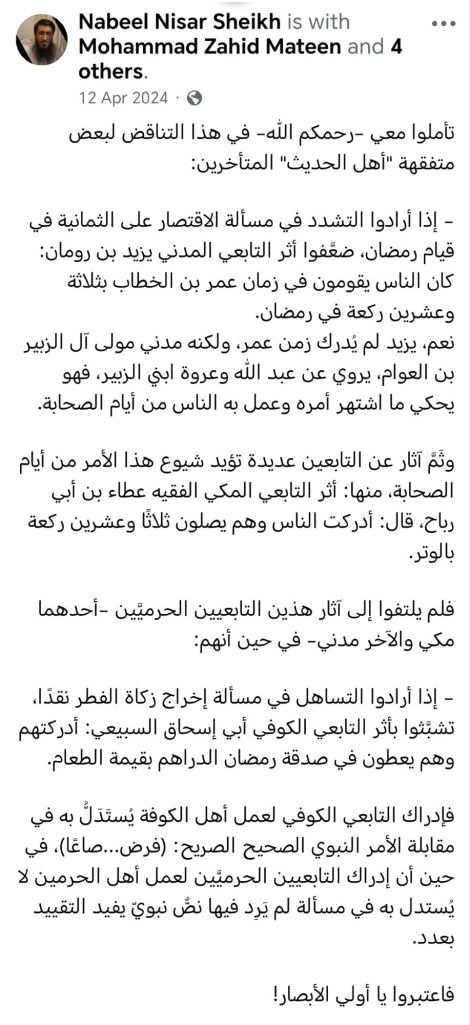
Reflect with me—may Allah have mercy on you—upon this contradiction found among some of the later jurists of the Ahlul-Hadith:


📌If they wish to be rigid on the issue of restricting the Ramadan night prayers (Qiyam) to eight [rak’ahs], they declare the report of the Medinan Successor (Tabi’i), Yazid ibn Ruman, to be weak: “The people used to perform twenty-three rak’ahs during Ramadan in the time of Umar ibn al-Khattab.”

📌Yes, Yazid did not witness the time of Umar, but he is a Medinan and a client of the family of az-Zubayr ibn al-Awwam. He narrates from Abdullah and Urwah, the two sons of az-Zubayr. Thus, he is recounting what was famous and practiced by the people since the days of the Companions.


📌Furthermore, there are numerous reports from the Tabain (students of the Sahabah) that support the prevalence of this practice since the days of the Companions, including the report of the Meccan Successor and Jurist, ‘Ata ibn Abi Rabah, who said: “I witnessed the people praying twenty-three rak’ahs, including the Witr.”


📌Yet, they disregarded the reports of these two Successors of the Two Holy Sanctuaries—one Meccan and the other Medinan—while at the same time:

📌If they wish to be lenient on the issue of paying Zakat al-Fitr in cash, they cling to the report of the Kufan Successor, Abu Ishaq al-Sabi’i: “I witnessed them giving dirhams as the value of food for the Sadaqah of Ramadan (Zakat al-Fitr).”


📌Thus, the witnessing of a Kufan Tabai regarding the practice of the people of Kufa is cited as evidence to oppose the authentic, explicit Prophetic command: “(He) enjoined… a Sa’,” whereas the witnessing of the two Tabain of the Two Holy Sanctuaries regarding the practice of the people of the Two Holy Sanctuaries is not cited as evidence in an issue regarding which no Prophetic text exists that stipulates a restriction on the number [of rak’ahs].

So take heed, O people of insight!

(Translated from Arabic to English. Originally posted on Ustadh Nabeel Nisaar Sheikh’s Facebook account.)

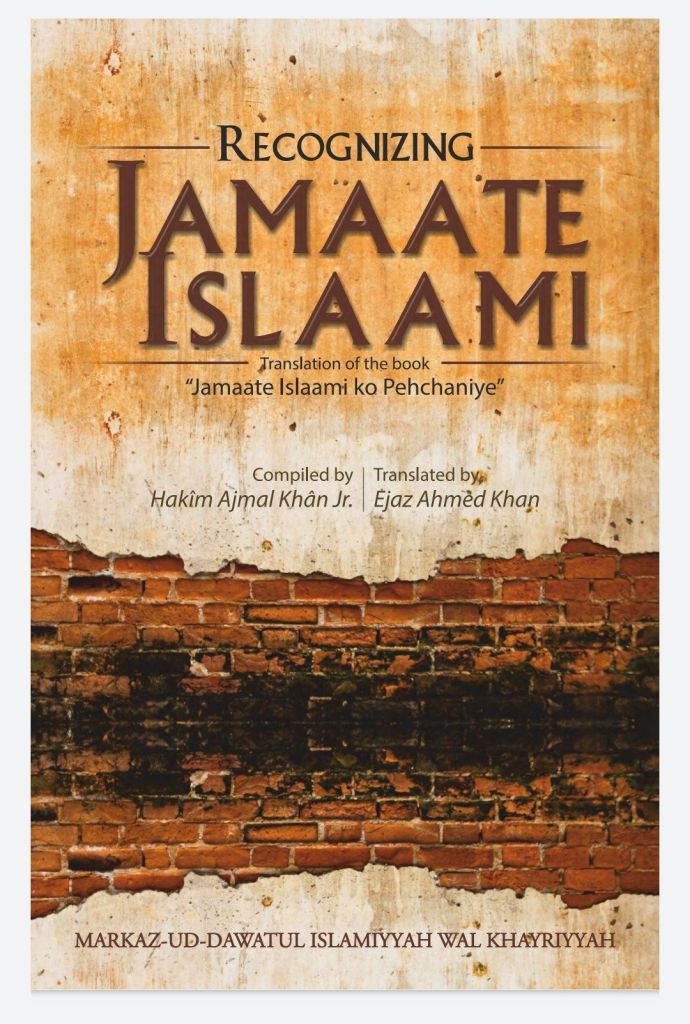
Recognising Jamaat-e-Islami (The Ikhwan-ul-Muslimeen of the Indian Subcontinent)

The Salafi scholars of India have refuted the issues of Jamaat e Islami (of Syed Abul Ala Moududi) thoroughly.

In brief words, they’re the Ikhwan-ul-Muslimeen of India.They’re enemies of the Salafi Da’wah here and continually oppose the way of the Sahabah in their principles.

Link: https://drive.google.com/file/d/1DzidQ1GkikBWE8umYqGCybgtfwyOD0pq/view?usp=drivesdk

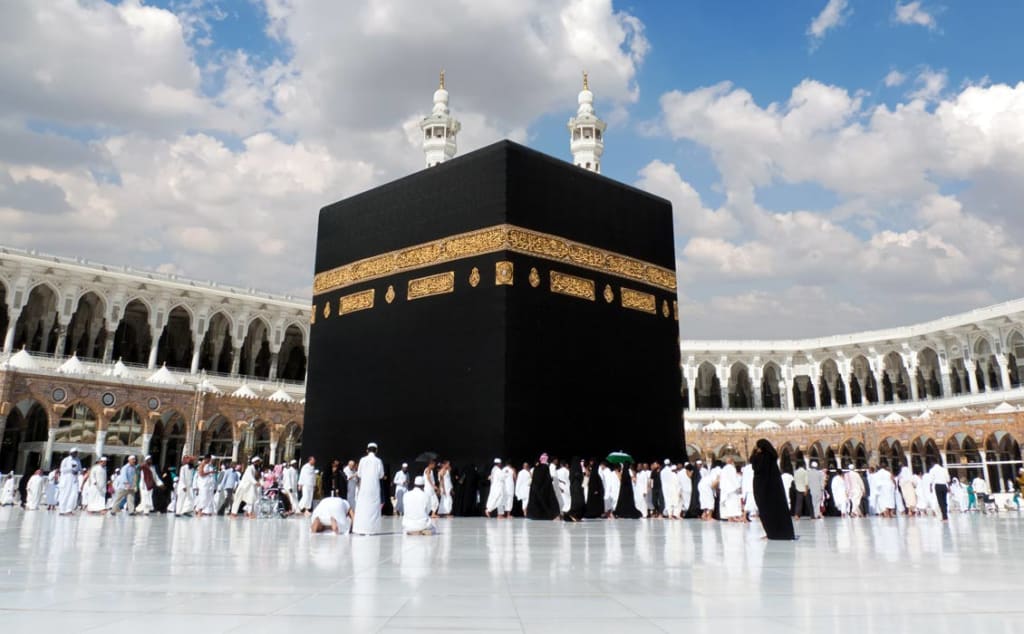
The Honor of the Kabah Lies in Revelation, Not Geometry Or Geography

The Honor of the Kabah

Lies in Revelation,

Not Geometry Or Geography

As Muslims, our hearts are naturally attached to Makkah. We love the House of Allah and often seek to share its magnificence with the world. However, in our enthusiasm, we sometimes circulate a popular claim: that the Kabah is located at the Earth’s exact “Golden Ratio point.”

This claim suggests that the city’s position is a unique mathematical and geometric center of the globe, a physical miracle designed by Allah (Subhanahu Wa Ta’ala). While this idea sounds appealing, it is scientifically inaccurate and, more importantly, unnecessary for our faith.

This article explores why this claim is a “hoax” scientifically and why true Islamic scholarship focuses on the spiritual, rather than geometrical, miracle of the Kabah.

1. What is the Golden Ratio?

The Golden Ratio, often represented by the Greek letter Phi ($\phi$), is a number approximately equal to 1.618. It is a mathematical ratio found in nature (like patterns in sunflower seeds or shells) and art, often associated with perfect balance.

The theory claims that if you measure the Earth’s map, Makkah falls exactly at this 1.618 ratio point. Let’s look at why the math doesn’t actually work.

2. The Latitude Claim (North-South): Close, But Not Exact

To understand this, we must first be clear on our terms.

  • Latitude (North-South): These are the horizontal lines that wrap around the Earth like a belt (e.g., the Equator). They measure how far “up” or “down” you are.
  • Longitude (East-West): These are the vertical lines that connect the North and South Poles. They measure how far “left” or “right” you are.

The Calculation: The distance between the North and South Poles is 180 degrees. If you divide this by the Golden Ratio (1.618), you get a point approximately 111.25 degrees from the South Pole.

The Reality: If you map this out, it lands at approximately 21.25° North. The actual latitude of the Kabah is 21.42° North.

  • The Difference: The gap is about 0.17 degrees.
  • In Distance: This equals approximately 19 kilometers (12 miles) south of the Kabah.

The Critical Flaw: This misses the mark significantly. The sacred boundary of the Haram (the Sanctuary) extends only about 11 to 12 kilometers to the South (at Idhat Libn). This means the theoretical “Golden Ratio point” is outside the Haram Sanctuary entirely. It lands in the non-sacred area known as Al-Hill. It is hard to call something a miracle when the math doesn’t even land inside the Sanctuary!

3. The Longitude Claim (East-West): A Human Invention

This is where the scientific claim falls apart completely.

Unlike Latitude (which has the Equator as a natural middle), Longitude has no natural starting point. The Earth is a spinning sphere. There is no natural “beginning” or “end” for East and West.

The line we use as “zero” today—the Prime Meridian—runs through Greenwich, England. Why? Because in 1884, humans voted to put it there. Before that, different civilizations used different starting lines.[1]

Because the starting line is human-made, you can technically draw a map starting anywhere to make a “Golden Ratio point” land on any city you want—New York, Tokyo, or Makkah. Therefore, claiming Makkah is the “natural center” of East and West is scientifically impossible, because the Earth has no East-West center.

4. The Religious Perspective: We Don’t Need Pseudoscience

As orthodox Muslims, we must be careful not to build our faith on shaky foundations. The great scholars of Islam have never relied on the “Golden Ratio” to prove the truthfulness or virtue of the Kabah.

The sanctity of the Haram is established by Divine Revelation (The Quran and Sunnah), not by geometry.

Allah says: “The first House (of worship) appointed for mankind was that at Bakkah (Makkah), full of blessing and a guidance for the worlds.” (Quran 3:96)

When we attach the truth of Islam to fragile scientific theories or hoaxes, we risk embarrassing the Ummah when those theories are disproven. The miracle of the Kabah is that it is the Qiblah of the believers, the place where the Prophets of Allah (Alaihimus Salam) worshipped Allah, and the site chosen by Allah for the rites of the Hajj, etc. This spiritual reality is far heavier on the scales than any map calculation, geometry or geography.

Summary

Here is the simple truth about Makkah and the Map:

  1. North and South: Some people say if you do a special math calculation between the North and South Poles, you land exactly on Makkah. This is not true. The numbers are close, but they do not match exactly.
  2. East and West: A ball has no beginning or end when you spin it sideways. Humans just drew a line on a map and said, “Let’s start here.” Because we can start the map anywhere we want, there is no real “center” of the Earth.
  3. The Real Miracle: We do not need a map to tell us Makkah is special. Makkah is special because Allah chose it. We love the Kabah because it is the House of Allah, and that is the only proof we need.

[1] Before the world agreed on Greenwich, UK, as the “Prime Meridian” in 1884, “0 degrees longitude” was a matter of cultural preference, not geographic reality. Different civilizations established their own starting lines based on politics and convenience:

  • Ancient India: Astronomers used the city of Ujjain as their central reference point for centuries.
  • France: The French measured the world relative to Paris, maintaining a scientific rivalry with Britain.
  • Islamic & Greek Scholars: Many classical geographers used the Canary Islands (the “Fortunate Isles”) as the zero point because it was the westernmost edge of the known world.
  • The USA: American maps often used Washington D.C. as the prime meridian.

These examples prove that the “East-West center” of the Earth changes depending on who draws the map. Therefore, you cannot claim any city is the objective “Golden Ratio center” of longitude, because the starting line for that measurement is entirely a human invention.

(-by Mohammed bin Thajammul Hussain Manna)

Is the Praise of Ahl-ul-Bid’ah a Cause for Expulsion from Salafiyyah?

Is the Praise of Ahl-ul-Bid’ah a Cause for Expulsion from Salafiyyah?

(by Shaykh Abdullah Muhammad Mushtaq, Jamia Darussalam Oomerabad, Jamiah Ha’il (Saudi Arabia))


What is the ruling on praising the People of Innovation (Ahl-ul-Bid’ah)? I will not discuss this specific issue here. Rather, my discussion focuses on this: If someone praises a person of innovation, will he then be considered expelled from Salafiyyah? Will his Methodology (Manhaj) be considered incorrect?


📚 It is evident from the books of the Salaf that people have praised Ahl-ul-Bid’ah for various purposes in every era, and this has been done by individuals whose Salafiyyah cannot even be doubted.


🔹 The Stance of Shaykh al-Islam Ibn Taymiyyah (Rahimahullah)
Allama Ibn Taymiyyah has refuted the Rafidah (Shia) more than anyone else; yet, he felt no hesitation in mentioning their virtues in certain places.

Thus, he writes:
> “And among the Rafidah, there are those who are devout worshippers, scrupulous, and ascetics, but in this regard, they are not like others among the People of Desires (Ahl-ul-Ahwa). The Mu’tazila are more intelligent, more knowledgeable, and more religious than them; and lying and immorality are less prevalent among them than in the Rafidah.
> And the Zaydiyyah among the Shia are better than them: they are closer to truthfulness, justice, and knowledge.
> And among the People of Desires, there is no one more truthful nor more devout in worship than the Khawarij.
> Yet, despite this, Ahl-us-Sunnah exercise justice and fairness with them and do not oppress them; for oppression is conventionally forbidden regardless of the situation, as has been mentioned previously. Rather, Ahl-us-Sunnah possess more goodness for every one of these groups than they have for one another; indeed, they are better and more just towards the Rafidah than some Rafidah are towards others.”

(Minhaj as-Sunnah an-Nabawiyyah 5/157)

✨ In this passage, Allama Ibn Taymiyyah has mentioned certain virtues of the Rawafid, the Mu’tazila, and the Khawarij, and then declared Ahl-us-Sunnah to be the greatest well-wishers for them.

🔹 Evidence from the Science of Narrator Criticism (Jarh wa Ta’deel)

In the books of Jarh wa Ta’deel, you will find regarding many narrators that the scholars said: “Reliable (Thiqah), Truthful (Sadooq), but he is a person of innovation.”

For example, Ibn Abi Hatim stated:
> “Amr bin Ali said: Uthman al-Barri is truthful (Sadooq), but has many errors and delusions, and he was a person of innovation.”

Allama Al-Dhahabi says regarding Aban bin Taghlib:
> “Aban bin Taghlib Al-Kufi was a zealous Shi’i, but he is truthful (Sadooq). So, for us is his truthfulness, and upon him is his innovation. Ahmad bin Hanbal, Ibn Ma’in, and Abu Hatim declared him reliable (Thiqah). Ibn Adi cited him and said: ‘He was extreme in Shi’ism.’ Al-Sa’di said: ‘A deviant who openly declared his deviation.'”

Adh-Dhahabi continues:
> “Someone might say: How is the authentication (Tawthiq) of an innovator permissible when the limit of reliability requires probity (‘Adalah) and precision? How can one who is a person of innovation be just?
> The answer is that innovation is of two types: A minor innovation, such as the exaggeration in Shi’ism, or Shi’ism without exaggeration and without distortion; this was common among the Tabi’in and their successors, alongside [their] religion, piety, and truthfulness.”
(Mizan al-I’tidal: 1/5)

🔹 The Case of Bishr al-Marisi
Furthermore, Allama Adh-Dhahabi mentions a severe innovator in good terms. Bishr al-Marisi is well-known for his innovation, and due to his innovation, scholars declared him a disbeliever (Kafir).

Yet, in his biography, Adh-Dhahabi (Rahimahullah) writes:
> “And he who is declared a disbeliever due to an innovation—even if it is major—is not like the original disbeliever, nor like the Jew or the Magian. Allah refuses to make the one who believes in Allah and His Messenger and the Last Day, and fasts, prays, performs Hajj, and gives Zakat—even if he commits major sins, goes astray, and innovates—like the one who opposes the Messenger, worships an idol, discards the laws, and disbelieves. However, we seek refuge with Allah from innovations and their people.” (Siyar A’lam an-Nubala 10/202)

⚠️ Now estimate this: Scholars declared a man a disbeliever due to innovation, yet Allama Adh-Dhahabi mentions his faith, prayer, fasting, and worship.

🔹 Other Examples

1️⃣ Az-Zamakhshari: The Mu’tazili stance of Zamakhshari, the author of Al-Kashshaf, is well-known. Despite this, Allama Ibn Kathir (Rahimahullah) writes in his Tafsir:
> “The Allama (Great Scholar) Abu al-Qasim Mahmud bin Umar az-Zamakhshari said in his Tafsir…”

Here, despite Zamakhshari’s I’tizal, Ibn Kathir refers to him as “Allama” in his Tafsir.

2️⃣ Al-Alusi: Allama Al-Alusi is a Naqshbandi Sufi exegete (Mufassir), and his Tafsir contains a large number of Sufi issues. Despite this, Allama Al-Albani (Rahimahullah) has mentioned him as “Allama” in several places. For instance, he says in one place:
“If you have known this, then it is not correct to use the verse as evidence in any way. And the Investigating Scholar (Al-Allama Al-Muhaqqiq) Al-Alusi said in ‘Ruh al-Ma’ani’…”

(Tahdhir al-Sajid min Ittikhadh al-Qubur Masajid, 55)

🛑 Conclusion
From these texts, it becomes known that if someone praises a person of innovation or mentions them in good terms, the method of expelling him from the Manhaj (Methodology) is a matter that requires reconsideration (Mahall-e-Nazar).

✍️ Abdullah Muhammad Mushtaq

(Translated by Mohammed bin Thajammul Hussain Manna from the Shaykh’s Facebook page, the post was originally in Urdu.)

The Necessity of Mutual Respect Despite Disagreement on Issues – Asad Azmi, Jamia Salafia Banaras

🌿 The Necessity of Mutual Respect Despite Disagreement on Issues 🌿

✍️ Asad Azmi / Jamia Salafia Banaras


Differences in perspective regarding various subjects and issues exist among individuals belonging to the different schools of thought within the Muslim community; it is due to these very differences that separate groups and sects come into existence. In many of these matters, the difference is of a minor nature.


📌 If differences cannot be eliminated, they can certainly be minimized. Furthermore, it is essential to respect one another despite these differences, to abstain from abuse, reviling, taunting, and mockery, and to practice mutual tolerance. This is the teaching of our religion. We must contemplate how, despite our differences, we can live together in unity. What guidance has our religion provided us in this regard? What is the responsibility of the noble scholars in this context?


📖 Read the Quran; what attributes of a believer have been described?
(Adhillatin ‘ala al-mu’minin a’izzatin ‘ala al-kafirin)
✨ “Humble toward the believers, mighty against the disbelievers.”
It is among the attributes of a believer that he remains soft for other believers and hard against the people of disbelief. In describing the attributes of the Companions, it is stated: (Ashidda’u ‘ala al-kuffar ruhama’u baynahum) — “Severe against the disbelievers, merciful among themselves.”


📜 Ho halqa-e-yaran to baresham ki tarah narm
Razm-e-haq-o-batil ho to faulad hai momin
(In the circle of friends, he is soft as silk; In the battle of truth and falsehood, the believer is [as strong as] steel.)


🛑 Where is our “steel-like” nature visible today?
When it comes to internal issues, we become very harsh. We have elevated the Maslak (sect/school of thought) to the status of the Deen (Religion). We consider the propagation of the Maslak to be the propagation of the Deen, and the defense of the Maslak to be the defense of the Deen. This is a significant weakness of ours.


Our differences are very minor; disagreement likely exists in only five to seven percent of issues. However, these five to seven percent always remain predominant, while the ninety-three to ninety-four percent of issues upon which there is consensus—where there is no disagreement—are never mentioned.
❓ Why is this so?
When our agreement lies in so many issues and disagreement in only a few, why then does this disagreement always prevail and dominate our minds and our society?

📚 The Ethics of Disagreement (Adab al-Khilaf)
Within the books on Islamic subjects, there is a topic known as “Adab al-Khilaf”—that is, how to handle disagreement, and how we can live together despite it. In the modern era, significant work has been done on this subject in the Arabic language; many books have appeared under titles such as Adab al-Khilaf or Adab al-Ikhtilaf fi al-Islam. Work is slowly progressing in Urdu as well.
The meaning of Adab al-Khilaf is that while we differ with you on certain issues, despite this difference, we attempt to understand and know one another, stay close to one another, and accord one another respect and reverence. Scholars have explained this by citing numerous examples.


👇 A few examples are presented below:

🌹 1. Umar and Abdullah bin Masud (Radi Allahu Anhuma):
Both are distinguished Companions. Allama Ibn al-Qayyim (Rahimahullah) has written that there was disagreement between them on more than one hundred issues.
Reflect upon this: disagreement on more than one hundred issues. Yet, did they fight one another? Did they hate one another? No.
It is written in their biographies that Umar (Radi Allahu Anhu) used to say regarding Abdullah bin Masud:
✨ “Kunayfun muli’a ‘ilman wa fiqhan aathartu bihi ahla al-Qadisiyah” (Abdullah bin Masud is a vessel filled with knowledge and jurisprudence; I have preferred the people of Qadisiyah with this [vessel]).
Think: disagreement on a hundred issues, yet he is praising him.
On the other hand, the condition of Abdullah bin Masud was such that after the passing of Umar, he used to say:
✨ “Rahimallahu ‘Umar, kana lil-Islami hisnan hasinan…” (May Allah have mercy on Umar; he was an impregnable fortress for Islam, and now that fortress has collapsed).


🌹 2. Imam Ahmad bin Hanbal and Ali bin Madini:
Once, a disagreement occurred between them regarding an issue. Ali bin Madini had come to Imam Ahmad bin Hanbal on a mount. After dismounting, a debate and discussion ensued on the issue, and narrators state that voices were raised; the debate took place in loud tones.
However, when the debate concluded and Ali bin Madini began to leave, Imam Ahmad bin Hanbal stood up, held the reins of his mount, and helped him seat himself upon it.
✨ Reflect: a debate just took place, yet behold this level of respect.


🌹 3. Maulana Sanaullah Amritsari:
This is an account from the recent past. He was a famous scholar and a great debater; people of every school of thought invited him to their debates. He debated Qadianis, Christians, Aryas, and all false sects.
His practice was such that when the debate concluded—regardless of who the opposing debater was—he would invite him to his place for food and lodging.
✨ The debate is ongoing, arguments are being exchanged, opposition is occurring, yet when the debate ends, he tells his opponent: “You must eat at our place and stay the night with us.”


🌹 4. Maulana Ismail Salafi:
It is narrated regarding Maulana Ismail Salafi of Gujranwala that once a caravan of Hajj pilgrims was departing. There was a crowd at the station to see the pilgrims off. The time for prayer arrived, and people stepped aside and formed rows. People pushed Maulana Ismail forward to lead the prayer.
After the Maulana stood on the prayer mat (Musalla), a gentleman from behind said, “Maulana, our prayer will not be valid behind you.”
The Maulana picked up his handkerchief, placed it on his shoulder, stepped back from the prayer mat, and said, “Sir, you lead the prayer; my prayer will be valid behind you.”
That person was deeply ashamed and apologized, and eventually had the Maulana lead the prayer.


❓ What would we have done?
At the very least, two congregations would have formed immediately: “Go pray behind your Imam, we are separating with our people.” And if it had reached the point of a physical altercation, it would not have been far-fetched or surprising.

🤝 My brothers!
Despite differences, we must think about and reflect upon respecting one another, understanding one another, and how to deal with one another. For one scholar to belittle another, or to persecute him due to a difference in issues, is contrary to his dignity. Indeed, such behavior does not befit even a common believer, let alone a scholar.

📜 A Lesson from the Salaf:
Sufyan bin Husain, who is among the predecessors (Salaf), narrates: “Once, I mentioned a man in somewhat poor terms in the presence of Iyas bin Muawiyah. Iyas bin Muawiyah was a very serious man of great insight. I complained about someone—backbit him—in his presence.
Iyas bin Muawiyah stared at me and asked:
❓ ‘A-ghazauta ar-Rum?’ (Have you fought against the Romans?) I said, ‘No.’
❓ ‘As-Sinda wal-Hinda was-Sin?’ (Have you fought against the people of Sindh, Hind, and China?) I said, ‘No.’
He said:
⚠️ ‘SubhanAllah! The Romans are safe from you, the Hindus and people of Sindh are safe from you, the people of China are safe from you, but your Muslim brother is not safe from you?'”


🔹 Conclusion
My brothers! Let us remain on our Maslak, let us adhere to our stance, but let us learn to respect the other and learn to understand the other. And let us also consider that there are some issues for which we need to rise above sect and denomination to reflect upon—common issues where there is no matter of sect or denomination, but rather issues of humanity.


For example, issues of health and disease. These narcotics, gutkha, tobacco, khaini, pan masala… our youth are immersed in this.
Is he Muslim or non-Muslim? Hanafi or Ahl-e-Hadith? Deobandi or Barelvi? Shia or Sunni?
Can we not unite to reflect upon these issues?


🚫 We also observe that we have divided our mosques, we have divided our madrasas, we have divided our places of worship, and we have divided books. Yet, despite this, we continue to look at the mosques of others with covetous eyes. Lawsuits are filed for this purpose, money is spent, fights break out in mosques, police are called into mosques, and cases drag on for years while money is spent freely.
Is there any room for such actions? Will we come to our senses even now, or will we continue to weaken ourselves further and further through these unnecessary customary fights?

(Translated by Mohammed bin Thajammul Hussain Manna from Urdu. This was originally posted on Facebook on Shaykh Abdul Lateef Salafi Madani’s page.)