The Virtue of Going to the Mosque
1- The One Who Preserves His Obligatory Prayers In The Masjid Will Be Shown Hospitality In Paradise:
In the two Sahihs, it is narrated from Abu Hurairah, may Allah be pleased with him, that the Prophet, peace be upon him, said: “Whoever goes to the mosque in the morning and returns in the evening, Allah will prepare for him a residence[as is prepared for a guest] in Paradise, every time he goes in the morning and returns in the evening.” [Sahih Al-Bukhari 662, Sahih Muslim 669.]
2- Walking To The Masaajid (Mosques) Expiates Evil Deeds And Raises Ranks:
Muslim narrated from Abu Hurairah, may Allah be pleased with him, that he said: The Messenger of Allah, peace be upon him, said: “Whoever purifies himself in his house, then walks to one of the houses of Allah to fulfill one of the obligations of Allah, his two steps will result in one of them wiping out a sin and the other raising his rank.” [Sahih Muslim 666.]
3- Going To And Returning From The Masjid Are Recorded In The Scale Of Good Deeds:
Muslim narrated from Ubayy bin Ka’b, who said: There was a man, and I do not know of any man who lived farther from the mosque than him. Yet, he never missed a prayer. It was said to him – or I said to him: “If only you bought a donkey to ride in the darkness and in the (extreme) heat.” He replied: “I wouldn’t be pleased that my house is near the Masjid, because I want my walking to the Masjid and my return when I go back to my family to be recorded (as rewarding) for me.” The Messenger of Allah, peace be upon him, said: “Allah has gathered all of that for you.” [Sahih Muslim 663]
4- Walking To The Mosque at Dawn and Nightfall Will Bring Light To The Servant On The Day Of Judgment:
Abu Dawud narrated, and Al-Albani said that it is Sahih, from Buraydah, that the Prophet, peace be upon him, said: “Give glad tidings to those who walk in darkness to the Masaajid of a complete light (of illumination) on the Day of Judgment.” [Sunan Abi Dawud 561.]
[End of the note by Shaikh Waheed Abdus Salam Baali. An additional Hadith below regarding walking to the Masjid on Fridays, by the translator.]
5- Walking To The Masjid On A Friday For The Jumuah Prayer:
It was narrated from Aws ibn Aws Ath-Thaqafi that the Messenger of Allah (blessings and peace of Allah be upon him) said: “Whoever does Ghusl on Friday and cleanses himself, and sets out early, and comes close to the imam and listens and keeps quiet, for every step he takes he will have the reward of fasting and praying qiyam for one year.” Narrated by al-Tirmidhi, 496; classed as sahih by al-Albani in Sahih al-Tirmidhi, 410.
Al-Qari said in Mirqat Al-Mafatih (3/1035): “One of the leading scholars said: We have not heard in the teachings of Islam of any sahih hadith that refers to anything like this reward, meaning: one should make sure to comply with it in in the hope of attaining that reward.”
May Allah accept this from us, and guide us to act upon what we have learnt. And may peace, mercy and blessings be upon Prophet Muhammad.
(Translated by Mohammed bin Thajammul Hussain Manna.)
The Story of Alqamah with His Mother (Regarding Disobedience To Parents) Is Not Authentically Proven- By: Abdullah bin Muhammad Zuqail.
All praise is due to Allah, and may peace and blessings be upon the Messenger of Allah ﷺ.
Stories attributed to the Prophet ﷺ, his companions, and the followers often circulate in discussion forums and mailing lists. However, when subjected to the scrutiny of Hadith criticism, they turn out to be baseless. One such well-known story—though fame does not mean a story is authentic—is the story of Alqamah (Radi Allahu Anhu) with his mother, which is used as an evidence for the punishment of disobedience to parents. What is the authenticity of this story?
I will summarize the analysis of this story from the book “Qisas La Tathbut” (Volume 3, pp. 19–39) in the following points:
First:
This story, in its current form and with such detailed narration, is widely known among people. It is frequently mentioned in discussions about “parental disobedience” or “a good ending.” However, in this specific wording, it has no origin in the Hadith collections. There is a brief mention of it, but those who are keen on their religion should not be pleased with its chains of transmission (because of their extreme weakness).
Second:
One of the books that narrated this story in the form you mentioned in your article is “Al-Kabair” by Adh-Dhahabi, in the edition published by Shaikh Muhammad Abdur Razzaq Hamza (may Allah have mercy on him). However, after examining the manuscript version, it was found to be absent from it. Such a fabrication would not deceive a scholar like Imam Adh-Dhahabi (may Allah have mercy on him).
The story is also mentioned in the book “Tanbih Al-Ghafilin” by As-Samarqandi, about whom Imam Adh-Dhahabi said in “Siyar A’lam al-Nubala” (16/323): “Fabricated Hadiths were circulated through him.” He also stated in “Tareekh Al-Islam” (incidents of 351–380 AH, p. 583): “The book Tanbih al-Ghafilin contains many fabricated reports.” Abu Al-Fadl Al-Ghumari also remarked in “Al-Hawi” (3/4): “The book Tanbih Al-Ghafilin includes weak and fabricated Hadiths. It should not be read by the general public, as they cannot differentiate between authentic and fabricated narrations.”
Third:
Abdullah ibn Imam Ahmad narrated in “Al-Musnad” (4/382): “In my father’s book, I found: ‘Yazid ibn Harun narrated to us, saying: Fa’id ibn Abdul Rahman informed us, saying: I heard Abdullah ibn Abi Awfa say: A man came to the Messenger of Allah ﷺ and said: ‘O Messenger of Allah, there is a young man here who has fallen unconscious. He is told to say ‘La ilaha illa Allah’, but he cannot say it.’ The Prophet ﷺ asked, ‘Did he use to say it during his lifetime?’ The man replied, ‘Yes.’ The Prophet ﷺ then asked, ‘What is preventing him from saying it at the time of his death?’”… (Then the Hadith continues.)
However, my father did not narrate these two Hadiths to us and had struck them out from his book, as he was not satisfied with the narration of Fa’id ibn Abdur Rahman or (perhaps he) considered him an abandoned narrator.
Fourth:
Al-Bayhaqi included this story in “Shu’ab Al-Iman” (6/197–198, no. 7892) and “Dala’il An-Nubuwwa” (6/205–206). Al-Qazwini mentioned it in “At-Tadwin fi Tarikh Qazwin” (2/369–370). Al-‘Uqayli recorded it in “Ad-Du‘afa’ al-Kabir” (3/461), from whom Ibn Al-Jawzi quoted it in “Al-Mawdu‘at” (3/87). It was also narrated by Al-Khara’iti in “Masawi’ Al-Akhlaq wa Madhmumuha” (no. 251).
Fifth:
The story revolves around Abul-Warqa’ Fa’id ibn Abdur Rahman Al-Attar. Al-Bayhaqi explicitly mentioned this in “Shu’ab Al-Iman” (6/198): “Fa’id Abul-Warqa’ is the sole narrator of this report, and he is not strong. And Allah knows best.”
Fa’id is an abandoned narrator, accused of fabrication. His narrations should not be relied upon, especially in this story which he attributes to Ibn Abi Awfa.
Sixth:
Several Hadith scholars and critics have declared the story weak, including:
1. Imam Ahmad – as mentioned by his son Abdullah in the third point above.
2. Al-Uqaili in “Ad-Du‘afa’ Al-Kabir”(3/461), stating: “Only someone of similar weakness would follow him in narration.”
3. Al-Bayhaqi in “Shu’ab Al-Iman” (6/198), saying: *”Fa’id Abul-Warqa’ is the sole narrator, and he is not strong.”
4. Ibn al-Jawzi in “Al-Mawdu‘at” (3/87), stating: “This narration is not authentic from the Messenger of Allah ﷺ. In its chain is Fa’id, whom Ahmad ibn Hanbal called an abandoned narrator, Yahya ibn Ma’in said, ‘He is nothing,’ Ibn Hibban said, ‘He should not be relied upon,’ and Al-Uqaili said, ‘Only someone of similar weakness would follow him in narration.’ Furthermore, in the chain is Dawud ibn Ibrahim, whom Abu Hatim Ar-Razi accused of lying.”
5. Al-Mundhiri in “At-Targhib wat-Tarhib” (3/222), introducing it with the phrase “It is narrated” (indicating weakness).
6. Al-Dhahabi in “Tartib Al-Mawdu‘at”(no. 874).
7. Al-Haythami in “Majma‘ Az-Zawa’id”(8/148), after attributing it to Ahmad and At-Tabarani, stating: “In its chain is Fa’id Abul-Warqa’, who is abandoned.”
8. Ibn ‘Iraq in “Tanzih Ash-Shari‘ah” (2/296–297, no. 51).
9. Ash-Shawkani in “Al-Fawa’id Al-Majmu‘a” (p. 231), stating: “In its chain are an abandoned narrator and a liar. It also has other chains.” -The verifier, Sheikh Abdul Rahman Al-Mu‘allimi, commented: “All its chains revolve around the abandoned narrator Fa’id ibn Abdul Rahman Abul-Warqa’ Al-Attar.”
Seventh:
None of the reported chains—despite their weakness—mention the young man’s name as Alqamah, nor do they state that he prioritized his wife over his mother. The commonly recounted details found in popular storytelling do not exist in any of the hadith sources.
Eighth (Conclusion):
This story is not authentic and has no valid chain of transmission. It is impermissible to narrate, spread, or include it in sermons, books, or messages. Anyone who does so contributes to the dissemination of weak and fabricated hadiths. The authentic hadiths in the Sunnah provide sufficient guidance on this topic.
End of the analysis with slight modifications.
Source: Summarized from “Qisas La Tathbut” (Vol. 3, pp. 21–30), authored by Abu Ubaida Mashhoor bin Hasan Aal-Salman.
-End of the article by Abdullah bin Muhammad Zuqail from saaid.org.
Source
(Translated into English by Mohammed bin Thajammul Hussain Manna.)
Alqama (Radi Allahu Anhu) aur unke maa ka waqiah Sahih nahi hai.
Khutaba aksar is riwayat ko ye zahir karne ke liye istemal karte hain ke maa ki nafarmani karna kitna khatarnak hai.
“Ek hadees hai ek Sahabi ke baare mein jinka naam ‘Alqamah’ tha; woh maut ke qareeb thay aur kalimah nahi keh pa rahay thay. Phir Nabi (sallallahu alaihi wasallam) ne unki maa ko bulaya, unki maa ne kaha ke woh unke betay Alqamah se naraz hain, kyun ke woh apni biwi ko unpar tarjeeh detay thay. Phir Nabi (sallallahu alaihi wasallam) ne lakdiyon ka gaththa ikattha kiya aur unki maa se kaha ke woh unke bete ko unki aankhon ke saamne jala denge. Maa ne kaha: Aey Allah ke Rasool, ye mera beta hai aur main aapko use apni aankhon ke saamne jalate hue nahi dekh sakti! Nabi (sallallahu alaihi wasallam) ne farmaya: ‘Aey Alqamah ki maa, Allah ka azab zyada sakht aur khatarnaak hai. Agar tum chahti ho ke Allah usay maaf kare, to tum khud usay maaf kardo. Us zaat ki qasam jiske haath mein meri jaan hai, uska namaz, roza, aur zakat uske kuch kaam na aaye ga jab tak tum usse naraz ho.’ Phir us maa ne apne betay ko maaf kar diya, aur kuch der baad woh kalimah pad saka aur dunia se chala basa. Hadees ke mutabiq, is ke baad Nabi (sallallahu alaihi wasallam) ne Muhajireen aur Ansar ko bulakar farmaya: ‘Agar tum mein se koi apni biwi ko apni maa par tarjeeh deta hai, to Allah, farishte, aur saare makhlooq uspar laanat karte hain, aur Allah uska sadaqa aur nek amal qabool nahi karta jab tak ke woh tauba na kare aur apni maa ki maafi aur raza talash na kare. Allah uske maa ki narazgi ki wajah se naraz rehta hai.’”
Abdullah bin Muhammad Zuqail ne is qissay ki tehqeeq apne article mein ki jiska naam hai, ‘Qissatu Alqamah Ma’a Ummihi (Uqooq ul Walidain) La Tahtbut’, aur kaha ki ye qissa jhuta hai aur manghadat (mawdoo, fabricated) hai. Us article se do paragraph ham yahan naqal karenge. InshaAllah.
1. Ibn Al-Jawzi ne “Al-Mawdoo’at” (3/87) mein kaha: “Yeh riwayat Rasool Allah (sallallahu alaihi wasallam) se sahih nahi hai, aur iske raavi Fa’id hai, Ahmad bin Hanbal ne kaha: “Fa’id key Hadith chhod diye gaye hai”, Yahya ne kaha: “Woh kuch nahi hai”, Ibn Hibban ne kaha: “Usse hujjat nahi li ja sakti”, ‘Uqaili ne kaha: “Aur uski mutabi’at nahi hai, siwaaye uske jaise logon ke”, aur iski sanad mein Dawood bin Ibrahim hai, Abu Hatim al-Razi ne kaha: “Woh jhootha tha”.
2. Khulasa (Summary): Yeh kahani sahih nahi hai, aur iske liye koi sahi sanad nahi hai, toh isko bayan karna jaiz nahi hai, aur na hi kisi majlis, khutba, ya khitab mein iska zikr karna chahiye, ya phir kisi risale mein iska tazkirah karna chahiye, aur jo koi aisa karta hai woh bahut si wahiyaat (false) kahaniyon aur ahadith ko phailane ke liye kaam karta hai, jabke sahih Sunnat aur Quran iske liye kafi hai (yani maa baap ke sath nek sulook sikhane ke liye Sahih Ahadis kafi saare hain).
(Compiled and translated by Mohammed Manna.)
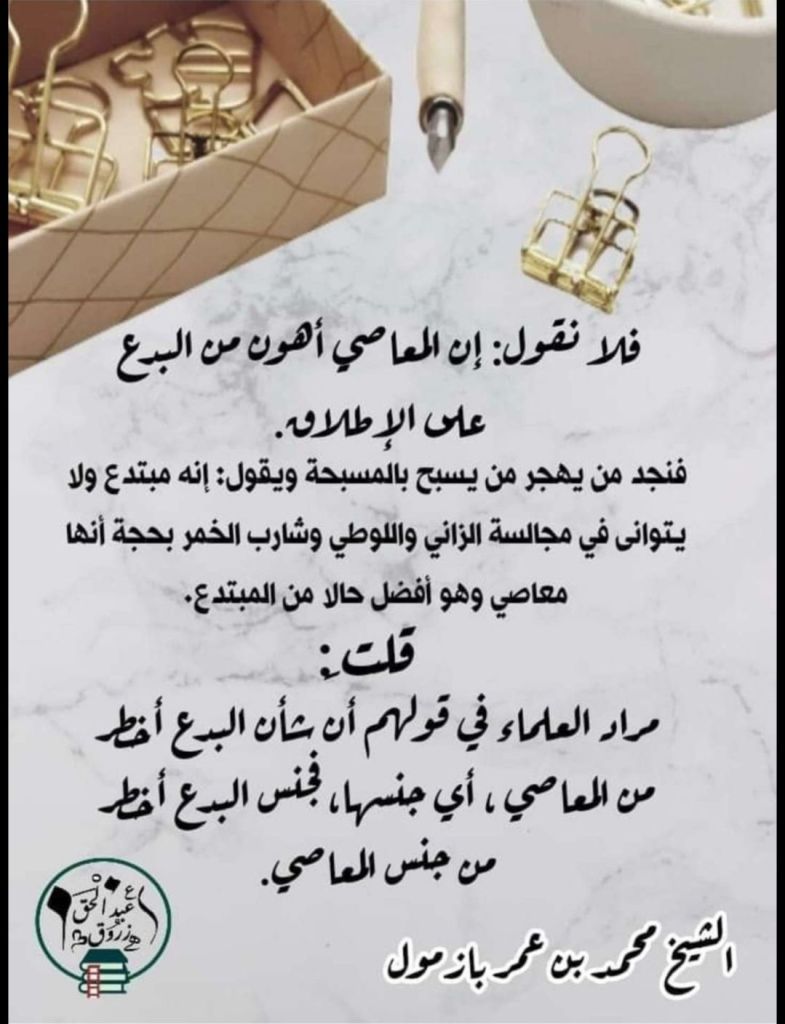
Do not generalize saying: “Committing a sin is a lighter matter in comparison to committing a Bid’ah.”- Shaikh Muhammad Bazmool
A clarification: Bid’ah is worse than Sin, and an innovator is more dangerous than a sinner.
Shaikh Muhammad Ibn Umar Baazmool said: Do not generalize saying: “Committing a sin is a lighter matter in comparison to committing a Bid’ah.”
One may find that a person has been abandoned because he uses prayer beads, labeling him as a Mubtadi (religious innovator). Whereas they would have no problem in sitting with a fornicator, or a homosexual, or the one who consumes intoxicants; and their argument is that the one who commits sins is still in a better state (with Allaah) than an innovator.
I (Muhammad Baazmool) say: The intent behind the scholars statement: “the position of Bid’ah is more dangerous than that of a sin”, they say this due to its nature. Depending on the type (category), Bid’ah is more dangerous than sin. End quote.
Notes (by Abu Dalia Fahad Barmem):
*1) The reason why scholars considered Bid’ah as more dangerous than sin is because the one who has fallen into innovation does it thinking it be a righteous deed and he may not repent from it, whereas the one who has fallen into sin may realize his mistake and repent from it.
*2) No doubt that every Bid’ah is misguidance, but not all Bid’ah are of the same level. Like sins, Bid’ah also vary in degrees; some Bid’ah, like sins, can reach to the level of Kufr, and others are less than that. So generalizing that every person who has fallen into Bid’ah is worse than the one who commits a Major or Minor sin, is injustice.
*3) Some of the brothers treat a person who has fallen into an innovation worse than a person who has fallen into Major sin. So we see that those who have fallen into innovations (like using Tasbeeh (prayer beads) or celebrating National Day) or those who differ with these brothers about an issue are boycotted while these same brothers would have among their ranks those who devour donations and Zakaah, or are engaged in Fawaahish etc. They do this relying on the “SAVED SECT” card. Wallahul Musta’an.
(Copied entirely from the Facebook account of the noble brother Abu Dalia Fahad Barmem, may Allah preserve him.)
Explanation of The Hadith- ‘O Allah, bless my Ummah in their early hours of the morning.’
The Hadith:
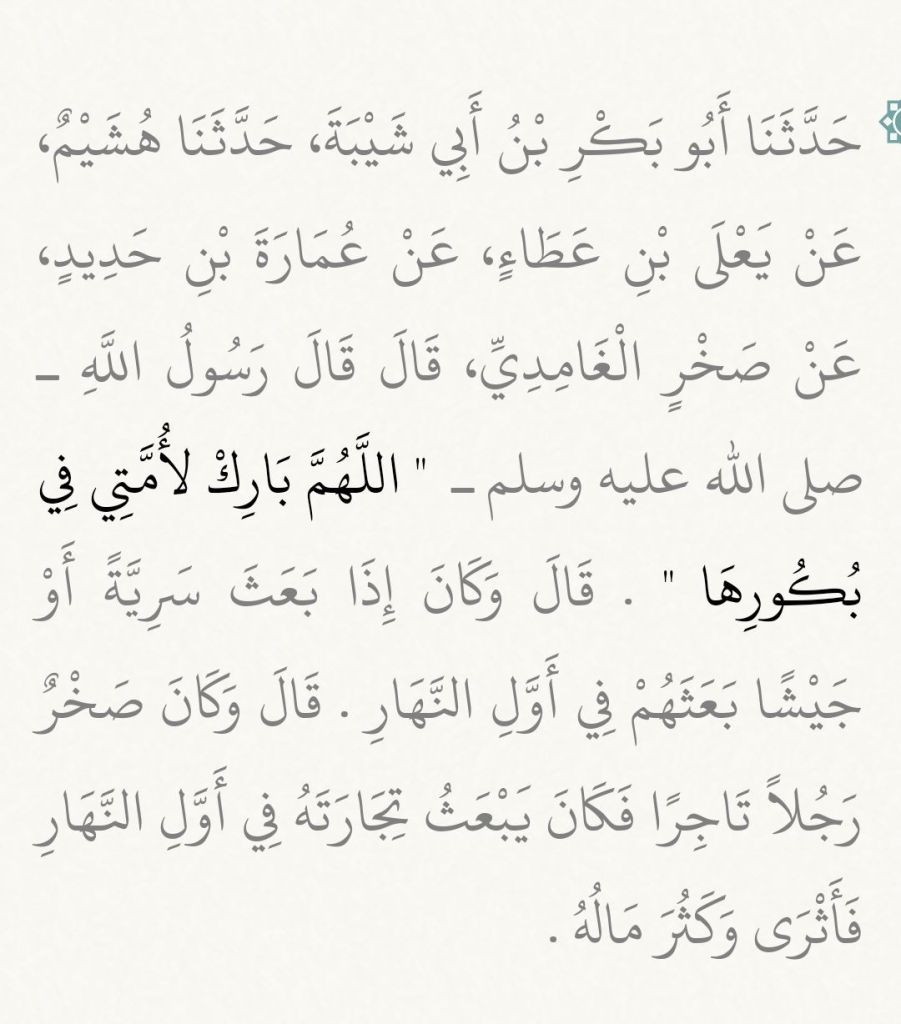
It was narrated from Sakhr Al-Ghamidi that the Messenger of Allah (ﷺ) said:
“O Allah, bless my Ummah in their early hours of the morning (i.e., what they do early in the morning).” He said: “When he sent out a raiding party or an army, he would send them at the beginning of the day.” He said: “Sakhr was a man engaged in trade, and he used to send his goods out at the beginning of the day, and his wealth grew and increased.”
(Sunan Ibn Majah 2236, translation from sunnah.com /Darussalam.)
Explanation of the Hadith from Dorar.net:
The Prophet (peace be upon him) was eager for the well-being of his Ummah, and part of his eagerness was that he would supplicate for them to be blessed and granted goodness. In this Hadith, it is reported that the Prophet (peace be upon him) said: “O Allah, bless my Ummah in the early hours of the morning.”
This supplication means: O Allah, increase the goodness and blessings for my Ummah, with abundance and growth, when they emerge in the morning to engage in their daily activities.
Sakhr ibn Wada’ah Al-Ghamidi, one of the narrators of the Hadith, said: The Prophet (peace be upon him) would dispatch a Sariyyah (a small military detachment or raiding party) or army, and by doing so, he would send them out early in the morning, in order to attain the blessings that are present at that time. A military detachment refers to a part of the army, which can consist of up to four hundred soldiers.
‘Umairah ibn Hadi, another narrator of the Hadith, said: Sakhr was a merchant who would send out his trade caravans early in the morning, acting upon the advice of the Messenger of Allah (peace be upon him), in order to attain the blessings of the Prophet’s supplication. As a result, Sakhr became wealthy and his wealth increased.
In this Hadith, there is an explanation of the Prophet’s eagerness for the goodness of his Ummah. It also encourages acting upon the Sunnah of the Messenger of Allah (peace be upon him) and adhering to his advice, as this is a means of attaining blessings. End quote.
Source In Arabic From Dorar.net.
The following question and answer was taken from islamweb.net and translated for further benefit.
Question: The Messenger of Allah (peace be upon him) said: “O Allah, bless my Ummah in the early hours of the morning” – So when does the time of Bukoor (early morning) begin and when does it end?
Answer: Alhamdulillah Was-Salatu Was-Salamu Ala Rasoolillah Wa Ala Aalihi Wa Sahbihi, Amma Ba’ad.
The Hadith was narrated by Abu Dawud, and At-Tirmidhi graded it as Hasan (good, acceptable), (was also reported by) Ibn Majah, and Ahmad, on the authority of Sakhr ibn Wada’ah Al-Ghamidi – may Allah be pleased with him – who reported that the Prophet (peace be upon him) said: “O Allah, bless my Ummah in their early hours of the morning (i.e., what they do early in the morning).” He said: “When he sent out a raiding party or an army, he would send them at the beginning of the day.” He (one of the narrators) said: “Sakhr was a man engaged in trade, and he used to send his goods out at the beginning of the day, and his wealth grew and increased.”
And “Bukoor” refers to the beginning and early part of the day. Abu Dawud, Ahmad, and An-Nasa’i narrated from the Hadith of An-Nu’man bin Muqarrin (May Allah be pleased with him) who said: “I was with the Messenger of Allah (ﷺ) when I witnessed that if he did not begin fighting in the early part of the day, he would postpone fighting till the sun had declined, the blowing of the breeze had blown and the victory from Allah had come.”
And in the wording of At-Tirmidhi: “He would wait.” And he (At-Tirmidhi) said: “Hasanun Sahih” (i.e., the Hadith is good and authentic, scholars have explained Hasanun Sahih in different ways).
And it has a supporting narration in Al-Bukhari, which is narrated in a connected chain (Musnad) from the Hadith of Abdullah ibn Abi Awfa. Al-Bukhari titled it with what is mentioned in the wording of the Hadith of An-Nu’man, and he narrated it in his Sahih in the Book of Jizyah from An-Nu’man with a different wording: “I witnessed battles with the Messenger of Allah (peace be upon him), and if he did not fight at the beginning of the day, he would wait until the winds blew and the prayers were performed.”
In the Hadith of An-Nu’man, there is evidence that between the end of the early part of the day and the time of noon, when the sun is at its peak, there is a period of time during which delay and waiting in battle are apparent. This period is not usually short. It appears that what is meant by “the beginning of the day” is the time from the dawn prayer (Fajr), after the spread of the true dawn light (Al-Fajr As-Sadiq) and the performance of the Fajr prayer, until the sunrise (Shurooq Ash-Shams, Tulu-e-Aftaab) and the rise of the sun and the beginning of the spread of its heat, i.e., until the beginning of the time of Duha.
Imam At-Tabari said in his Tafseer of Allah’s saying: “And glorify Him in the evening and in the early morning” (Aal-Imran: 41): “As for the early morning (Al-Ibkar), it is a noun derived from the saying of the one who says: ‘So-and-so hastened to his task,’ and he hastens with haste. This is when he goes out to perform his task from the time of the dawn until the time of Duha. This is what is called the early morning (Al-Ibkar). It is said in this context: ‘So-and-so hastened and hastened with haste.'”
And that is because the period between these two times was when people would begin their daily activities during the prophetic era and thereafter, until recent times. Therefore, it was specifically mentioned in the supplication.
Ibn Battal said: “The narration ‘O Allah, bless my Ummah in the early morning’ (Bakur) does not indicate that there is no blessing in other times. This is because every action of the Prophet (peace be upon him) contains blessings, and his Ummah has the greatest example in it. Rather, the Prophet (peace be upon him) specifically supplicated for blessings in the early morning, as opposed to other times – and Allah knows best – because it is the time when people intend to begin their daily activities. It is a time of vigor and rising from slumber. Therefore, he specifically supplicated for it, so that his entire Ummah may attain the blessings of his supplication.”
Ibn ‘Uthaymeen said in his explanation of Riyadh-us-Saliheen, while explaining this Hadith: “However, unfortunately, most of us today sleep during the early part of the day and do not wake up until Duha, thus missing out on the early part of the day that contains Barakah (blessings).”
And his statement: “thus missing out on the early part of the day that contains blessings” – means the specific blessings that the Prophet (peace be upon him) supplicated for during this time. And Allah knows best.
[Translated by Mohammed bin Thajammul Hussain Manna.]
 Saheehus-Seerah