Did The Prophet Muhammad (Salallahu Alaihi Wa Sallam) Ever See An Ocean (or a Sea)?

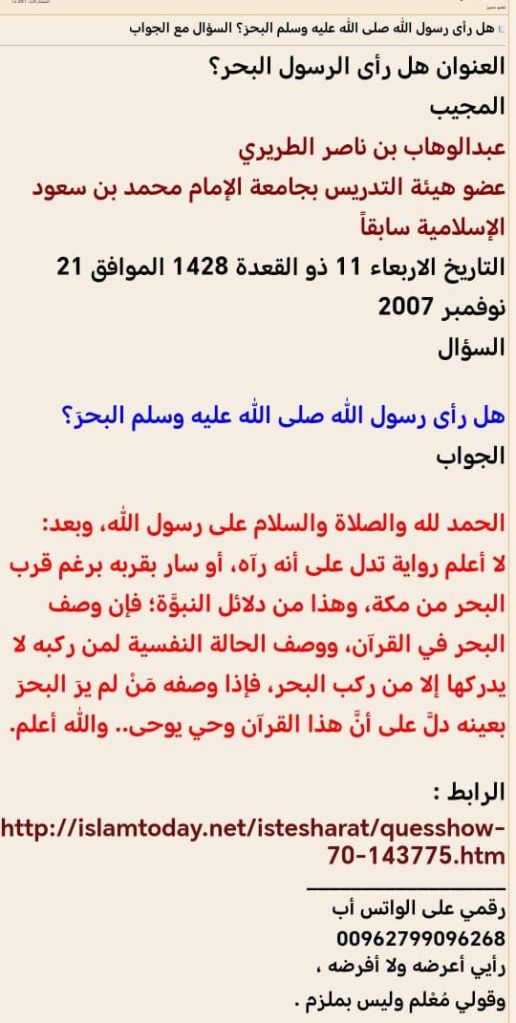
Did The Prophet Muhammad (Salallahu Alaihi Wa Sallam) Ever See An Ocean (or a Sea)?
-by (Shaikh) Abdul Wahhab bin Nasir At-Twareeri.


(Former faculty member at Imam Muhammad bin Saud Islamic University
Dated: Wednesday, 11 Dhu al-Qadah 1428, corresponding to November 21, 2007.)

The Question: Did the Messenger of Allah (Salallahu Alaihi Wa Sallam) see the sea?

Answer (by Shaikh Abdul Wahhab bin Nasir At-Twareeri): I do not know of any narration that indicates that he (Prophet Muhammad) saw it (the sea), or walked close to it, despite the sea being close to Makkah. This is one of the signs of prophethood. The description of the sea in the Quran, and the description of the psychological state of those who ride it, can only be understood by those who have ridden the sea. So, if someone who has not seen the sea with his own eyes describes it, it indicates that this Quran is revelation that was revealed (by Allah)… And Allah knows best.

Source:
http://islamtoday.net/istesharat/quesshow-70-143775.htm
https://www.kulalsalafiyeen.com/vb/showthread.php?t=45592

(Translated by Mohammed bin Thajammul Hussain Manna. Dated: 28 November 2024)

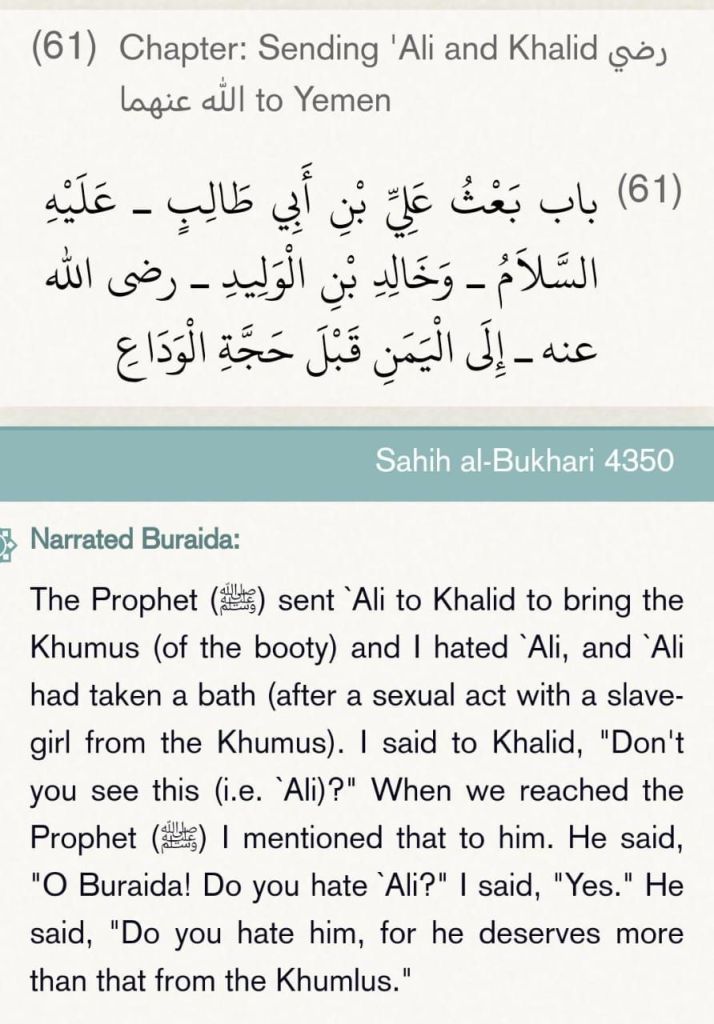
Explanation Of Buraydah (Radi Allahu Anhu) Disliking An Action Of Ali ibn Abi Talib (Radi Allahu Anhu)

(Explanation summarized from dorar.net)

The Companions of the Messenger of Allah (peace be upon him) are the best of this Ummah after our Prophet Muhammad (peace be upon him). Despite their virtues, status, and Jihad, they were humans who were susceptible to error, forgetfulness, and sometimes doing things they shouldn’t have done. However, they distinguished themselves by being the quickest to repent and respond to Allah’s and His Messenger’s command.

Buraydah bin Al-Husayb Al-Aslami (may Allah be pleased with him) narrated that he was in an army with Khalid bin Al-Walid (may Allah be pleased with him). The Prophet (peace be upon him) sent Ali bin Abi Talib (may Allah be pleased with him) to Khalid bin Al-Walid to collect the Khums (one-fifth) of the booty from the people of Yemen’s wealth.

Buraydah (may Allah be pleased with him) disliked Ali (may Allah be pleased with him) due to some issues. He saw Ali taking a bath and assumed he had done so after having sexual relations with a slave girl he had chosen for himself from the booty before it was distributed or without ensuring she was free from pregnancy. Buraydah held this against him (and so disliked Ali at that instant).

The response to this was that the Messenger of Allah (peace be upon him) had sent Ali to distribute the booty and collect the khums (one fifth of the total booty), which he did. The slave girl was part of his share, so he (Ali) dealt with her as he pleased.

Regarding Ali’s bath, it was said that perhaps the slave girl was pre-pubescent, and they do not require purification. Alternatively, perhaps he bathed for another reason and did not have any sexual relations with the slave girl, leading to the assumption that his bath was due to sexual relations.

Buraydah’s dislike for Ali due to this incident is excusable, as humans often dislike others when they misunderstand their actions.

When Buraydah reported this to the Prophet (peace be upon him), he asked, “Do you dislike Ali?” Buraydah admitted his dislike, thinking Ali had taken something not rightfully his. The Prophet forbade him from disliking Ali, stating that Ali had more right to the Khums than what he took.

Afterward, Buraydah said, as recorded in Ahmad’s Musnad, “From then on, no one was dearer to me than Ali.” May Allah be pleased with all the Companions.

This hadith highlights Ali bin Abi Talib’s virtue and prohibits disliking him. End.

Doing Multiple Umrahs In One Year Or One Day, Imam An-Nawawi (Rahimahullah)

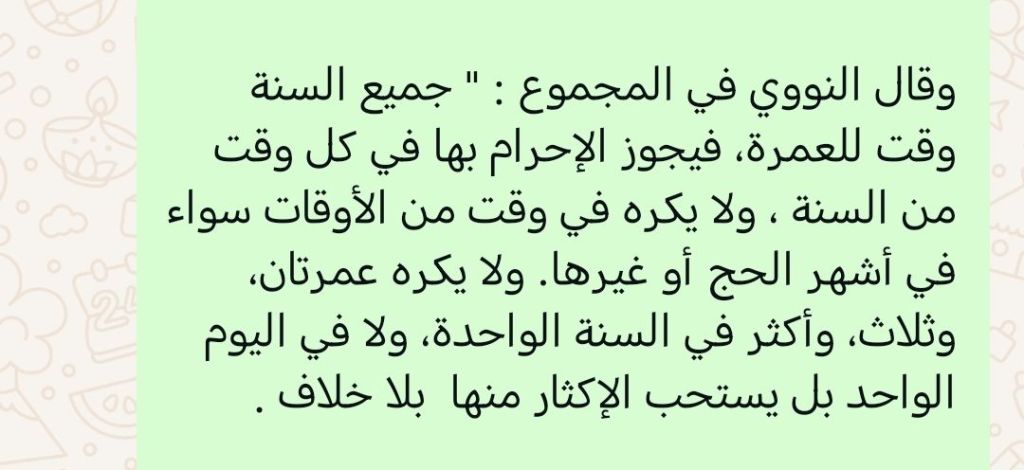
Al-Nawawi said in Al-Majmu’: “The entire year is a suitable time for Umrah, so it is permissible to enter into Ihram (ritual consecration) for Umrah at any time of the year. It is not disliked at any time, whether during the months of Hajj or otherwise.

Also, performing two, three, or more Umrahs in one year, or even in one day, is not disliked. On the contrary, it is recommended to perform Umrah frequently, and there is no disagreement about this.” End quote.

Peculiar case when the Hindu legal system judges just like a Muslim Shariah court!


(See link below for the news.)


A Hindu man from Madhya Pradesh found himself entangled in a complicated marital dispute after his first wife initiated legal proceedings upon discovering his second marriage, which is generally prohibited under Hindu personal law as per the constitution. Advocate Harish Dewan, appointed by the Gwalior Family Court as counsel, advised the first wife that she could file a case under IPC Section 498A. However, he cautioned that the legal process would be protracted, allowing her husband to continue living with his second wife, and potentially leaving her without immediate recourse or financial support. Dewan suggested exploring alternative solutions to safeguard her livelihood.

The issue brought to the court’s attention focused on ensuring a balanced, fair arrangement. To avoid dissolution of the second marriage or penal actions against the husband, the judge mediated between the parties and arrived at a schedule of living arrangements (similar to the Islamic principle of fair treatment in polygamy). This court-mandated compromise involved the husband splitting time equally: three days a week with each wife, with the Sunday left free to manage his personal responsibilities.

This case has drawn attention as the verdict echoes the Islamic Shariah’s guidance, which requires justice among spouses in a polygamous marriage. It underscores that even secular judicial systems sometimes are forced by circumstances to adopt solutions aligned with Islamic values of fairness, despite differences in religious backgrounds.

This case also shows that if a man is capable enough and the women are sensible enough, polygamy had been and will forever be a good solution for women in particular, and humanity in general.


https://www.hindustantimes.com/india-news/man-two-wives-reach-an-agreement-three-days-of-week-with-one-next-three-with-the-other-101678820771431.html

How Allah Protected Me: A Cautionary Tale of a Charity Scam Attempt

Just now, someone tried to scam me by pretending to offer a donation of 1 lakh 70 thousand rupees in charity. Wallahi, it looked so genuine that if Allah hadn’t helped me recognize the red flags, I would have lost precious charity money from my account. Let me share the details…


Red Flag 1

A random guy calls and says he wants to contribute to the charity project. I told him it was already complete.

The first red flag was when he replied, *”I want to contribute to any other project you have. I have 1 lakh 70 thousand ready to give immediately.”*

(I was really impressed.) *Note: If it’s too good to be true, it usually isn’t!*


I asked, “Wow, who gave you my number?” He responded, “So-and-so, ‘XYZ,’ gave me your number.” Coincidentally, I actually knew someone named XYZ, so it seemed genuine. He then took my account number and QR code.

Red Flag 2

He immediately called back and said, “If I send you more than 1 lakh, I’ll be taxed. So I’ll send you Rs.95,000, but please send me Rs.45,000 back to help me avoid the tax!” This gave me a chill.


I replied, “Why don’t you send me Rs.50,000 instead? That way, I don’t need to send anything back.” He insisted, “No, no, trust me.” At that point, a light bulb went off.

Red Flag 3

He then asked me to use another phone to video call him during the transaction so he could “help” me with the process. I responded, “Wait, wait, can you please tell me exactly who this ‘XYZ’ brother is who gave you my number? I need to confirm with him.”

They usually ask us to show our transaction screen because they plan to use our ID to withdraw an amount and generate an OTP. As soon as we receive it on our screen, visible to them, they enter the OTP and withdraw whatever amount they want.

Alhamdulillah, by this time, Allah guided me to realize that this was a scam. I started asking him counter-questions, and he quickly hung up. Allah saved me from a potential disaster.


The reason I was initially off-guard was because I frequently encounter generous Muslims, making it hard to identify who might be a scammer. And, Alhamdulillah, where I’m from—Mangalore—so many Muslims just call and, within a minute, send 25-30k in charity, without me even knowing them personally. Barakallahu feehim.

Nevertheless, this is a reminder to always stay alert and not get carried away. Also, always ask Allah to protect you.


—Mohammed Manna.

(4th Nov 2024)