The main aim of our site is to purify The Seerah of Prophet Muhammad ﷺ from weak and fabricated narrations using the works of the scholars of Islam. We may add other beneficial material as well.
Having many children who live and die upon Islam is beneficial even if they do not make Dua for you particularly. Since you as a Muslim parent are the source of their Islam, thus all the good deeds that they do will add up as Sadaqah Jariyah (ongoing charity) for you In-sha-Allah. This will continue down the line to your grandchildren and great-grandchildren and so on InshaAllah…
Abu Huraira reported: The Messenger of Allah, peace and blessings be upon him, said, “When the human being dies, his deeds end except for three: ongoing charity, beneficial knowledge, or a righteous child who prays for him.” (Sahih Muslim 1631)
In Mirqat al-Mafatih (commentary on Mishkat al-Masabih), it is mentioned:
“The Prophet specifically mentioned the child’s supplication to encourage the child to pray for his father.
It has been said that the parent receives the reward for the righteous deeds of the child, whether the child prays for the parent or not,
… just as the one who plants a tree receives a reward when its fruit is eaten, whether the one who eats the fruit supplicates for him or not.” (Mirqat al-Mafatih, commentary on Mishkat al-Masabih, 1/453, Rashidiyah Library edition).
Note: This is just one of the many benefits of having a lot of children.
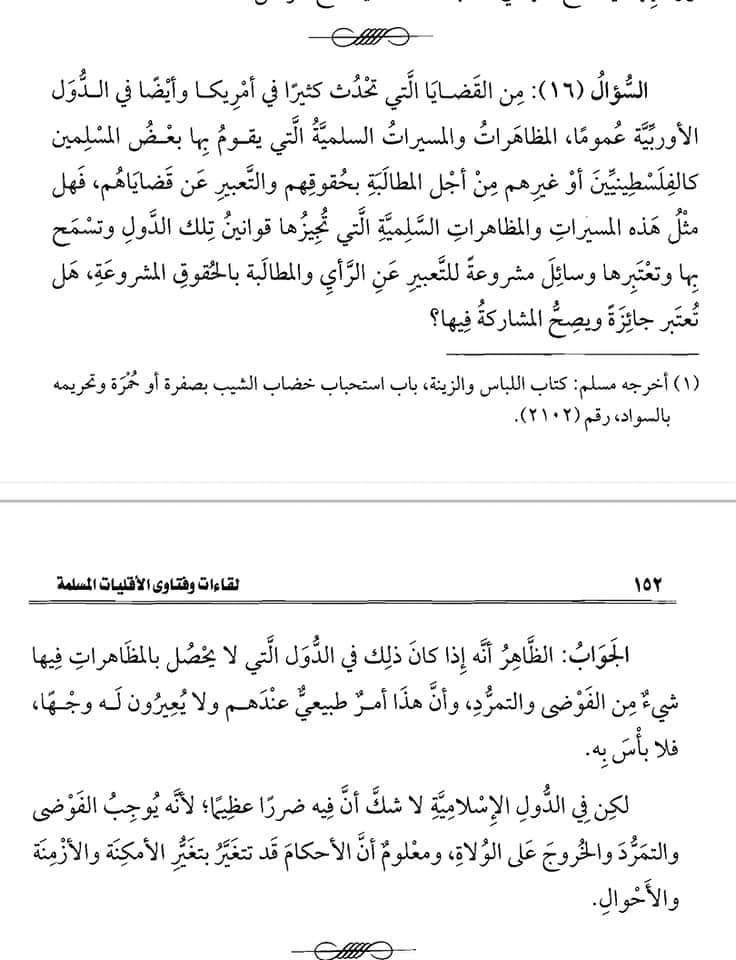
Shaikh Muhammad bin Saleh Al-Uthaymeen (Rahimahullah) generally disallowed protesting, but he considered it permissible in Non-Muslim lands subject to certain conditions. (See Fatwa below:)
Question (16): Among the issues that have become common in America and some European countries are the protests and peaceful marches in which some Muslims participate, like the Palestinians or others, demanding their rights and expressing their grievances. Are such peaceful marches and protests, which are permitted by the laws of those countries, legitimate means of expressing opinions and demanding rights according to Shariah? Is it permissible to participate in them?
Answer: It appears that if these protests occur in countries where such demonstrations do not result in any rebellion, chaos, or harm, and are considered a normal practice among the people without causing any issues, then there is no problem with it.
However, in Islamic countries, there is no doubt that such actions cause significant harm by leading to chaos, rebellion, and insurrection against the authorities. It is known that rulings may change according to circumstances and situations. End quote.
***
The Permissibility Of Protests In United Kingdom Under Certain Conditions- Fatawa by The Lajna (Committee Of Ulama) In Pakistan
Question
In UK against vilification of Prophethood or vilification of the Quran and to defend against similar matters, according to European laws, protest rallies are organised, whose aim is to make our voice reach rulers and people of influence and to obtain our right. We do not have any better way or mean other than this. We have two kinds of people who look at these rallies from the religious perspective:
Doing a protest is not a Shar’i way.
This is the only way we have, we can’t do without it. So is a peaceful protest permissible in the Shari’ah? Sometimes the crowd carried by emotions especially the youth, without desiring, some violence and loss occur, what does the Shari’ah say in such a case?
Answer
Al-Hamdullilahi Wahdah, was Salatu was Salamu ‘ala man la Nabiya Ba’dah!
Allah Ta’ala says in the noble Quran:
“Allah does not like the public mention of evil except by one who has been wronged “ (Surah An-Nisa: 148)
We find in this verse the permissibility of Ihtijaj (protest) against any form of injustice. We also have evidence from Hadith. Indeed Abu Hurayrah (Radi Allahu ‘Anhu) said:
“A man came to the prophet (May peace be upon him) complaining against his neighbor. He said: go and have patience. He again came to him twice or thrice. He then said : Go and throw your property in the way. So he threw his property in the way and the people began to ask him and he would tell them about him. The people then began to curse him; may Allah do with him so and so! Then his neighbor came to him and said: Return, you will not see from me anything which you dislike.” (Abu Dawood: 5153)
Hence Ihtijaj (protest) can be done, although some rules and conditions should be taken into account:
The aim of the protest should only be to make your voice reach rulers, record your protest, and outside this there should not be any insult or such kind of comments The protest should be in such a manner that those crossing should not have any obstruction or difficulty There should be no burning, encircling and breaking of things as in our place in most cases protestors in intense zeal break things, encircle and bring destruction to state properties, and burn cars of those passing nearby. So in such a case, protesting is not permissible at all and Haram. This is not a protest but thuggery and corruption. Yet if all above mentioned conditions are taken into account, then protesting is allowed
Wa Aakhir Da’wana Anal Hamda Lillahi Rabbil Alameen
Noble Muftis (Signatories):
His excellence Shaykh Abu Muhammad AbdusSattar Hammad (President of the Lajnah) His excellence Shaykh Abdul Haleem Bilal (may Allah preserve him) His excellence Shaykh Javed Iqbal Sialkoti (may Allah preserve him) His excellence Shaykh Dr.Abdulrahman Yousuf Madani (may Allah preserve him) His excellence Shaykh Saeed Mujtaba Saeedi (may Allah preserve him) His excellence Shaykh Muhammad Muneer Qamar (may Allah preserve him) His excellence Shaykh Hafiz AbdurRauf Sindhu (may Allah preserve him) His excellence Shaykh Muhammad Idrees Athari (may Allah preserve him)
Note: This is a translation of the original text of the fatwa which was issued in the Urdu language. Translator: Ali Hasan Khan
It is said that the ‘Beary‘ Muslim community were descendants of Yemeni merchants who settled and married in the Malabar coast in South India.
Beary is a Dravidian language that has a lot of words taken from other languages as well. One famous alternative name of Beary is ‘Naknik’.
In a narration where Abdullah bin Umar scolds Hajjaj bin Yusuf, Abdullah bin Umar uses a word that is no longer used by Arabs but a corrupted form of it is used in Urdu.
Ibn Umar said, ‘Baqbiq bada dhalika ma shi-ta min Baqbaqah‘, meaning ‘Babble as much as you want to babble afterwards’.
In Urdu we say ‘Bakbak‘ for blabbering.
Another narration in Tareekh Al-Islam of Adh-Dhahabi says, Ibn Umar said, ‘Naqniq ma shi-ta min Naqnaqah’, meaning, ‘Chatter as much as you want with your chattering’.
So just like how Baqbiq became Bakbak in Urdu, it is possible (perhaps) that the Arabs who came to the Malabar coast heard the Bearys talk and felt that they were ‘Chattering’ something and called it ‘Naqniq’, and it soon was called ‘Naknik‘ by the local people. And Allah knows the best.
Smile. It’s just my theory.
-Mohammed bin Thajammul Hussain Manna. ***
B.E [Aeronautical Engineering], B.A [Islamic Studies]. Islamic Studies Teacher, Author of ‘The Biography of Prophet Muhammad (From Reliable and Credibly Established Narrations)’ [Three Volumes, 1400+ pages] which is the first book of Seerah in the English language that uses only authentic narrations for the storyline of the Biography of The Prophet [SalAllahu Alaihi Wa Sallam]. Download some chapters of the book from HERE for free.
Other books by Mohammed bin Thajammul Hussain Manna: Famous but Unauthentic stories from The Seerah of The Prophet Muhammad (Translated and summarized from Arabic into English), The Authentic Biography of Bilal bin Rabah [Radi Allahu ‘Anhu], Mukhtasar Sahih Seeratun-Nabi [A very summarized, authentic biography, filled with references from Ahadith for every story mentioned. Sal Allahu ‘Alaihi Wa Sallam].
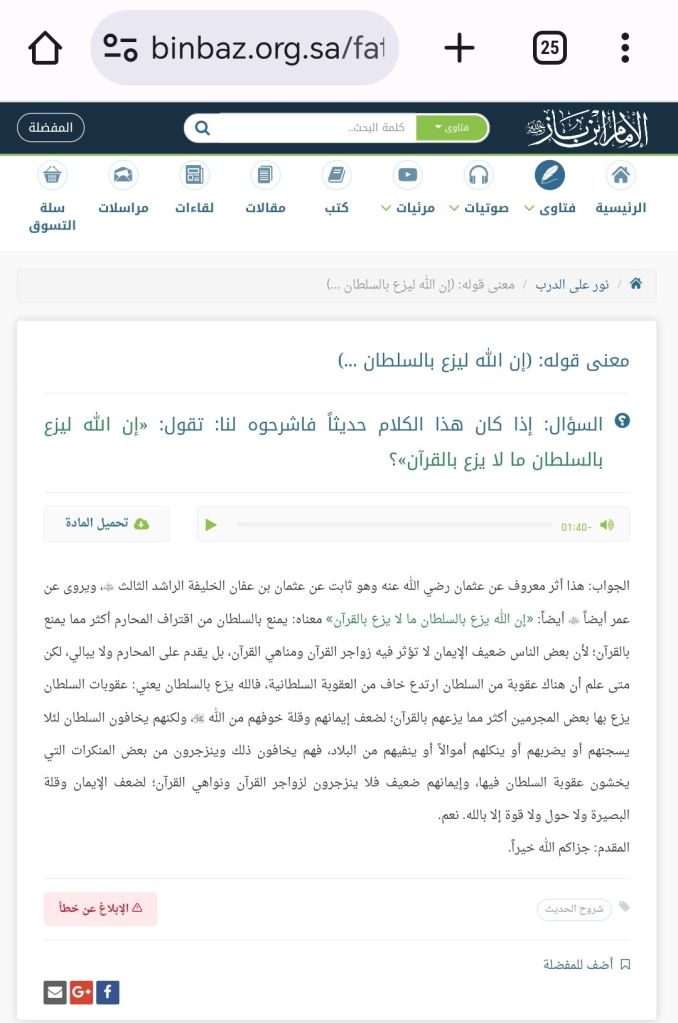
Question: If this statement is a Hadith (from the Prophet [Peace and blessings be upon him]), explain it to us. It says: “Verily, Allah prevents by the authority (Sultan, ruler), what He does not prevent by the Qur’an.”
Answer: This is a well-known narration from Uthman (Radi Allahu ‘Anhu) and it is also proven from Uthman bin Affan, the third rightly guided Caliph, and it is also narrated from Umar (Radi Allahu ‘Anhu) . (The narration) “Verily, Allah prevents by the authority (Sultan), what He does not prevent by the Qur’an.”
It means: The ruler prevents people from committing forbidden acts more than the Quran prevents; because some people have weak faith and the warnings and prohibitions of the Quran do not affect them, but they commit forbidden acts without caring (about the repercussions).
However, when they know that there is a punishment from the ruler, they refrain, fearing the ruler’s punishment. So, Allah repels with the ruler, meaning the punishments of the ruler, the (evil of the) Mujrimeen (criminals), more than He repels with the Quran; due to their weak faith and lack of fear of Allah. But they fear the ruler, lest they be imprisoned, beaten, fined from their wealth, or exiled from their land.
They fear that and refrain from some forbidden acts which they fear the ruler’s punishment for, while their faith is weak and they do not refrain due to the warnings and prohibitions of the Quran; due to their weak faith and lack of insight. And there is no power or strength except with Allah.
Presenter: May Allah reward you with good.
-Answered by Shaikh Abdul Azeez bin Abdullah bin Baaz (Rahimahullah)
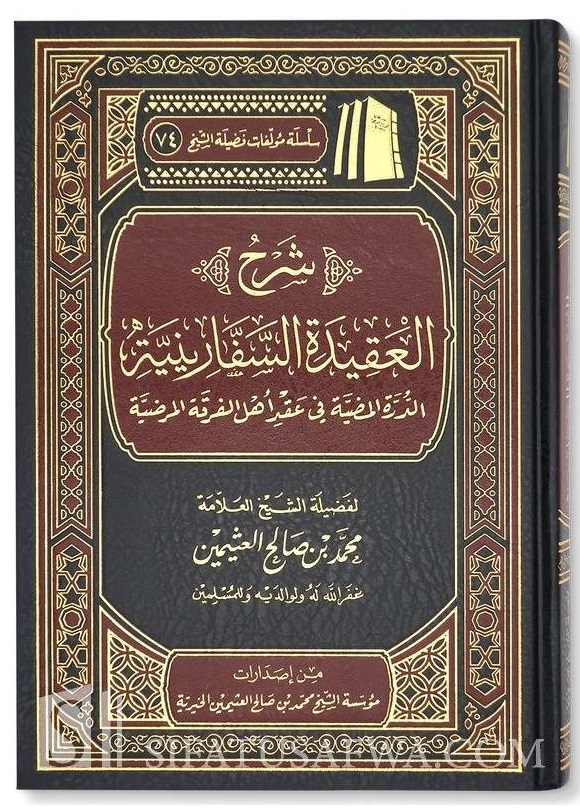
A beautiful benefit from the Sharh (explanation) of ‘Al-Aqeedah as-Safaariniyyah’ by Shaikh Muhammad bin Saleh Al-Uthaymeen (Rahimahullah, 9 March 1929 – 10 January 2001).
***
Shaikh Ibn Uthaymeen, may Allah have mercy on him, said:
“It is not possible to say that all matters of ‘Aqeedah (creed) must be upon Al-Yaqeen (certainty), because there are issues within `Aqeedah on which the scholars, may Allah have mercy on them, have differed. Any matter that is subject to scholarly disagreement cannot be said to be one upon Yaqeen (certainity), for certainty cannot be negated under any circumstances.
For instance, the scholars, may Allah have mercy on them, differed regarding the punishment of the grave: is it inflicted upon the body or the soul?
The scholars also differed, may Allah have mercy on them, concerning what will be weighed on the Day of Judgment: is it the deeds themselves, the records of deeds, or the person who performed the deeds?
They also differed, may Allah have mercy on them, regarding the Paradise that Adam was made to dwell in: was it the Paradise of eternity or a paradise in the Dunya (earth)?
Furthermore, the scholars, may Allah have mercy on them, differed about whether the Prophet ﷺ saw his Rubb (Lord Almighty) : did he see Him with his eyes—meaning in life—or did he see Allah with his heart?
They also differed regarding the Fire: is it eternal or does it eventually end?
All these issues pertain to Aqeedah. To claim that there is no disagreement in Aqeedah whatsoever – is incorrect, as there are matters of `Aqeedah where a person acts upon Dhann (conjecture and assumption, or a belief or opinion with the possibility that otherwise may also be true).
For example, in the Hadith Qudsi, Allah says: ‘Whoever draws near to Me by a handspan, I will draw near to him by an arm’s length.’ A person cannot be certain that the proximity (closeness) intended here is Hissi (physical, anything that can be felt) . For indeed, it undoubtedly occurs to a person’s mind that the intended closeness here is Ma’nawi closeness (metaphorical meaning of closeness).
Likewise, in the verse: ‘Whoever comes to Me walking, I will come to him running,’ one cannot assert with certainty that Allah physically runs. It is possible that what is meant is the hastening of reward, and that Allah is quicker to grant reward than a person is to act. This is why the scholars of Ahlus-Sunnah differed on this issue. Indeed, if you adopt either position, you do not hold it with the same certainty as you do for Allah’s descent, of which the Prophet ﷺ said: ‘Our Rubb descends to the lowest heaven,’ where there is no doubt that it is a real descent, just as there is no doubt that Allah’s statement: ‘The Most Merciful rose over the Throne’ (Surah Taha: 5) refers to a real rising.
In summary: not all matters of `Aqeedah require absolute Yaqeen (certainty). Certainty or Dhann (conjecture or supposition) depends on the strength of the evidence, and the strength of the evidence varies according to a person’s understanding and knowledge. What may seem like two (or more) conflicting evidence (on an issue) to one person may be entirely clear to another, leading the latter to have no confusion but complete certainty (on the issue), while the former (who felt that the evidences were conflicting) may remain unsure, and if he leans towards one side, he does so based on predominant Dhann (i.e. supposing and assuming that his side has stronger evidences than the other opinion, but the other opinion is not entirely wrong as well).
Therefore, we cannot say that all matters of Aqeedah require absolute certainty and are free from disagreement, for the reality is otherwise. (That is-) There are matters of Aqeedah in which there is disagreement, and there are matters in which one cannot be certain, but rather follows what is more likely (to be the truth according to him).
Thus, the statement that we often hear, that ‘there is no disagreement in matters of Aqeedah’, is not to be taken in absolute terms, because the reality contradicts this.”
[End quote from ‘Sharh Al-Aqeedah As-Safaariniyyah 1/307.]
(Translated by Mohammed bin Thajammul Hussain Manna [B.E (Aeronautical Engineering), B.A (Islamic Studies), M.A (Islamic Studies, Ongoing 2nd Year)].)



 Saheehus-Seerah