An advice to those inviting to or attending motivational lectures…

[Read as PDF: https://authenticseerah.com/wp-content/uploads/2023/10/an-advice-to-those-inviting-to-or-attending-motivational.pdf ]
Assalamualaikum brothers & sisters. This is a sincere Naseehah to everyone in general with regards to ‘Attending sessions by motivational speakers’.
First of all, no one should read this as a ‘warning against any speaker’j, or as a ‘refutation’. This is a general advice to all and a particular one to those inviting or about to invite ‘motivation speaker(s)’.
Second, no one should assume that the issues I will be mentioning here are only about ‘unqualified speakers’, as many would love to assume. Actually the problem is even with some graduates and scholars from Islamic Universities.
Third, our intention is only Islaah (rectification), as much as is possible from our end. This applies to all of the Ummah, we all are are imperfect, and we all need someone, to correct us time and again.
***
Motivational speakers help energise the youth and their parents towards a beneficial goal, and they have their beneficial space in the society. However the speaker, the organisers and those who attend the sessions (the audience) need to keep some things in mind as they give their ears to these speakers.
With regards to the speakers, it is their responsibility that they confirm whatever they are presenting of facts (Islamic or scientific, Hadith or quotes of the wise men) to be authentic. It has been observed time and again, for example, that even after The Qur’an And Sunnah are filled with Ayaat and Ahadith of the ‘Rights of Parents’ some speakers would use an extremely weak or fabricated narration.
***
Say for example, (The Hadith:) “A righteous child who looks upon his parents, even a single glance of genuine affection, receives a reward from Allah equal to the reward of an accepted Hajj.” A simple checking through Hadith Softwares, or even Google search, will show that, ‘Imam Adh-Dhahabi said that this Hadith is Munkar (rejected), and Imam Al-Albani said ‘Fabricated”.
You may think what’s wrong even if the statement is not a Hadith?! Doesn’t it have a good meaning!? My dear brother, it’s a major sin, Major Haram action, to spread false quotes and attributing it to Prophet Muhammad ﷺ. Because he ﷺ said, “Whoever ascribes to me what I have not said then (surely) let him occupy his seat in Hell-fire.” (Al-Bukhari 109)
This is just one example, and two other examples I heard some of these speakers telling is, ‘The Jewish lady who used to throw thrash upon the Prophet ﷺ’ and ‘The Jewish lady whose luggage was carried by the Prophet ﷺ’. These examples are enough. In-Sha-Allah.*
***
It is the responsibility of the event organisers that they’ve to make it clear to the respected speaker, at least a week or some days before the event, that the Hadiths (Ahadith) quoted or facts mentioned (even worldly issues) must be authentic and reliable.
Also the organisers must have a student of knowledge or Islamic scholar as a note-taker who can note down any mistake done while mentioning something from the Prophet ﷺ or the Sahabah. At the end of the lecture, the Islamic scholar can politely with wisdom inform the audience that such-and-such a thing mentioned was not authentic. It may seem apparently offensive and hurting to the speaker, but if politely done, and if the speaker is a sincere individual, he will accept it In-Sha-Allah.
Even if he gets offended and angry, we’ve to understand that, our priority must be to not allow our stage to be a place from where a major sin happens and a false narration is spread.
****
Whatever I mentioned above, regarding speakers and presenting authentic Hadiths, also applies to Islamic students of knowledge and graduates, who give classes around us. They must use the knowledge of research and cross verifying that they learnt in their institutions, to prepare their classes.
Many of our brothers, even after spending 5-6 years or more studying pure Islamic sciences, just watch a few lectures online and quickly prepare their classes. I myself have watched/heard some of these lectures in English, Urdu and Beary, and Subhanallah, seems like they did not even bother to look it up before putting it out.
Not only did some of them mention extremely weak and fabricated narrations, some of them also presented (unintentionally) some ‘made-up’ stories to present their lecture. They didn’t do it purposely, I assume positively In-Sha-Allah, rather they were just careless about conveying the religion and copied it from somewhere else.
***
With regards to those who attend the events, you’ve to be careful of a few things. And you’ve to be extra careful if you are a ‘student of Islamic knowledge’.
*(1)Always carry a small booklet to these sessions, and make notes of especially the Ahadith mentioned.*
*(2)Never assume, if you’re listening to a class/speech, or are preparing for a class/speech, that a story mentioned in books published by Darussalam (Riyadh, KSA) is automatically authentic and acceptable. Rather, the fact of the matter is that, if it is from Darussalam Publications, do an extra and meticulous cross checking. Because from my personal experience I have seen that Darussalam Publishers’ Seerah Books with the title ‘Golden Stories of …’ are filled with baseless and fabricated narrations.
***
(Mark my words throughout this write-up, I say- ‘extremely weak’, ‘baseless’, ‘fabrication’ etc.,- because there is an important difference between ‘weak’ and ‘extremely weak’, that only students of knowledge know, and we need not explain that here. I am not condemning the use of slightly weak narrations here in this write-up for a particular reason.)
Another important issue. We’ve to agree that modern scientific education is very important and necessary for the Muslim Ummah, some parts of it may be a communal obligation as well (Fard Kifayah).
However, Islamic institution, especially the Salafi ones (because Salafis/Ahle-Hadis claim that they wish to follow the strict interpretation of Islam according to the Sahabah’s way), should be careful of promoting motivational speakers who in their talks are known to belittle the concept of ‘gender segregation’, ‘full Islamic Hijab’ etc.
***
My cousin (female) once attended a ‘Salafi’ motivational event a few years back where all the organizers were Mutanaqqibaat (Niqabis), yet the female motivational speakers mocked the students for covering their faces and wearing gloves in a very insulting manner. Yet, the organisers didn’t have the Gheerah (self respect) for the Deen to even politely clarify the issue after her motivational talk was over.
I saw another young speaker, condemning the idea of not sending our daughters to mixed schools, and no one in the end corrected him.
So if Salafi institutions, are calling or promoting such individuals, please do a careful background check. Remember, our strict interpretation (people call it extreme) of the Deen, according to the Sahabah’s way, is the balanced interpretation of the religion of Islam. And we have to maintain it that In-Sha-Allah, or else, do whatever you wish, but remove the title of ‘Salafi/Ahle-Hadis’ from yourselves.
***
Last point, I feel people will not agree to it, but still, we’ve been sent to just convey to the people and not force them, so I will mention it here.
The scholars overall (with some exceptions) have agreed that ‘printed images’ are prohibited and ‘digtal images/videos’ are ‘ok’ , except for passports and documents etc,. I remember years ago when Shaikh Anees-ur-Rehman (Hafidhahullah) spoke about using printed images for Da’wah purposes, said, ‘There is no Barakah (blessings) in the Da’wah that happens these days because of the use of pictures’ (او كما قال).
The Prophet ﷺ said,”The people who will receive the severest punishment from Allah will be the picture makers.” (Al-Bukhari 5950)
***
So we’ve to avoid, printing posters, large or small, with images of the speaker, in order to not fall under the previous Hadith. Alhamdulillah, today we have social media, and you all know better, that we can In-Sha-Allah, make short clips or posters for WhatsApp/Instagram statuses and promote the event (as digital images are ok). If need be, we can print huge posters with just the name and details of the events.
If the organisers have already printed such posters, Salafi Masaajids and institutions,should not allow them to be pasted outside their campuses, rather they may cover the face or print out new face-less posters for themselves.
***
Lastly, every such session, should either begin with or end with, a short message, a short talk of the importance of sticking to the religion, and not compromising on Islamic values like, Tawheed, Salah (Namaz), full Islamic Hijab, and the importance of staying away from major sins (like various types of Shirk, love affairs, fornication, drugs etc.).
The students, since a great majority would be Muslims (if the organisers are Muslims), must be encouraged to study the Islamic religion and read Islamic books on a daily basis.
They have to be warned in a direct or indirect manner against the dangers of atheism and LGBT, they’ve to be reminded that they must be an asset to this Ummah (the Muslim nation) and our country as well.
They must be reminded that their actions, positive or negative, will either way affect the image of the Muslims in the society. They’ve to be reminded that their main goal is the Akhirah (The Next Life), come what may.
***
These were some points I wanted to mention. I end by what Shuaib (Alaihis Salam) said to this people, (ان اريد الا الاصلاح ما استطعت) “I only intend reform as much as I’m able to. (Al-Qur’an 11:88)”
May Allah accept this from me and rectify our condition, may Allah accept the efforts of one and all, who work to serve the religion and the Ummah.
***
-Mohammed Manna (Currently a student of B.A Islamic Studies (3rd Year, distance) and M.A Islamic Studies (1st Year, online).
(24th October 2023)
This Ummah is not dead…
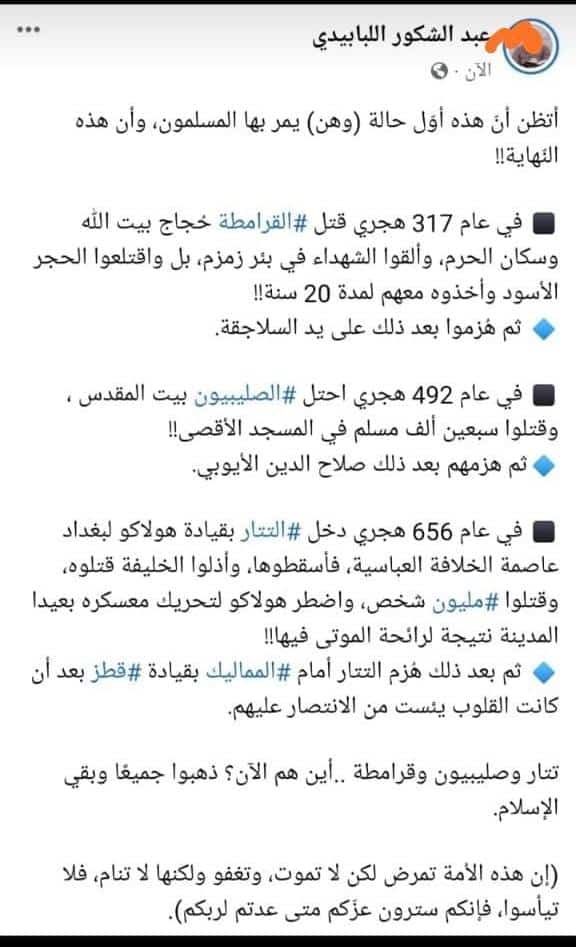
Do you think this is the first time Muslims have faced such trials, and this is the end?
In the year 317 Hijri, the Qaramitah killed pilgrims in Mecca and the residents of the Haram, throwing their bodies into Zamzam well and even took the Black Stone with them for 20 years!! Later, they were defeated by the Seljuks (The Seljuk Sultans).
In the year 492 Hijri, the Crusaders occupied Jerusalem, killing (more than) seventy thousand Muslims in Al-Aqsa Mosque!! Salahuddin Ayyubi later defeated them (and conquered Al-Aqsa).
In the year 656 Hijri, the Mongols, led by Hulagu, entered Baghdad, the capital of the Abbasid Caliphate, and sacked it, killing the Caliph and around a million people. Hulagu had to move his camp far from the city due to the stench of the dead bodies!! Later, the Mongols were defeated by the Mamluks, led by ‘The Lion of Ain Jaloot’ Saifuddin Qutuz, after the hearts of the Muslims had despaired of ever defeating the Mongols.
Mongols, Crusaders, and Qaramitah… Where are they now? They are all gone, but Islam remains.
This Ummah (community) may be sick, but it is not dead. It may doze off, but it does not sleep. So, do not despair Oh Ummah of Muhammad, for you will see your glory when you return to the obedience of Allah Subhanahu Wa Ta’la.
(Translated by Mohammed Manna.)
The Sad Condition Of The Ahle Hadis Youth In India… Reflections.
Was listening to a Barelvi (extreme Soofis of India) scholar. He was complaining that, ‘From the past 50 years, our people have had huge conferences in which 100% of the attendees were Barelvi, yet we always spent nights after nights refuting Wahhabis, as a result, today our youth don’t know even the basic issues of Fiqh’. Contemplate over this and look at the condition of the Ahle Hadis (Ahlul-Hadith, Salafi) youth, ….
Contemplate over this and look at the condition of the Ahle Hadis youth…except for a handful of select students of knowledge who are a very small number, most of them would know who is a ‘good/bad speaker’, ‘on/off Manhaj’, etc. But most wouldn’t know even intermediate Arabic, basic definition of Shirk/Kufr/Nifaq/Bidah and its types (even in English/Urdu), a lot of the masses may know how many Rakah to pray in Taraveeh, but wouldn’t know how to do Sajda As-Sahw or issues related to the Sutra.
I have experienced this sad phenomenon myself, I’ve seen for example students of knowledge who keep saying ‘Aqeedah, Aqeedah, Manhaj, Manhaj’, and they are yet to start reading The Qur’an, after 5-8 years of being into the true path (of Ahle Hadis, Salafiyyah, the way of the pious predecessors). All this Deobandi-Barelvi-Ikhwani-Manhaj bashing is good to know the right path and enter it, but if you keep doing this for your entire life, you will be the Ahle Hadis version of the Jahil Barelvis the Barelvi Scholar spoke about.
The situation has reached such proportions that most Ahle Hadis if there is a topic related to Ilm, will not attend the class or will not view that lecture. However, if the topic is, ‘Refutation of …’ see the views flying high. This is not a problem only of the ignorant youth, now this problem has reached some young Shaikhs as well. They study for a few years, get these titles, Muhammadi, Rahmani, Makki, Madani, etc., and now they get the licence to throw other older scholars and entire Salafi Madrasas ‘out of the Manhaj’.
Refutations are a part of the Deen, just like Jihad is a part of the Deen. But if you go extreme in Jihad, with the wrong principles, you will end up like ISIS. Similarly if you become extreme in refuting, you will end up in no-man’s land, with no scholars to follow (since all have some ‘issues’), and you will harbour an extreme hatred against fellow Muslims and fellow Salafis as well. Be with those scholars who teach you knowledge, make you sit and study, and ask you, ‘Where did you learn Arabic or Quran?’ instead of, ‘Are you listening to this and that and him…?’
And an advise for our Salafi brothers. When our own scholars fight over petty issues, take it as a fight between your uncles, or your aunt and your mom. Take the side of truth if you wish to, but don’t cut off from one scholar and spread words against each other. Will you speak against your uncle/aunt to the whole family and hide their good deeds and speak of only their mistakes? ‘No’ right! Then don’t do this when Ulama have some issues with each other, they’ve a greater right to our silence and patience. Abandon those Muslims and groups, who claim Salafiyyah (path of the Sahabah and Imams), and spread malicious speech about the infighting between scholars.
Some Salafis, act more like an ‘Intelligence Agent’ than a student of knowledge. Taking news from a scholar here, spreading it there, gathering people against one scholar against the other. They also also speak like they have some, ‘Intelligence reports’, jokers. Abandon all this useless stuff, people need basic Ilm, they need basic Dawah.
Our youth are into Shirk, Kufr and major sins. Seek knowledge, learn a small book with a scholar or a Madrasah graduate near your house, go and sit with 10-15 college youth and teach them that book. In-Sha-Allah You will find yourself in a much better position in the next ten years than busying yourself in this refutation business.
May Allah guide all of us towards the truth and remove hatred and malice from our hearts towards our fellow Muslims. May Allah use us to serve his Deen, and keep us away from unnecessary argumentations and discussions. Aameen.
-Mohammed Manna (21/Oct/2023) [Currently a student in B.A.Islamic Studies (Distances, Preston International College, Chennai, 3rd Yr. And M.A.Islamic Studies (Online), Aspire College of Excellence, Bangalore, 1st Yr.]
Virtuous Stories Of The Two Sons Of Kuwait …

Yasser Arafat, the head of the Palestinian Liberation Organisation 🇵🇸, with Sheikh Fahad (bin) Ahmad Al-Jaber Al-Sabah of Kuwait, in action on the battlefield 🇰🇼. (May Allah have mercy upon both of them.)
Sheikh Fahad Al-Ahmed Al-Jaber Al-Sabah (Rahimahullah August 12, 1945 – August 2, 1990) was one of the sons of the longest reigning Kings of Kuwait Ahmed Al-Jaber Al-Sabah. Even though he was from The Kuwaiti Royal Family and held positions in the Kuwaiti Government he participated in the Six-Day Arab-Israeli War in 1967 actively leading from the front (and possibly a few Kuwaiti soldiers).
On August 1990, Iraq invaded Kuwait. While Kuwait was being overrun by the Iraqi Forces, the then Emir of Kuwait (Sheikh Jaber Al-Ahmed Al-Jaber Al-Sabah) escaped from the country. Various Kuwaiti Military Forces units were engaged in different battle sectors; Fahad was martyred fighting bravely alongside the Kuwait Emiri Guard commanders in the Battle of Dasman Place. My father who was in Kuwait during the Iraqi invasion said that news was spread amongst the people about Fahad Al-Ahmed, that Fahad wasn’t martyred before he killed around 15 Iraqi soldiers.
May Allah have mercy upon this soldier of Islam, and forgive his shortcomings.
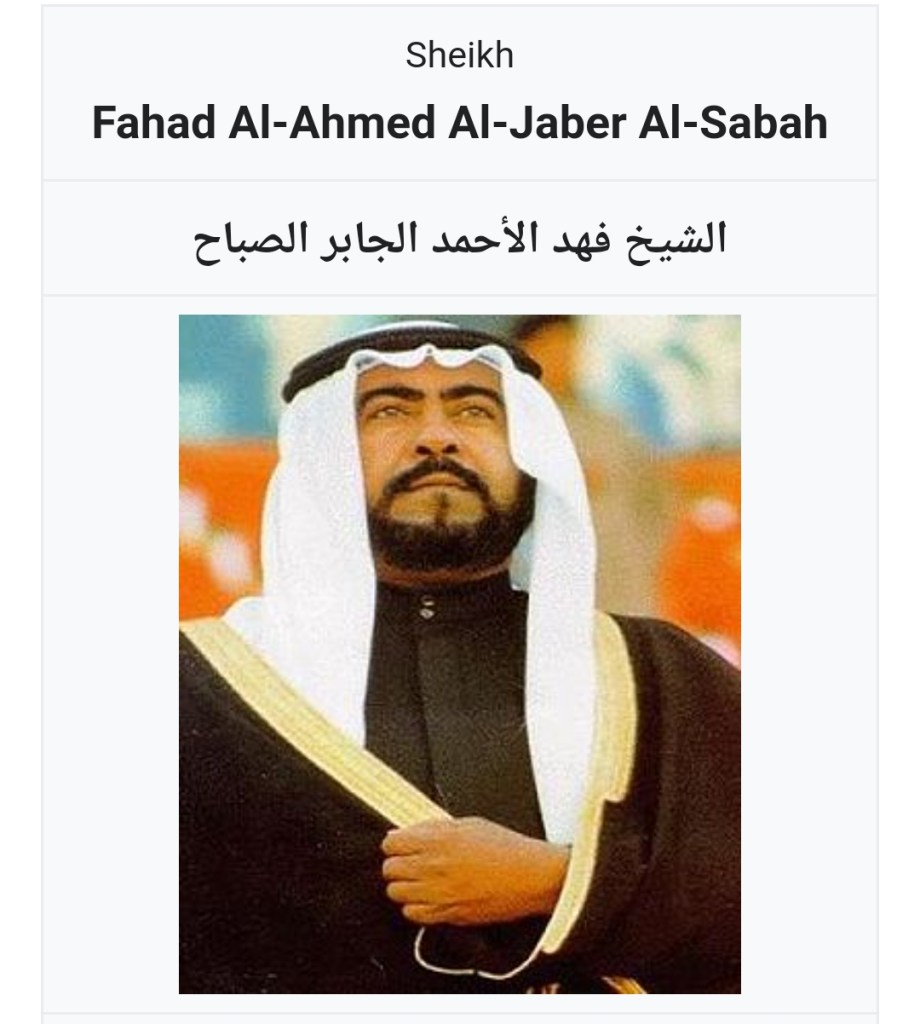
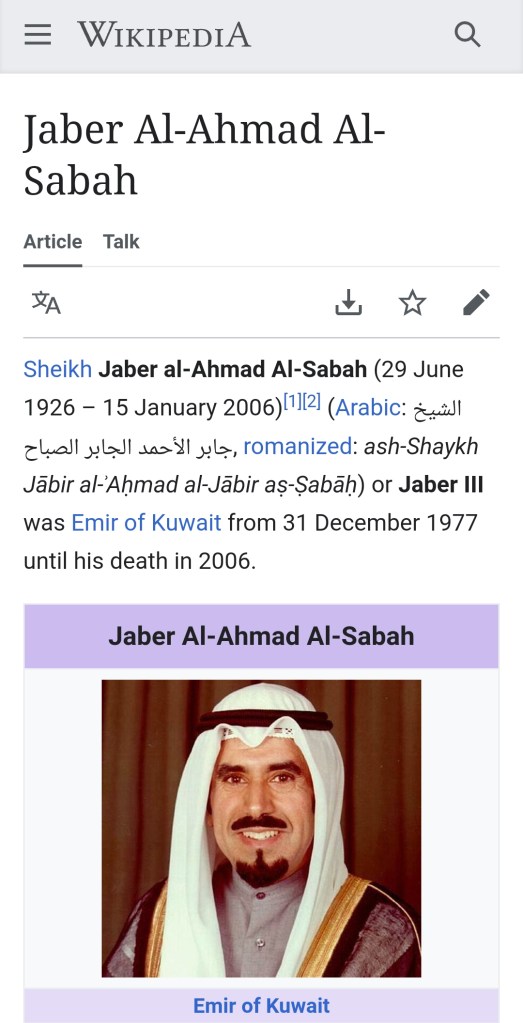
The second one who we will be mentioning about will be the elder brother of Sheikh Fahad (one discussed above), Sheikh Jaber Al-Ahmed Al-Jaber Al-Sabah (Rahimahullah).

[Shaikh Dr.Abdur Rahman As-Sumait Rahimahullah (the senior Shaikh on the right side) was a Medical doctor and Caller to Islam from Kuwait, he has numerous virtues, which have been mentioned in various documentaries. He is an inspiration for the Ummah, do look into his biography and works, In-Sha-Allah. We will not be discussing about him here, In-Sha-Allah. We will be discussing about his meeting and experience with the King of Kuwait, Shaikh Jaber Al-Ahmed Al-Jaber Al-Sabah (on the left side).]
(@ALfalehaaa Shaikh Abdul Azeez bin Abdullah Al-Faleh narrated this account:)
“One of the virtuous people involved in charitable work told me: Sheikh Abdul Rahman As- Sumait (Rahimahullah), told me that he once asked Ad-Diwan Al-Amiri (the Royal Office Manager or something similar) in Kuwait to meet Sheikh Jaber Al-Ahmad As-Sabah (former King of Kuwait, Rahimahullah), only for ten minutes to talk to him about some philanthropic (charity) efforts needed in Africa.
Sheikh As-Sumait said, ‘After a few days I got a call from the Royal Office, that Sheikh Jaber has agreed to meet you on such and such a day’. I said: It will be good In-Sha-Allah (by Allah’s Will).
On the appointed day, I went, preparing myself on how I could condense and summarize my speech within ten minutes. When I entered, I began talking, describing the suffering of Muslims in Africa due to famine and conversion efforts (by Christian missionaries). I noticed that the Ameer (King Shaikh Jaber Al-Ahmed Al-Jaber Al-Sabah) was responsive, so I shared more stories. We ended up talking for over an hour, and I sensed the Ameer’s emotional response.
When I finished, he (Sheikh Jaber Al-Ahmed Al-Jaber Al-Sabah) bid me farewell, saying: ‘It will be all be fine, In-Sha-Allah.’ Dr.As-Sumait narrates: After a few days, the Ameer’s office contacted me and said: ‘Prepare yourself for travel today.’ I asked: ‘Where to?’ They replied: ‘We don’t know; this is how the orders came to us.’ I went to the airport, where they took me to a private plane. It was only moments before we flew that a man who I didn’t recognize entered.
When I looked closely, I realized it was Sheikh Jaber, Rahimahullah. He had changed his attire, wearing no headband or cloak, and he had his scarf covering part of his face… I was surprised! He greeted me and said, ‘I want to see these villages you spoke about.’ I was delighted by the prince and his stance. We traveled to some African lands and witnessed some of the tragical scenes.
At that moment, I learned about Sheikh Jaber’s deep love for goodness, generosity, and helping the poor. When we returned to Kuwait, it marked the beginning of charitable work for the Direct Aid Society (the charity and Dawah organisation started by Dr.Abdur Rahman As-Sumait). The narrator (of this incident) states: These charitable deeds performed by Kuwait continue to be, after Allah’s Mercy, the reason for the protection of Kuwait and its people during the days of the brutal invasion (by Iraq). May Allah restore such blessings to them.” End of the story.
May Allah have mercy upon everyone who serves Islam and all the heroes mentioned in this write-up.
– Mohammed bin Thajammul Hussain bin AbuSayyid Manna.
 Saheehus-Seerah