Explanation of the issue of ‘Public Criticism of Muslim Rulers’ by Shaykh Muhammad bin Saleh Al-Uthaymeen

The Questioner: Your Eminence, Shaykh, there are some who say that publicly denouncing rulers is from the methodology of the Salaf. They cite as evidence the Ḥadīth of Abū Sa‘īd al-Khudrī regarding his denunciation of Marwān ibn al-Ḥakam when he delivered the sermon before the prayer, and the saying of the Prophet (peace be upon him), which means: “There will be oppressive rulers, so whoever opposes them will be safe or absolved,” and the Ḥadīth: “The master of martyrs is a man who stood before a tyrannical ruler, commanded him to do good and forbade him from evil, and was then killed.” Is this statement correct? And how can these authentic narrations be reconciled with his (peace be upon him) saying: “Whoever wishes to advise a ruler, let him do so secretly and not openly”? We request a detailed explanation of this matter, as many of the youth of the Islamic awakening are ignorant of the correct ruling on this issue, especially since there are some callers [to Islam] who say that publicly denouncing rulers is from the methodology of the Salaf, which causes the youth to become agitated and to think that not denouncing publicly is a sign of compromise in religion and other such things. Due to the seriousness of this issue, we request a detailed explanation, and may Allah reward you with good.

The Shaykh: This question is important, and its answer is, in reality, even more important. There is no doubt that enjoining good and forbidding evil is an obligation upon everyone capable of it, due to the saying of Allah, the Blessed and Exalted: {And let there be from among you a nation inviting to all that is good, enjoining what is right and forbidding what is wrong, and those are the successful. * And do not be like those who became divided and differed after the clear proofs had come to them. And for them is a great punishment.} [Āl ‘Imrān: 104-105]. The lām in His saying {And let there be} is the lām of command. And the Prophet (peace be upon him) said: “You must enjoin what is right and forbid what is wrong, and you must restrain the foolish person, and you must compel him to adhere to the truth, or Allah will strike the hearts of some of you against others, then curse you as He cursed them.” That is, as He cursed the Children of Israel, about whom Allah said: {Those who disbelieved among the Children of Israel were cursed by the tongue of Dāwūd and ‘Īsā, son of Maryam. That was because they disobeyed and were transgressing. * They used not to forbid one another from the evil they committed.} [Al-Mā’idah: 78-79].

However, we must understand that the legislative commands in such matters have specific contexts, and the use of wisdom is indispensable. If we see that public denunciation will remove the evil and bring about good, then we should denounce publicly. If we see that public denunciation will not remove the evil—I repeat, if we see that public denunciation will remove the evil and bring about good, then wisdom dictates that we denounce publicly. But if we see that public denunciation will neither remove the evil nor bring about good, but rather will increase the pressure from the rulers on those who denounce and on the people of goodness, then it is better to denounce secretly. By this approach, the evidences can be reconciled. Thus, the evidences indicating that denunciation should be public – apply when we expect what? Benefit, which is the attainment of good and the removal of evil. And the texts indicating that denunciation should be secret – apply when public denunciation would increase evil and not bring about good.
I tell you: No one from this Ummah has gone astray except by taking one side of the texts and abandoning another, whether in matters of creed, or in dealing with rulers, or in dealing with people, or in other matters. We will give you examples so that it becomes clear to those present and those listening: For example, the Khawārij and the Mu‘tazilah saw the texts of warning that contain threats for certain major sins, so they took these texts and forgot the texts of promise that open the door of hope. For instance, they said: If a person (who is a Muslim) intentionally kills a believer, he becomes a disbeliever—according to the Khawārij—whose blood is permissible and who will abide eternally in Hellfire. And according to the Mu‘tazilah, they say: If he kills him, he exits Islam but does not enter disbelief, because we cannot definitively state that he is a disbeliever. So, we say: He exited Islam and was in a position between Islam and disbelief, but he will abide eternally in Hellfire. Then they forgot the verses of promise and the texts of promise indicating that Allah, the Exalted, will bring out of Hellfire anyone who has in his heart even the slightest speck of mustard seed of faith.

Then others countered them and said: No matter what sins a person commits that are less than disbelief, he is a believer with complete faith and will never enter Hellfire. And they said: The saying of Allah, the Exalted: {And whoever kills a believer intentionally, his recompense is Hell} [An-Nisā’: 93]—this applies to a disbeliever who kills a believer. Now, why did both these groups go astray? Because they took only one side of the texts.

Similarly, for example, regarding the attributes of Allah, the Mighty and Majestic, some people said: Allah, the Mighty and Majestic, cannot come Himself, nor can He descend to the lowest heaven, and He does not have a face, nor does He have hands. Why? They said: Because Allah said: {There is nothing like unto Him} [Ash-Shūrā: 11], and if you affirm these matters, you would be likening Allah. Is this understood?

Well, others countered them and said: Allah, the Exalted, has affirmed for Himself a face, and He has affirmed for Himself two hands, and He has affirmed that He descends, and that He comes. So, His face is like our faces, and His hand is like our hands, and His descent is like our descent, and His coming is like our coming, because we do not comprehend coming, hand, and face except what we witness, and Allah has addressed us with what can be comprehended. So, the coming of Allah, the face of Allah, the hand of Allah, and the descent of Allah are like what is affirmed for us.
Therefore: these are at one extreme and those are at another, and all of them are astray, because each one took only one side. So, we say: Indeed, Allah, the Exalted, has a face and has two hands, and He comes and descends, but it is not like our hands nor like our faces—far be it from Him, the Mighty and Majestic, from that—because {There is nothing like unto Him, and He is the All-Hearing, the All-Seeing} [Ash-Shūrā: 11].

Similarly, regarding the issue of advising rulers, some people wish to take one side of the texts, which is to publicly denounce rulers, regardless of the resulting harms. Others say: We can never denounce publicly; rather, it is obligatory to advise rulers secretly, as stated in the text mentioned by the questioner. We say: The texts do not contradict each other, nor do they clash with each other. So, when is denunciation public? When there is a benefit, and the benefit is that evil is removed and good is established. And it is secret if public denunciation does not serve the benefit, meaning it neither removes evil nor establishes good.

And you know—may Allah bless you—that rulers can never satisfy all people, ever. Even the Imām of the mosque, the Imām of the mosque, is he pleasing to the entire congregation? No. Some say: You pray too early! And some say: … Some say you prolong the prayer! And some say: You shorten it! And in winter, they dispute, and some say pray in the sun, and some pray in the shade—agreement is not reached. So, if public denunciation of rulers is announced, those who dislike them will exploit it, making a mountain out of a molehill, and sedition will erupt. Nothing has harmed people except such matters. The Khawārij were with ‘Alī ibn Abī Ṭālib (may Allah be pleased with him) against the army of Syria. When he reconciled with them—with the army of Syria—to spare the blood of the Muslims, they revolted against him and said: You are a disbeliever.

They even declared ‘Ali a disbeliever! Why? Because the masses and rabble cannot be controlled, and public criticism of rulers is exploited by such rabble to achieve their aims. As the Prophet said: “Indeed, Satan has despaired of being worshipped by those who pray in the Arabian Peninsula, but he is content to sow discord among them.” Among whom? Among the inhabitants of the peninsula. He incites conflict that may escalate to killing. A Muslim might meet his fellow Muslim perhaps even his relative or cousin – and kill him for no reason at all. Therefore, we advise the youth of the Islamic awakening to consider all textual evidence and to reflect on the consequences of their actions. The Prophet said: “Whoever believes in Allah and the Last Day, let them speak good or remain silent.” Use this as a criterion for your words and actions. Allah is the One who grants success.

[End of Fatwa, Kitāb Liqā’ al-Bāb al-Maftūh (10/62), Shaykh Muhammad bin Saleh Al-Uthaymeen]

Source

(Translated by Mohammed bin Thajammul Hussain Manna, except for the last paragraph.)

Regarding the Ruling on Public Denunciation of Those in Authority- – Shaikh Abu Abd Al-Mu’iz Muhammad Ali Ferkous (Hafidhahullah)


Regarding the Ruling on Public Denunciation of Those in Authority
– by Shaikh Abu Abd Al-Mu’iz Muhammad Ali Ferkous[1]

Fatwa Number: 1260, Category: Methodological Fatawa

Question:

A group of students of knowledge believes that public denunciation of those in authority is absolutely impermissible. They have attributed this ruling to the entire methodology (Madhhab) of the Salaf (Pious Predecessors), citing texts that command advising them secretly. They have accused those who differ with them in this ruling of being ignorant of the foundational principles (Usul) of the methodology of Ahl As-Sunnah wa Al-Jama’ah in dealing with rulers.

We request our Shaykh – may Allah preserve him (hafidhahullah) – to clarify this issue, which has taken up a significant amount of debate and discussion among students of knowledge currently, with supporters and opponents, especially on social media platforms on the internet. May Allah reward you with good.

Answer:

All praise is due to Allah, Lord of the worlds. May peace and blessings be upon the one whom Allah sent as a mercy to the worlds, and upon his family, his Companions, and his brothers until the Day of Judgment. As for what follows:

Know – may Allah have mercy upon you (rahimakallah) – that among the ways of giving sincere advice (Nasiha) to the leaders of the Muslims is to remind them of the responsibility placed upon their shoulders, and to inform them of the errors and contraventions they have fallen into with gentleness, wisdom, and kindness.

The general principle (Asl) in admonishing them is that it should be done secretly whenever possible, without exposing, rebuking, or defaming them.

Ash-Shafi’i (rahimahullah) said: “Whoever admonishes his brother secretly has advised him and adorned him, and whoever admonishes him publicly has exposed him and shamed him.”[2]


Ibn Rajab (rahimahullah) said: “The Salaf, when they intended to advise someone, would admonish him secretly, to the extent that some of them said: ‘Whoever admonishes his brother between himself and him, it is sincere advice. And whoever admonishes him before a gathering of people, he has only rebuked him.’ Al-Fudhayl (rahimahullah) said: ‘The believer conceals and advises, while the evildoer exposes and reviles.’ And ‘Abdul-‘Aziz ibn Abi Rawwad (rahimahullah) said: ‘Those who came before you, if a man saw something from his brother, he would enjoin him with gentleness, and he would be rewarded for his enjoining and forbidding. But one of these (contemporaries) harshly confronts his companion, thereby angering his brother and exposing his faults.’ Ibn ‘Abbas (radhiAllahu ‘anhuma) was asked about enjoining good upon the ruler and forbidding him from evil, and he said: ‘If you must do it, then let it be between you and him.'”[3]

Yahya ibn Ma’in said: “I never saw a fault in a man except that I concealed it and wished to rectify his affair. I never confronted a man to his face with a matter he disliked, but I would clarify his error to him between myself and him. If he accepted it, then [good]; otherwise, I would leave him.”[4]

Admonishing those in authority is done secretly, either through a confidential letter sent to them via private or electronic mail, or by delivering it to them by hand through a trustworthy person, or by requesting a brotherly meeting in which advice is conveyed to them secretly, and similar means of ensuring the advice is beneficial in the fields of Da’wah (calling to Islam), education, and information dissemination. The Hadith is interpreted in this light: “Whoever wishes to advise one in authority, let him not do so publicly, but let him take him by the hand and be alone with him. If he accepts it from him, then that is [good], and if not, he has fulfilled what was upon him.”[5]

However, if it is not possible to admonish them secretly to remove a reprehensible act (Munkar) they have committed publicly, and it is highly probable that good will be achieved by public denunciation without any resulting negative consequences (Mafsadah), then it is permissible – in this situation – to advise them and denounce [their actions] publicly, without vilification, reviling, or defamation. This is what wisdom dictates for denouncing the Munkar, establishing the truth, and achieving good.

Indeed, the noble Companion Abu Sa’id Al-Khudri (radhiAllahu ‘anhu) publicly denounced Marwan ibn Al-Hakam for delivering the Khutbah (sermon) before the Eid prayer, without public shaming or incitement, but it was done openly in the sight and hearing of the Companions and others, without anyone objecting.[6]

This is supported by what Abu Qilabah said: “I was in Ash-Sham in a circle wherein was Muslim ibn Yasar. Then Abu Al-Ash’ath came. They said: ‘Abu Al-Ash’ath, Abu Al-Ash’ath!’ So he sat down. I said to him: ‘Narrate to our brother the Hadith of ‘Ubadah ibn As-Samit.’ He said: ‘Yes. We went on a military expedition, and Mu’awiyah was in charge of the people. We acquired much booty, and among what we acquired were silver vessels. Mu’awiyah ordered a man to sell them for the people’s stipends. The people rushed into that. This reached ‘Ubadah ibn As-Samit, so he stood up and said: ‘Indeed, I heard the Messenger of Allah (SallAllahu ‘alayhi wa sallam) forbidding the sale of gold for gold, silver for silver, wheat for wheat, barley for barley, dates for dates, and salt for salt, except like for like, hand to hand. Whoever gives more or takes more has engaged in Riba (usury).’ So the people returned what they had taken. This reached Mu’awiyah, so he stood up and delivered a sermon, saying: ‘What is the matter with men who narrate Ahadith from the Messenger of Allah (SallAllahu ‘alayhi wa sallam) which we witnessed him and accompanied him, yet we did not hear them from him!’ So ‘Ubadah ibn As-Samit stood up and repeated the story, then said: ‘We shall indeed narrate what we heard from the Messenger of Allah (SallAllahu ‘alayhi wa sallam), even if Mu’awiyah dislikes it – or he said: even if he is averse to it. I do not care if I do not accompany him in his army for a single dark night.'”[7]

This is but a drop in the ocean of the Companions (radhiAllahu ‘anhum) denouncing [wrongdoing] by emirs and governors. In this context, Ibn Al-Qayyim (rahimahullah) said: “What ‘Ubadah ibn As-Samit and others said: ‘We pledged allegiance to the Messenger of Allah (SallAllahu ‘alayhi wa sallam) to speak the truth wherever we were, and not to fear in Allah the blame of any blamer.’ And we bear witness [by Allah] that they fulfilled this pledge, spoke the truth, and proclaimed it openly, and the blame of any blamer did not deter them in [their duty to] Allah. They did not conceal any of it for fear of a whip, a stick, an emir, or a governor, as is known to anyone who reflects on their guidance and biography. Indeed, Abu Sa’id denounced Marwan when he was the emir of Madinah, and ‘Ubadah ibn As-Samit denounced Mu’awiyah when he was the Caliph, and Ibn ‘Umar denounced Al-Hajjaj despite his power and might, and he denounced ‘Amr ibn Sa’id when he was the emir of Madinah. This is very abundant from their denunciation of emirs and governors when they deviated from justice; they did not fear their whips or their punishment. Those who came after them did not possess this status; rather, they would abandon much of the truth out of fear of oppressive rulers and tyrannical emirs. So, it is impossible that these [later ones] would be guided to what is correct while the Companions of the Messenger of Allah (SallAllahu ‘alayhi wa sallam) were deprived of it.”[8]

It should be known that public advice is to be delivered without vilification, reviling, or defamation, as these contradict moral conduct, and without rebellion in word or deed, as this contravenes the methodology of Islam in governance and politics. This is even more so if they themselves permit advice to be given to them publicly, and they open the door for expressing opinions and criticism and allow it. This is implied in the statement of As-Siddiq (radhiAllahu ‘anhu): “And if you see me upon falsehood, then correct me,” and in another wording: “And if I deviate, then straighten me.”[9]

An-Nawawi (rahimahullah) said: “And in this is [guidance on] etiquette with rulers, being kind to them, admonishing them secretly, and conveying to them what people say about them so that they may desist from it. All of this is if it is possible. If secret admonishment and denunciation are not possible, then let him do it publicly, so that the foundation of truth is not lost.”[10]

And he (rahimahullah) said in another place: “The scholars have said: Enjoining good and forbidding evil is not exclusive to those in positions of authority; rather, it is permissible for individual Muslims. Imam Al-Haramayn said: ‘The proof for this is the consensus (Ijma’) of the Muslims, for indeed, those not in authority in the first generation and the era that followed it used to enjoin the rulers with good and forbid them from evil, with the Muslims affirming their actions and refraining from rebuking them for engaging in enjoining good and forbidding evil without [holding] a position of authority.'”[11]       

It should be known that the word of truth is above the position of leadership, and the awe of the ruler does not prevent responding to him and denouncing his statements with gentleness and leniency, according to the established guidelines and conditions for advice, out of a desire for good for him and a dislike of evil for him. This is from the right of the Imam upon the Ummah, and in it is a revival for him and a rescue for him from rushing into the Fire.

This is attested to by what At-Tabarani narrated in Al-Mu’jam Al-Kabir[12] and Al-Awsat[13], and Abu Ya’la in his Musnad[14], and Ibn ‘Asakir in Tarikh Dimashq[15], from the Hadith of Mu’awiyah (radhiAllahu ‘anhu) that he said: I heard the Messenger of Allah (SallAllahu ‘alayhi wa sallam) saying: “There will be leaders after me who will speak, and their speech will not be refuted to them; they will rush into the Fire just as monkeys rush.”[16]

As-San’ani (rahimahullah), explaining the meaning of the Hadith, said: “«There will be leaders after me who will speak» meaning, reprehensible speech, as indicated by his statement: «and their speech will not be refuted to them» out of awe for them and fear of their oppression, «they will rush into the Fire», meaning, they will fall into it just as a person rushes into a grave matter and throws himself into it without deliberation, «just as monkeys rush» i.e., into the matter upon which this [analogy] is based. And it is possible that the pronoun «they will rush» refers to the leaders and to those who did not refute them out of flattery and laxity in the Deen.”[17]

It is worth noting that if it is highly probable that the Mafsadah (negative consequence) and the Munkar (reprehensible act) will not be removed by public admonishment, but rather it may lead to adverse outcomes detrimental to the Da’wah to Allah and to those who advise publicly, then what Maslahah (public interest/benefit) dictates – in this situation – is to avoid public denunciation and suffice with admonishing them secretly when possible. Ibn Al-‘Uthaymin (rahimahullah) said: “So if we see that public denunciation will remove the Munkar and achieve good, then let us denounce publicly. And if we see that public denunciation will not remove the evil, nor achieve good, but rather will increase the pressure of those in authority on those who denounce and on the people of good, then what is good is that we denounce secretly. By this, the evidences are reconciled. Thus, the evidences indicating that denunciation should be public are for when we anticipate benefit in it, which is the achievement of good and the removal of evil. And the texts indicating that denunciation should be secret are for when publicizing the denunciation would increase the evil and not achieve good.”[18]

And Allah Ta’ala knows best. Our final supplication is that all praise is due to Allah, Lord of the worlds. May Allah send blessings and abundant peace upon our Prophet Muhammad, and upon his family, his Companions, and his brothers until the Day of Judgment.

Algeria on: 17 Shawwal 1442 H
Corresponding to: 29 May 2021 CE[19]


[1] Shaikh Abu Abd al-Mu’iz Muhammad Ali Ferkous is a prominent Algerian scholar and professor at the Faculty of Islamic Sciences in Algiers. Born in 1954, he pursued his religious education at the Islamic University of Madinah, studying under esteemed scholars like Attiya Muhammad Salim, Abd al-Qadir Shaiba al-Hamd, Abu Bakr al-Jazairi, and Muhammad al-Mukhtar al-Shinqiti, and benefiting from lectures by Shaikh Abd al-Aziz ibn Baz. Shaikh Ferkous is renowned for his rigorous academic methodology in authorship and verification, with numerous works in Usul al-Fiqh, Fiqh, and Hadith. He is known for advocating Tawhid and Sunnah and defending the Salafi creed, serving as a significant reference for students of knowledge in Algeria and beyond.

[2] Hilyat Al-Awliya’ by Abu Nu’aym (9/140), Sharh Muslim by An-Nawawi (2/24).

[3] Jami’ Al-‘Ulum wa Al-Hikam (77).

[4] See: Siyar A’lam An-Nubala’ by Adh-Dhahabi (11/83).

[5] Narrated by Ibn Abi ‘Asim in As-Sunnah (2/521), from the Hadith of ‘Iyad ibn Ghanm (radhiAllahu ‘anhu), and authenticated by Al-Albani in Dhilal Al-Jannah (1096).

[6] Narrated by Al-Bukhari in Abwab Al-‘Idayn (2/17) chapter on going out to the Musalla without a Minbar, and Muslim in Salat Al-‘Idayn (1/69) chapter on the fact that forbidding evil is part of faith, from the Hadith of Abu Sa’id Al-Khudri (radhiAllahu ‘anhu).

[7] Narrated by Muslim in Al-Musaqah (11/13), chapter on currency exchange and selling gold for silver on the spot.

[8] I’lam Al-Muwaqqi’in by Ibn Al-Qayyim (4/110).

[9] Narrated by Ibn Jarir in At-Tarikh (2/237), and Ibn Hisham in As-Sirah An-Nabawiyyah from the chain of Muhammad ibn Ishaq ibn Yasar from Az-Zuhri from Anas ibn Malik (radhiAllahu ‘anhu). Ibn Kathir said [in Al-Bidayah wa An-Nihayah (5/248, 6/301)]: “And this chain of narration is authentic (Sahih).”

[10] Sharh Muslim (18/118).

[11] Ibid. (2/23).

[12] (19/393).

[13] (5/279).

[14] (13/373).

[15] (59/168).

[16] The Hadith was authenticated by Al-Albani in As-Silsilah As-Sahihah (4/398), and Husayn Asad, the verifier of Musnad Abi Ya’la (13/373).

[17] At-Tanwir Sharh Al-Jami’ As-Saghir (6/390).

[18] Liqa’ Al-Bab Al-Maftuh (62/10).

[19] https://www.ferkous.app/home/index.php?q=fatwa-1260

The Ruling on Naming with “Aṣiyah,” “Āsiyah,” and “Shamsiyah,” and the Meanings of These Names

Question: 228745 (from Islamqa.info)

What is the meaning of the names ‘Āṣiyah, Āsiyah, and Shamsīyah? Are they names with good meanings? Despite the negative meaning of the name ‘Āṣiyah, I do not know why people use this name. And what is the meaning of the names: Bakar, Bukar, or Bakr?

Answer:


All praise is due to Allah, and may peace and blessings be upon the Messenger of Allah. To proceed-

Firstly: One should choose good names and avoid choosing ugly names. The Prophet (peace be upon him) used to consider the implication of a name and would change an ugly name to a good one.
Refer to Question No. (147252).

Names have indications regarding their referents, and there is a congruity between them.

Ibn al-Qayyim (may Allah have mercy on him) said: ‘Allah, in His wise decree, inspires people to give names that fit their meanings. This way, His wisdom ensures that words match what they describe, just like causes match their effects… In short: Bad qualities, actions, and behaviors deserve names that reflect them, and good ones deserve names that reflect them.'”

[End of quote from] “Tuḥfat al-Mawdūd” (pp. 146-147).

Secondly: “Shamsīyah”: This name is derived from ash-Shams (the sun). For instance, one says ‘sanah shamsīyah’ (solar year), referring to the sun, just as one says sanah qamarīyah (lunar year), referring to the moon.

It is stated in “Al-Mu‘jam al-Wasīṭ” (1/494):

“Shamsīyah: Pertaining to the sun. Ash-Shamsīyah also refers to an umbrella carried by hand to shield oneself from the sun.” End quote.

Perhaps those who name their daughters Shamsīyah consider some qualities of the sun and hope their daughters will embody them, such as widespread benefit, or the radiance, roundness, and beauty of the face, or similar attributes.

It is permissible to name a child “Shamsīyah,” given that the default rule for naming is permissibility.

It is stated in “Al-Mawsū‘ah al-Fiqhīyah” (11/332): “The fundamental principle is the permissibility of naming with any name, except for what has been explicitly prohibited.” End quote.
However, the legislated and recommended names offer ample sufficiency and richness.”

As for “Āsiyah”: It has several meanings in the Arabic language:

(Translator’s addition: This is referring to the name ‘Āsiyah’ mentioned in The Quran as the name of Firaun’s wife.)


It is stated in “Lisān al-‘Arab” (14/34):
“Al-Asā: Treatment and remedy, and it also means sorrow. Asā al-jurḥ: He treated the wound. Al-Asūw and al-Isā’, both mean medicine, and the plural is Āsiyah.” End quote.


Al-Āsiyah in construction refers to something firmly built, and al-Āsiyah also means a pillar or a female circumciser.
“Al-Qāmūs al-Muḥīṭ” (p. 1259)

And al-Āsiyah also means a column.
“Aṣ-Ṣiḥāḥ” (6/2269)
It is said that a column (sāriyah) was named Āsiyah because it supports and straightens the roof, derived from asawtu bayna al-qawm: I reconciled between the people.

“Tāj al-‘Arūs” (37/79)
Perhaps the name “Āsiyah” is derived from all these meanings, all of which are good. There is no objection to naming with it.

As for “‘Āṣiyah”: It comes from al-‘iṣyān (disobedience), which is the act of departing from obedience and violating a command. It is an ugly name. Indeed, Muslim (2139) narrated from Ibn ‘Umar: “The Messenger of Allah (peace be upon him) changed the name of ‘Āṣiyah and said: ‘You are Jamīlah (beautiful).'”

This Ḥadīth is sufficient to demonstrate the dispraise of this name and that it is disliked for a Muslim to name his daughter with it. This is in addition to the natural aversion people feel towards such a name and their discomfort with anyone who bears it.

As for Bakr: It refers to a young camel. It is stated in “Tāj al-‘Arūs” (10/241):
“Al-Bukr and al-Bakr: The offspring of a she-camel, or the young one among them; its status among camels is like that of a young person among humans.” End quote.

Thus, one who names with it perhaps considers the meaning of strength and youth. It is a well-known name among the Arabs, by which a group of the Companions (may Allah be pleased with them) were named, and Abū Bakr aṣ-Ṣiddīq (may Allah be pleased with him) was known by this kunyah (agnomen).
See: “Al-Iṣābah fī Tamyīz aṣ-Ṣaḥābah” by Al-Ḥāfiẓ Ibn Ḥajar (1/212-215).

For further benefit, refer to Question No. (1692) and Question No. (101401).
And Allah knows best.

[Translated by Mohammed bin Thajammul Hussain Manna.]

Sulaymān al-Ḥalabī -The Forgotten Muslim Hero of Anti-Colonial Resistance

Taken from the book ‘Mi’atu min ‘uzamā’i ummati al-Islām ghayyarū majra at-tārīkh’ by At-Turbani.[1] (Slightly Adapted)

(Hadith) “Indeed, faith exists in the Levant when afflictions befall.”[2]

(Hadith) “Verily, the stronghold of the believers is in the Levant.”[3]

We now turn to a great figure from the blessed lands of the Levant (Bilād al-Shām), a magnificent young man who sacrificed the prime of his youth in the cause of Islam. But before we narrate his heroic story, let us go back to the year 1798 CE. Let us leave the lands of the Levant for a moment and turn to the land of Kinānah, Egypt (Miṣr). There, on the shores of Alexandria (al-Iskandariyyah), invading ships advanced under the command of the French leader of Italian origin, Napoleon Bonaparte, in a military campaign that we studied in our curricula under a deceptive name: “The French Campaign in Egypt.” The truth that those rotten curricula concealed from us is that the real name of this campaign was “The French Crusader Campaign in Egypt”! Indeed, it is high time for this Ummah (Muslim community) to call things by their true names, without any flattery or humiliation. And if anyone doubts the Crusader nature of this campaign, let them follow the beginning of the story with me and observe what those murderers did to the Egyptians—I mean, specifically, the Muslims among the Egyptians!

Initially, Napoleon pretended that he had come only to spread civilization and progress throughout Egypt. He sent a letter to the Sharīf of Makkah (Ghālib ibn Mas‘ūd) and to the Shaykhs and dignitaries of al-Azhar, claiming that he had demolished churches in Europe, deposed a Roman Pope before his arrival in Egypt, and that he was a lover of the Prophet Muḥammad (peace and blessings be upon him); indeed, that he—Napoleon—was a supporter of the Islamic religion! However, this old deception did not fool the monotheists (muwaḥḥidīn) among the people of al-Maḥrūsah (Cairo). The spark of the “First Cairo Revolution” was thus ignited against the French. It was then that the French revealed their true colors, and it became clear that these proponents of culture and civilization still carried a hideous Crusader legacy in their hearts. The French stormed al-Azhar with their horses, trampled upon the Book of Allah (the Qur’an) with their feet, mounted cannons on “Jabal al-Muqaṭṭam” (Muqaṭṭam Mountain), and bombarded the neighborhoods of old Egypt, turned the district of “Būlāq” into ruins, and demolished mosques upon their worshippers. At that point, the honorable men of al-Azhar rose up, striving in the cause of Allah. The French Crusaders killed two thousand of the finest scholars of al-Azhar in a single day! It was precisely at this moment that the Muslims realized they were facing a Crusader invasion no different from previous ones; the essence was the same, even if the names differed. What further solidified the Muslims’ conviction regarding the Crusader nature of this campaign was what the Egyptian historian al-Jabartī recounts in his book ‘Ajā’ib al-Āthār fī al-Tarājim wal-Akhbār (Wonders of Antiquities in Biographies and Reports) about the treacherous Crusader collaboration of Ya‘qūb Ḥannā with the occupiers against his own countrymen in Egypt, and how he formed legions of Crusader traitors from among the native inhabitants, like himself, to assist the French in storming the homes of their fellow Egyptian Muslims!

After Napoleon believed he had successfully suppressed the Egyptian uprising, he returned to France to continue his criminal record among the European peoples, leaving command to another war criminal named Kléber. This French commander was a Crusader to the core. As soon as he took the reins after his predecessor, the French openly displayed their depravity. They converted Egypt’s mosques into brothels for the amusement of their vile soldiers, raped Muslim girls in front of their fathers, and murdered infant suckling children before their mothers. Everyone thought that Islam had come to an end in Egypt.

It was then that Mujāhidīn (holy warriors) rose from every corner, raising the banner of Lā ilāha illā Allāh, Muḥammad Rasūl Allāh (There is no god worthy of worship except Allah, Muḥammad is the Messenger of Allah) throughout Egypt. Egypt transformed into a fiery mass confronting the invaders. The Egyptian mujāhidīn in Upper Egypt and along its coast rose up against the French. The heroic Mamluk knights launched raids against the Crusaders everywhere. Delegations of mujāhidīn from the Ḥijāz, from Makkah and al-Madīnah, sailed to the Egyptian coast to aid their Muslim brethren. Thousands of Turkish fighters secretly infiltrated Cairo to participate in the jihād declared by the Ottoman Caliph (Selim III), and the residences of Moroccan students in al-Azhar were converted into barracks for the popular resistance. As for the Riwaq al-Shām (Levantine Quarter) in al-Azhar, there is no need to elaborate; the Muslims of the Levant volunteered in the ranks of the Egyptian popular resistance, and among these heroes was a Kurdish youth from the city of Aleppo; the French Crusaders killed his teacher, the Egyptian mujāhid Shaykh al-Sharqāwī. They desecrated al-Azhar Mosque with their horses before his very eyes. The heart of this young man, who was not yet twenty-two years old, filled with intense rage against those criminal murderers. He resolved to carry out a unique military operation, one that would require him to sacrifice his life for its success!

This young man’s name was Sulaymān al-Ḥalabī. This heroic Kurdish youth decided to storm the military palace and attack the French army’s command center alone in a complex operation, the culmination of which would be the assassination of the Commander-in-Chief of the Crusader invading forces. Indeed, Sulaymān al-Ḥalabī carried out this military operation with complete success, ridding Muslims and humanity of the evil of a war criminal named Jean Baptiste Kléber.

But look at what the proponents of “freedom and progress” did to Sulaymān al-Ḥalabī after that!

They burned his hand until the bone was exposed, then they burned three Palestinians from Gaza alive in front of him, after it was proven that those heroic Gazans had collaborated with him in preparing for Kléber’s assassination. As for Sulaymān himself, may Allah have mercy on him, they tore his intestines from within while he was still alive, leaving him in that state, crucified for several days, to be devoured by birds of prey. The strange thing is that those criminals were not content with what they did to our hero while he was alive; after his death, they took his skull to preserve it in the Museum of Man (Musée de l’Homme) in Paris, writing beneath it in French: “Criminel” (meaning “criminal”)!!!

The truly disgusting thing is not merely the criminality of the old French, but rather what the “new” French are doing, as they still keep the skull of this mujāhid in their museum to this very day! By Allah, if I were an Arab official, I would not let any of the proponents of French democracy discuss matters of freedom and human rights in our countries without first discussing with them the matter of that skull which they preserve in their museum!

Sulaymān, the hero, was not a criminal as the French portray him. Rather, he was one of the finest youths of Islam. His only “crime” was that he wished to study at al-Azhar University. He was horrified by the French killing his elderly teacher and disgusted by the tearing of the holy Book of Allah by those who claimed to be proponents of knowledge. Thus, he avenged the injustice of Napoleon and his followers, a revenge befitting their oppression and tyranny. As for the real criminals, they are your leaders, O French, who killed innocent civilians. If you truly want to know who the real criminal is, then search for him among the names of your murderous ancestors!

The laughable thing in this story, rather, what truly invites mockery, is that I found, through my preparation of this historical material, that foreign sources—both English and French, as evil as they could get—claim that Sulaymān al-Ḥalabī only killed Kléber to free his father from taxes imposed on him by the Turks! Oh, what fools you are, exploiting your peoples and hiding the crimes of your armies from them, until your peoples are now questioning the secret that drives others to hate you!

And after that… This was just one chapter from the story of French terrorism in the lands of Islam. This terrorism was confronted by a Kurdish Levantine mujāhid who sacrificed the prime of his youth in the cause of Allah against those terrorists who now sneak glances at his skull morning and evening. What hatred do those “civilized” people still carry in their hearts? And what pleasure do they find in looking at a human skull, even if he was a criminal in their eyes?! It is, without a doubt, a filthy Crusader barbarity!

And if you want to know more about the crimes of those murderers, but this time in other Muslim lands; and if you want to know the story of a new heroic epic of a new great figure in the Islamic Ummah who would not accept humiliation for himself, his people, or his religion… then follow along with me!

To be continued…… (End of the write-up.)[4]


[1] Pages 63-66.

[2] Al Hakim reported in Al Mustadrak from the Hadith of `Abdullah ibn `Amr (may Allah be pleased with him) who narrated that the Messenger of Allah (peace be upon him) said: “I have seen the pillar of the book was taken from under my pillow. Then I looked and found it as a bright light was planted in the Levant (the region covering Syria, Lebanon, Jordan, and Palestine). Indeed, faith exists in the Levant when afflictions befall.” Mustadrak Al Hakim (5 /712 – 713) (No. 8601) and Al Hakim graded it as authentic and Adh-Dhahaby agreed to his judgment on the Hadith. Sheikh Al Albany graded it as authentic in his verification to the Hadiths of the virtues of the Levant of Ar-Rib`y (P. 85). [https://en.alukah.net/Shariah/0/5026/#_ftnref9]

[3] Musnad (Hadith compilation of) Imam Ahmad (28 /165) (No. 16965). The verifiers of Hadith said: Its chain of narration is good. [https://en.alukah.net/Shariah/0/5026/#_ftnref9]

[4] The next chapter of the book is about the Hero of Algeria, Ameer Abdul Qadir Al-Jazairi (Rahimahullah).

In brief: – Ameer Abdul Qadir Al-Jazairi (1808-1883): A renowned Algerian Islamic scholar and resistance leader. He played a pivotal role in the Algerian resistance against French colonial rule, leading a successful guerrilla campaign for over 15 years. He surrendered to the French in 1847 due to lack of tribal support, a Moroccan royal decree against him, and overwhelming French military pressure. After being exiled to Damascus, he protected thousands of Christians during the 1860 Mount Lebanon civil war, earning international recognition. He spent his later years in Damascus, where he passed away on May 26, 1883, and was buried with honors. As one of the most prominent figures in Islamic history, Ameer Abdul Qadir’s legacy extends beyond his military achievements, showcasing his profound impact on Islamic thought, culture, and interfaith relations.

-Translated by Mohammed bin Thajammul Hussain Manna, the title ‘The Forgotten Muslim Hero of Anti-Colonial Resistance’ was added by the translator.

Shaikh Abdur Rahman Haran Makki mentioned my book, Alhamdulillah.

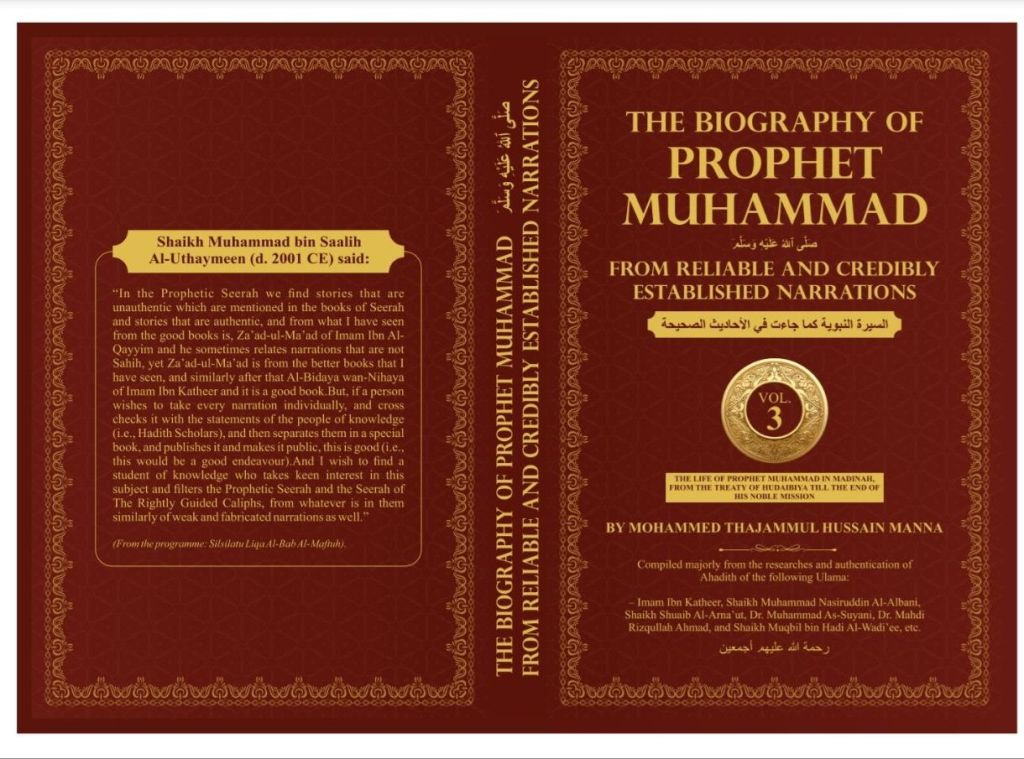
Shaikh Abdur Rahman Haran Makki (Hafidhahullah): The book which you are asking about, Salatur Rasoolullah (Salallahu Alaihi Wa Sallam) by Asadullah Al-Ghalib. Wallahu Alam, I do not know about this book. If you want to read about the prayer (of the Prophet Salallahu Alaihi Wa Sallam), there is a book called Sifatus Salatin Nabi ﷺ by Imam Al-Albani Rahimahullah- you can read that book. And second thing is regarding Ar-Raheeq Al-Makhtum (The Sealed Nectar) which is written by Safiur Rahman Mubarakpuri- It’s a good book InshaAllah. You can absolutely read it. And there is another book on the biography of Rasoolullah (Salallahu Alaihi Wa Sallam) which is written by a person whom I know, Mohammed Manna, Ustad Mohammed Manna- That is based, it’s three volumes and everything is authentic in that inshaAllah. He has collected those Hadith and it is authentic alhamdulillah- You can read that book. And there is Z’ad al-Ma’ad, that is which is on the life of Rasoolullah ﷺ by Ibn al-Qayyim Rahimahullah. You can read these books. (End of the audio.)

(7th July 2025, 8:11 PM on his QnA group.)


Note: The book authored by Mohammed Manna is, The Biography of The Prophet Muhammad From Reliable And Credibly Established Narrations (3 Volumes), Salallahu Alaihi Wa Sallam.